Why moderation matters in CX
- Last Updated : February 12, 2026
- 98 Views
- 4 Min Read

We recently came across a survey report that provided an eye-opening insight—so eye-opening that we spoke about it in one of the latest episodes of our Weekly CX Catch-up. Now what does this report say? In a nutshell, personalization works if and only if brands do it in the right amount; overdoing it leads to more negative outcomes than positive.
Here are two findings that stood out to me in the report:
More than one-third of consumers have stopped buying from a brand because they felt overwhelmed by the deluge of customer outreach material they were receiving.
Two-thirds of consumers stand the risk of ignoring critical messages or emails due to excessive communication from brands.
That made me pause and look at my own behavior in this regard. There are a few brands whose communications I don't read at all. The moment I see their name in my inbox, I immediately select the email and delete it; in fact, I bulk-delete multiple such emails from multiple brands almost every single day (unsubscribing presents a different set of pain points, you see).
Promotional SMS or RCS message? Left-swipe and archive.
Push notification? Mark as read right there.
These actions are almost muscle memory now; that's how terrible the bombardment of communication is from certain brands.
In contrast, there are a few brands that take a more thoughtful approach and send promotional emails and other updates at reasonable intervals. They play it right by creating hype and making people curious about what they have to say. The probability of consumers opening their emails and wanting to keep a tab on them is higher.
That got me thinking: What are some things that brands overdo or execute with little to no forethought?
Chasing social media trends
Social media is no doubt a great channel for bonding with customers, but when brands participate in a viral, individuals-driven trend out of FOMO, it reflects poorly on them. That's even more so if there isn't much substance or relevance in the campaign, as customers can see through the shallowness and end up feeling that the brands are trying too hard. Brands that get there first at least stand a chance of being received with more kindness. When the execution is neither relevant nor timely, it comes across as both desperate and uncool.
Here's a comic strip that succinctly captures this effect:
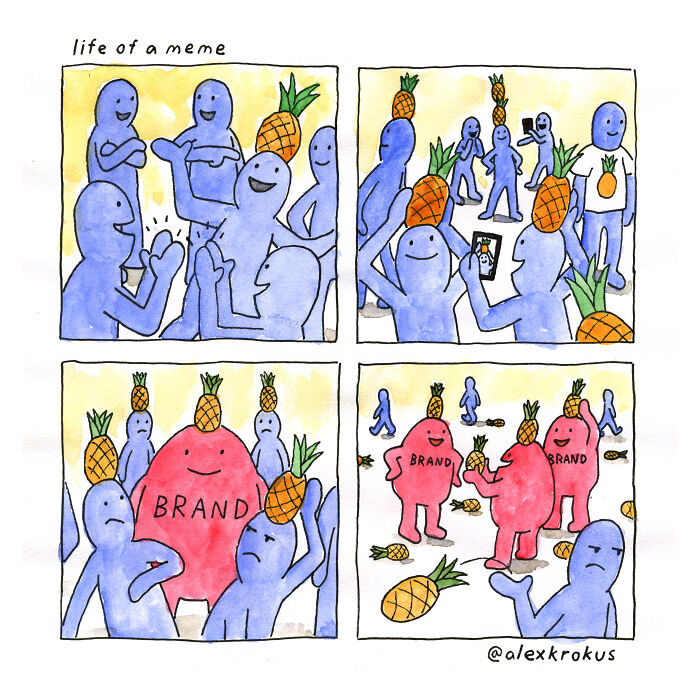
Now how can you, as a brand, avoid this perception from customers?
First and most importantly, curb the temptation to participate in a viral trend just for the sake of getting visibility. As mentioned earlier, it makes you look more desperate or lame than cool. Participate only if your brand can contribute in a relevant and meaningful manner, and even then, do it only once in a while.
Develop an identity for your brand and use social media to amplify it. Trends come and trends go, but your brand identity leaves a more lasting impression.
Excessive calling
We aren't referring to telemarketing here but to the practice of talking to customers who already pay for and use your offerings. Proactively following up on a customer complaint or just generally checking on customers is usually a positive thing, but it can have a negative effect on customers in certain cases:
You have neither a fixed nor a tentative time for resolving a complaint, but you just keep contacting the customer to say that the team is still working on resolving it. The customer appreciates it the first two or three times, but keep following up without a fixed deadline, your customer is sure to become furious. Depending on their mood, they might even take it out on your support agent.
Your account/relationship managers call customers at regular intervals, but try to cross-sell or up-sell every single time. Again, customers are generally tolerant of it the first or second time, but if the pattern keeps repeating, customers might stop attending subsequent calls, and you stand the risk of actually losing a genuine revenue opportunity.
Revise your customer support and account management processes to space customer interactions more thoughtfully and intentionally. Both of these functions/roles serve as bridges between you and your customers, and you don't want those bridges burned down.
Indiscriminate use of genAI tools
The overall capabilities and speed of genAI tools make it tempting to use them for any and every task, but this approach does more harm than good. According to a recent study, customers "avoid services advertised by AI-generated images" and "distrust AI-generated images, which are perceived as lacking veracity." However, that doesn't mean you need to impose a blanket ban on the use of genAI tools; it only implies that you need to be selective about where and why you use them.
For instance, the same study reveals that customers don't mind seeing AI-generated images when it comes to low-involvement activities and utilitarian services, wherein the pictures exist only to provide a rough idea and not reflect the actual output.
Therefore, once again, be selective about genAI use cases and don't treat such tools as an all-encompassing solution that provides authentic or accurate information or creative output. This applies not just to creative output, but also to the coding side of things—lest you end up posting rants like this.
There's a timeless saying that goes, "Too much of anything is good for nothing". Remember that the spirit of this saying applies to your CX practices as well.
Hope you enjoyed reading this article. If yes, do consider following us on X and YouTube as well!