- HOME
- Know Your Tech
- AI vs. human app developers: Comparison and key trends
AI vs. human app developers: Comparison and key trends
- Last Updated : August 4, 2026
- 89 Views
- 10 Min Read
According to a 2025 report, 84% of developers now use or plan to use AI in their workflow. That's a sharp jump from the previous year’s data. AI is changing how apps get built across every industry.
So, does that mean AI can replace your development team? Not quite. AI handles speed and repetition well, but human developers still own the creative, strategic, and security-critical parts of building software.
Highlights
- AI tools speed up repetitive coding tasks like code generation, bug detection, and testing, but they lack creative and strategic judgment.
- Human developers lead in complex problem-solving, security decisions, and building apps that match specific business requirements.
- The most effective development approach is a hybrid model where AI handles routine work and humans focus on design, logic, and customization.
- AI-generated code can introduce security vulnerabilities and bias if not reviewed and validated by human developers.
- Choosing between AI and human developers depends on project complexity, security needs, and how much customization your app requires.
This blog post breaks down where AI and human developers each perform best. You'll see a practical comparison, current trends, and a framework for deciding when to use one, the other, or both.
How AI is used in app development
AI development tools use machine learning models, automation, and data-driven algorithms to handle parts of the app creation process. They generate code from natural language prompts, automate testing and deployment, and adapt app behavior based on user data.
AI works best when the task is structured and repeatable. It can write standard code, run automated tests, and deploy updates faster than any human. Where it falls short is anything that requires original thinking, business-specific judgment, or context that doesn't exist in its training data.
How human developers approach app development
Human developers write code, design system architecture, and make decisions based on business context, user needs, and technical trade-offs. Unlike AI, traditional coding gives developers full control over programming languages, frameworks, and infrastructure based on what the project requires long-term.
The advantage human developers bring is judgment. They assess risk, design for edge cases, and build applications that account for how real people actually use software. AI can speed up development, but the decisions that determine whether an app is secure, usable, and built to last still depend on human expertise.
AI vs. human app developers: A side-by-side comparison
Most teams don't need to choose one over the other. The practical question is which tasks to assign to AI and which ones need a human developer. The answer depends on several factors that directly affect your project's speed, quality, and cost. Here’s how both approaches compare:
| Factor | AI developers | Human developers |
| Speed | Generates and deploys in minutes | Slower on routine tasks, faster on complex ones |
| Creativity | Limited to learned patterns | Designs original, novel solutions |
| Customization | Handles standard configurations | Builds deeply tailored applications |
| Security | Detects known vulnerabilities | Assesses full business risk context |
| Cost | Lower upfront for structured work | More cost-effective for complex projects |
| Scalability | Scales repetitive tasks across platforms | Scales through architecture and team planning |
| Adaptability | Struggles with undefined requirements | Pivots quickly to changing needs |
Let’s compare each approach across different factors.
Speed and efficiency
AI's biggest advantage is speed on repetitive, well-defined tasks. Code generation, automated testing, and deployment can happen in minutes instead of hours. For instance, generating a data entry form with validation rules takes AI seconds, while a developer might spend a full day on the same task.
Human developers are slower on routine work, but faster when the task involves original thinking. Debugging a complex integration issue or designing a multi-step approval process requires understanding that AI can't replicate. AI saves time on volume. Humans save time on complexity.
Creativity and innovation
AI produces outputs based on patterns from its training data. It can suggest code structures, auto-complete functions, and generate standard UI components. What it can't do is invent something new.
For instance, if a healthcare company needs a patient intake app that adapts its questions based on real-time symptom analysis and provider availability, a human developer designs that logic from scratch. AI would need a prebuilt template to work from, and for a scenario this specific, one likely doesn't exist. Human developers bring the creative thinking that turns a business idea into a working feature.
Customization depth
AI handles standard configurations well. It can generate forms, set up basic data flows, and apply common business rules. The limitation shows up when your requirements go beyond templates.
For example, a manufacturing company tracking production quality across three plants with different equipment, suppliers, and compliance standards needs custom logic at every step. A human developer maps those specific business rules into the application. AI would produce a generic version that requires significant rework to match real operations.
Security and risk assessment
AI tools scan codebases for known vulnerabilities and flag common security issues quickly. They're useful for catching standard problems early. The limitation is that AI can't evaluate context-specific risks.
A human developer considers which data is most sensitive, who has access, what compliance rules apply, and how the application interacts with other systems. For instance, an app handling payment data needs security decisions that account for payment card industry (PCI) compliance, user roles, and data encryption at every layer. AI flags known patterns. Humans assess actual risk. Zoho Creator's research found that 46% of organizations saw significant QA improvements with AI tools, but human review remains necessary for context-sensitive security decisions.
Cost considerations
AI lowers the upfront cost for structured, repeatable tasks. Generating standard code, running automated tests, and handling deployments costs less with AI than with a dedicated developer.
The cost advantage shifts for complex projects. If AI-generated code needs heavy rework, the total cost can exceed what a human developer would have charged to build it correctly the first time. For example, a company that uses AI to generate a customer portal might save on initial development but spend more on fixing security flaws, customization issues, and integration errors later.
Scalability and long-term growth
AI scales repetitive tasks easily. It can generate code across platforms, run tests on large codebases, and handle high-volume deployments without slowing down.
Human developers scale differently. They plan application architecture for long-term growth, design systems that handle increasing data volumes, and structure codebases so new features can be added without breaking existing ones. For a business app that starts with 50 users and needs to support 5,000 within a year, human architectural decisions at the start determine whether that growth happens smoothly.
Adaptability to changing requirements
Business needs change. A feature that seemed important during planning might become irrelevant after user testing, or a new compliance requirement might reshape the entire data model. Human developers adapt to these shifts by re-evaluating the approach and restructuring the application.
AI works best when requirements are fixed and well-documented. Changing direction mid-project means re-prompting, reviewing outputs, and often starting sections over. The more dynamic your project, the more you need human developers who can reason through trade-offs and make judgment calls on the fly.
The pattern is consistent across every factor. AI excels at structured, repeatable, well-defined work. Human developers lead on anything that requires original thinking, contextual judgment, or adaptability. The strongest development approach uses both, assigning each to the tasks they handle best.
When to use AI, human developers, or both
The right approach depends on what you're building, how complex it is, and how much customization your business needs. Here's a practical framework for deciding.
What AI works best for
AI delivers the most value on projects with clear, repeatable requirements. Use AI when the task is structured and well-documented.
- Rapid prototyping:Creating apps using AI prompts and generate a working proof of concept in hours instead of weeks.
- Standard business apps: Data entry forms; basic dashboards; and simple create, read, update, delete (CRUD) applications with predictable logic.
- Automated testing: Running test suites across large codebases and flagging common errors faster than manual QA.
- Code generation at scale: Writing standard code, generating API connectors, and handling repetitive syntax work across platforms.
- Data processing tasks: Sorting, validating, and formatting large datasets based on defined rules.
What human developers work best for
Human developers are essential when the project requires judgment, creativity, or deep business knowledge.
- Complex business logic: Apps with custom rules, multi-step approval chains, or industry-specific compliance requirements.
- Security-sensitive applications: Projects handling financial data, patient records, or personal information that require context-aware security decisions.
- Custom user experiences: Interfaces designed around specific user behaviors and workflows that no template covers.
- Evolving requirements: Projects where the scope is likely to change based on user feedback or shifting business priorities.
- System architecture: Designing the foundation for applications that need to scale, integrate with other systems, and support long-term growth.
The hybrid model
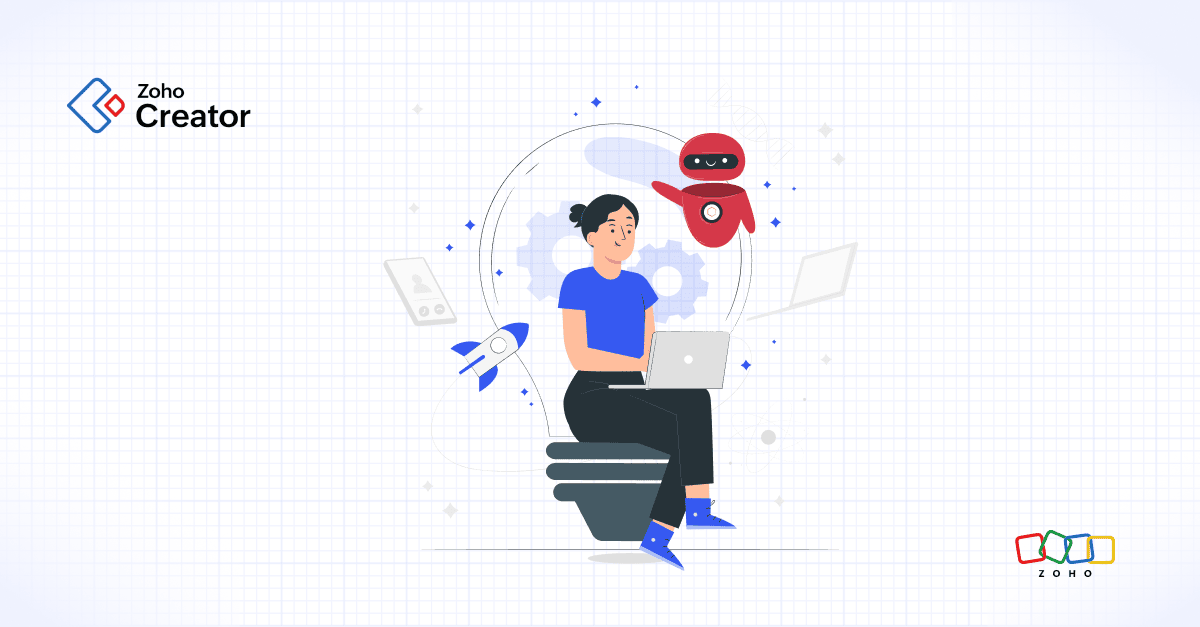
Most successful teams today combine both approaches. AI handles code generation, testing, and deployment while human developers focus on architecture, security, design, and business-specific logic.
For example, a retail company building an inventory management app could use AI to generate data collection forms and automated notifications. Human developers would then design the business rules for reorder thresholds, supplier integrations, and role-based access controls.
This model is gaining traction. Zoho Creator's 2026 study found that 66% of professionals expect code generation to be fully automated within five years. That shift means human developers will increasingly focus on oversight, strategy, and customization, while AI handles the execution layer.
Key trends shaping AI and human collaboration in development
AI and human collaboration in app development is evolving fast. These trends are already influencing how teams work today, not in some distant future.
AI-assisted code generation is standard practice
AI code assistants now suggest, complete, and refactor code in real time. Gartner predicts that by 2028, 90% of enterprise software engineers will use AI code assistants. These tools handle routine code and syntax, letting developers focus on logic and architecture.
Low-code platforms are changing who builds apps
AI-powered low-code platforms allow business users to build apps with minimal coding. These platforms automate backend processes, generate forms and workflows visually, and handle deployment automatically. This reduces the dependency on specialized developers for standard business applications.
Hybrid development is the default model
Teams are structuring their workflows so that AI handles initial code generation, automated testing, and deployment, while human developers handle design, review, and strategic decisions. This split lets teams ship faster without sacrificing quality.
AI-driven testing and security checks
AI testing tools detect bugs earlier in the development cycle and run continuous security scans. They integrate into continuous integration and continuous delivery (CI/CD) pipelines to flag issues before code reaches production. However, human review is still needed for context-specific security risks and complex logic validation.
Real-time personalization at scale
AI enables apps to adapt content, interfaces, and features based on individual user behavior in real time. Human developers design the personalization framework and business rules, while AI handles the data processing and decision execution.
These trends point to a future where AI takes on more of the execution work, and human developers focus more on strategy, design, and oversight. The teams that combine both effectively will build better apps faster. For a deeper look at where AI development is headed, see this guide on AI automation trends in app development.
Ethics in AI-powered app development
Using AI in development comes with responsibilities that go beyond writing functional code. As AI takes on more of the development process, human oversight on ethical issues becomes more important, not less.
Bias in AI-generated code
AI models learn from existing data, and if that data contains biases, the AI reproduces them. For instance, an AI tool trained on skewed datasets could generate recommendation algorithms that favor certain user demographics over others. Regular audits of AI-generated outputs and diverse training datasets help reduce this risk.
Data privacy and compliance
AI systems process large volumes of data during development and in production. Handling that data responsibly means following regulations like the general data protection regulation (GDPR) and health insurance portability and accountability act (HIPAA). Human developers need to review how AI tools handle data storage, access, and sharing to ensure compliance.
Security risks in AI-generated code
AI-generated code can introduce vulnerabilities that standard testing might miss. Unlike human developers, AI doesn't fully understand the security context of the application it's building. Human review of AI-assisted software development output is essential for catching exploitable flaws before they reach production.
The need for human accountability
AI can automate decisions, but it can't take responsibility for them. When an AI-generated feature causes a data breach or produces biased results, the accountability falls on the team that deployed it. Clear review processes and defined ownership over AI outputs keep your development practice both effective and responsible.
Ethical AI development requires ongoing human involvement at every stage, from training data selection to production monitoring.
Build smarter apps with AI and human expertise on Zoho Creator
Finding the right balance between AI speed and human judgment is the real challenge in app development today. Most teams either rely too heavily on AI and deal with quality issues, or stick entirely with manual development and fall behind on delivery timelines.
Zoho Creator is an AI-powered low-code application development platform that brings AI and human expertise together in one place. With Zia, Zoho's AI assistant, your team can generate app components, automate repetitive tasks, and get data-driven recommendations while keeping full control over design, business logic, and security.
The platform's AI-powered features handle predictive analytics and intelligent task routing so your team can focus on the decisions that need human judgment. Every app you build works natively on web, iOS, and Android, and connects to your existing tools through 1,000+ integrations.
FAQ
Can AI build a complete production-ready app on its own?
AI can generate working prototypes and simple applications quickly. For production-ready apps with complex business logic, security requirements, and custom features, human review and refinement are still necessary.
What types of projects are best suited for AI development tools?
Standard business apps with repeatable patterns, like data entry forms, basic dashboards, and automated notifications, are ideal for AI tools. Projects with well-defined requirements benefit the most.
How do hybrid development teams typically split work between AI and humans?
AI usually handles code generation, automated testing, bug detection, and deployment tasks. Human developers focus on architecture, security review, UX design, and custom business logic.
What are the biggest risks of relying only on AI for app development?
AI-generated code can contain security vulnerabilities, biased logic, and weak edge-case handling. Without human review, these issues can reach production and cause data breaches or poor user experiences.
How does low-code fit into the AI vs. human developer discussion?
Low-code platforms combine AI automation with human-controlled visual builders. They let business users handle standard app development tasks while developers focus on complex customization and integrations.
 Bharathi Monika Venkatesan
Bharathi Monika Venkatesan is a content writer at Zoho Creator. Outside of work, she enjoys exploring history, reading short novels, and cherishing moments of personal introspection.