- HOME
- Know Your Tech
- AI in business app development: All you need to know
AI in business app development: All you need to know
- Last Updated : December 1, 2025
- 750 Views
- 9 Min Read
App usage is increasing every single day. Users now expect apps to adapt to their preferences, predict their needs, and continually update features. Apps that don't evolve quickly become irrelevant.
Highlights
AI in business app development accelerates app creation by automating repetitive tasks and enhancing decision-making processes.
AI helps create more personalized and adaptive mobile apps that improve user engagement and simplify workflows.
Technologies like machine learning, natural language processing, and computer vision are transforming app functionalities, from predictive analytics to visual interactions.
The integration of AI into mobile apps enables businesses to improve efficiency, reduce IT dependency, and meet the growing demand for smarter, more capable applications.
AI in business app development keeps you competitive. You can build apps that learn from user behavior, automatically personalize experiences, and improve without manual updates. What used to require months of development and specialized teams now happens in weeks with AI-powered platforms.
Find out how AI transforms the app-building process and what those apps can do. Explore examples across industries, AI capabilities, and effective ways to start building intelligent apps for your business.
What is AI in business app development?
AI in business app development refers to using artificial intelligence technologies to build applications. With AI, you can build apps that can predict user needs, automate complex workflows, and provide insights that help users work more efficiently.
For instance, an AI-powered inventory management app can predict stock needs based on seasonal trends, while a customer service app can understand user requirements and provide relevant solutions.
Through AI in business app development, businesses can create apps that not only perform essential functions but also feel intuitive and tailored to each user. This boosts engagement and productivity, helping businesses stay competitive in a tech-driven world. The global AI app market, valued at $2.94 billion in 2024, is expected to grow to $26.36 billion by 2030, with a CAGR of 38.7%, demonstrating AI’s increasing importance in mobile app development.
How AI improves the business app development process
AI changes how you build apps by reducing manual work and providing intelligent assistance throughout development. This means faster cycles, better productivity, and more time for your team to focus on creating features that solve business problems.
Here's how AI supports your development work:
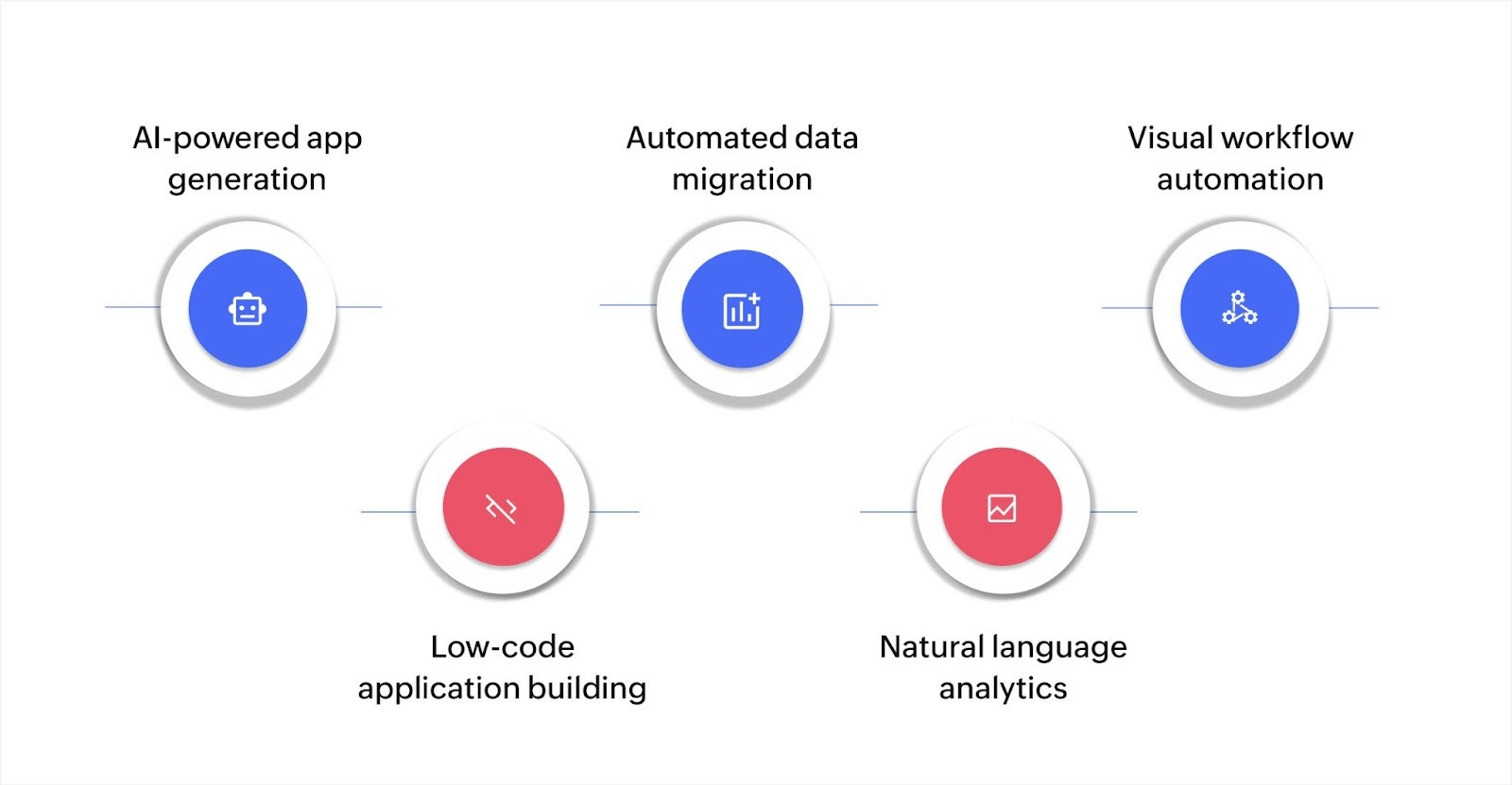
AI-powered app generation: Describe your app requirements in plain language and AI creates the initial structure with tables, forms, and workflows. You skip the blank canvas problem and start refining a working app instead.
Automated data migration: Connect spreadsheets or legacy databases and AI handles the cleanup work. It identifies data types, fixes formatting inconsistencies, and maps relationships between tables without manual configuration.
Visual workflow automation: Drag and drop elements to build automation sequences. The visual interface shows you how data flows between actions, while the platform handles the technical execution of triggers, conditions, and notifications.
Low-code application building: Build apps by dragging components onto a canvas instead of coding from scratch. The platform provides pre-built elements for forms, reports, and pages that you customize for your needs, while AI features assist with data structuring and app setup.
Natural language analytics: Ask questions about your data in everyday language and AI generates the charts and reports. You get insights without writing database queries or configuring analytics dashboards manually.
AI-powered app capabilities in business apps
AI inside your apps enables intelligent features that adapt to users and deliver personalized experiences. These capabilities transform basic applications into smart tools that learn from usage patterns and improve over time.
Machine learning (ML): Automating decisions with predictive analytics
Machine learning (ML) empowers mobile apps to analyze data and make predictions based on past user behavior. This technology is central to creating apps that adapt and evolve over time, providing users with a more personalized experience.
Predictive analytics: ML algorithms analyze historical data to anticipate user needs, from product recommendations to content delivery, enhancing user engagement.
Behavior modeling: By understanding user interactions, ML enables apps to deliver tailored content, improving satisfaction and retention.
With ML, mobile apps are better equipped to automate decisions, allowing businesses to offer a more dynamic and relevant user experience.
Natural language processing (NLP) and deep learning: Enhancing communication
Natural language processing (NLP) and deep learning are transforming the way users interact with mobile apps. These technologies enable apps to understand, process, and respond to user input in a more intuitive way.
Voice assistants: NLP powers voice recognition in apps, allowing users to interact using simple commands, improving accessibility and convenience.
Automated customer support: NLP and deep learning enable chatbots to provide immediate, context-aware responses, enhancing customer service without the need for manual input.
Sentiment analysis: These technologies also analyze customer feedback, helping businesses gauge emotions and better understand user sentiment for more personalized responses.
By integrating NLP and deep learning, businesses can improve customer satisfaction through quicker, more accurate responses.
Computer vision (CV): Unlocking visual interactions
Computer vision (CV) allows mobile apps to process and understand visual information, opening up innovative features for users and businesses.
Image recognition: CV technology helps apps identify objects in images, improving functionalities like visual search or automated inventory management.
Augmented reality (AR): With AR powered by CV, apps can offer virtual try-ons, product visualizations, and enhanced shopping experiences.
Facial recognition: CV enables secure, efficient user identification through facial recognition, enhancing security features in apps.
Incorporating CV into mobile apps not only enriches the user experience but also allows businesses to use visual data to optimize operations.
Real-world use cases of AI in business mobile apps
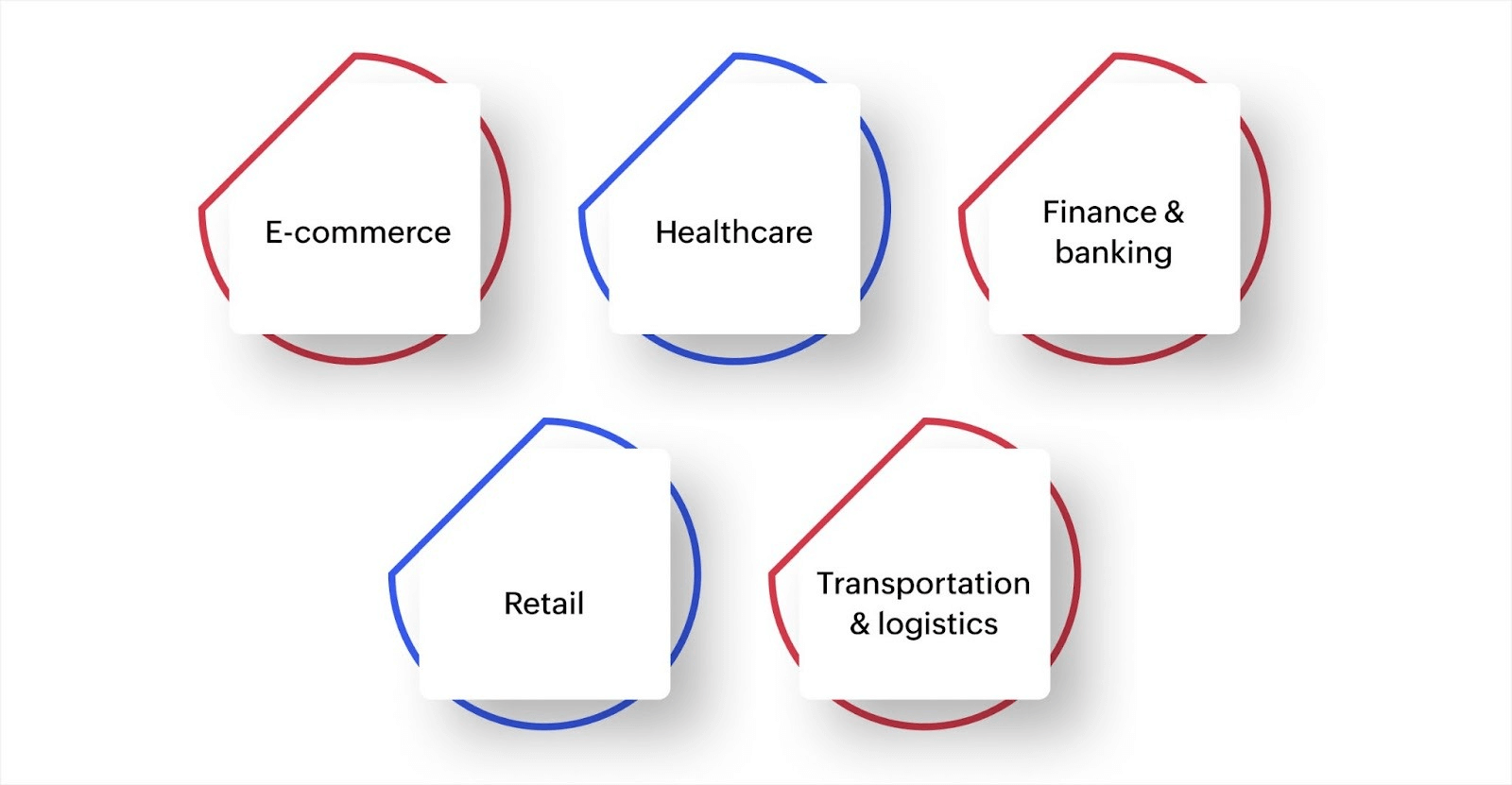
E-commerce: Personalized shopping and customer support
AI-powered mobile apps in e-commerce are enhancing the shopping experience and improving customer service through machine learning and natural language processing (NLP).
Personalized shopping: AI uses algorithms like collaborative filtering and content-based filtering to recommend products based on customer behavior, purchase history, and preferences. For example, Amazon’s recommendation engine uses AI to suggest products by analyzing vast amounts of transactional data, resulting in higher conversion rates.
AI chatbots: AI-driven chatbots, powered by NLP, provide real-time customer support, answering queries, assisting with orders, and managing returns. Platforms like Shopify integrate AI bots to simplify customer interactions, reducing the need for human intervention while delivering personalized service.
Healthcare: Remote consultations and patient monitoring
Telemedicine: AI-powered apps like Teladoc analyze patient data (such as health history and symptoms) to provide remote diagnosis and treatment recommendations. Machine learning models help doctors identify patterns in symptoms, offering data-driven insights that lead to better diagnoses.
Remote patient monitoring: AI apps track real-time health data from wearable devices (e.g., heart rate, oxygen levels) to monitor patient conditions. AI-driven algorithms detect anomalies in vital signs, enabling timely alerts for healthcare providers to intervene.
Finance and banking: Fraud detection and robo-advisors
In the finance sector, AI apps use predictive analytics, anomaly detection, and natural language processing to enhance security and provide personalized services.
Fraud detection: Banks use machine learning models to analyze transaction patterns and identify outliers that could indicate fraud.
For instance, AI algorithms evaluate factors like spending habits and transaction location to detect suspicious activities and reduce the risk of financial fraud.
Robo-advisors: Platforms like Betterment use AI to provide tailored investment advice based on individual goals.
These models rely on predictive analytics to optimize portfolio performance, removing the need for traditional financial advisors.
Retail: Inventory management and customer behavior analysis
AI in mobile apps helps retail businesses optimize inventory and improve customer insights by analyzing large datasets in real-time.
Smart inventory management: AI-driven systems, such as those used by Walmart, monitor inventory levels using demand forecasting algorithms. These systems adjust stock levels based on predictive models that analyze trends, seasonality, and consumer behavior, ensuring optimal inventory management.
Customer behavior analysis: AI uses clustering algorithms to segment customers based on their purchase history and browsing data. This allows businesses to predict future purchasing behavior and tailor marketing efforts, enhancing both customer engagement and sales efficiency.
Transportation and logistics: Route optimization and autonomous vehicles
AI in logistics is optimizing routing, reducing costs, and powering autonomous vehicles by analyzing large datasets and using machine learning algorithms.
Route optimization: AI apps, such as those used by Uber and FedEx, use real-time data analysis to optimize delivery routes. Machine learning models take into account factors like traffic, weather, and driver behavior to suggest the fastest and most efficient routes, reducing fuel consumption and delivery times.
Autonomous vehicles: AI algorithms, such as computer vision and deep learning, power self-driving cars. Companies like Tesla use AI to process data from sensors and cameras, enabling vehicles to recognize objects, navigate complex environments, and make decisions in real-time, improving safety and efficiency.
As AI continues to evolve, these real-world use cases are just the beginning. The potential for AI to transform mobile apps in business is vast, offering new opportunities for innovation and efficiency across industries. Businesses embracing AI now are setting themselves up for a future where technology drives smarter, more adaptive solutions.
Challenges in integrating AI into mobile apps
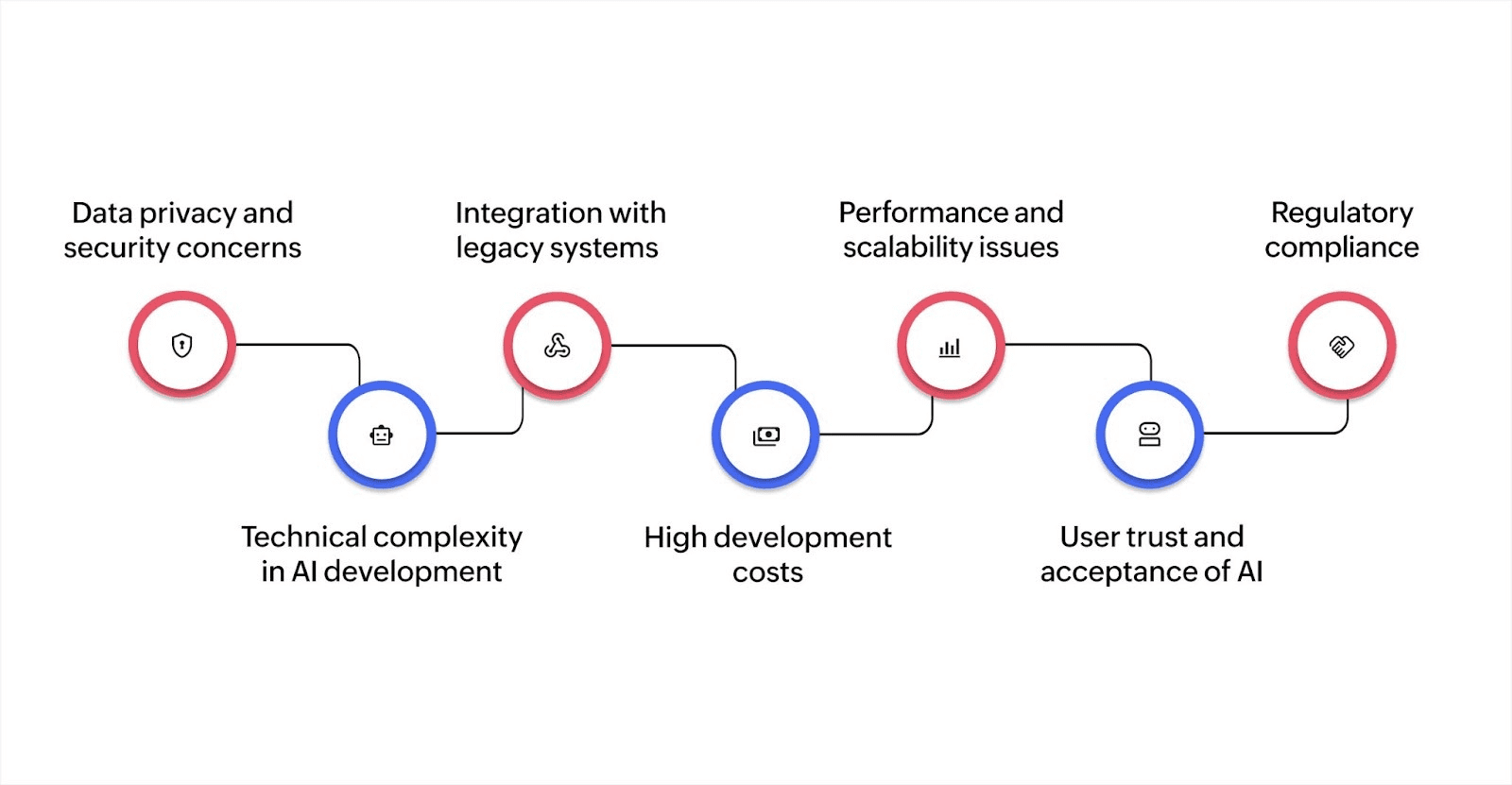
Data privacy and security concerns
Challenge
AI-powered apps collect and process sensitive user data, making data security a top priority.
Solution
Encryption: Apply end-to-end encryption to protect data during transmission.
Anonymization: Anonymize data where possible to safeguard user privacy.
Compliance: Ensure adherence to regulations like GDPR or HIPAA, and conduct regular security audits.
Technical complexity in AI development
Challenge
Developing AI apps requires specialized technical knowledge, which may not be readily available within your team.
Solution
Upskilling: Train your developers in machine learning, natural language processing, and data analytics.
Pre-built AI models: Use available AI models and APIs to reduce development time and complexity.
Low-code platforms: Utilize low-code platforms like Zoho Creator, which offer AI functionalities that are easy to integrate without deep coding expertise.
Integration with legacy systems
Challenge
Older systems may struggle to integrate with AI technologies, creating compatibility issues.
Solution
Modular approach: Build AI features as separate modules that can be added gradually to existing systems.
APIs: Use APIs to connect AI components to legacy systems, avoiding the need for complete overhauls.
High development costs
Challenge
Developing AI apps requires substantial investment in resources, datasets, and expertise.
Solution
Cloud platforms: Use cloud computing services to avoid the need for expensive hardware and scale as needed.
Open-source tools: Take advantage of open-source AI frameworks like TensorFlow and PyTorch to build AI models at a lower cost.
Outsourcing: For smaller businesses, outsourcing AI development to specialists can help manage expenses.
Performance and scalability issues
Challenge
AI-powered apps must perform well even as data volume and user traffic increase.
Solution
Edge computing: Move processing to the user’s device to reduce delays and improve performance.
Model optimization: Optimize AI models to ensure they run efficiently on mobile devices.
Load balancing: Implement load balancing to evenly distribute traffic across servers and maintain app stability under heavy usage.
User trust and acceptance of AI
Challenge
Some users may be skeptical about AI features, especially when they are unclear about how decisions are made.
Solution
Transparency: Clearly explain how AI works in the app and how it benefits users.
Human oversight: In important applications, involve human oversight to provide reassurance and build trust.
Regulatory compliance
Challenge
AI apps must comply with industry-specific regulations, especially in sectors like healthcare and finance.
Solution
Audits: Regularly audit AI systems to ensure they meet industry regulations and ethical standards.
Ethical practices: Follow ethical guidelines to ensure fairness and protect user privacy, particularly in sensitive industries.
By using cloud services, open-source tools, and low-code platforms, businesses can effectively tackle these challenges. Strategic planning and execution will allow companies to successfully integrate AI into mobile apps, creating smarter solutions and driving business growth.
Build apps faster with AI-powered low-code tools
AI in business app development holds the potential to significantly change how businesses operate, automating repetitive tasks, improving decision-making, and creating more personalized user experiences. With Zoho Creator, integrating AI into your mobile apps becomes straightforward, even for businesses without extensive coding expertise.
Zoho Creator's AI-powered low-code platform lets you quickly build and deploy custom mobile apps for both Android and iOS. The platform’s drag-and-drop interface makes app creation easy, while AI-powered features like Zia assist in automating tasks and offering intelligent suggestions, further simplifying the development process.
Whether you're looking to optimize workflows, personalize user interactions, or automate manual tasks, Zoho Creator equips you with the tools to integrate AI into your mobile apps. This solution is ideal for businesses of all sizes, from SMBs to enterprises, providing flexibility, scalability, and ease of use.
With Zoho Creator, you can transform your business by creating AI-powered mobile apps that improve efficiency, productivity, and overall business performance. Start building smarter mobile applications today and discover the power of AI in business app development.
FAQ
What are the long-term benefits of integrating AI into mobile apps?
Integrating AI into mobile apps can lead to long-term benefits such as improved customer retention, better user insights, and the ability to continuously evolve apps based on real-time data and user behavior.
How can businesses ensure the ethical use of AI in mobile apps?
Businesses can ensure ethical AI use by following guidelines for transparency, fairness, and privacy. Implementing regular audits, ensuring data anonymization, and complying with industry regulations like GDPR can help maintain ethical standards in AI-driven mobile apps.
What skills are required to integrate AI into mobile app development?
While platforms like Zoho Creator reduce the need for advanced coding skills, a basic understanding of AI concepts like machine learning, natural language processing, and data analytics can be helpful in making the most out of AI-powered app development tools.
How does AI in mobile apps contribute to business scalability?
AI enables mobile apps to scale effectively by automating tasks, optimizing workflows, and adapting to increasing data volumes. This allows businesses to expand their operations without a corresponding increase in manual efforts or IT dependencies.
 Bharathi Monika Venkatesan
Bharathi Monika Venkatesan is a content writer at Zoho Creator. Outside of work, she enjoys exploring history, reading short novels, and cherishing moments of personal introspection.