- HOME
- Know Your Tech
- Hyperautomation benefits: Top 5 ways it improves performance
Hyperautomation benefits: Top 5 ways it improves performance
- Last Updated : March 5, 2026
- 553 Views
- 10 Min Read
Many companies automate specific tasks but still face delays when work moves between systems. Invoice processing runs automatically, but someone manually transfers data to accounting software. Customer requests route through automated workflows, but staff coordinate hand-offs between support tools and CRM platforms. Automation exists, but business velocity hasn't increased proportionally.
Highlights
- Manual hand-offs between automated systems cause bottlenecks that hyperautomation removes through proper coordination.
- Benefits of hyperautomation include process coordination, reduced IT dependency, lower integration costs, consistent decisions, and scalable operations.
- Finance uses hyperautomation for compliance automation, healthcare for patient data accuracy, manufacturing for production scheduling.
- Implementation challenges include legacy system integration, process selection, change management, and governance balance.
- Cloud-based platforms scale resources dynamically during volume spikes without manual intervention.
Basic automation addresses individual tasks without connecting the systems on which those tasks depend. As a result, teams end up managing coordination between automated steps manually. IT departments build custom integrations to connect these systems, creating maintenance overhead that scales with each new tool adoption.
Hyperautomation addresses this coordination problem by connecting automation tools across systems. This blog post explains the specific benefits hyperautomation delivers, how different industries apply it, and key considerations for effective implementation.
What is hyperautomation?
Hyperautomation solves the coordination problem that basic automation creates. When individual processes run automatically but still require manual hand-offs between systems, operational bottlenecks persist despite automation investment. That’s where hyperautomation comes in, maintaining process flow and removing coordination work that slows operations.
For instance, when an expense claim moves through approval, reaches the finance system, updates budgets, and triggers reimbursement, hyperautomation coordinates each transition without manual intervention.
5 key benefits of hyperautomation
The global hyperautomation market was valued at USD 46.4 billion in 2024 and is projected to grow at a CAGR of 17.06% from 2025 to 2034. This fast growth highlights the rising demand for hyperautomation solutions as businesses seek to improve efficiency, reduce costs, and drive innovation.
Here are the key benefits of hyperautomation and how they can transform your operations.
1. Process coordination replaces manual hand-offs
When systems share process context automatically, work flows without status checks, data re-entry, or queue management. Teams that previously coordinated between tools now monitor exceptions instead of managing routine transitions.
Workflow coordination keeps information intact as work moves between systems. When one automated step finishes, the next one starts automatically with all the details it needs. Decision rules determine where work goes next, and rule engines check data quality and business requirements before moving things forward.
For instance, when processing expense reports, approval notifications go out automatically based on dollar amounts. Approved expenses flow straight to accounting systems with all the receipts and documentation attached. Budget tracking updates in real time as each expense posts. Finance teams only review the exceptions that get flagged, not every single transaction.
2. IT dependency decreases through business user automation
Business teams can change workflows and add automation steps without filing IT tickets. IT sets the rules and users work within those boundaries. This removes the IT bottleneck that usually slows down automation efforts.
Low-code platforms provide visual workflow builders with ready-made templates they can customize. Users drag and drop components to change how processes work, and their updates go live right away within the approved limits. IT keeps oversight while teams make their own adjustments as things change.
For instance, procurement teams can add new approval steps when vendor categories change, tweak notification rules when order volumes jump, and update validation checks as requirements shift. IT builds the framework once, then procurement makes ongoing adjustments without waiting on developers.
3. Integration maintenance costs drop
Instead of building custom connections between every system, teams use prebuilt connectors. When your software vendors push updates, the connector providers handle the compatibility work. Your internal teams focus on business rules instead of fixing integrations.
Hyperautomation platforms come with connector libraries for common business tools. API management handles login credentials, request limits, and error messages automatically. Data moves through these connectors without anyone writing custom code for each connection, which keeps technical work manageable.
For instance, connecting your CRM, ERP, and support systems needs just three connectors instead of six separate custom integrations. When your CRM vendor updates their API, the connector provider fixes any compatibility issues. Your team works on process improvements instead of maintaining integrations.
4. Decision quality improves through consistent rule application
Automated decision points apply the same criteria to every transaction. Rule engines check data quality, verify business requirements, and route exceptions the same way each time. This removes inconsistent judgment calls while keeping human review for genuine edge cases.
Business rules spell out the decision criteria like approval thresholds, required fields, and routing logic. AI models apply these rules to each transaction and flag anything that needs a closer look. Machine learning spots patterns in the exceptions over time and suggests ways to improve the rules.
For instance, credit approval processes check every application against the same risk criteria. Each one gets the same verification steps for income, credit history, and debt levels. Loan officers review the flagged cases with full details instead of manually deciding on thresholds for every application.
5. Operations scale without proportional cost increases
When transaction volumes grow, automated processes handle the extra load without needing more staff. Systems manage busy periods automatically and adjust computing power based on what's happening. You can grow without increasing your operating costs at the same rate.
Cloud platforms add computing power automatically when volumes spike and scale back down when things quiet down. Work gets distributed across whatever capacity is available, and queue management keeps everything processing smoothly during rush periods. You get alerts before you hit capacity limits, not after things slow down, so there's time to make decisions.
For instance, ecommerce order processing during holiday sales handles much higher volumes through the same automation setup. Systems add capacity automatically during the rush, scale back after it ends, and keep processing speeds consistent without any manual work.
Industry applications of hyperautomation
Hyperautomation is driving operational transformation across industries, combining AI, RPA, machine learning, and low-code platforms to automate complex tasks. It connects systems, simplifies workflows, and boosts efficiency. Here’s how hyperautomation is benefiting various industries.
Finance
In the finance sector, hyperautomation is reshaping processes like compliance management, fraud detection, and financial operations. It reduces manual intervention, speeds up decision-making, and ensures greater accuracy in financial workflows.
- Compliance management: Automating compliance tasks helps ensure up-to-date regulatory adherence without manual effort.
- Fraud detection: AI-driven systems analyze transactions in real time, identifying potential fraud and reducing risk.
- Operational efficiency: Hyperautomation enhances the accuracy and speed of processes such as credit assessments and financial reporting.
Example: Automating credit risk assessments and compliance checks leads to faster, more accurate decision-making, minimizing the risk of compliance errors.
Healthcare
Hyperautomation in healthcare improves patient care management, appointment scheduling, and data handling. AI and RPA help automate administrative processes, allowing healthcare professionals to focus on important tasks.
- Patient management: Automating data entry ensures medical records are accurate and easily accessible.
- Scheduling and billing: Automation eliminates scheduling conflicts and simplifies medical billing for faster claim processing.
- Data analysis: AI tools analyze patient data, enabling healthcare providers to make faster, data-backed decisions.
Example: Automating medical billing and appointment scheduling improves operational efficiency, reduces errors, and enhances patient satisfaction.
Manufacturing
In manufacturing, hyperautomation helps optimize maintenance, inventory management, and supply chain processes. By using AI and machine learning, companies can predict equipment failures and improve overall production efficiency.
- Predictive maintenance: AI systems predict when equipment needs maintenance, preventing unplanned downtimes.
- Inventory management: Automation tracks inventory levels, ensuring timely restocking and preventing production delays.
- Supply chain optimization: Hyperautomation improves coordination across the supply chain, reducing inefficiencies.
Example: AI-driven maintenance schedules for equipment reduce downtime by predicting failures and scheduling maintenance ahead of time.
Retail and ecommerce
In retail and ecommerce, hyperautomation improves customer experience, inventory management, and order fulfillment. Automated systems enable businesses to respond faster to customer needs and optimize back-office operations.
- Customer experience: AI-powered product recommendations boost engagement and increase sales.
- Inventory management: Automation ensures products are consistently available, reducing the risk of stockouts or overstocking.
- Order fulfillment: Automated systems simplify order processing, ensuring timely deliveries.
Example: Automating product recommendations based on browsing history enhances the customer experience and drives higher conversion rates.
Across industries like finance, healthcare, manufacturing, and retail, hyperautomation is enhancing efficiency, reducing costs, and improving decision-making. By automating repetitive tasks and connecting systems, businesses can focus on more strategic activities while minimizing manual errors.
Challenges and considerations of implementing hyperautomation
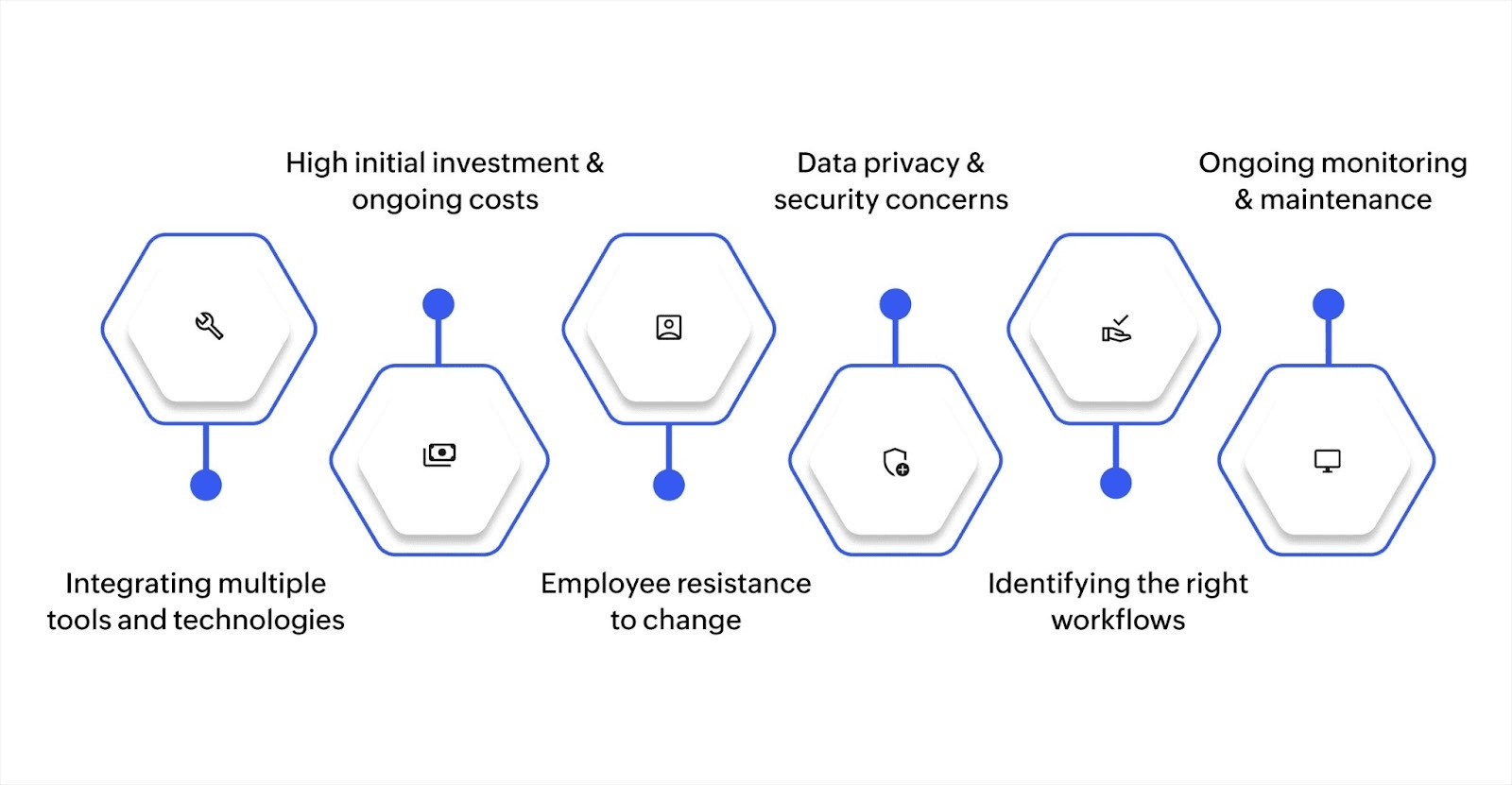
While hyperautomation offers substantial benefits, such as improved efficiency and cost reductions, there are several challenges that businesses need to address for successful implementation. Understanding these obstacles is essential to maximizing the long-term advantages of automation.
Integrating multiple tools and technologies
A key challenge businesses face when adopting hyperautomation is integrating various tools and technologies, especially when dealing with legacy systems.
- Compatibility: Outdated systems may not align well with new automation tools, creating integration issues.
- Choosing compatible solutions: Selecting tools that work smoothly with existing infrastructure is vital to avoiding inefficiencies.
High initial investment and ongoing costs
Though hyperautomation offers long-term savings, the initial setup can be expensive, particularly for smaller businesses.
- Upfront costs: These include technology acquisition, system integration, and training expenses.
- ROI: While the investment may seem high, businesses can expect a substantial return as the automation system improves efficiency and cuts costs over time.
Employee resistance to change
Employees may feel threatened by automation due to concerns about job security or unfamiliar technology. This resistance can be a significant barrier to successful implementation.
- Change management: Providing training and clear communication helps employees understand how automation enhances their roles.
- Reassuring employees: It’s important to emphasize that automation will improve productivity, not replace jobs.
Data privacy and security concerns
Automation, especially when integrated with cloud-based tools, raises data security concerns. Businesses must ensure that sensitive information remains protected.
- Security protocols: Implement strong encryption and access controls to safeguard data.
- Compliance: Regular audits and adherence to industry regulations are essential to maintain security.
Identifying the right workflows for automation
Not all business processes are suitable for automation. Over-automating complex tasks can introduce inefficiencies.
- Evaluate processes: Focus on repetitive, rule-based tasks that will benefit most from automation.
- Human oversight: Ensure automation complements human work, rather than replacing tasks requiring judgment or creativity.
Ongoing monitoring and maintenance
After implementation, hyperautomation systems require constant monitoring to ensure they continue to perform optimally.
- Continuous checks: Regular monitoring helps detect issues early and ensures the system runs smoothly.
- Adapting to changes: As business needs evolve, the automation system must be updated to stay aligned with new goals.
While hyperautomation benefits can transform your operations, it's important to carefully manage challenges like integration, costs, and employee adoption. With proper planning and continuous maintenance, businesses can realize the full potential of hyperautomation, driving efficiency and growth.
The future of hyperautomation
As businesses evolve to meet new demands, hyperautomation is set to change how organizations operate. Hyperautomation goes beyond traditional automation by connecting systems, integrating AI, and automating departments.
Advancements in AI and machine learning
The future of hyperautomation will see deeper integration of AI and machine learning, allowing businesses to not only automate routine tasks but also to make intelligent, data-driven decisions in real time.
AI will enable systems to learn and adapt continuously, improving decision-making, predicting trends, and optimizing workflows. These capabilities will allow businesses to become more agile, responding faster to market changes and ensuring higher efficiency in operations.
Rise of low-code and no-code platforms
The increasing adoption of low-code and no-code platforms is another key driver of hyperautomation’s future. These platforms allow businesses to create custom automation solutions without requiring extensive coding knowledge. Zoho Creator is a prime example, offering a low-code platform that enables business users to build tailored applications to automate workflows and integrate systems.
As more organizations embrace these platforms, the barriers to automation will lower, empowering employees at all levels to take charge of process automation without overloading IT teams.
Market growth and industry adoption
As hyperautomation continues to mature, its widespread adoption will expand across industries. With businesses looking for scalable, efficient solutions, hyperautomation offers a significant competitive edge.
From finance to healthcare and retail, industries are beginning to realize the potential for hyperautomation to improve both operational efficiency and customer satisfaction. The increasing market demand signals that hyperautomation will be integral in driving business growth, making it an important tool for long-term success.
In the years to come, hyperautomation will not only improve current processes but will fundamentally alter how businesses approach operational challenges. With AI, machine learning, and user-friendly low-code platforms at the core, hyperautomation is set to unlock new possibilities for businesses, ensuring they stay competitive, efficient, and future-ready.
Preparing your business for the future with hyperautomation
The future of hyperautomation offers transformative potential for businesses looking to simplify their operations and drive growth. By integrating AI, machine learning, and low-code platforms, hyperautomation will enable companies to not only automate routine tasks but also enhance decision-making, improve efficiency, and reduce operational costs. With the global hyperautomation market growing rapidly, now is the perfect time for organizations to adopt these technologies to stay competitive in an increasingly dynamic business landscape.
Zoho Creator is an AI-powered low-code app development platform that helps businesses automate workflows across departments. The platform enables teams to build custom applications with minimal coding, addressing unique business needs without heavy reliance on IT.
MGM Healthcare, a leading multi-speciality hospital in Chennai with 750 employees, used Zoho Creator to automate its entire hospital processes, achieving 20% productivity gains and 15% cost savings through coordinated automation across emergency services, facility management, and patient care systems.
With Zoho Creator, organizations can simplify IT processes to enhance operational efficiency. Its ability to integrate smoothly with existing tools ensures smooth data flow across systems to promote better collaboration and reduce friction between different departments.
FAQ
Can hyperautomation be implemented in small businesses without large IT resources?
Yes, small businesses can implement hyperautomation using low-code platforms like Zoho Creator. These platforms allow users to automate tasks and workflows without requiring a dedicated IT team, enabling efficient operations with minimal technical expertise.
How does hyperautomation help businesses scale operations?
Hyperautomation allows businesses to handle increased workload by automating repetitive tasks, making it easier to scale operations without the need for additional staffing. It ensures that processes remain efficient as the business grows, maintaining high productivity levels.
What role does hyperautomation play in improving regulatory compliance?
Hyperautomation improves regulatory compliance by automating tasks like data validation, reporting, and audits. AI and machine learning ensure that processes remain consistent with regulatory standards, reducing errors and the risk of non-compliance.
How can businesses measure the success of hyperautomation implementation?
Businesses can track the success of hyperautomation by measuring key metrics such as cost savings, process efficiency, accuracy, and employee productivity. Platforms like Zoho Creator provide insights and analytics to help evaluate the impact on overall business performance.
 Ann Elizabeth Sam
Hey! I'm Ann, and I work as a content writer at Zoho Creator. I'm exploring the SaaS world through various forms of content creation. Outside of work, I love dancing and would give up anything to read a good murder mystery.