- HOME
- Know Your Tech
- AI vs traditional coding: Key differences
AI vs traditional coding: Key differences
- Last Updated : December 5, 2025
- 939 Views
- 8 Min Read
Building custom business applications used to mean hiring developers to write thousands of lines of code. That approach works, but it's slow, expensive, and creates dependency on technical teams for every change you need.
Highlights
Speed: AI-powered low-code platforms create applications in just a few days, while traditional coding can take weeks or months with manual development for every feature.
Control: Traditional coding provides full control for highly customized solutions. AI-assisted coding offers flexibility but less precision.
Maintenance: AI platforms handle updates and scaling automatically, while traditional coding requires manual testing and infrastructure management.
Cost structure: AI-powered low-code platforms work with subscription models, while traditional coding involves developer salaries, infrastructure, and ongoing maintenance expenses.
Suitability: AI-powered low-code platforms excel at business applications, workflows, and portals, while traditional coding is better suited for specialized systems with unique technical requirements.
AI-powered platforms help you create applications by understanding what you need and building it with you without requiring complex coding. You describe your requirements, the AI suggests the structure, and you customize using visual tools.
This guide compares AI-assisted app creation with traditional coding. You'll learn how each approach works, where they excel, and which one fits your business needs. By the end, you'll know whether to use AI-powered tools or stay with traditional development based on your needs.
What is traditional coding?
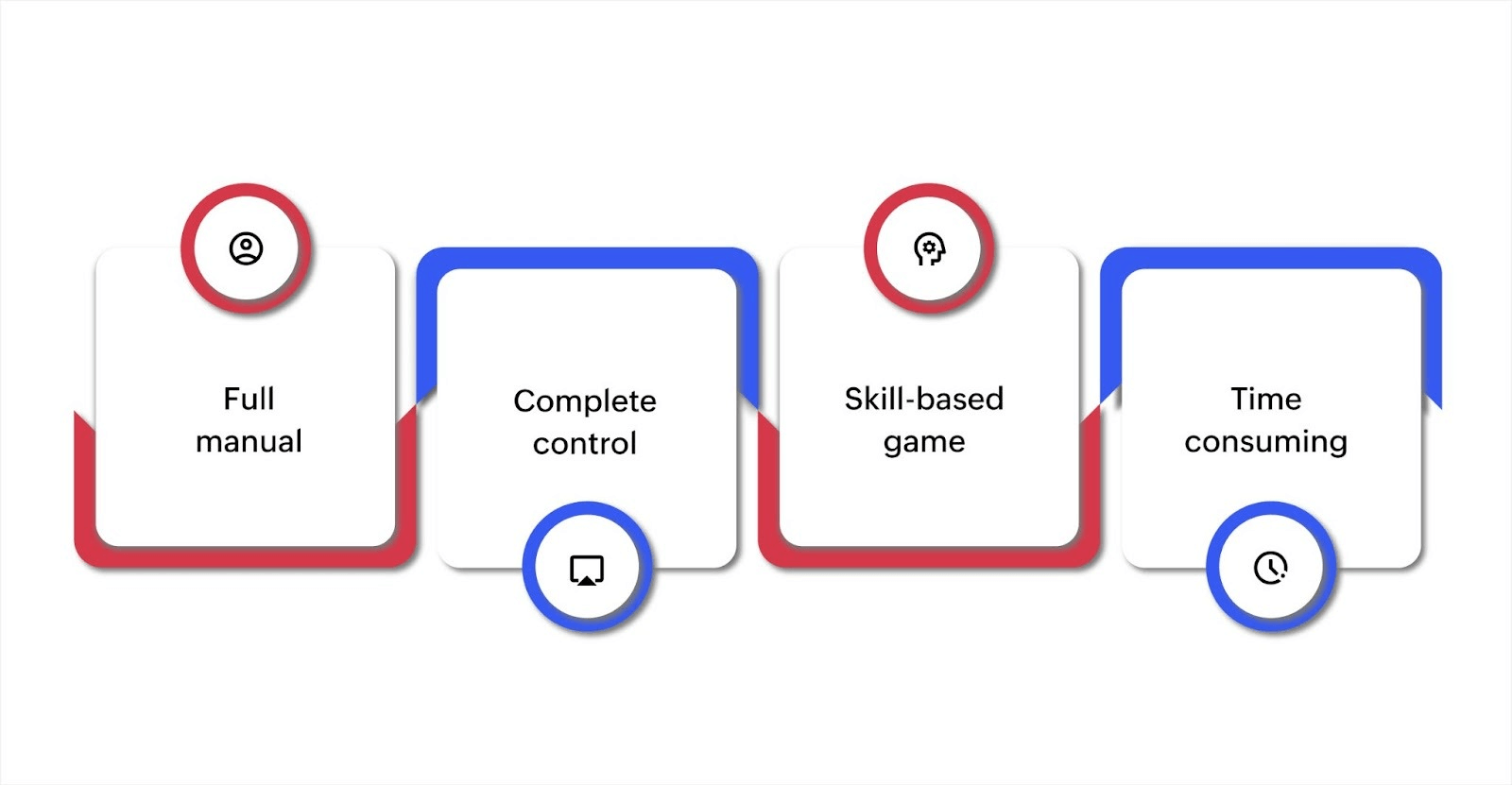
Traditional coding is how things have been done for years. It’s the method where developers write every line of code by hand to build software. Here’s how it works:
It’s all manual: You write the code yourself, using languages like Java, Python, or C++. This requires knowing the ins and outs of the language and being able to solve problems on the go.
You control everything: As the developer, you’re in charge of every detail, writing functions, fixing bugs, and making sure the program works smoothly.
It’s a skill game: You need a solid understanding of programming languages and algorithms. It’s ideal for custom or complex projects that need full control.
It can be slow: Because everything is done by hand, development can take a long time. For businesses, this means higher costs and longer project timelines.
While traditional coding gives you complete control, it can also be time-consuming and require more resources, especially for smaller teams or businesses.
What is AI-assisted coding?
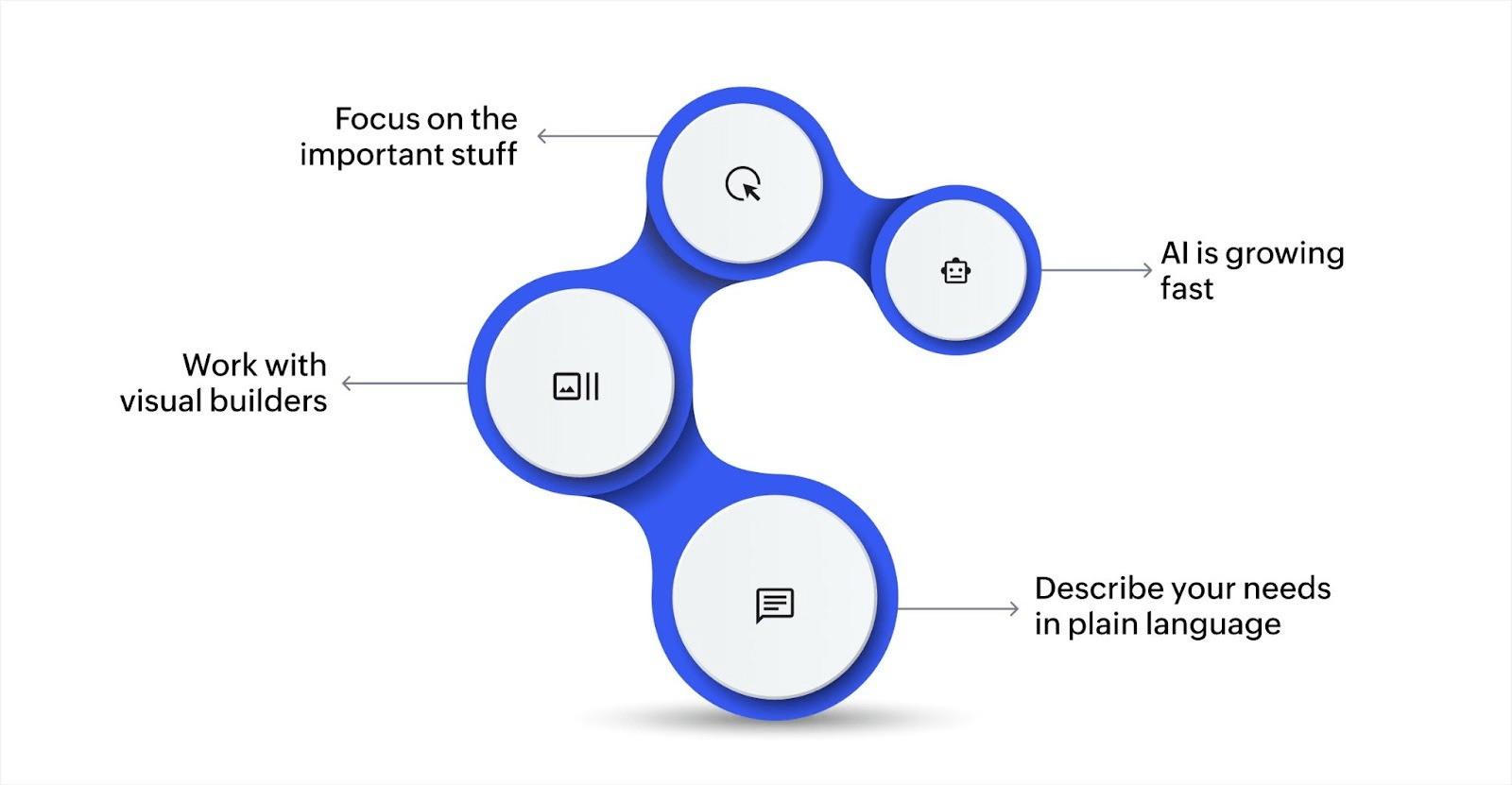
AI-assisted coding is a more modern approach that uses artificial intelligence tools to help speed up the development process. Instead of writing everything yourself, AI takes care of the repetitive tasks. Here’s how it works in practice:
Describe your needs in plain language: You explain what you need, like "I need an application to track customer orders with approval workflows." The AI-powered low-code platform analyzes your requirements and suggests a complete structure including forms for order entry, databases to store information, automated notifications, and approval processes.
Work with visual builders: You customize everything through drag-and-drop interfaces. Add fields to forms, connect data sources, and set up automation rules without writing code. The AI handles the technical complexity behind the scenes while you focus on what the application should do.
Focus on the important stuff: With AI handling the repetitive parts, you can focus on designing the bigger picture and solving the tricky problems. It makes you more efficient and creative.
AI is growing fast: A 2025 survey by Jellyfish found that 90% of engineering teams are now using AI tools in their workflows, up from 61% the year before. Almost half (48%) of those teams use multiple AI tools, which shows just how fast AI is becoming a standard part of the development process.
AI-assisted coding makes development quicker and easier, and businesses can get products to market faster without needing deep coding skills.
Key differences between AI-assisted low-code app creation and traditional coding
Factor | Traditional coding | AI-assisted low-code app creation |
Development speed | Months for basic applications | Days to weeks for most applications |
Technical skills needed | Advanced programming knowledge required | Minimal coding knowledge needed |
Initial setup | Build everything from scratch | AI suggests structure automatically |
Customization method | Write custom code for every feature | Visual builders with low-code options |
Maintenance | Manual updates and debugging | Automated updates, guided fixes |
Scalability | Requires infrastructure planning | Automatic scaling included |
Cost structure | Developer salaries, infrastructure costs | Subscription-based, no infrastructure costs |
Learning curve | Steep, requires training | Gentle, guided by AI and visual tools |
Let's look at the specific differences that impact how you build and maintain applications.
Development approach and speed
Traditional coding follows a linear process. Developers gather requirements, design the architecture, write code, test functionality, fix bugs, and deploy. Each step takes time. A change request means going back through the process.
AI-assisted low-code platforms compress this timeline. You define requirements, the AI generates a starting structure, you customize using visual tools, and you launch. For instance, adding a new approval step to a workflow takes minutes with drag-and-drop tools instead of hours of coding.
Technical knowledge requirements
Traditional coding requires developers who understand programming languages, database design, security protocols, and system architecture. Finding and retaining these skills costs money and time. Your business depends on their availability for updates and maintenance.
AI-powered low-code platforms lower this barrier significantly. Business users can build applications with guidance from AI and visual tools. For more complex customization, low-code lets you adjust specific features without full programming knowledge. Your IT team can focus on strategic projects instead of building every business application from scratch.
Customization and control
Traditional coding gives complete control. Developers can build any feature, integrate with any system, and optimize performance for specific needs. This matters for specialized applications with unique technical requirements.
AI-assisted low-code platforms provide structured customization. You work within the platform's capabilities, using pre-built components and templates. For instance, instead of coding a custom authentication system, you configure user roles and permissions through visual settings. For unique requirements beyond standard features, low-code customization options let you extend functionality without starting from scratch.
Most business applications don't need the complete control of traditional coding. Standard features like forms, workflows, reports, and integrations cover the majority of use cases. AI platforms handle these efficiently while traditional coding makes sense for truly specialized systems.
Maintenance and updates
Traditional coding requires ongoing developer involvement. Software updates, bug fixes, security patches, and performance optimization all need technical work. As your business changes, modifying the application means scheduling developer time and testing changes thoroughly.
AI-powered low-code platforms handle much of this automatically. The platform manages infrastructure, applies security updates, and scales resources as needed. When you need to modify your application, you use the same visual tools that built it. Changes take effect immediately without deployment processes. This reduces the technical burden and lets you adapt quickly to business changes.
Benefits of AI over traditional software development
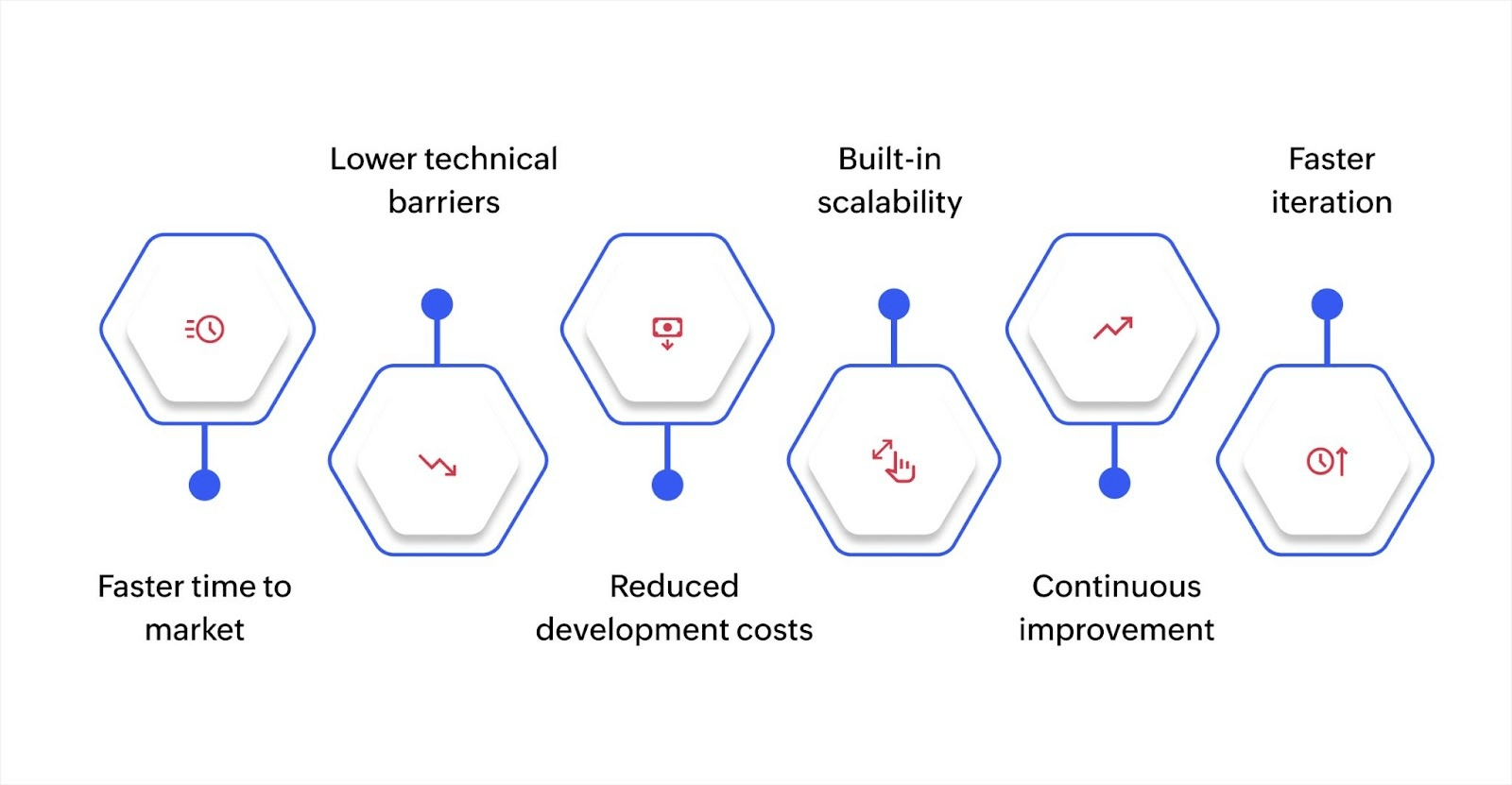
AI-assisted app creation offers specific advantages that help businesses move faster and reduce technical complexity. Here's what you gain by using AI-powered platforms instead of traditional coding.
Faster time to market: AI-powered low-code platforms help you launch applications in days or weeks instead of months. The AI generates the initial structure, pre-built components handle common features, and visual tools let you customize quickly. For instance, a customer portal that might take three months to code traditionally can launch in two weeks with an AI platform.
Lower technical barriers: Non-technical team members can build applications with AI guidance and visual builders, letting departments create solutions for their specific needs without always involving IT. Your marketing team can build a campaign management application. Operations can create inventory trackers. Finance can build approval workflows.
Reduced development costs: Subscription-based platforms cost less than hiring and retaining developers. You pay for the platform, not for individual developer hours. Infrastructure, maintenance, and updates are included. Small businesses and startups can build custom applications without significant upfront investment.
Built-in scalability: AI platforms handle scaling automatically. As your user base grows or data volume increases, the platform adjusts resources without manual intervention. Traditional coding requires infrastructure planning and optimization work as your needs change.
Continuous improvement: AI learns from usage patterns and improves suggestions over time. The platform evolves with new features and capabilities without requiring you to rebuild applications. Traditional coded applications need significant work to adopt new technologies or frameworks.
Faster iteration: Changes happen quickly through visual tools. Updates like adding a field, modifying a workflow, or adjusting permissions take minutes instead of hours or days. This flexibility helps you adapt to changes rapidly.
When traditional coding still makes sense
While AI-powered low-code platforms handle most business application needs, traditional coding remains the right choice for specific situations. Here's when custom development makes more sense than using an AI platform.
Ultra-custom UI/UX that must behave like a fully bespoke product: Some businesses want interfaces that don’t follow standard design patterns—think “Figma-level animations,” “pixel-perfect branded interactions,” or “game-like dashboards.” Low-code focuses on functional business apps, not artistic or heavily animated front-ends. In these cases, teams hand-code just the front-end for brand experience.
Custom data-processing engines inside business workflows: Some organizations have niche calculations or optimisation engines that rely on advanced logic—far beyond standard business rules. Think multi-variable financial risk scoring, complex supply-chain optimisation solvers, or custom AI models trained in-house.
Deep integration: If your business runs on older systems with proprietary protocols or unique data structures, traditional coding might integrate more smoothly. Custom code can handle unusual technical requirements that platforms don't support.
For most businesses, these scenarios don't apply. Standard business applications like project management, customer portals, inventory tracking, approval workflows, and reporting dashboards work perfectly well on AI-powered low-code platforms. The speed, cost, and accessibility advantages outweigh the control you gain from custom coding.
Start building applications faster with Zoho Creator
Traditional coding makes sense for specialized systems, but most businesses need something different. You need applications that handle daily operations, automate workflows, and connect your team, without months of development time or dependency on scarce developer resources.
That's where AI-powered low-code platforms change the equation. Instead of writing code line by line, you describe what you need and customize using visual tools. The AI handles technical complexity while you focus on what the application should do for your business.
Zoho Creator provides a balanced solution by combining AI-powered features, such as the AI modeler, with low-code features. This allows businesses to develop intelligent applications without the need for deep coding knowledge, while still having the flexibility to adjust workflows as needed.
Visit Zoho Creator to learn how its AI tools and low-code platform can help your business build custom applications efficiently.
FAQ
How does AI-assisted coding affect collaboration between developers and business users?
AI-assisted coding tools can improve collaboration by allowing business users to actively participate in the development process. Since these tools require less technical expertise, business teams can focus on designing workflows and logic, working alongside developers to create applications that meet business requirements.
How does the learning curve for AI-assisted coding compare to traditional coding for non-technical users?
AI-assisted coding tools like Zoho Creator have a significantly lower learning curve compared to traditional coding. Non-technical users can build custom applications through a simple drag-and-drop interface, while AI features help automate repetitive tasks, making it accessible to users without deep technical knowledge.
Are there any limitations to AI-assisted coding in terms of functionality?
While AI-assisted coding tools can handle a wide range of tasks, there may be limitations when it comes to highly specialized or complex applications that require custom logic or integrations with existing systems. In such cases, traditional coding may still be necessary for full customization.
 Bharathi Monika Venkatesan
Bharathi Monika Venkatesan is a content writer at Zoho Creator. Outside of work, she enjoys exploring history, reading short novels, and cherishing moments of personal introspection.