
- HOME
- Know Your Tech
- How to build an effective low-code strategy in 2026
How to build an effective low-code strategy in 2026
- Last Updated : February 27, 2026
- 281 Views
- 8 Min Read
Digital transformation is no longer a one-time project. It's become a continuous process that demands clear priorities and structured execution. Among the many choices you make in this journey, defining a low-code strategy stands out as a key step.
Highlights
- A low-code strategy defines how your organization uses visual development platforms to accelerate application delivery while maintaining governance and security.
- Effective strategies reduce IT dependency by enabling business users to build applications while IT focuses on complex integrations and infrastructure.
- Platform selection should match your integration needs, security requirements, and scalability goals rather than just feature lists.
- Governance frameworks prevent shadow IT risks by establishing clear policies for who can build what and how applications get reviewed.
- Team enablement programs ensure both business users and IT staff understand their roles in low-code development.
Low-code is about building applications faster, aligning your technology choices with business goals, and ensuring that resource constraints don't hold back innovation. With the low-code market projected to reach $50 billion by 2028, it's clear that more organizations are treating low-code as a foundation for long-term growth.
This blog post will walk you through how to design and implement a low-code strategy that fits into your digital roadmap while ensuring proper oversight.
What is low-code development?
Low-code development offers a modern way to create applications while requiring minimal traditional coding. Using intuitive visual interfaces, drag-and-drop elements, and ready-made templates, business users can quickly design and launch apps. This approach opens up application development to a wider range of users, allowing teams to build solutions suited to their specific needs without advanced programming skills.
A low-code platform serves as the environment that supports this approach. It provides tools and components that simplify app creation, reducing reliance on professional developers and speeding up the development cycle. These platforms make it easier for businesses to build applications efficiently and extend development capabilities to non-technical users.
The market for low-code technologies is expanding rapidly, with forecasts showing continued growth and increased adoption across industries in the coming years.
Key features of low-code platforms include:
- Visual interfaces: Build applications through intuitive graphical interfaces, making development faster and more user friendly.
- Prebuilt components: Use drag-and-drop tools to assemble apps quickly without writing complex code.
- Workflow automation: Automate business processes to reduce the need for manual intervention and improve efficiency.
- Security and scalability: Make sure your applications remain protected and can expand seamlessly as your business evolves.
Why do you need a low-code strategy?
Low-code platforms can deliver significant business value when used strategically. A clear plan helps teams build the right applications, work together effectively, and avoid common problems that slow progress. Here's what a good strategy enables:
Deliver applications when businesses needs them
Traditional development timelines measured in months don't match business realities where competitive advantages only last weeks. A low-code strategy lets you build and deploy applications in days or weeks instead of months.
This speed matters when market conditions shift or new opportunities emerge. For example, when a manufacturer needs to track new compliance requirements, waiting six months for IT to build a solution means months of manual tracking and potential violations.
Reduce pressure on IT resources
Your IT team probably has a backlog of projects spanning years. Every new business request adds to that queue. Low-code strategy reduces this pressure by enabling business users to build applications themselves.
IT shifts from building every application to providing platforms, establishing standards, and handling complex integrations. This frees technical staff for work that truly requires their expertise while business needs get addressed faster.
Align technology with business objectives
Applications should solve business problems and support company goals. When business units wait months for IT to understand their requirements and build solutions, the final applications often miss the mark or arrive too late to help.
A low-code strategy puts application creation closer to business users who understand their own processes. IT provides the platform and governance while business teams build solutions matching their actual needs. This alignment produces more useful applications and reduces rework.
Control development costs
Traditional development requires specialized skills that cost significant amounts to hire and retain. Low-code reduces these costs by letting existing staff build applications with visual tools rather than extensive coding.
You also save on project overhead. Business users who build their own workflow automation or data collection forms reduce costs significantly. You avoid expenses from requirement gathering, back-and-forth clarification, and post-launch adjustments that occur when developers build solutions for processes they don't use daily.
Scale application development safely
As your business grows, application needs multiply. Hiring developers proportionally creates unsustainable cost increases. Low-code platforms let you scale development capacity by enabling more people to build applications.
However, scaling without a strategy creates risks. Increased development activity can compromise security, create integration problems, or result in unmaintainable applications scattered across your organization. A clear framework prevents these issues.
Key components of a low-code strategy
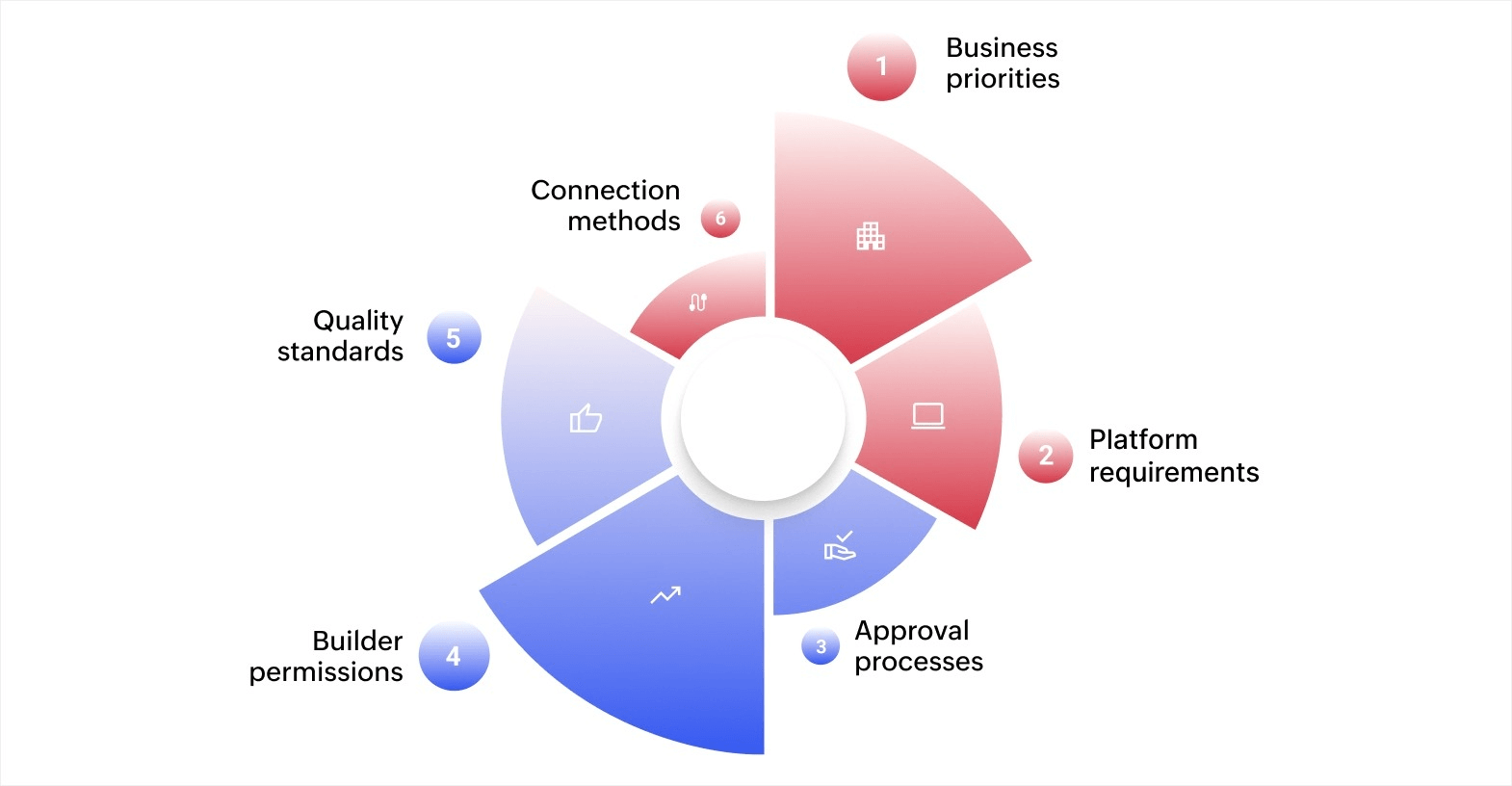
Your low-code strategy needs a foundation before teams start building applications. Without these elements in place, development efforts become disconnected and difficult to manage. Here are the components that make your strategy work:
- Business priorities: Identify which processes need applications first based on potential impact and implementation difficulty.
- Platform requirements: List technical needs like system integrations, security certifications, and the user capacity your platform must support.
- Approval processes: Define which applications need review, who approves them, and what security checks apply before deployment.
- Builder permissions: Specify which teams can create applications, what types they can build, and when they need IT assistance.
- Quality standards: Set expectations for application documentation, testing procedures, and performance requirements.
- Connection methods: Determine how applications will share data with existing business systems and external services.
Also read: Understanding low-code vs. no-code development platforms
How to build a low-code strategy in your organization
A low-code strategy allows businesses to reduce their reliance on IT while accelerating digital transformation. Here’s how you can successfully implement a low-code strategy and scale development in your organization.
1. Define specific outcomes you want to achieve
Identify particular problems you need to solve with faster application development. Talk to department heads about operational challenges consuming staff time, manual processes creating errors, or business needs waiting months in IT queues.
List these opportunities and prioritize based on potential business impact and implementation complexity. For example, automating expense approvals might offer quick wins while modernizing your entire order management system requires more planning and resources.
2. Assess your current development situation
Review existing applications and how they get built today. Document average delivery timelines for different request types, identify bottlenecks causing delays, and note where business needs go unmet because development takes too long.
This assessment shows where low-code development provides the most value. If simple data collection requests take months to deliver, low-code forms and reports offer immediate benefits. If complex integrations cause delays, focus on platforms with strong connection capabilities.
3. Evaluate and select your platform
Test platforms against your specific requirements using pilot projects that represent actual use cases. Avoid selecting based solely on feature lists or analyst reports without hands-on validation.
Involve both IT and business users in the evaluation. IT assesses technical capabilities like security features, scalability options, and integration approaches while business users evaluate whether they can actually build solutions to their real problems without constant technical assistance.
4. Create governance policies and processes
Document clear policies defining application approval workflows, security requirements, data handling standards, and quality expectations. Make these policies accessible to everyone who will build applications.
Size your governance to enable rather than obstruct development. Simple internal tools might need only manager approval while customer-facing applications require IT security review. For instance, an employee directory application needs less oversight than a payment processing portal.
5. Launch pilot projects with real business value
Select initial projects offering genuine benefits while limiting risk if problems occur. Good pilots demonstrate platform capabilities, reveal gaps in your governance processes, and build team confidence through successful delivery.
Choose projects with a manageable scope and clear success criteria. For instance, a driver check-in application used by 20 delivery staff members makes a better pilot than a customer portal affecting thousands of users. The smaller scope provides learning opportunities with controlled exposure.
6. Build enablement and support programs
Create training resources covering both platform skills and governance requirements. Develop templates or starter applications for common use cases like approval workflows, data collection forms, or reporting dashboards to accelerate initial development.
Establish clear support channels so business users know where to get help with platform features or technical questions. Define how IT will support low-code development without becoming a bottleneck that recreates the problems you're trying to solve.
Implement an effective low-code strategy with Zoho Creator
Executing your low-code strategy requires a platform supporting rapid development while maintaining the governance and security your business demands. Many organizations struggle with platforms that either lack necessary controls or make development so complex that speed benefits disappear.
Zoho Creator is an AI-powered low-code application development platform designed for building custom business applications that match your specific processes and requirements. The platform combines visual development tools that business users can learn quickly with AI assistance that accelerates every stage of application creation.
CoCreator, powered by Zia, works as your development collaborator. Describe what you need in plain language and get field suggestions, workflow designs, or complete application structures. You can start from text prompts, business documents, or even sketched workflows, and the AI translates your vision into functional applications.
You can also embed AI capabilities directly into your applications to make them smarter. Add sentiment analysis to evaluate customer feedback, use keyword extraction to process unstructured data, apply predictive models to forecast trends, or implement object detection for visual recognition tasks.
You can build applications for workflow automation, data collection, reporting dashboards, or customer portals without extensive coding knowledge. The drag-and-drop interface lets teams create functional solutions in hours or days rather than months.
Sign up for free today to see how quickly you can build your first application. Start executing your low-code strategy with proper governance and flexibility.
FAQs
1. What should be included in a low-code governance policy?
Define who can create applications, what approval processes apply to different application types, security requirements for handling various data categories, and integration standards. Include clear processes for requesting exceptions when standard policies don't fit specific needs.
2. What types of applications work best for low-code development?
Workflow automation, data collection forms, reporting dashboards, approval processes, and customer portals work well with low-code platforms. Applications requiring complex calculations, real-time processing, or highly specialized functionality might need traditional development approaches.
3. Can low-code applications integrate with legacy systems?
Most platforms offer integration capabilities through APIs, database connections, or file exchanges. Integration complexity depends on the accessibility and documentation of your legacy systems. IT involvement helps ensure integrations maintain security and data integrity standards.
4. Should IT or business teams own the low-code platform?
Shared ownership works best, with IT providing platform management, security oversight, and integration support while business teams handle application development for their specific needs. Clear role definitions prevent conflicts and ensure appropriate expertise applies to different aspects.
5. How do you measure low-code strategy success?
Track application delivery time, development costs, IT backlog reduction, business user satisfaction, and application quality metrics. Compare these against baseline measurements from before low-code adoption to demonstrate strategy value.
 Rohith Krishnan S
Rohith is a product marketer at Zoho. He writes about low-code, workflow automation and follows the latest digital transformation trends. Outside work he enjoys spending time with family, watching football matches and reading about futuristic trends, in no specific order.