What is data compliance? Frameworks every business needs
- Last Updated : June 1, 2026
- 153 Views
- 8 Min Read

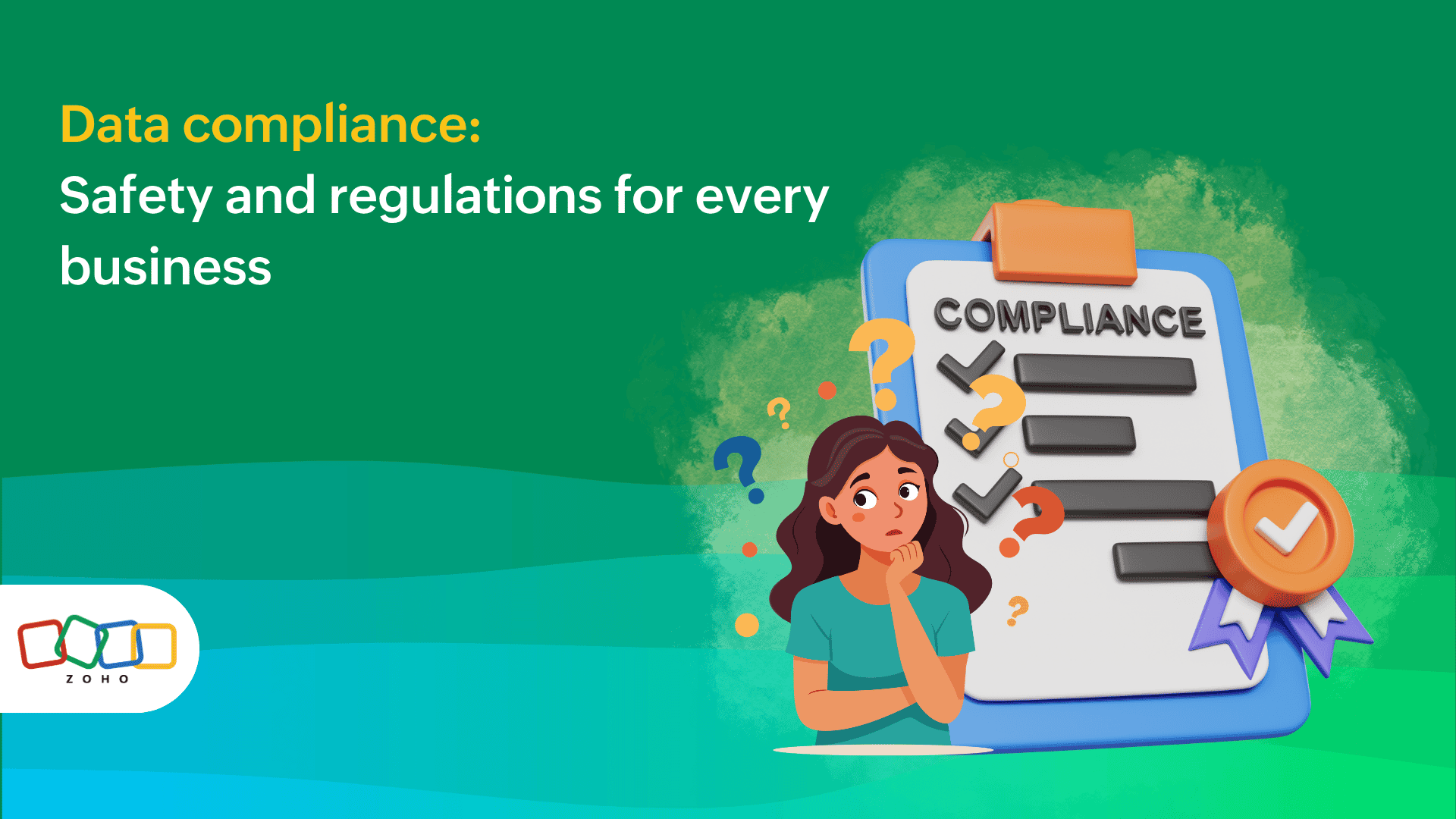
What is data compliance?
If your team only thinks about data compliance when an auditor schedules a meeting, the best you can do is switch to cleanup mode. This is expensive, stressful, and usually powered by screenshots, spreadsheets, and lots of people saying, “Wait, who had access to this folder?”
Data compliance is the practice of handling data in line with the laws, standards, and internal policies that apply to your business. In practical terms, it means knowing what data you have, managing who can access it, keeping records of changes and sharing, and retaining or deleting it based on the circumstances.
Compliance gets much simpler when file access, auditability, and governance are built into the workflow instead of being bolted on at the end.
While, that sounds simple on paper. In reality, it is quite difficult. Data lives across shared folders, chat threads, emails, contracts, HR records, and a truckload of duplicate files. When compliance lives outside that daily flow of work, teams get stuck in the same blind spot: they have stored the data, but they have not governed it accordingly.
Why data compliance becomes an empty frame
The first problem is volume. The second is visibility. Lastly, the third is false confidence.
A recent Cloud Security Alliance press release highlighted their recent survey results, which found that 56% of respondents said they had only partial visibility into where their data is stored. The same study found that 68% reported that less than 80% of their unstructured data is protected, and nearly a third said they use 11 or more tools to manage unstructured data. That is not just messy. That is an administration headache waiting to happen.
This matters because unstructured content is where a substantial amount of the real business risk sits: contracts, financial records, product specs, legal documents, and customer files. CSA also mentioned that unstructured data is difficult to track, govern, and secure at a nominal scale, even though it often contains the exact information attackers or auditors care about most.
Similarly, IBM also points that dark data—hidden and/or unstructured data that organizations collect but do not actively manage can create cybersecurity, compliance, and data-loss risks.
And then there is the productivity tax. McKinsey has estimated that knowledge workers spend about 20% of their time searching for and gathering information. So the compliance problem is not just legal exposure. It is also an operational drag. If your team cannot quickly find or verify the right record, you have a workflow problem long before you have an error in your auditing process.
These factors demonstrate why data compliance isn’t just “security settings”. Security protects data while compliance proves you are handling it correctly. Meanwhile, governance creates the rules, ownership(s), and evidence trail that make that proof possible.
The advice from the Information Commissioner’s Office is blunt here: accountability means you must comply and be able to demonstrate that compliance with appropriate technical and organizational measures, records, policies, and security controls.
Frameworks every business needs to understand
Not every business needs every framework. A small services firm and a multinational healthcare provider do not have the same obligations. But most SMBs and enterprises still need a working knowledge of the major compliance frameworks below, because they shape how you collect, store, share, secure, and retain data.
GDPR / UK GDPR
If you handle personal data for people in the EU or UK, GDPR principles matter. The regulation applies not only to organizations based in the EU, but also to organizations outside the EU that offer goods or services to people there or monitor their behavior. It is fundamentally about collecting, storing, and managing personal data lawfully, securely, and transparently. The UK Information Commissioner's Office (ICO) also emphasizes accountability, documentation, access controls, monitoring, and evidence of compliance.
CCPA and CPRA
If your business is subject to California privacy law, you need to be ready to provide notices, respond to consumer rights requests, and support processes around access, deletion, correction, and disclosure. In other words, you need to know what data you hold, where it lives, and how quickly you can act on a request.
HIPAA
If you are a covered entity or business associate handling electronic protected health information, HIPAA requires administrative, physical, and technical safeguards to protect confidentiality, integrity, and availability. In healthcare, access controls, file handling discipline, activity review, and auditable processes are non-negotiable.
PCI DSS
If you store, process, or transmit payment card data, PCI DSS applies. PCI says it provides technical and operational requirements to protect payment account data, and its guidance has long stressed tracking and monitoring access because logging is critical for forensics and vulnerability management. Retail, hospitality, ecommerce, and any payments-adjacent business should treat this as table stakes.
SOC 2
SOC 2 is especially relevant for software and service organizations that need to prove to customers, prospects, and partners that controls around security, processing integrity, confidentiality, or privacy are in place. It is about demonstrating trust through control design and evidence. If enterprise buyers keep asking your team for assurance documents, this is one of the reasons why.
ISO/IEC 27001 and ISO/IEC 27701
ISO 27001 is one of the best-known global standards for building an information security management system, and ISO promotes it as a holistic approach across people, policies, and technology. ISO 27701 extends that discipline into privacy information management and helps organizations demonstrate compliance with privacy regulations such as GDPR. These are especially useful when you need repeatable governance, not just point fixes.
NIST CSF and the NIST Privacy Framework
These are not laws, but they are beneficial operating frameworks. NIST says the CSF 2.0 can be used by any organization, regardless of size, sector, or maturity, to understand, assess, prioritize, and communicate cybersecurity risk. It is organized around six functions:
Govern
Identify
Protect
Detect
Respond
Recover
The NIST Privacy Framework plays a similar role for privacy risk management. For SMBs, this gives you structure. For enterprises, it gives teams a common language.
The big takeaway here is not collecting more frameworks. It is to match the right framework to the data you handle, the regions you serve, and the proof your customers, regulators, and partners expect.
A checklist for SMBs and enterprises
If you want a useful starting point, here is the practical version.
Know what data you have and where it lives: NIST’s Identify function calls for inventories of systems and documentation of information flows. If you cannot map your documents, records, and sensitive content across teams, you will struggle with access reviews, retention, and subject rights requests.
Set role-based access and keep it current: The ICO specifically points to access controls and security monitoring as examples of appropriate measures, and NIST’s “protect” function says users should only have access to necessary resources. This is where compliance stops being theoretical and becomes operational.
Keep audit trails and activity records: Logs demonstrate who accessed, modified, shared, or deleted data. PCI emphasizes tracking and monitoring access, and the ICO stresses keeping evidence of compliance steps and breach records.
Create retention rules instead of keeping everything forever: The ICO says holding personal data for too long becomes unnecessary by definition and creates inefficiency, while loading on storage costs, and additional burden when responding to requests. Clear retention periods and erasure policies are part of good compliance hygiene. “Save everything forever” is not a retention policy, no matter how confidently someone says it in a meeting.
Build compliance into approvals and file-routing workflows: This is the part teams often skip. If you depend on people remembering the right folder, the right approver, the right label, and the right retention action every single time, your process is fragile. Shared workflows, checkpoints, and standard routing reduce that fragility and make evidence easier to collect later.
Review, train, and update: Regulations evolve, risks change, and teams grow. The ICO says accountability is not a one-time thing, and NIST’s “govern” function makes the same broader point: policy, roles, oversight, and communication need to be maintained, not written once and forgotten in a digital graveyard.
The Zoho WorkDrive angle
For most teams, compliance becomes painful when the evidence is scattered across collaboration systems. The easier outcome is this: your team creates, shares, approves, stores, and retrieves files in a system where access rules, audit records, classification, and workflow controls already live close to the content. It’s simple when you realize that compliance becomes simpler when file access, auditability, and governance are built into the workflow.
Zoho WorkDrive already has several building blocks that support that outcome.
Granular access controls: Custom Folder permissions let you assign organize, edit, view, or comment-only rights at the subfolder level, restrict members from areas they do not need, and update access as roles change. You do not need to duplicate folders or create awkward workarounds just to keep sensitive content visible to the right people only.
Structured team spaces: Team Folders give departments and cross-functional teams shared workspaces with role-based access, while still allowing more targeted sharing when someone needs access to one project but not the whole repository.
Auditability and reporting: WorkDrive’s enterprise security and enterprise-focused content both emphasize activity tracking and audit reporting. You can generate activity reports for a user or team and monitor actions on corporate files across the life of those records. That is the sort of evidence trail auditors and internal review teams usually ask for after the fact, so having it available by design is a big deal.
DLP and classification:WorkDrive DLP lets admins classify sensitive information automatically or manually and manage those policies centrally from the Admin Console. The practical value is simple: you are not relying entirely on users to remember what is sensitive and what should never be broadly shared.
Workflow orchestration: WorkDrive’s workflow automation is especially relevant for compliance because it standardizes how files move through review and approval processes. WorkDrive’s own guidance notes that workflows create immutable audit trails for file movement and approvals, which supports audit readiness while reducing inconsistent manual routing across teams.
WorkDrive’s vision isn’t just to add another "data compliance" feature. It is that compliance gets easier when your collaboration layer, governance layer, and workflow layer stop competing with each other. Files are easier to find. Access is easier to control. Evidence is easier to export. Reviews are easier to standardize.
Frequently asked questions
What is data compliance in simple terms?
Data compliance means handling data in line with the laws, standards, contracts, and internal rules that apply to your business. Usually, that includes access control, secure storage, documentation, monitoring, retention, and the ability to demonstrate that those controls actually work.
Is data compliance the same as data security?
No. Security focuses on protecting data from unauthorized access, loss, or misuse. Compliance is broader: it includes security, but also documentation, rights handling, retention, auditability, policies, and proof that your organization is meeting applicable requirements.
Which data compliance frameworks matter most for SMBs?
For SMBs, the most useful baseline is often a practical operating framework such as NIST CSF or the NIST Privacy Framework, combined with the specific regulations that match the data you handle, such as GDPR, CCPA, HIPAA, or PCI DSS. NIST explicitly says CSF 2.0 can be used by organizations of any size or maturity.
Why are audit trails so important for data compliance?
Because compliance is not just about doing the right thing. It is about being able to prove what happened. Regulators, customers, partners, and auditors often need evidence: who accessed a file, what changed, when it changed, and how the organization responded. Logging and monitoring are core themes in PCI, ICO accountability guidance, and NIST’s Detect and Protect functions.
How can collaboration software help with data compliance?
It helps when access permissions, activity logs, classification, retention support, and approval workflows are embedded directly into the place where teams already work on files. In WorkDrive, that includes subfolder permissions, centralized DLP controls, audit reports, workflow automation, and permissions-aware content intelligence.
Implementing and addressing an organization’s data compliance laws shouldn’t feel like a yearly scramble but rather like a cleaner and well-defined daily workflow. With Zoho WorkDrive, you too can achieve this goal!