PCI compliance: What it is and how to achieve it
- Last Updated : July 13, 2026
- 121 Views
- 5 Min Read

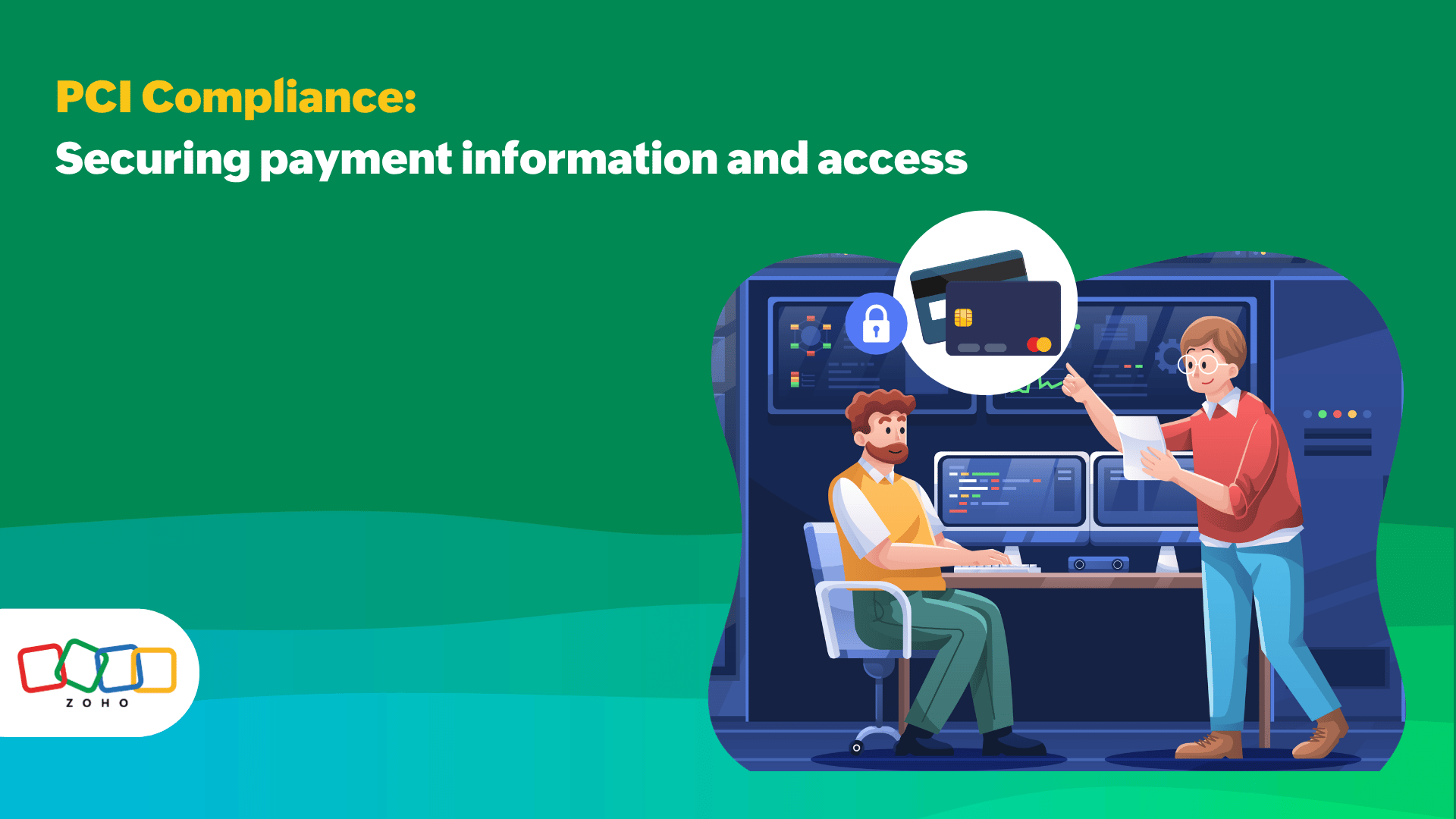
On paper, a quick skim through of the requirements for Payment Card Industry Data Security Standard (PCI DSS, or just PCI for short) compliance feels easy to remember.
But when someone asks for the latest processor attestation, proof of access reviews, or the file that shows who approved an exception—all that knowledge goes kaput. And, what would worsen this situation further? All the information being buried under a mountain folders and disparate files.
No, this isn’t an example on paper. This is quite realistic and you might find it relatable.
PCI compliance means meeting PCI DSS requirements so your business protects payment card data in a secure environment. In practice, you achieve it by defining and shrinking your cardholder data environment, applying the right controls, documenting evidence, and validating the result through the self-assessment questionnaire (SAQ) or assessor path your payment brand or acquirer requires.
What PCI compliance really means
PCI DSS is the payment card security standard published by the PCI Security Standards Council with the active version of this international regulation being PCI DSS v4.0.1. It provides a foundation of technical and operational requirements designed to protect payment account data. It applies to entities that store, process, or transmit cardholder data or sensitive authentication data, as well as entities that could impact the security of the cardholder data environment. That includes processors, acquirers, merchants, issuers, and service providers.
For businesses that accepts card payments, PCI DSS is not just an IT regulation. It covers how your teams handle access, how vendors are managed, how evidence is gathered, and how consistently you can show that security controls are working. In a similar vein, smaller merchants are still in scope, even if their environments are simpler and their compliance effort is lighter than a larger enterprise’s.
So when you ask, “How do we become PCI compliant?” the answer is: One size isn’t going to fit everyone. Just one tool won’t fix it either. You have to define the scope, reduce risks, apply the right controls, validate correctly, and keep the whole process governable over time for your firm.
How to achieve it without making it chaotic
The cleanest way to think about PCI compliance is as a sequence. Operationally, it looks something like this:
Mapping the payment data flow and identifying every system, user group, and vendor that can affect it.
Reducing what you store, where you store it, and who can access it.
Confirming whether your environment is SAQ-eligible or whether you need assessor-led validation.
Keeping policies, third-party attestations, scan outputs, remediation records, and approvals organized in one governed place.
Ensuring your teams can show who accessed a file, what changed, and when.
Treating PCI as an ongoing data compliance program, not an annual scramble.
For SMBs, the goal is usually simplicity: fewer systems, fewer hand-offs, less guesswork. For enterprises, the win is consistency: repeatable governance, cleaner collaboration, and evidence that stands up when finance, security, auditors, or assessors come asking.
How WorkDrive fits into a PCI workflow
No collaboration platform, by itself, makes a business PCI compliant. Zoho WorkDrive will not replace your payment processor; network security controls, segmentation work, or formal PCI DSS validation. This requires a combination of people, resources and, tools. That’s where WorkDrive plays a key role: what it can do is make workflows around compliance far more manageable.
For example, WorkDrive gives teams role-based permissions, admin-level controls over whether content can be shared externally, expiring share links, and ownership transfer controls. Its Admin Console also surfaces activity reports, audit trail details, shared item management, and centralized visibility into user and Team Folder activity. The exact kind of operational governance that helps when compliance work needs to be easily accessed and proven.
WorkDrive’s Data Loss Prevention capabilities add another useful layer. You can classify content, monitor activity, apply retention policies, support MFA and SSO, and automatically scan files for sensitive information such as credit card numbers or PII.
It can also restrict access, alert admins, quarantine files, and support detailed activity reporting. For teams trying to keep payment-related artifacts from drifting into the wrong folders or the wrong hands, that is a practical governance outcome, not just a feature list.
WorkDrive Workflows are designed to move files through predefined paths, automate approvals, move approved files to the right locations, and generate real-time notifications. So instead of chasing screenshots, policy approvals, vendor AOCs, exception reviews, and sign-offs across inboxes, teams can run those steps through a more understandable workflow. Less detective work, more controlled collaboration.
And if your PCI process includes collecting evidence from outside the business, say from a processor, partner, or internal stakeholder—WorkDrive’s secure file collection lets you create upload links, set time frames, organize uploads, track who submitted what and when, and export collection reports.
FAQ
What is PCI compliance?
PCI compliance means meeting PCI DSS requirements so your business protects payment account data in a secure environment. It applies to organizations that store, process, or transmit cardholder data, or that can affect the security of the cardholder data environment.
Who needs to be PCI compliant?
PCI SSC says PCI DSS applies to merchants, processors, acquirers, issuers, service providers, and other entities that store, process, transmit, or can impact the security of cardholder data. Small merchants are not exempt just because they are small.
Does using a third-party payment processor or P2PE solution remove PCI DSS completely?
Not automatically. Encryption alone is not enough to make cardholder data out of scope, and a PCI-listed P2PE solution can significantly reduce applicable requirements but does not remove then PCI DSS benchmark entirely. In some third-party cases, encrypted data may be out of scope only if the provider cannot decrypt it and has no access to the keys or clear text.
What is the current PCI DSS version?
The current version is PCI DSS v4.0.1 which is the version supported by PCI SSC after PCI DSS v4.0 retired on December 31, 2024.
Can collaboration software help with PCI compliance?
Yes—if it improves governance around compliance work. Access controls, secure sharing, audit trails, classification, evidence collection, and approval workflows can make PCI-related documentation easier to manage. Zoho WorkDrive offers those kinds of controls. However, software alone does not replace PCI DSS validation or core payment security controls.
PCI compliance is about more than passing an assessment. Instead of teams stitching together bits and pieces of info to get the right level of compliance and control, how about trying a dedicated collaboration platform like Zoho WorkDrive that puts in all your information right in front on you?