- HOME
- Best CRO Tools in 2026
Best CRO Tools in 2026
- Last Updated : September 12, 2026
- 1.2K Views
- 20 Min Read

The CRO landscape shifted more between 2023 and 2026 than in the decade before it. Google Optimize has retired. VWO and AB Tasty have merged. Hotjar, Heap, and Contentsquare are now one platform. This guide cuts through the consolidation to tell you what's actually worth using in 2026.
Before you decide on a tool, answer three questions first.
Do you need to understand why visitors aren't converting, or do you need to run experiments to fix it? Those are two different things.
How much traffic do you have? Session and user limits will catch you off guard if you don't check them before signing up.
Are you replacing a broken stack or adding to a functional one? The most expensive CRO mistake is ending up with one tool for heatmaps, another for A/B testing, and a third for analytics — then spending half your time stitching data together.
A proper CRO platform handles the full loop: understand what's happening (analytics, heatmaps, session recordings, form analytics), hypothesize and test (A/B testing, split URL, multivariate, multipage testing), and personalize and engage (personalization, surveys, push notifications, pop-ups). Every tool below is placed against that loop so you know exactly what it covers and where it stops.
The quick breakdown
Platform | Best for | Starting price | Free plan |
Zoho PageSense | Full CRO loop: behaviour insights through A/B testing across web, mobile and server-side in one place | $20/month | Yes — Forever Free |
VWO (post-AB Tasty merger) | Mid-market experimentation programs needing deep targeting | ~$314/month | 30-day trial |
Optimizely | Enterprise-grade server-side experimentation and feature flags | ~$36,000/year | Rollouts free tier |
Contentsquare (incl. Hotjar & Heap) | Enterprise behaviour intelligence across web and mobile | Custom (enterprise) | Hotjar: limited free |
Crazy Egg | Heatmaps + basic A/B testing at a low entry price | $29/month | 30-day trial |
Microsoft Clarity | Zero-budget teams needing unlimited heatmaps and recordings | Free | Yes — always free |
PostHog | Product-led SaaS teams wanting warehouse-native experimentation | Free up to 1M events/mo | Yes |
Lucky Orange | Teams where live chat alongside behavior data is the priority | $32/month | 7-day trial |
FullStory | Enterprise-level experience analytics with autocapture | Est. ~$10,000/year | Preview only |
Kameleoon | European teams needing enterprise experimentation with strict data residency | Custom (enterprise) | No |
Amplitude | Product analytics and experiment management for data-mature SaaS teams | Free up to 10M events/mo | Yes |
Note: FullStory and Kameleoon do not publish pricing. FullStory figure is based on independently reported procurement data. Kameleoon contracts are quote-only; $30,000+/year is an independent estimate.
Zoho PageSense
The full optimization stack without the context-switching.
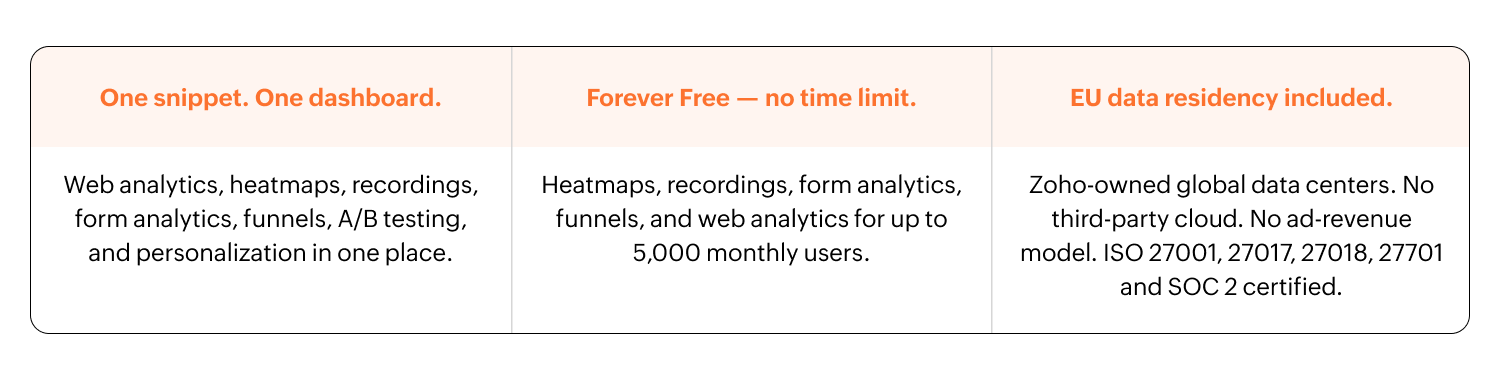
Zoho PageSense is a privacy-first CRO and experimentation platform built for teams who want the full optimization loop without the tool sprawl. The real value isn't a single standout feature. It's that everything talks to each other. Website analytics, heatmaps, session recordings, form analytics, funnels, A/B testing, and personalization run off a single snippet, in a single dashboard. Teams can build well-grounded hypotheses from behavioral data, run experiments with statistical confidence, and act on results without filing engineering tickets or exporting data between tools. When you spot a drop-off in your funnel, you're one click away from the session recordings of the people who left, and one more click from launching a test to fix it.
The Forever Free plan is more complete than the paid plans of several tools in this list. It gives you heatmaps, recordings, form analytics, funnels, and web analytics for up to 5,000 monthly users with no time limit. When you scale, the Professional tier ($20/month) adds website feedback surveys and push notifications, and the Enterprise tier ($49/month) unlocks advanced testing and server-side experiments.
Key features of Zoho PageSense
Heatmaps and session recordings: Click, scroll, and attention maps are generated automatically across tracked pages. Session recordings capture complete browsing journeys with friction signals like rage clicks, dead clicks, and JavaScript errors. Filter by device, traffic source, location, or custom event.
Form analytics: Tracks drop-off rates, correction counts, hesitation time, and blank submissions at the field level. Connects directly to funnel data in the same dashboard.
Funnel, user journeys, and web analytics: Multi-step funnel builder with conversion rates, drop-off visualization, and time-to-completion data. User journey mapping reveals the unexpected paths visitors actually take through your website so you can find and fix the detours that silently kill conversions. Built-in web analytics tracks traffic sources, top-converting pages, and key KPIs.
A/B testing and experimentation: Visual and code editor for building page variants with multivariate, split URL, and multipage testing. The statistical engine supports both Bayesian and frequentist methods — Bayesian for faster directional decisions, frequentist for fixed-horizon significance testing. Multi-armed bandit automatically shifts traffic toward the better-performing variant so you stop wasting traffic on losing versions while the experiment runs. Server-side experiments available on Enterprise.
Personalization: Rules-based personalization lets you serve different content to visitors based on location, behavior, traffic source, or time, without touching your codebase.
Zia AI insights: Zia connects data across modules and flags problem spots in your funnel, spotting unusual behavior patterns in session data, and suggesting test hypotheses based on what it finds. Ask it questions in plain English and it pulls the answer from across your analytics, heatmaps, and experiment data.
MCP (Model Context Protocol) server: PageSense MCP server lets your favorite AI agent query your experiment results, funnel performance, and session insights in plain language, without logging into the dashboard. Your AI assistant can pull live experiment data and surface drop-off points as part of a broader workflow, so PageSense fits into how your team already works with AI
Zoho ecosystem and third-party integrations: Connects natively with Zoho CRM, Zoho SalesIQ, Google Analytics, GTM, Zapier, Amplitude, and more.
What works
The full CRO loop in one place — web analytics, recordings, form analytics, funnels, A/B testing, personalization, push notifications, and surveys. One snippet, one dashboard.
The Forever Free plan is real. Heatmaps, recordings, form analytics, funnels, and web analytics for up to 5,000 tracked users with no time limit.
Zoho owns its own data centers globally, EU data residency included. No third-party cloud, no ad-revenue model. ISO 27001, 27017, 27018, 27701 and SOC 2 certified.
Plans scale with where you actually are. Free for understanding what is happening, Professional for engaging visitors, Enterprise for running experiments. Nothing is gated arbitrarily.
Transparent pricing with no "contact sales" gating.
Limitations
A/B testing and personalization require Enterprise. If experiments are the goal from day one, factor that into your budget upfront.
Free plan covers one project and one month of data retention — works for a single site with recent data, not for teams managing multiple properties or needing historical lookback.
VWO (post-AB Tasty merger)
The mid-market experimentation standard
In January 2026, VWO and AB Tasty merged under Everstone Capital. If you were evaluating either platform separately, you're now looking at the same company. VWO remains the default for mid-market teams running serious experimentation programs, but the modular pricing is both an advantage and a trap — the Testing, Insights, and Personalize modules are priced separately, and most teams end up needing at least two of them.
Key features of VWO
A/B, multivariate, and split URL testing: Run tests using a no-code visual editor without filing engineering tickets. Supports multiple test types across web and mobile.
VWO Insights: Heatmaps, session recordings, on-page surveys, funnel analysis, and form analytics — sold as a separate module or bundled.
VWO Personalize: Audience-based personalization sold as an add-on to the Testing module.
VWO FullStack: Server-side testing and feature flags for engineering teams running experiments in the backend or across mobile APIs.
AI Copilot: Suggests test ideas and copy variations, and pulls insights from experiment data automatically.
Integrations: GA4, Salesforce, HubSpot, Shopify, Snowflake, Segment, and more.
What works
Mature experimentation engine covering Bayesian stats, multivariate testing, server-side experiments, and feature flags.
Combined AB Tasty roadmap adds EmotionsAI and stronger e-commerce merchandising capabilities.
Deep targeting and segmentation options that go well beyond basic audience rules.
30-day full-access free trial is a real evaluation window.
Limitations
Modular pricing scales fast — Testing + Insights alone can reach $1,161/year at 50K users. Enterprise requires a sales call.
Free Starter has been removed in 2026 across most regions.
Merger integration is still underway, verify which features are actually shipping before signing.
Reporting discrepancies between VWO dashboards and integrated analytics tools are a recurring user complaint.
Optimizely
Enterprise experimentation infrastructure — powerful, but priced accordingly.
Optimizely is the tool teams reach for when experimentation is a core engineering function, not just a marketing activity. Its statistical engine is industry-leading, its server-side testing and feature management capabilities are mature, and its MCP servers let AI agents query experiment state directly. If you're running A/B tests across web, mobile APIs, and backend simultaneously at enterprise scale, nothing in this guide matches it on technical depth.
What works
Best-in-class frequentist Stats Engine for rigorous significance testing.
Server-side, mobile, and API experimentation in a single platform.
Feature management and CI/CD-integrated feature flags for engineering teams.
MCP server integration lets AI agents read and query experiment results directly.
Limitations
Web Experimentation starts at ~$36,000/year (annual contracts only).
No native behavioral analytics. You need a separate tool for heatmaps, session recordings, and form analytics.
Requires dedicated engineering capacity to set up and maintain.
Not the right fit if marketing teams are running tests independently without developer support.
Contentsquare (including Hotjar and Heap)
Excellent for user research, but watch the pricing.
Contentsquare has acquired both Hotjar (legal merger completed July 2025) and Heap (December 2023), bundling them into a single "Experience Intelligence Platform" — though all three still run as separate interfaces while integration continues.
Hotjar remains the most accessible entry point, but the pricing got complicated. Surveys are now a separate "Voice of Customer" product, so if you want heatmaps ($49/mo) and surveys ($99/mo), you're looking at $148 a month minimum. That's caught a lot of legacy users off guard.
That said, if you actually want to talk to your users, Hotjar is brilliant. The user interview scheduling, on-site polls, and NPS tools are top-tier. Just don't expect it to help you optimize forms or run A/B tests — it's a research tool, not an optimization platform.
The enterprise Contentsquare platform is for large organizations treating behavioral data as infrastructure, with custom pricing starting well above $50,000/year.
What works
Hotjar's qualitative research toolkit such as surveys, NPS, user interview scheduling, is the best mid-market option for asking visitors questions rather than just watching them.
Enterprise Contentsquare platform has deep journey mapping, zone-based analysis, and benchmark data across industries.
200,000 free Hotjar sessions per month is generous for evaluation.
Limitations
Surveys now sold separately at $99/month on top of heatmaps at $49/month — $148/month minimum for both. Many existing users are finding this out mid-migration.
No A/B testing at any Hotjar tier.
Contentsquare enterprise pricing starts above $50,000/year, not suitable for SMBs.
Privacy terms changed post-merger. Review the updated DPA before deploying in regulated industries.
Microsoft Clarity
Free, unlimited, and genuinely good — as long as you understand what it doesn't do.
Microsoft has kept Clarity completely free with no session caps or traffic limits. Click maps, scroll maps, session recordings, funnel analysis, and Copilot AI summaries are all included at no cost. It's far better than the free tiers of most paid tools. The hard limits matter though — there's no form analytics, no surveys, no A/B testing, and no paid tier to upgrade to. When you outgrow it, you don't upgrade. You migrate.
What works
No session caps, no traffic limits, no cost.
Copilot AI surfaces patterns and session summaries without manual review.
Funnel analysis included at no charge — most free tools skip it entirely.
Clean GA4 integration links behavioral data to acquisition and conversion metrics.
Limitations
No form analytics, A/B testing, or surveys at any level — and no paid upgrade path. When you need those things, you're rebuilding your setup in a completely new tool.
Session recordings kept for 30 days only.
Since October 2025, Clarity collects zero data from EEA visitors without consent — a significant blind spot if you have European traffic.
Microsoft uses anonymized Clarity data to improve its own products (Bing, Edge). This needs to be reflected in your privacy policy, which catches teams off guard.
Crazy Egg
Crazy Egg's biggest differentiator is the Confetti view: individual clicks color-coded by traffic source, device, or 22 other filters. Seeing how paid search visitors interact with a page compared to organic visitors — on the same heatmap — changes how you diagnose problems. No other tool in this list does this at the same price point. It prices by pageviews rather than sessions, which works in your favor if you want to focus tracking on specific high-value pages rather than your entire site.
What works
Confetti view shows which audience segments behave differently on the same page — useful for diagnosing traffic-source problems without building separate reports.
A/B testing included from the Plus plan, no separate product purchase.
Pageview-based pricing means you only pay for pages you're actively analyzing.
30-day trial gives real runway before committing.
Limitations
Static heatmaps only — on React, Vue, Angular, or Next.js sites, click positions will be inaccurate because the tool overlays a screenshot rather than the live page.
A/B testing is not on the $29 Starter plan. You need Plus at $99/month — a bigger jump than the entry price suggests.
No form analytics at any tier.
Annual billing only — full year charged upfront.
PostHog
The product analytics and experimentation platform for engineering-led teams.
PostHog is built for engineering-led teams who live in their data warehouse. Unlike most tools in this guide that layer behavioral data on top of a third-party reporting system, PostHog connects experiments directly to your own data infrastructure. It handles product analytics, session replay, feature flags, A/B experiments, and surveys in one open-source platform. The free tier covers up to 1 million events per month, and the self-hosted option gives teams with air-gapped environments or hard compliance requirements full control over where data lives. The tradeoff is setup cost: PostHog requires more instrumentation than any SaaS tool in this list, and the product is built around the assumption that an engineer owns the implementation.
What works
Free up to 1 million events per month, a working product with full feature access, not a capped preview.
Connecting experiments to your own warehouse means results live alongside your product and revenue data, not in a separate reporting silo.
Feature flags, A/B testing, and session replay ship together in one codebase, so engineering teams aren't managing multiple vendor contracts for the same workflow.
Self-hosting is a real option for teams in regulated industries where data cannot leave your own infrastructure.
Limitations
PostHog is built for optimizing logged-in product flows, not top-of-funnel marketing pages. There are no click or scroll heatmaps, no landing page tools, and no personalization layer for anonymous visitors.
Every implementation requires engineering time. A marketing team working without developer support will hit walls quickly.
Self-hosted deployments lost active support for scaled configurations in 2025. If you need scale, the cloud version is the practical path now.
Lucky Orange
Lucky Orange has a clear lane: it's the only tool in this guide that lets you watch a live visitor on your site and open a chat conversation with them before they leave. That single capability, a live visitor dashboard with built-in co-browsing and chat, is what most of its customers buy it for. Everything else, forms, funnels, heatmaps, recordings, is unlocked on every plan. You only pay more for higher session volume. For e-commerce and SaaS teams where sales-assisted conversion is part of the model, that combination is hard to replicate with other tools without stitching three products together.
Where it stops is equally clear. There is no A/B testing at any tier, no EU data residency, and the Discovery AI feature that surfaces high-impact opportunities is an add-on rather than included in the base price. Teams using Lucky Orange for live engagement and needing to run experiments alongside it will need a second tool. PageSense pairs cleanly with it for that reason: Lucky Orange handles the live layer, PageSense handles the test-and-optimize layer.
What works
Live chat and live visitor view sit directly inside the analytics dashboard. No separate chat tool, no switching tabs to see who is on the site.
Dynamic heatmaps render on the actual live page, which makes them more accurate on responsive layouts and JavaScript-heavy pages than static screenshot overlays.
Every feature is available on every plan. The only difference between tiers is session volume and how far back recordings are stored.
Limitations
No A/B testing at any tier. Lucky Orange tells you what visitors are doing; you need another tool to test whether changing it makes a difference.
No EU data residency. For teams with European data governance requirements, this is a hard stop.
No permanent free plan, only a 7-day trial.
Discovery AI is priced as an add-on, not bundled into the base subscription.
FullStory
Enterprise-level experience analytics with a matching price tag.
FullStory sits in a different category from most tools in this guide. Its Fullcapture technology logs every micro-interaction automatically from day one — clicks, taps, scrolls, hovers, form inputs, rage gestures — without requiring predefined event tagging. The critical consequence is retroactive analysis: if a bug surfaces six weeks after launch, you can go back and see exactly how many users hit it before you knew it existed. No other tool in this list does that.
Key features of FullStory
Fullcapture autocapture: Records every interaction from day one without any tagging setup. Lets you investigate problems retroactively — including issues you didn't know to track when they started.
StoryAI: Uses Google Gemini to generate written summaries of individual sessions or session groups, cutting hours of manual review down to minutes.
Session replay with frustration detection: Flags rage clicks, dead clicks, and error clicks automatically. Omni-search lets you query across all session data to find specific behavior patterns without manually filtering.
Heatmaps and journey mapping: Aggregate click maps and user journey visualizations showing how visitors move through your product.
Funnels, segmentation, and product analytics: Multi-step funnel builder with cohort segmentation and revenue impact analysis, built for analyst teams connecting UX data to business outcomes.
Enterprise compliance: SOC 2 Type II certified, ISO 42001 for responsible AI governance, role-based permissions, SSO, and multi-org management.
What works
Retroactive investigation of problems you didn't think to track is the unique capability here — nothing else in this guide does it.
SOC 2 Type II certified with strong enterprise compliance documentation.
StoryAI session summaries cut manual review time significantly for teams managing large volumes of recordings.
The free preview gives 30,000 sessions and 12 months of retention — enough to properly evaluate before starting a sales conversation.
Limitations
Based on independently reported procurement data, entry-level contracts typically start around $10,000/year, with mid-sized deployments reaching $25,000–$50,000+.
The free plan is a preview, not a working product — no dashboards, no funnels, no integrations. Moving to paid requires a sales process and annual contract.
No A/B testing or personalization at any tier.
Built for analyst and product teams with dedicated data resources — steeper learning curve for marketing generalists.
Kameleoon
Kameleoon is the tool that keeps coming up when a team has a hard EU data residency requirement and needs enterprise-grade experimentation to go with it. It's a French company, GDPR-native by design rather than compliance-retrofitted, making it the go-to for regulated industries — financial services, healthcare, and public sector — where US-based alternatives don't clear procurement. Unlike tools that bolt on compliance as an afterthought, Kameleoon was built from the ground up with European data governance at its core.
Key features of Kameleoon
Client-side and server-side A/B testing: Runs experiments across web, mobile apps, and APIs. Marketers use a no-code visual editor; engineering teams work through an SDK layer. Both live in the same platform.
Flexible statistical engine: Teams can switch between frequentist and Bayesian analysis at the individual experiment level — not locked into one method across the whole platform.
Kameleoon AI personalization: Segments visitors in real time based on behavioral signals and serves targeted experiences automatically, without building manual rules for every audience.
EU data residency: Data stays in European infrastructure by default. Built for Schrems II compliance, with no data transfer to US servers.
Feature flags and server-side experimentation: Gradual rollouts, targeting rules, and kill switches for engineering teams alongside the marketing experimentation layer.
Integrations: GA4, Adobe Analytics, Segment, Salesforce, CDP connectors, and major tag management systems.
What works
The clearest EU data residency story of any experimentation platform in this guide — clears procurement conversations that US-based tools don't.
Switching between frequentist and Bayesian stats at the experiment level is rare and useful for teams running different test types at different velocities.
Full client-side and server-side experimentation plus AI personalization in one platform, no separate personalization tool needed.
Strong support reputation for European enterprise customers, including local-language support and EU-timezone coverage.
Limitations
Quote-only pricing with no self-serve entry. Independent estimates put contracts at $30,000+/year.
No free trial — evaluations go through a proof-of-concept process with the sales team.
No built-in behavioral analytics — no heatmaps, session recordings, or form analytics. You need a separate tool for the diagnostic side of your CRO program.
Amplitude
Product analytics and experimentation for data-mature teams — not a traditional CRO tool.
Amplitude is frequently misclassified as a CRO platform. It has no heatmaps, no session recordings, no form analytics, and no visual editor for building page variants without code. It's one of the most capable product analytics platforms available, with a mature experimentation layer built on top of warehouse-native infrastructure. If you're a SaaS team with a strong data foundation that wants rigorous experiment management tied directly to product metrics, Amplitude is the right layer for that.
Key features of Amplitude
Behavioral analytics and event tracking: Captures events automatically and through custom instrumentation, with cohort analysis, retention curves, user paths, and funnel analysis built for product managers and analysts tracking behavior over time.
Amplitude Experiment: A/B testing and feature flagging with sequential testing and CUPED variance reduction — reaches statistically significant results faster than classical fixed-horizon testing and with less traffic wasted on losing variants. Connects directly to product metrics and revenue in the same dashboard.
Session Replay: Sold as an add-on, linking session recordings directly to user cohorts and experiment assignments rather than presenting them as standalone clips.
Amplitude AI: Natural-language querying of analytics data, automated insight surfacing, and predictive audience segmentation.
Data governance and warehouse integration: Native connections to Snowflake, BigQuery, Redshift, and Databricks. Treats your warehouse as the source of truth rather than a downstream export.
Integrations: GA4, Segment, Braze, Salesforce, HubSpot, and major CDP and data warehouse platforms.
What works
Free tier covers 10 million events per month — enough for most product teams to run a real analytics program without paying anything.
Amplitude Experiment's statistical approach reaches conclusions faster and wastes less traffic on losing variants than classical A/B testing.
Connecting experiment results to retention, revenue, and LTV in the same platform is what most CRO tools can't do without a separate data engineering project.
Session Replay linked to cohort and experiment data gives qualitative context that standalone replay tools can't match.
Limitations
Not a CRO tool for top-of-funnel web pages — no heatmaps, no visual editor, no form analytics, no personalization for anonymous visitors.
Requires enough data engineering investment to set up properly. Not a no-code tool for marketing teams working without developer support.
Session Replay is an add-on — the cost adds up when you're already paying for analytics and Experiment.
Experimentation at scale requires a custom contract — Starter covers analytics basics but not a full program.
Which one should you pick?
Zero budget.Microsoft Clarity. Free, unlimited, no catch. Know that when you need form analytics or A/B testing, there's no upgrade path — you migrate to a new tool and start over.
Under 5,000 monthly users, want the full picture for free. PageSense's Forever Free plan covers more than most paid tools in this list — heatmaps, recordings, form analytics, funnels, and web analytics. Worth starting here before paying for anything.
You know what's broken and want to test the fix. The question is whether you want to do that in the same platform where you spotted the problem. PageSense lets you do that. Most tools here don't.
Mid-market, running a serious experimentation program. VWO (post-AB Tasty merger). Mature statistical engine, deep targeting, modular toolset. Verify what the merger means for your specific modules before signing.PageSense is worth evaluating alongside it if you want the behavioral data and experimentation layer in one place without modular pricing surprises.
Engineering-led, product analytics and feature flags. PostHog for open-source flexibility and free-tier runway. Amplitude if you're data-mature, already warehouse-native, and want rigorous experiment management connected directly to retention and revenue metrics. For teams that also need a marketing-facing CRO layer alongside their product analytics, PageSense covers that side of the stack cleanly.
Enterprise server-side experimentation. Optimizely. Best-in-class for rigorous multi-channel testing with dedicated engineering capacity. For enterprise teams that also need behavioral diagnostics in the same workflow as their experiments, PageSense's Enterprise tier handles that without a separate tool purchase.
EU data residency is a hard compliance requirement. EU data residency is a hard compliance requirement. Kameleoon for GDPR-native experimentation architecture that clears procurement in regulated European industries. PageSense for teams that need the full CRO loop, behavioral analytics through to A/B testing, with EU residency included at no extra tier.
Enterprise behavioral analytics with retroactive investigation. Enterprise behavioral analytics with retroactive investigation. FullStory's autocapture means the session data already exists when a problem surfaces, even if you didn't anticipate it. Contracts are not self-serve and are estimated at $10,000+/year based on independent procurement data, making it a fit for large organizations with dedicated analyst teams rather than generalist marketing teams.
Qualitative research is central to how your team works. Qualitative research is central to how your team works. Hotjar (Contentsquare) for surveys, NPS, and user interview scheduling. It remains the best mid-market option for asking visitors questions directly. Budget for $148+/month if you need both heatmaps and surveys, and or choose PageSense if you also need A/B testing, form analytics, or personalization, none of which Hotjar offers at any tier.
Live chat and live visitor engagement is the priority. Lucky Orange would be best for the live visitor view and chat combination at this price. Go with Zoho PageSense if you also need A/B testing.
Frequently asked questions
Is Google Optimize still available in 2026?
No. Google permanently deprecated Google Optimize in September 2023 and has published no replacement. If you're still running Optimize scripts on your site, you're collecting no experiment data. The free alternatives in 2026 are Microsoft Clarity for heatmaps and session recordings, GrowthBook (open-source) for experimentation, and Zoho PageSense's Forever Free plan for the full CRO loop.
When does it make sense to use Amplitude instead of a traditional CRO tool?
When your experiments need to be evaluated against product metrics — retention, LTV, trial-to-paid conversion — rather than just page-level conversion rates, and when your team already has a data engineering function. Amplitude connects experiment results directly to long-term behavioral outcomes in a way that traditional CRO tools can't, because those tools don't have the longitudinal behavioral data to do it. If you're a SaaS team trying to understand whether a feature change improves 30-day retention, Amplitude is the right layer. If you're trying to lift a landing page conversion rate, it isn't.
What's the difference between A/B testing and CRO?
A/B testing is one tool inside a CRO program. CRO is the full loop: understanding what visitors do and why they don't convert (analytics, heatmaps, session recordings, form analytics), forming hypotheses, running experiments (A/B testing, split URL, multivariate), and personalizing experiences based on what you learned. You need the diagnosis layer before A/B testing produces results. Several tools in this guide do one of those things well; fewer do all of them in a connected workflow.
Which CRO tools are GDPR compliant with EU data residency?
All major tools claim GDPR compliance, but the difference that actually matters in procurement is data residency: where the data physically lives and who controls it. Zoho PageSense and Kameleoon both offer EU data residency with full data ownership. Kameleoon is GDPR-native by architecture and the clearest option for regulated European industries where Schrems II compliance is a hard requirement. Microsoft Clarity stores data within Azure's EU boundary, but questions around its US parent company's data access have complicated Schrems II assessments since October 2025, when Clarity also stopped collecting any data from EEA visitors without explicit consent. Crazy Egg and Lucky Orange are US-based with no EU residency option.
Do I need a separate A/B testing tool, or does it come with any analytics platform?
It depends on the tool. Microsoft Clarity and Hotjar have no A/B testing at any tier — they show you the problem but don't help you test the fix. FullStory has no A/B testing either. Crazy Egg includes A/B testing but only from $99/month. VWO's A/B testing and behavioral analytics are separate modules with separate pricing. Amplitude Experiment is a separate layer on top of its analytics platform. Zoho PageSense is the only tool in this guide that includes heatmaps, form analytics, funnels, and A/B testing in one connected platform at a transparent price.
What's the best CRO tool for a small business starting out?
Start with Zoho PageSense's Forever Free plan. It covers heatmaps, session recordings, form analytics, funnels, and web analytics for up to 5,000 monthly users with no time limit — more than most paid tools offer. It's also the clearest upgrade path: when you need A/B testing, you stay in the same platform rather than migrating data to something new. Microsoft Clarity is a valid alternative if you only need heatmaps and recordings and truly have zero budget, but it stops there.