- HOME
- Know Your Tech
- The future of enterprise app development and key trends
The future of enterprise app development and key trends
- Last Updated : September 1, 2026
- 0 Views
- 10 Min Read
The future of enterprise app development looks very different from even just a few years ago. AI-assisted tools, low-code platforms, and cloud-native strategies have moved from experimental to expected.
Highlights
- AI-native applications use intelligent agents to automate decisions, analyze data, and handle multi-step tasks within enterprise systems, while AI-assisted tools speed up the development process.
- Hyper-automation connects workflows across departments into end-to-end processes, reducing handoff delays and giving leadership full visibility into every stage.
- Composable and modular design lets enterprises assemble apps from independent, reusable components that can be updated or replaced without affecting the rest of the system.
- Edge computing processes data closer to the source, improving speed and responsiveness for field operations, manufacturing, and logistics.
- Choosing a platform that supports AI integration, automation, and multi-device deployment is key to building apps that stay relevant as technology evolves.
For IT leaders and business decision-makers, keeping up with these changes is no longer optional. The platforms and methods you choose today will shape how your organization operates for years to come.
This blog post breaks down the key trends driving this shift. You'll see what's changing and why it matters, helping you prioritize the right app development approach for your organization.
What is enterprise app development?
Enterprise app development is the process of building software designed for large-scale organizational use. These applications handle complex operations like supply chain management, financial reporting, customer relationship tracking, and internal collaboration across departments and locations.
What sets enterprise apps apart from smaller business tools is their scale and scope. They need to work reliably for hundreds or thousands of users, connect with existing systems, meet strict security requirements, and adapt as the organization grows. For instance, a logistics company might need an app that tracks shipments across regions, syncs with warehouse systems, and provides real-time updates to customers.
The way organizations build these applications is shifting. Traditional development, with long timelines and heavy IT dependency, is giving way to faster, more collaborative approaches. The trends driving that shift are redefining what's possible for enterprise app development teams.
Top trends shaping the future of enterprise app development
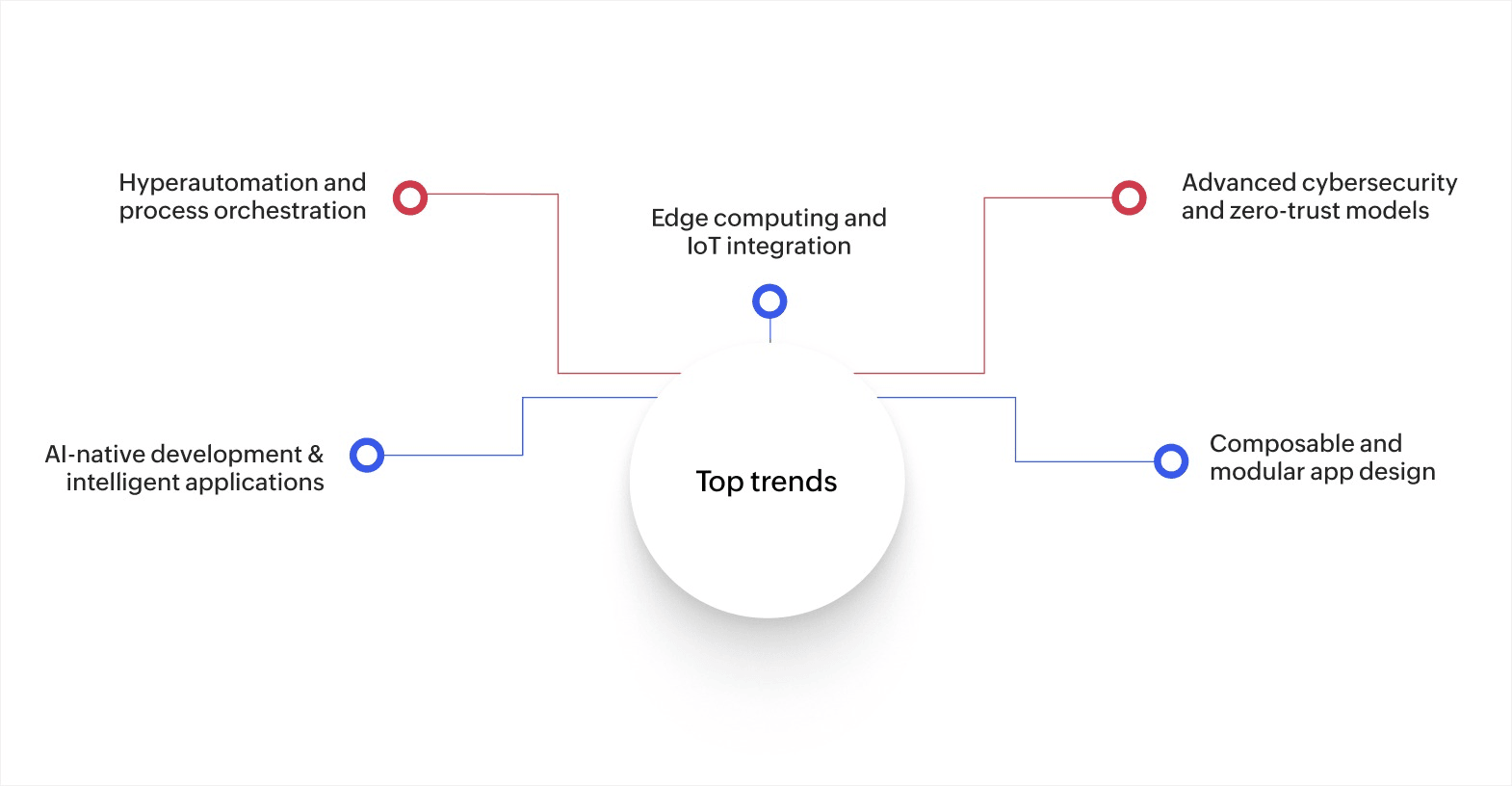
Enterprise app development is moving away from long, rigid development cycles toward faster, more adaptive methods. There are 5 trends driving this shift in the future of enterprise app development, and each affects how your organization plans, builds, and maintains its applications.
1. AI-native development and intelligent applications
AI is reshaping enterprise app development from two directions. It's changing how apps get built, and it's changing how those apps work once they're live.
How AI is changing the development process
AI-assisted development tools now handle tasks that previously required hours of manual coding. Code generation, automated testing, error detection, and smart field suggestions speed up the build process and reduce the back-and-forth between business teams and developers.
For instance, instead of manually writing validation logic for a procurement form, a developer can describe the rules in plain language and let the AI generate the code. This cuts development time and makes it easier for less technical team members to contribute to app building. AI-powered development platforms are also getting better at suggesting app structures, predicting data models, and auto-generating workflows based on a simple description of what the app needs to do.
As these tools improve, citizen developers can build increasingly complex applications that once required professional developer support. Teams spend less time on repetitive setup and more time refining business logic and user experience.
How AI makes enterprise apps smarter
On the application side, AI is moving beyond isolated features like chatbots or basic recommendations. AI-native applications are built with intelligence at their core, using machine learning models and AI agents to automate multi-step workflows, surface insights, and make decisions in real time.
For example, an AI agent in a procurement app could evaluate supplier bids, flag compliance risks, check inventory levels, and generate a purchase recommendation without requiring human input at each step. Similarly, a customer service app with built-in AI can analyze ticket patterns, predict escalations, and route cases to the right team before delays occur.
The shift here is significant. Instead of AI handling one isolated task, intelligent agents manage entire process chains. They learn from historical data, adapt to new patterns, and improve their accuracy over time. Organizations that invest in AI-native capabilities on both the development and application sides will have a clear advantage as these tools continue to mature.
2. Hyperautomation and process orchestration
Automation in enterprise apps has moved well beyond single-task triggers. Hyperautomation connects multiple automated workflows across departments into coordinated, end-to-end processes that run with minimal human involvement.
The difference from traditional automation is the scope. A basic automated workflow might send a notification when a purchase request is submitted. Hyper-automation takes that same request and routes it through budget validation, manager approval, vendor selection, compliance checks, and payment processing, all as one connected sequence. AI decides the routing at each step based on predefined business rules and real-time data.
For enterprise teams, this changes how apps are designed. Instead of building isolated tools for each department, organizations are building apps that orchestrate processes across procurement, finance, HR, and operations as a single flow.
For instance, an employee onboarding app with hyper-automation can trigger IT equipment provisioning, schedule orientation sessions, assign training modules, create payroll records, and notify the reporting manager, all from one form submission.
The benefits of this approach go beyond time savings. Connected workflows reduce handoff delays between teams, lower the risk of steps being missed, and give leadership full visibility into where a process stands at any point. When every step is tracked and automated, bottlenecks surface quickly, and compliance becomes easier to implement.
3. Edge computing and IoT integration
Edge computing processes data closer to where it's generated, rather than sending everything to a central cloud server. For enterprises with field operations, manufacturing facilities, or large device networks, this means faster response times and less dependence on constant internet connectivity.
When combined with internet of things (IoT) devices, edge computing creates a powerful data layer for enterprise apps. Sensors on equipment, vehicles, or production lines generate continuous data. Edge computing processes that data locally and sends only the relevant insights to your central systems. For instance, a manufacturing plant could use edge-connected sensors to detect equipment anomalies and trigger maintenance alerts in real time, before a breakdown disrupts production.
For enterprise app builders, this trend means designing applications that work across distributed environments. Apps need to handle data from the edge and the cloud, provide real-time dashboards, and support offline functionality for field teams. The organizations that build for this reality will operate with better visibility and faster response times.
4. Advanced cybersecurity and zero-trust models
Enterprise apps handle sensitive data, from customer information to financial records to intellectual property. As cyber threats grow more sophisticated, security can't be treated as an add-on—it needs to be built into the application from the start.
Zero-trust security is becoming the standard approach. Instead of trusting users or devices based on their network location, zero-trust verifies every access request independently. Every login, every data request, and every API call gets validated. This significantly reduces the risk of breaches, especially in organizations with remote workforces and cloud-based systems.
Beyond zero-trust, enterprise apps are integrating AI-powered threat detection, encryption for data at rest and in transit, and privacy-by-design principles that build compliance into the application structure. For instance, an app handling patient health records can enforce role-based access and automatically flag unusual access patterns. Building secure enterprise workflows into your apps from the ground up is no longer a competitive advantage—it's a baseline expectation.
5. Composable and modular app design
The days of building a single, massive application to handle everything are fading. Enterprises are shifting toward modular app design, where applications are assembled from smaller, reusable components that each serve a specific function.
This approach supports a blended strategy that's gaining traction across the industry. Instead of choosing between off-the-shelf software and fully custom development, organizations combine both. You might use a prebuilt CRM module, connect it with a custom reporting tool, and add a third-party payment gateway, all working together through APIs.
The advantage is speed and adaptability. When a business process changes, you update or swap the relevant module instead of overhauling the entire system. For enterprise teams, this means shorter development cycles, easier maintenance, and applications that evolve alongside business needs. Modular design also reduces vendor lock-in, giving organizations more control over their technology stack.
In practice, these trends support each other. AI-native apps run on cloud infrastructure. Low-code platforms make modular design accessible to business teams. Edge computing feeds real-time data into AI models. Security sits across every layer. The strongest enterprise app strategies treat them as parts of one approach, not six separate projects.
Key challenges enterprises face when adopting new app development approaches
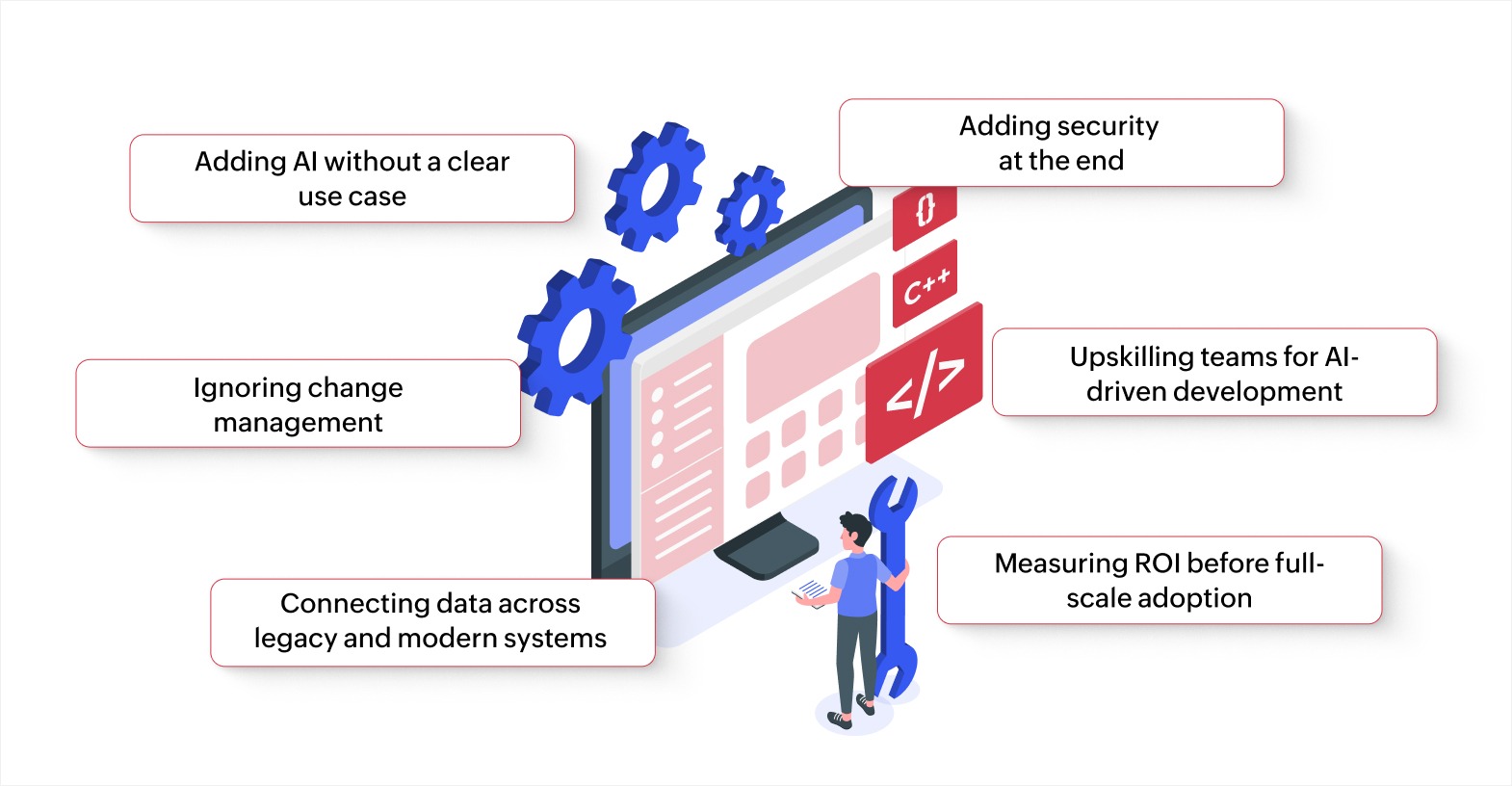
Most organizations recognize these trends early enough. Where they struggle is in how they apply them. Here are the most common challenges teams face when shifting their app development strategy:
- Adding AI without a clear use case: AI capabilities are easy to activate on modern platforms. The risk is adding them because they're available, not because they solve a specific problem. Start with one high-impact workflow where AI adds measurable value, then expand.
- Adding security at the end: Security reviews after development is complete are expensive to fix and easy to skip under deadline pressure. Build access controls, encryption, and compliance checks into the app from the first sprint.
- Ignoring change management: New platforms and tools only work if your teams actually use them. Plan for training, documentation, and feedback loops. A great platform with low adoption is a wasted investment.
- Upskilling teams for AI-driven development: AI-assisted tools speed up app building, but teams still need to know how to define business rules, validate AI-generated outputs, and manage data quality. Without proper training, AI features get underused or misapplied.
- Connecting data across legacy and modern systems: Many enterprises run a mix of older on-premises software and newer cloud-based tools. Getting these systems to share data cleanly remains one of the biggest blockers to building connected, real-time enterprise apps.
- Measuring ROI before full-scale adoption: Leadership often wants clear returns before committing budget to new platforms. The challenge is that the full value of a modern app development approach, like faster iteration or reduced maintenance costs, only becomes clear over time. Pilot projects with defined success metrics help build the case.
Addressing these challenges early saves time, budget, and rework down the line. The organizations that get the most from these trends are the ones that plan the rollout as carefully as they plan the technology.
How to evaluate an enterprise app platform for long-term fit
A platform that checks every feature box today can still become a bottleneck if it doesn't align with where your organization is heading. Here's what to prioritize when evaluating options:
- Speed to first working app: Ask how long it takes to go from an idea to a functional prototype. Platforms that support visual building and prebuilt templates cut this timeline from months to days.
- Citizen developer support: Look for guided scripting, drag-and-drop builders, and built-in guardrails that let business users build apps safely without needing full developer support.
- Integration depth with your current stack: Check whether the platform connects natively with the CRMs, ERPs, and cloud tools you already use. Ready-made connectors save weeks of custom integration work.
- Deployment flexibility: Your apps should run on web, mobile, and tablet from a single build, with options for on-prem or hybrid deployment when needed.
- Long-term cost predictability: Compare pricing models carefully. Platforms with transparent, per-user pricing and no hidden infrastructure costs are easier to budget for as your app portfolio grows.
The right choice depends on your team's size, technical capacity, and where you expect your app needs to grow over the next two to three years.
Build future-ready enterprise applications with Zoho Creator
Keeping up with these trends while managing existing systems, limited developer resources, and growing business demands is a real challenge. Most enterprise teams need a platform that makes it practical to act on these trends without starting from scratch.
Zoho Creator is an AI-powered low-code application development platform that helps enterprises build, deploy, and scale custom apps quickly. It brings together visual app building, AI-powered assistance, and built-in automation so your teams can move from idea to working app in days, not months.
With Zoho Creator, you can design business processes visually using drag-and-drop builders and set up automated workflows that handle approvals, notifications, and task assignments without manual follow-up. The platform's AI capabilities help you build smarter apps with predictive insights, data analysis, and intelligent recommendations built right in.
FAQ
1. What's the biggest shift in enterprise app development right now?
The move toward AI-native applications is the most significant shift. Enterprise apps are being built with AI at their core, handling complex workflows and delivering real-time insights rather than just automating isolated tasks.
2. How does low-code development affect IT teams?
Low-code platforms free IT teams from routine app requests. Business users handle simpler applications independently, while IT focuses on architecture, security, integrations, and complex development projects.
3. Can enterprise apps built on low-code platforms handle large-scale operations?
Yes. Modern low-code platforms support auto-scaling, high user volumes, and complex data operations. They're designed for enterprise-grade workloads, not just simple departmental tools.
4. What does zero-trust security mean for enterprise applications?
Zero-trust means every access request is verified independently, regardless of user location or device. Enterprise apps built with zero-trust principles validate every login, data request, and API call before granting access.
5. How do composable and modular architectures benefit enterprise development?
Modular architecture lets you build apps from independent, reusable components. You can update or replace individual modules without affecting the entire system, which reduces maintenance time and makes it easier to adapt to changing business needs.
 Bharathi Monika Venkatesan
Bharathi Monika Venkatesan is a content writer at Zoho Creator. Outside of work, she enjoys exploring history, reading short novels, and cherishing moments of personal introspection.