- HOME
- Know Your Tech
- Top 10 AI trends in enterprise app development for 2026
Top 10 AI trends in enterprise app development for 2026
- Last Updated : September 1, 2026
- 0 Views
- 7 Min Read
AI budgets across enterprises are expected to grow significantly over the next few years, and the pressure to spend wisely is just as intense as the pressure to spend at all.
The question most IT and business leaders face right now is "where exactly should we invest?" Picking the wrong trend costs both time and budget.
Highlights
- Leading companies using AI in development are reporting 16–30% gains in productivity and faster time to market.
- Over 78% of organizations now apply generative AI in at least one business function, signaling a clear move from pilots to production.
- The low-code technology market is on track to reach $58.2 billion by 2029, with AI and citizen development as key growth drivers.
- Enterprise AI budgets are expected to grow roughly 150% over the next five years, with spending shifting from efficiency toward innovation.
- By 2030, CIOs project that every IT task will involve some level of AI, with 75% done through human-AI collaboration.
This article breaks down the top 10 AI trends in enterprise app development backed by current data. You'll see which ones are gaining traction and why they matter for your planning.
Top 10 AI trends in enterprise app development
These AI trends in enterprise app development reflect where the industry is moving right now. Each one is based on recent data and has direct implications for how business applications get built, deployed, and used.
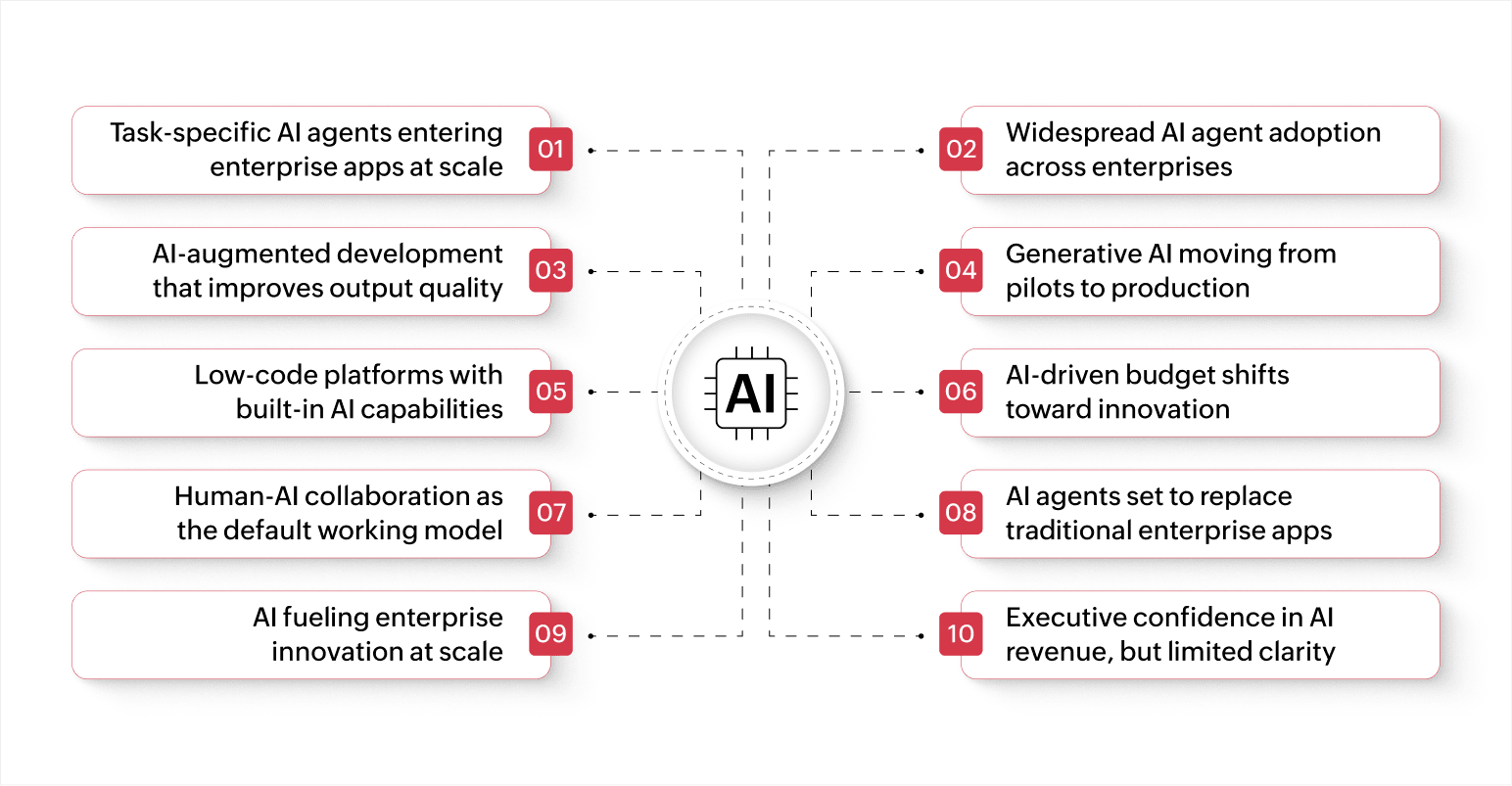
1. Task-specific AI agents entering enterprise apps at scale
Enterprise applications are quickly moving beyond simple chatbots toward AI agents that can own entire tasks on their own. Gartner projects that roughly 40% of enterprise apps will include dedicated, task-specific agents by the close of 2026. That figure sat below 5% just a year earlier. These agents independently handle defined work, like processing invoices, routing support tickets, or managing approval sequences.
This shift changes how enterprise apps are designed. Instead of building applications where every step requires user input, development teams are creating apps where AI manages the routine work and only surfaces decisions that need a human.
2. Widespread AI agent adoption across enterprises
The agent trend isn't limited to a small group of early adopters. In a PwC survey of 300 senior leaders, 88% said they plan to put more money toward AI specifically because of agentic capabilities. The same research showed 79% already have AI agents running within their organizations. Among those teams, two out of three (66%) reported that the agents are already producing clear productivity improvements.
For enterprise app development teams, these numbers paint a clear picture: Building for AI agents isn't a future roadmap item. The majority of large organizations are investing in and deploying them right now.
3. AI-augmented software development improving output quality
AI-powered tools for writing code, running tests, and catching bugs are now a standard part of many development workflows. McKinsey studied close to 300 publicly listed companies and found that the top-performing group is seeing 16–30% improvements in how quickly and efficiently they ship software. That same group also reported 31–45% gains in the overall quality of what they deliver.
For enterprise app teams, this means AI is helping produce better code with fewer issues reaching production. Developers spend less time on repetitive tasks and more time on architecture and business logic.
4. Generative AI moving from pilots to production
The experimentation phase for generative AI is winding down across most industries. McKinsey's latest findings show that more than 78% of companies have put gen AI to work in at least one area of their business. A year earlier, that number was closer to 55%. On top of that, 62% of organizations say they're at minimum testing AI agents in some capacity.
For teams building enterprise applications, gen AI has become a feature users expect. Applications that include smart content generation, automated reporting, or intelligent search are quickly becoming the norm rather than the exception.
5. Low-code platforms with built-in AI capabilities
Low-code development platforms are adding AI features that allow non-technical users to build and customize applications on their own. Gartner estimates the low-code technology market will be worth $58.2 billion by 2029, growing at a steady 14.1% year over year. Agentic AI, citizen development, and a stronger push for operational efficiency are among the main forces driving that growth.
This trend is especially relevant for enterprise app development because it addresses two pressures at once. Developer talent remains hard to find, and the demand for custom business applications keeps growing. Instead of waiting weeks for a developer to create a custom workflow or report, a business user can build it using AI-assisted low-code tools, helping teams deliver more without stretching their existing resources.
6. AI-driven budget shifts toward innovation
How enterprises allocate their AI spending is changing in a meaningful way. IBM's enterprise research indicates that leaders expect their AI investment to climb by approximately 150% as a share of revenue between now and 2030. Currently, close to 47% of that spending targets efficiency improvements. By 2030, executives anticipate roughly 62% of their AI budgets to go toward building new products, services, and business models.
For app development leaders, this is a meaningful signal. The teams that connect their AI-powered applications to revenue growth and new customer experiences will attract the most investment going forward.
7. Human-AI collaboration as the default working model
A Gartner survey covering more than 700 CIOs revealed a striking projection for 2030. They expect zero percent of IT work to happen without any AI involvement at all. Their forecast breaks down to 75% of work being done by people working alongside AI, and the remaining 25% handled by AI independently.
This reshapes how enterprise applications need to be designed. Every app built today should account for workflows where AI drafts, suggests, and automates while humans review, approve, and make final calls. The applications that get this collaboration model right will see the highest user adoption.
8. AI agents set to replace traditional enterprise apps
A growing number of enterprise leaders see AI agents eventually taking over work that standalone business applications handle today. In a 2025 Gartner survey, 46% of respondents said they expect most of their enterprise apps to be replaced by AI agents over time.
This doesn't mean every existing application becomes obsolete overnight. It does mean the direction of travel is clear: Development teams that build AI-native applications from the start, rather than adding AI as an afterthought, will be better prepared for this shift.
9. AI fueling enterprise innovation at scale
Beyond efficiency, AI is becoming a direct driver of how companies create new products and improve existing ones. McKinsey's global survey found that 64% of organizations say AI is actively enabling their innovation efforts. That number reflects a meaningful move away from using AI mostly for cost savings.
For enterprise app development, this means AI features are no longer just about automating what already exists. Teams are building applications where AI helps identify new opportunities, test ideas faster, and deliver experiences that weren't possible before.
10. Executive confidence in AI revenue, but limited clarity
IBM's enterprise research found that 79% of executives believe AI will play a major role in their company's revenue by 2030. The catch is that only 24% say they can clearly pinpoint where that revenue will come from.
This disconnect between confidence and clarity creates a real opportunity for app development teams. The organizations that build AI-powered applications tied to specific, measurable business outcomes will close that disconnect faster than those adding generic AI features. Connecting AI capabilities to concrete results is what separates real progress from optimistic projections.
These trends make one thing clear. AI in enterprise app development has moved well past the planning stage. The organizations acting on these shifts now are building a real advantage, while those still waiting risk falling further behind with each quarter.
Build AI-ready enterprise applications with Zoho Creator
Acting on these AI trends requires a development approach that's fast enough to keep pace. Most enterprise teams hit a familiar wall: Traditional development takes too long, and ready-made tools don't fit specific processes. The demand for custom AI-powered apps keeps growing, and development capacity can't always match it.
Zoho Creator is an AI-powered low-code application development platform that helps you build enterprise-grade applications without heavy development overhead. With built-in AI capabilities, you can create apps that automate decisions, predict outcomes, and adapt to your business needs.
You can design business processes visually, build apps that work across web and mobile, and connect your existing tools through integrations. Real-time dashboards keep stakeholders informed as your data changes, so everyone stays on the same page.
Teams across industries use Zoho Creator to build internal tools, customer portals, and core business systems that match exactly how they work. Sign up for free today and start building applications that are ready for what's next.
FAQ
1. What are AI agents in enterprise applications?
AI agents are software systems that can perform defined, multi-step tasks within business apps without needing human input at every step. They handle work like ticket routing, data processing, or scheduling based on rules and context you configure.
2. How is generative AI used in enterprise app development?
Development teams use generative AI for code writing, automated testing, content creation, and intelligent search within business applications. It also helps speed up prototyping and documentation during the build process.
3. Why are low-code platforms important for AI adoption?
Low-code platforms lower the technical barrier for creating AI-powered applications. Business users can build and customize apps using visual tools and AI-assisted features without needing deep programming skills.
4. How should enterprises prioritize AI investments?
Start by identifying which business functions will benefit most from AI-powered features. Focus on areas where AI can deliver measurable results, like faster processing times, better user experiences, or reduced manual work.
5. What does human-AI collaboration look like in enterprise apps?
In a human-AI setup, AI handles drafting, suggestions, and routine automation while people review outputs, make final decisions, and handle exceptions. The goal is to give users more capacity, not to remove them from the process.
 Bharathi Monika Venkatesan
Bharathi Monika Venkatesan is a content writer at Zoho Creator. Outside of work, she enjoys exploring history, reading short novels, and cherishing moments of personal introspection.