- HOME
- Threat types
- Conversation hijacking in the real world: Examples and how to protect your organization
Conversation hijacking in the real world: Examples and how to protect your organization
- Last Updated : July 1, 2026
- 122 Views
- 8 Min Read

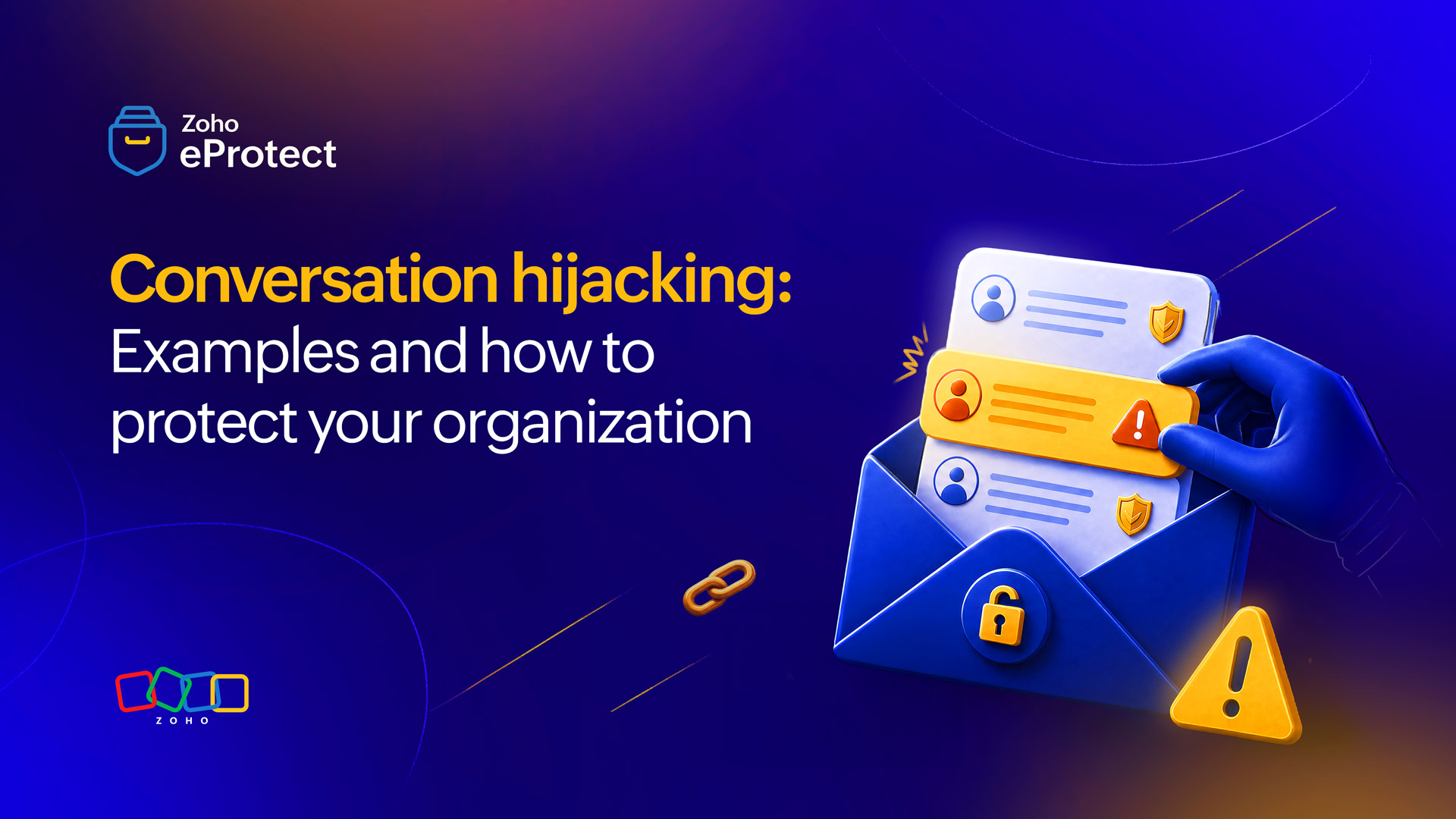
Most cyberattacks succeed by exploiting technology—but conversation hijacking succeeds by exploiting trust.
When an attacker inserts themselves into an ongoing email thread, they're not breaking through a firewall or bypassing an authentication system. They're borrowing the credibility of a relationship that has already been established, and they're using it to get someone to act. That's what makes this attack pattern so effective and difficult to catch with conventional defenses.
In this article, we'll discuss the specific ways these attacks play out in real organizational contexts, the reasons they slip past standard email filters, and the layered set of controls that reduce your exposure.
How conversation hijacking attacks unfold in practice
The pattern in a conversation hijacking attack follows a consistent logic: Gain access to a legitimate account, observe silently, identify the right moment to intervene, and then act in a way that feels entirely normal to the recipient. What changes is the context, the target, and the end goal. Below are four scenarios that reflect how these attacks commonly materialize.
Scenario 1: The supplier payment redirect
A mid-sized manufacturing company has been ordering raw materials from the same supplier for several years. Payments are processed by someone on the finance team, and the invoicing communication is handled through email with a consistent back-and-forth on order volumes, delivery timelines, and amounts due.
The attacker targets the supplier's email account and gains access through a credential phishing attack. Rather than acting immediately, they spend two to three weeks reading emails, learning the cadence of the relationship, the invoice formats the supplier uses, the typical payment amounts, and the names and roles of the people involved on both sides.
When a thread opens about an upcoming order worth $85,000, the attacker replies from the supplier's compromised account. The reply arrives in the middle of an existing chain, carries the full email history, and uses the same tone and formatting the supplier always uses. The message informs the manufacturer that the supplier has recently changed banks following an internal restructure, and attaches a revised invoice with new wire transfer details. The request is not unusual. Companies change bank accounts. The thread looks exactly like every previous thread.
The finance team processes the payment to the attacker's account. The fraud is discovered three weeks later when the real supplier follows up on the outstanding balance. By then, the money is unrecoverable.
What made it believable: The attacker never sent a cold email. They replied to an existing conversation, used insider knowledge about the relationship, and timed the message to coincide with a legitimate transaction that was already in progress.
Scenario 2: The IT support thread takeover
A financial services firm relies on a central IT helpdesk for support requests submitted by staff. A senior analyst opens a ticket about a problem with her VPN client, and a short email thread develops between her and an IT support agent over two days.
The attacker has already compromised the IT support agent's account through credential stuffing, using credentials obtained from a third-party data breach. They monitor the thread and wait. On the third day, when the VPN issue is still unresolved, the attacker replies posing as the IT agent and explains that the fix requires the analyst to log in to a specific internal portal to reset her authentication token. The link in the email points to a convincing replica of the company's internal login page.
The analyst clicks through without hesitation. She has been expecting a follow-up from IT. The email came from the right address, referred to the exact issue she had raised, and arrived at a plausible moment in the conversation. She enters her credentials. The attacker captures them and uses them to access the firm's internal systems within the hour.
What made it believable: The attacker did not need to craft a persuasive story from scratch. The context already existed. They simply borrowed it.
Scenario 3: The executive authorization request
A company's CFO is in an ongoing email thread with the head of business development and two external advisors, discussing the terms of a potential acquisition. The thread has been running for several weeks and involves detailed back-and-forth on valuation figures and due diligence timelines.
The attacker gains access to one of the external advisor's email accounts and monitors the acquisition thread. When the conversation shifts to finalizing an initial payment to engage a third-party specialist firm, the attacker sends a reply from the compromised advisor's account, addressed to the CFO, with what appears to be a confirmation of the payment details and a request to process the transfer before end of business. The message references specifics from earlier in the thread and is written in the advisor's recognizable style.
The CFO forwards the details to the finance team and approves the transfer. No one questions it because the instruction came through a trusted channel, embedded in a thread that had already established context for the payment.
What made it believable: The attacker's message didn't arrive out of nowhere. It arrived as the logical next step in a conversation that had been building for weeks.
Scenario 4: The internal malware relay
Not all conversation hijacking attacks target financial transactions. Some use a compromised email account to spread malware laterally within an organization, relying on internal trust to do the work.
In this scenario, an attacker compromises the account of a project manager at a logistics company. They monitor internal email threads and identify a team working on a quarterly operations report. When the project manager sends a draft document to colleagues for review, the attacker waits a day, then sends a follow-up from the compromised account with a message that reads as a natural continuation: "Revised version attached, please use this one instead."
The attachment contains malware. Because the message arrives in a thread the team is already engaged in, from a colleague's real account, with a plausible reason for the attachment, most recipients open it without suspicion. The attacker gains footholds across multiple machines from a single compromised account.
What made it believable: Internal emails from known colleagues don't trigger the same instinctive skepticism as unsolicited external messages. This familiarity is used as a weapon.
Why standard email filters miss these attacks
Conventional email security tools are built to catch threats that look like threats. They check sender domains, scan for known malicious links and attachment signatures, and filter messages that arrive from unfamiliar or suspicious sources.
Conversation hijacking defeats most of those checks by design. The email arrives from a legitimate account, with a legitimate domain, carrying a full history of genuine previous messages that establish context and credibility. There are no suspicious links to scan if the attacker is redirecting a payment verbally. There are no malicious attachment signatures if the attacker is using a freshly created file. The reply-chain email doesn't trigger domain mismatch alerts because the domain isn't mismatched. Standard filters have no way to distinguish a legitimate reply from a hijacked one if both look identical at the technical level.
What these attacks require to be caught is behavioral analysis: the ability to notice that a reply came from an unusual IP address, that a user who normally accesses email from one country is suddenly active from another, that a mailbox forwarding rule was created two days ago, or that the writing style in a thread has subtly shifted. That kind of detection is beyond the scope of signature-based filtering.
How to protect your organization against conversation hijacking
Because conversation hijacking operates across multiple stages, from initial credential theft through to the final fraudulent action, no single control is sufficient. Protection requires a set of overlapping measures that address different points in the attack chain.
Configure DMARC, DKIM, and SPF on all your domains
These email authentication protocols work together to verify that emails claiming to come from your domain actually originate from authorized servers. SPF specifies which mail servers are permitted to send on your domain's behalf. DKIM adds a cryptographic signature to outgoing messages that receiving servers can verify. DMARC ties both together and tells receiving mail servers what to do when a message fails either check.
When properly configured, these controls make domain impersonation significantly harder and reduce one of the most common methods attackers use to insert themselves into threads from lookalike addresses.
Monitor mailbox rules and account access patterns
Attackers who compromise an email account frequently set up forwarding rules to receive copies of incoming messages, or create inbox filters that hide replies from the legitimate account owner. Regular audits of mailbox rules across your organization can surface these changes before an active attack progresses. Access logs showing logins from unfamiliar locations or devices are important signals that should not be ruled out.
Require out-of-band verification for financial changes
This is the control that most directly breaks the conversation hijacking attack chain in financial fraud scenarios. Any request to change payment details, update wire transfer information, or approve an urgent transfer should require a separate confirmation through a channel that is entirely independent of email, such as a direct phone call to a known number. This one procedural requirement would have prevented every financial fraud scenario described in this article.
Apply zero-trust principles to high-value requests
The fact that a request comes through a trusted email thread, from a recognizable name, in a familiar tone, is not sufficient grounds for action on anything involving money, credentials, or sensitive data. Training employees to apply skepticism and zero-trust principles to mid-thread requests—the same as they would to cold emails—is a cultural shift that pays dividends across a wide range of social engineering attacks, not just conversation hijacking.
Enforce MFA across all accounts
Most conversation hijacking attacks begin with credential theft. MFA doesn't make credential theft impossible, but it significantly raises the bar. An attacker who obtains a username and password through phishing or a data breach still can't access the account without the second factor. Combined with monitoring for leaked credentials on dark web sources, MFA addresses the initial access stage that the entire attack chain depends on.
Train employees specifically on mid-thread risk
General phishing awareness training teaches people to be suspicious of unexpected emails from unknown senders. That doesn't prepare them for the specific pattern of conversation hijacking, where the email is expected, the sender is known, and the request feels like a natural continuation of something already in progress.
Training should include concrete examples of what these attacks look like, with particular attention to the signals that something may be off: a slight change in tone, a request that asks for action outside the normal process, a link that leads somewhere slightly unfamiliar.
Deploy a dedicated email security solution
Email security solutions like Zoho eProtect go beyond signature matching. eProtect detects reply-chain attacks by analyzing message context and anomalous patterns, scans URLs at the time of click to catch redirects to phishing pages, and sandboxes attachments before they reach the recipient. These capabilities address the specific techniques that conversation hijacking relies on, rather than generic threat signatures.
The layered reality of defending against conversation hijacking
Conversation hijacking is effective because it layers legitimacy at every stage. The account is real. The thread is real. The relationship is real. Attackers don't need to manufacture trust from nothing; they borrow it from something that already exists.
Defending against it requires the same layered logic. Technical controls like DMARC, behavioral email security, and account monitoring address the infrastructure. Procedural controls like out-of-band verification address the human decision points. Training addresses the gap between what people know about phishing in general and what they actually recognize in the moment. No single layer covers everything, but together they make the attack significantly harder to execute and much more likely to be caught before the damage is done.
eProtect is a cloud-based email security and archiving solution that provides an additional layer of security for email accounts. The solution offers advanced threat detection mechanisms that can secure on-premise and cloud email accounts from evolving email threats. eProtect is the security solution that powers Zoho Mail, a platform that millions of users all over the world trust.