- HOME
- Know Your Tech
- How AI speeds up time-to-market in app development
How AI speeds up time-to-market in app development
- Last Updated : December 1, 2025
- 606 Views
- 9 Min Read
How long does it take your team to launch a new application? If your answer is months rather than weeks, you're not alone. Most businesses struggle with lengthy development cycles that delay product launches and slow responses to market changes.
Highlights
AI automates manual configuration, app structure design, and data setup, significantly reducing development time.
AI-powered insights help businesses make quicker decisions based on real-time data and market trends.
AI-powered platforms scale infrastructure resources automatically based on usage patterns, maintaining app performance during peak demand without manual capacity planning.
Data integration across departments, team training on AI capabilities, and initial platform setup require upfront effort, but the sustained speed improvements make AI implementation worth it.
AI changes how fast you can build and launch products. It handles repetitive work automatically, guides you toward better decisions, and makes complex development tasks simple enough for business users to handle.
Find out the specific ways in which AI speeds up time-to-market and how AI-powered low-code platforms help you launch applications faster.
What is the time to market in app development?
Time to market (TTM) refers to the period between the inception of an app idea and its release to customers. In app development, TTM is a key metric that reflects how quickly a product can be launched to meet market demands. Several factors, such as the development framework, tools, team coordination, and app complexity, influence the overall TTM.
From a technical perspective, TTM is shaped by the approach chosen for development, such as agile methodologies or using no-code platforms. Striking a balance between delivering quickly and maintaining quality is important to avoid compromising the app's functionality or user experience.
Different strategies to improve time-to-market
Time-to-market strategy changes based on your competitive situation and constraints. Companies in crowded markets often prioritize speed to claim market share first, while those with seasonal demand focus on hitting specific launch windows. Here's what each approach looks like:
Speed-focused strategy
Speed matters when being first provides a clear advantage. This approach prioritizes rapid delivery using agile processes, visual development tools, and automated workflows. AI contributes here by suggesting app structures based on your requirements, automating process flows, and helping you build functional applications quickly through natural language descriptions.
Agility-focused strategy
Agility centers on adapting quickly to changes without delaying your launch. This strategy uses iterative development methods like Scrum or Kanban that incorporate feedback throughout the process. AI supports this by analyzing user feedback in real time, predicting which features will have the most impact, and helping you adjust app functionality based on changing priorities.
Predictability-focused strategy
Predictability matters when you have fixed deadlines tied to events, seasonal demand, or regulatory requirements. This approach emphasizes detailed planning, clear milestones, and risk management. AI helps by forecasting potential delays, optimizing resource schedules, and providing early warnings when projects drift off track.
Top 5 benefits of AI for speeding up time to market
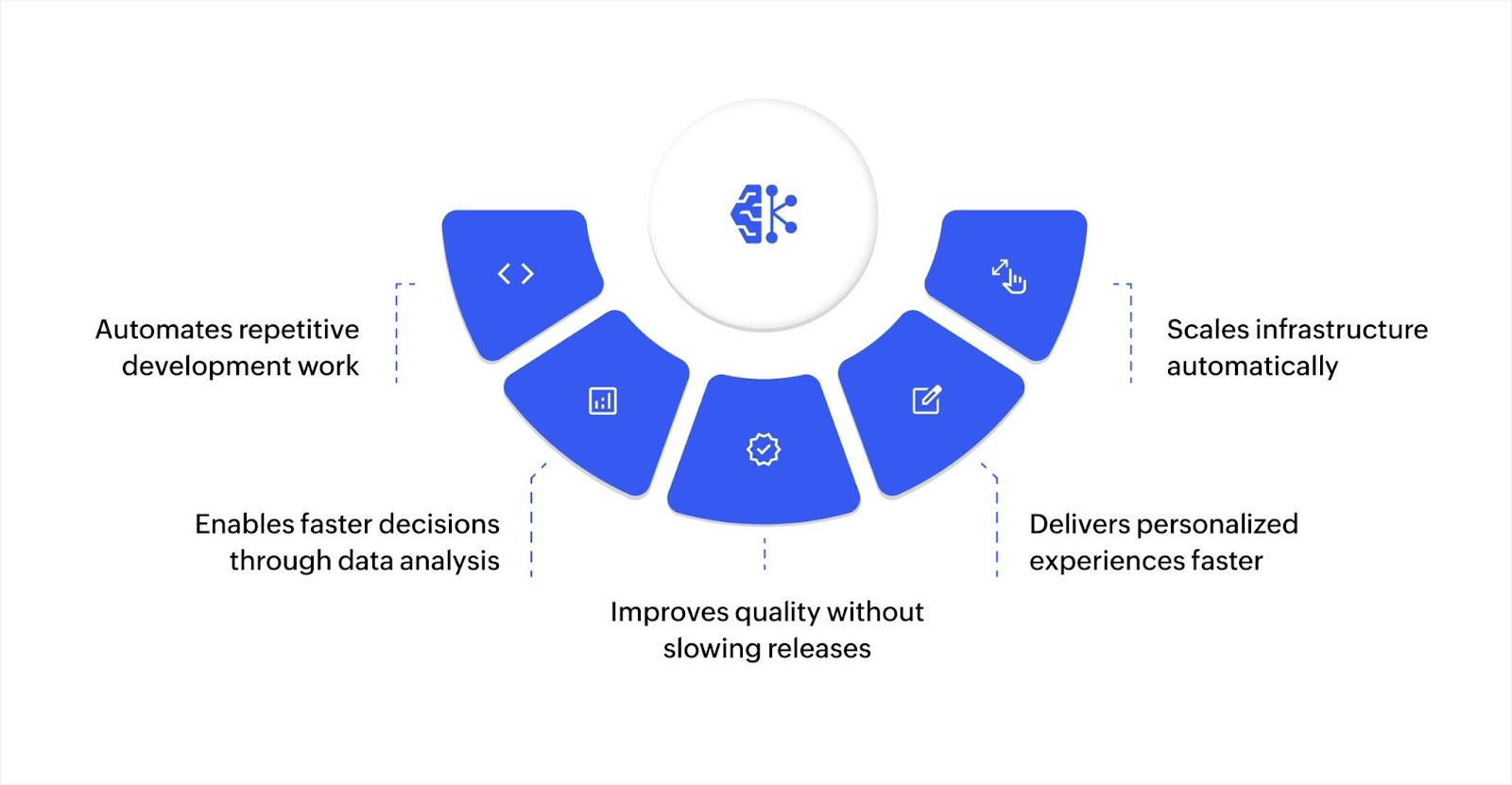
Incorporating AI into your development processes offers several advantages that can dramatically reduce time to market (TTM). AI automates tasks, improves decision-making, and boosts product quality, enabling faster delivery and a competitive advantage. The global AI app development market is projected to grow from USD 40.3 billion in 2024 to USD 221.9 billion by 2034, at a compound annual growth rate (CAGR) of 18.60%, showing the increasing role of AI in faster development.
Here's how AI can help accelerate your development cycle, reduce costs, and improve product quality, ensuring faster time to market.
1. Automates repetitive development work
AI handles tasks that traditionally consume significant time and resources. Rather than manually building every component from scratch, AI can suggest optimal app structures, create workflow logic, and set up data relationships based on simple descriptions.
App structure suggestions: AI recommends optimal database structures and form layouts based on your business requirements.
Workflow creation: AI helps design approval processes, notifications, and automated actions without manual configuration.
Data relationship mapping: AI identifies how different data elements should connect, reducing setup time significantly.
Interface design assistance: AI suggests user interface arrangements based on usability best practices.
For instance, a logistics company building a shipment tracking system can describe their workflow in plain language, and AI assists with creating the tracking stages, notification triggers, and status updates automatically, reducing weeks of manual configuration to hours.
2. Enables faster decisions through data analysis
AI processes large datasets quickly, turning raw information into actionable insights. You can analyze customer feedback from thousands of users in minutes, identify which features matter most, and adjust your roadmap accordingly.
Customer feedback analysis: AI identifies patterns in user comments and requests, highlighting priority improvements.
Market trend identification: AI spots emerging trends by analyzing industry data and competitor movements.
Feature impact prediction: AI forecasts which capabilities will drive the most user engagement and value.
Performance monitoring: AI tracks how users interact with your application, revealing optimization opportunities.
For example, a SaaS company can use AI to analyze usage patterns across its customer base and discover that mobile access is the most requested feature, helping them prioritize development efforts on capabilities that actually matter to users.
3. Improves quality without slowing releases
AI finds problems early when they're easier and cheaper to fix. Rather than discovering issues after launch, AI can identify potential workflow gaps, data inconsistencies, and user experience problems during development.
Early issue detection: AI flags potential problems in app logic before you deploy to users.
Data validation suggestions: AI recommends validation rules that prevent common errors.
Workflow optimization: AI identifies bottlenecks or unnecessary steps in your processes.
User experience analysis: AI evaluates app flows and suggests improvements for better usability.
For instance, a healthcare provider building a patient appointment system can have AI review the booking workflow and identify that patients need to see available time slots before selecting a doctor, preventing a confusing user experience before launch.
4. Delivers personalized experiences faster
AI analyzes user behavior and adapts features automatically. Rather than building separate versions for different user types, AI can help create dynamic experiences that adjust based on individual needs and preferences.
User behavior tracking: AI monitors how different user segments interact with your application.
Adaptive interface suggestions: AI recommends interface adjustments based on user roles and preferences.
Content customization: AI helps display relevant information to each user based on their context.
Experience optimization: AI continuously learns from user interactions to improve the application.
For example, a learning platform can use AI to adjust content difficulty and format based on student progress, creating a personalized experience without building separate versions for different learning styles or skill levels.
5. Scales infrastructure automatically
AI manages technical resources as your user base grows. Rather than manually adjusting server capacity or worrying about performance during peak times, AI handles resource allocation based on actual demand.
Scaling benefits include:
Resource optimization: AI allocates computing power based on current usage patterns rather than fixed estimates.
Automatic capacity adjustment: AI increases or decreases infrastructure resources during peak and slow periods.
Performance monitoring: AI identifies potential bottlenecks before they affect user experience.
Cost management: AI prevents over-provisioning resources, keeping infrastructure costs aligned with actual needs.
For instance, a food delivery platform can handle lunch rush traffic automatically, with AI scaling up capacity during peak ordering hours and scaling down during slow periods, maintaining fast performance without wasting resources.
How AI enables faster time-to-market
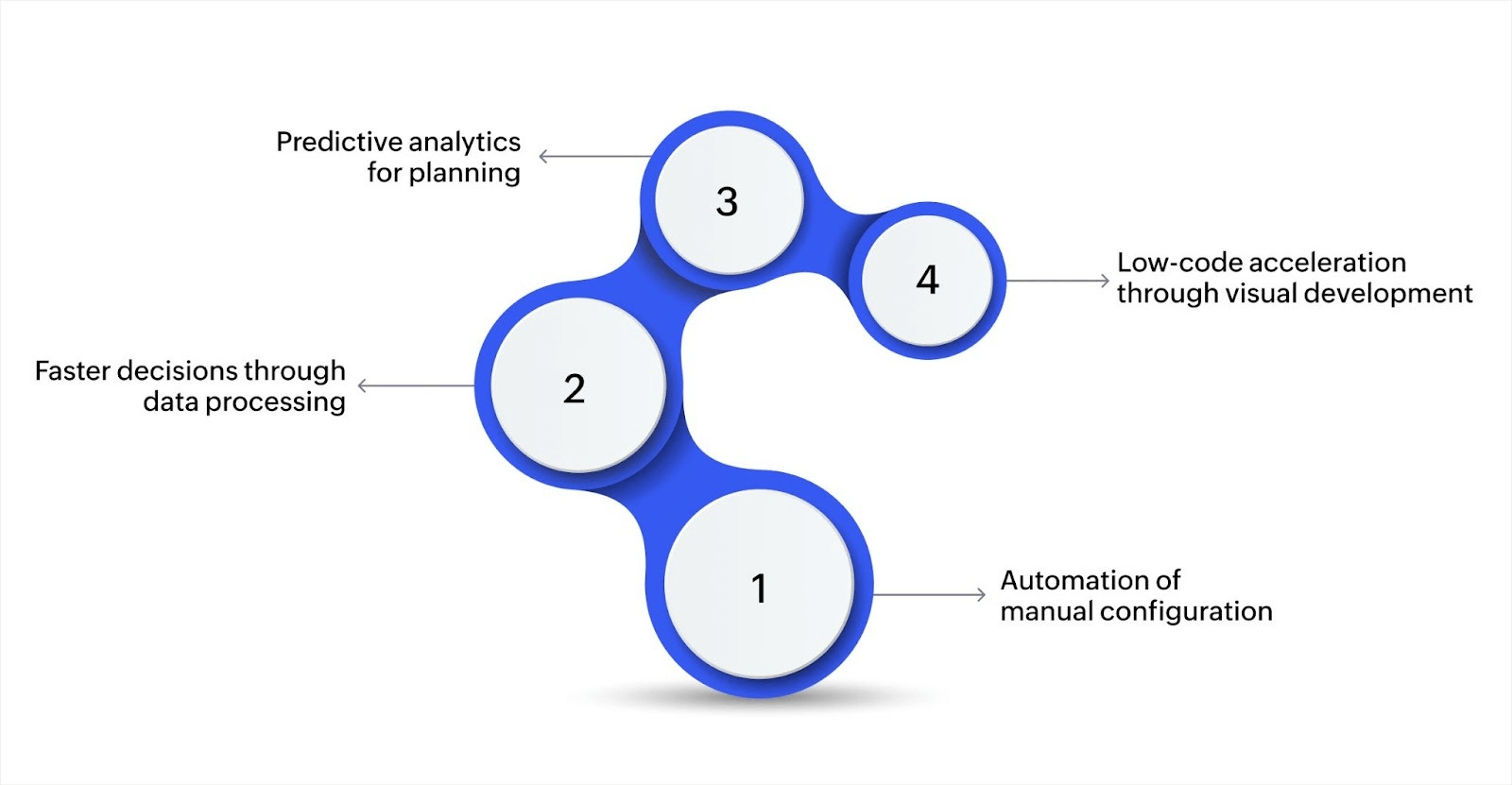
Automation of manual configuration
AI handles the setup tasks that traditionally consume hours or days of manual work. When you describe what your application needs to do, AI creates the database structure, sets up field relationships, and configures data validation rules automatically.
This removes the need to manually define each form field, dropdown option, and data connection. What used to take multiple days of careful configuration now happens in hours, letting you move to actual feature building faster.
Faster decisions through data processing
AI analyzes datasets that would take humans days or weeks to process manually. It scans customer feedback across thousands of interactions, identifies recurring themes, and highlights which features users request most frequently.
This continuous analysis helps you make feature decisions based on actual data rather than assumptions. When choosing between different capabilities to build, AI provides usage patterns and impact predictions in minutes, removing the research bottleneck that typically delays development decisions.
Predictive analytics for planning
AI analyzes historical development patterns to forecast realistic timelines. It identifies which types of features typically take longer than estimated based on past projects, helping you plan more accurately.
This foresight prevents the common problem of underestimating complexity. For instance, if you plan to add a multi-level approval workflow, AI can predict the additional time needed based on similar implementations, letting you adjust schedules proactively rather than discovering delays mid-project.
Low-code acceleration through visual development
AI-powered low-code platforms like Zoho Creator combine visual interfaces with intelligent assistance to speed up development. You can arrange components using drag-and-drop tools to build functional applications quickly.
This approach converts natural language descriptions into functional structures without code. For instance, describing your requirement as "I need a system to manage customer orders that routes through three approval levels based on order value, with notifications sent to approvers at each stage and automatic status updates visible to customers" guides the AI to build the order form, create the approval hierarchy, and set up notifications. Business users can complete this in weeks rather than waiting months for traditional development.
Challenges in implementing AI for a faster time-to-market
Data integration and accuracy
AI systems rely on accurate, structured data to function effectively. Integrating data from various sources into a cohesive system is a significant challenge. Poor data quality or fragmentation can lead to faulty AI outputs, which compromises the time-to-market advantages.
Key considerations for data integration:
Centralize data across departments or systems.
Clean and structure the data for AI analysis.
Keep data updated to maintain accuracy.
Skill development and adoption
For AI to truly speed up your time to market, your team needs the right technologies and skills. Supporting employees through upskilling and continuous learning helps them confidently adopt AI and make the most of its capabilities.
How to overcome this challenge:
Invest in training to build AI expertise in-house.
Encourage an environment of learning and adaptability.
Hire or consult AI experts to fill knowledge gaps.
Initial setup and investment
The initial cost and effort of setting up AI systems can be a barrier for SMBs. While the upfront investment is necessary, selecting the right AI tools and customizing them for your business processes is time-consuming. However, this investment is essential for long-term efficiency.
Key points to consider during setup:
Assess the long-term ROI before making large investments.
Start with a pilot project and scale gradually.
Partner with vendors that provide comprehensive support.
While initial setup costs can be high, the long-term AI time-to-market benefits far outweigh the upfront challenges.
By tackling these challenges such as data integration, skill development, and initial investment, businesses can fully leverage AI to speed up their time to market. With the right tools, training, and planning, AI can drive long-term growth and efficiency.
Accelerate your time-to-market with AI and Zoho Creator
Most businesses need custom applications but lack the technical resources to build them quickly. Your team describes what they need, IT translates requirements into technical specifications, developers write code for forms and workflows, and months pass before anyone sees a working application. Meanwhile, the business problem you wanted to solve becomes more urgent, and the requirements have already changed.
Zoho Creator, powered by Zia, provides an easy way to bring AI into your workflows. Zia acts as your development collaborator, turning text prompts, sketched workflows, or business documents into functional applications. Tell it, "I need a vendor approval system with three authorization levels," and it creates the form structure, builds the routing logic, and automatically configures notifications.
Ready to take action? Start building with Zoho Creator today and see how AI can help you improve your time-to-market.
FAQ
How does AI improve collaboration between teams in app development?
AI-powered tools can automate task assignments, track project progress, and provide real-time updates. This helps teams stay aligned, collaborate more effectively, and avoid miscommunication, speeding up development.
What are the common challenges businesses face when implementing AI for faster time to market?
Businesses often struggle with data integration, upskilling their teams, and the initial investment required to implement AI systems. Overcoming these challenges is key to unlocking AI’s potential in reducing time to market.
How does AI help prioritize features in app development to meet customer needs?
AI analyzes customer feedback, usage patterns, and market trends to identify which features should be prioritized. This ensures that app development aligns with user preferences, improving market fit and reducing time to market.
What impact does AI have on post-launch app updates?
AI helps monitor app performance in real-time, identifying areas for improvement or new feature requirements. This enables quick updates and continuous improvement, maintaining speed and quality in the app's lifecycle.
 Bharathi Monika Venkatesan
Bharathi Monika Venkatesan is a content writer at Zoho Creator. Outside of work, she enjoys exploring history, reading short novels, and cherishing moments of personal introspection.