Still think event management software is just another fancy tool in the box? Event planning platforms are now indispensable for any business that is serious about their events strategy.
Events are one of the largest promotional spends of businesses today. About 74% of professionals feel highly optimistic about events as a growth channel, thanks to measurable ROI and direct impact on business growth.
With leadership teams increasingly willing to allocate larger budgets, event organizers are shifting focus from just hosting events to designing personalized, scalable event experiences powered by emerging technology and platforms.
But this evolution in events comes with its own complexity. Juggling spreadsheets, vendor emails, and siloed tools doesn't just slow teams down—it limits how much value they can deliver. Today's event professionals need more than manual effort and patchwork systems to keep up.
Enter event management software—a unified platform that connects every part of event planning to business outcomes like revenue, engagement, and brand growth.
Why should you choose an event management software?
What is event management software?
An event management software is a comprehensive solution that helps event teams plan, track, measure and scale events efficiently. It unifies critical functions like registration, ticketing, attendee engagement, and analytics into a single platform, thus streamlining the entire event planning process.
Event technology is no longer a nice-to-have, it's a must-have, with over 65% of event planners already finding solutions such as QR check-ins, automation,AI-driven analytics indispensable to running events smoothly. Yet, nearly 1 in 5 event planners complain that using 4–7 different technology tools drains time and resources.
That's why an all-in-one event management software is fast becoming a non-negotiable investment in an event's success. Beyond streamlining operations and providing a suite of digital tools, an event management platform can directly impact efficiency, ROI, and attendee experience.
Top 10 benefits of using event management software
A good event management software enables event planners to anchor every event-related activity to measurable brand and revenue outcomes. Let's walk through all the advantages of event management software to help you choose the best event platform for your business.
1. Centralize event planning across event types
Typically, if you're running a business with a strong event strategy, you might be planning anywhere between 10 to 35+ events annually.
Your event planning team might be experimenting across event formats and types—from virtual streams and hybrid conferences, to in-person tradeshows, each with its own unique budgeting, logistics, and engagement needs.
However, instead of juggling a dozen different tools and checklists, what if you could find every task, update, and attendee insights right where you need it?
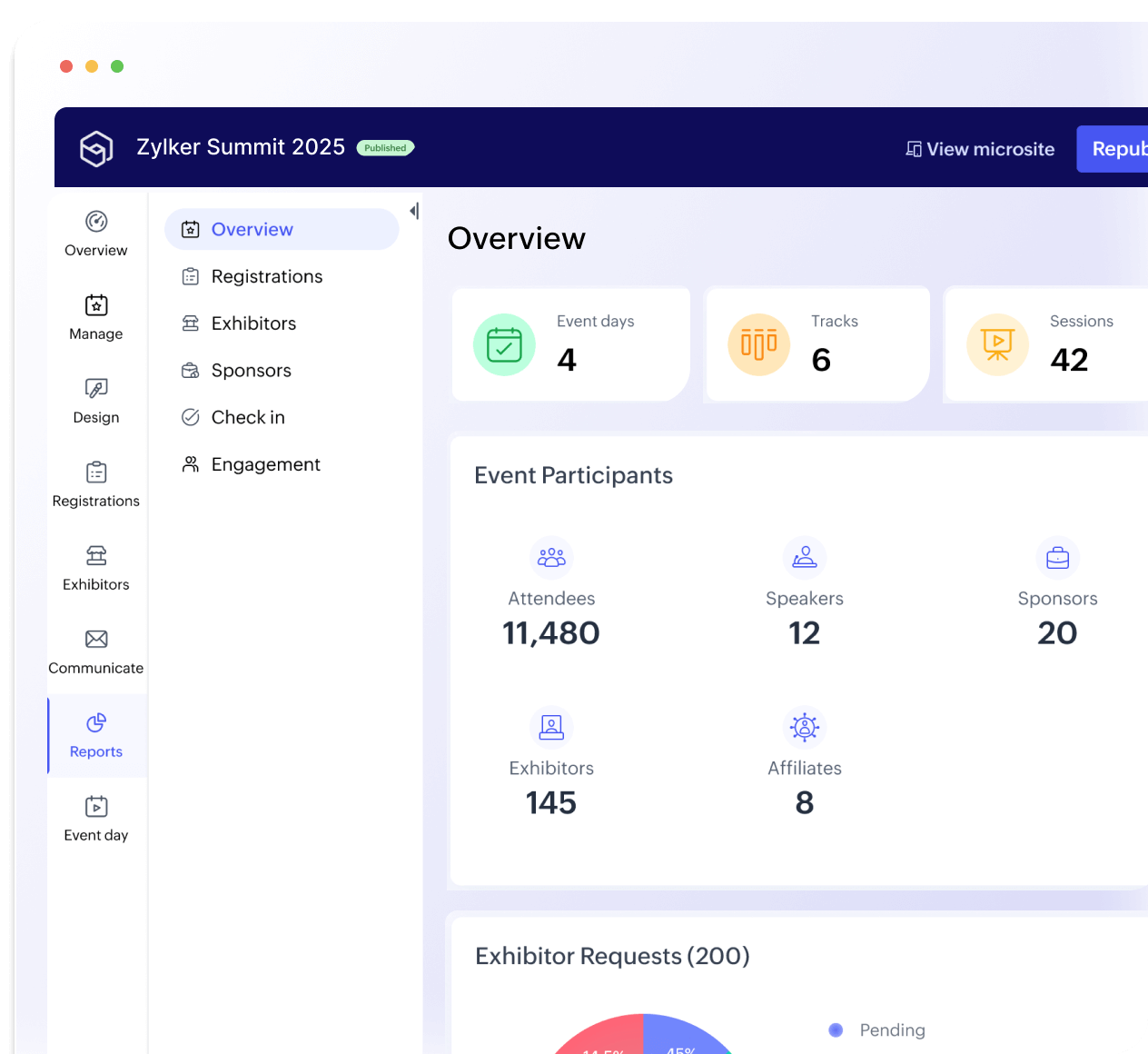
That's where event management software changes the game. A comprehensive solution, like Zoho Backstage, wraps everything from task tracking and ticketing to check-in solutions in a single platform.
Some capabilities that facilitate this include:
Multi-event management from a single dashboard (virtual, hybrid, or in-person)
Built-in task and checklist management for teams
Role-based access and collaboration for internal teams
Speaker and agenda management modules
2. Scale event promotions with marketing automation
A solid, data-driven distribution strategy is the heartbeat of a good event marketing plan.
But most companies rarely have visibility into where their marketing spend goes, and what impact it creates, thanks to using basic tools that don't offer any analytics, scattered expense tracking and very little insights from budget spreadsheets. This means all your learnings and re-strategizing is reactive after the event—never letting you improve the experience on the move.
Instead, an event management software can streamline your entire promotional strategy right from the start to the finish. It acts as a full-stack marketing solution, connecting across multiple MarTech tools, CRMs and more. This makes it easy for event planning teams to use quick, no-code solutions to plan out digital marketing without ever leaving the platform or needing a developer.
Imagine this scenario: you can create an event landing page, build registration forms, schedule your social media posts, sell tickets, and even send pre-event mailers from the same platform. Here are other features that enhance your marketing and promotions strategy:
Drag-and-drop event website builder with customizable templates
Integrated email campaigns and pre-event communication tools
Integrations with CRMs, analytics, and third-party marketing tools
Social media scheduling and shareable event links
Automated reminder and follow-up workflows
This is exactly what Fluetic International did. They used Zoho Backstage to build out an entire two-day event complete with a full-fledged website, ticketing, agenda etc., all within just an hour and a half!
3. Streamline budgeting and cost control
Budgeting for events at scale is hard, both in terms of allocation, as well as management.
And, your event planning team is still managing budgets manually, then activities like timely payments, reconciliation, expense tracking etc., might leave you spending many hours on budgeting and still prone to errors.
There are two ways an event management software helps event planning teams make this easier: automation and expense tracking.
Statistically, using an event management software increases savings on efforts, cost and time by about 40%, all thanks to digitization and automation. When every task—registration, communication, budgeting, and vendor management—runs on a single platform, teams cut down on redundant tools, repeated data entry, and last-minute fixes.
Additionally, budget and spending are also not siloed in different trackers; you can bring teammates from finance, procurement, and other divisions into a collaborative space within your planning software. In the future, as financial tracking becomes largely AI-assisted, an event management software also gets your data "AI ready".
You can streamline your budgeting mechanism by using features like:
Expense and payment tracking for tickets, vendors, exhibitors etc.,
Automated invoicing and payment gateway integrations with providers like Stripe etc.,
A centralized dashboard that provides a cost and revenue overview
Detailed collaboration tools for finance and procurement teams
Using an event management software thus makes a heavy impact on long-term cost saving—with smarter budgeting and expense control.
4. Automate engagement with a suite of tools
The term "attendee engagement" once used to be confined to simple event swag ideas. Now, it's a key component for all events, especially virtual ones—digital attention spans are now down to just 47 seconds!
There are various engagement options today to combat this, from simple QA and polling to advanced gamification.
However, using scattered tools for attendee engagement leaves you stuck with conventional tactics like simple polling or comment boxes—none of which actually helps engage or communicate with your audience. This brings down your overall experience design and engagement game down by many notches.
Event planning platforms solve for this by providing built-in, end-to-end engagement features based on latest trends and technology advancements. Using these features, you build engagement flows that follow your attendees' journey from start to finish.
Zoho Backstage, for instance, offers everything from streaming options with built-in engagement features, certificate builders, and even customized mobile apps—complete with Zia, an AI engine that "matchmakes" between attendees to help them network with peers.
Here are other attendee engagement features you can use to make your event experience a lot more engaging:
Live polls, Q&A, and audience chat modules
Gamification options
Certificate builder for post-event engagement
AI-powered attendee matchmaking
Engagement analytics by session or attendee
This, in turn, makes for a more personalized engagement strategy that results in higher attendee satisfaction and NPS (Net Promoter Score) results.
5. Enhance attendee experiences
A great attendee experience is the baseline of a great event—it turns one-time audiences into recurring visitors, and eventually, loyal customers.
The attendee experience starts from the very first interaction your audience has with your event. If your signup process is too complex, the entry line too long or the venue not arranged right, event attendees will notice.
Creating smooth, simplified event journeys is hard to crack for event planning teams who are in a time crunch. That's where your event management software comes into the picture.
The right software offers registrations, payments, and ticketing all rolled into one master attendee flow to streamline sign-ups for attendees.
You can also offer contactless check-in via quick QR scanning to cut hour-long waits to just a few minutes—adding to the experience.
Here are some features on your event management software to enhance attendee experiences:
QR-based check-in and badge printing
Customizable attendee mobile app (with agenda, venue map, and updates)
Personalized attendee itinerary and notifications
Multi-language support and accessibility features
Seamless ticketing and payment workflows
This is how, from the very first instant, your event management software helps build connected, end-to-end experiences.
6. Simplify your stakeholder management
Your standard event planning team has members from across various teams—from marketing to finance, procurement to leadership. You're also navigating requirements across external teams such as vendors, external speakers, a multitude of exhibitors (if you're having a tradeshow, for example).
An event management software helps bring all these stakeholders across the board, on board. With multiple internal collaboration tools, it helps provide everyone the right visibility they need without compromising on security and authorization.
You can, for example, use your platform's exhibitor management and speaker management modules to ensure everyone is on the same page. By using advanced technology like smart floor planning, you avoid hassle during event logistics planning.
There are other features to support this, such as:
Exhibitor and sponsor management modules
Detailed authorization rules and role-based access
An organizer mobile app that teams can use for instant internal communication
Smart floor planner for booth allocation and layout visualization
Workflow automation to reduce manual efforts
On event day, this means fewer discrepancies, easy setups, and happier exhibitors and speakers.
7. Ensure security and compliance
A lot of the time, event management, especially for in-person events, requires the secure holding of a large amount of personal data. You may be collecting private information such as contacts, addresses, even some medical details of attendees. Using plain forms and basic excel sheets does not guarantee enough data integrity in these cases.
With an event management platform, however, every single piece of data collection is accompanied by robust encryption and compliance, such as:
SOC 2, GDPR, and CCPA compliance
Secure attendee data storage and encryption
Configurable access permissions for teams
HIPAA compliance while storing sensitive personal data
With rigorous authorization rules, a sophisticated platform ensures that only fully authorized event planners can access attendee details.
8. Access detailed analytics in real-time
Imagine a scenario where you get to know your attendees' response to your event even before they sign up to it. With the right event management software, this is very much a reality!
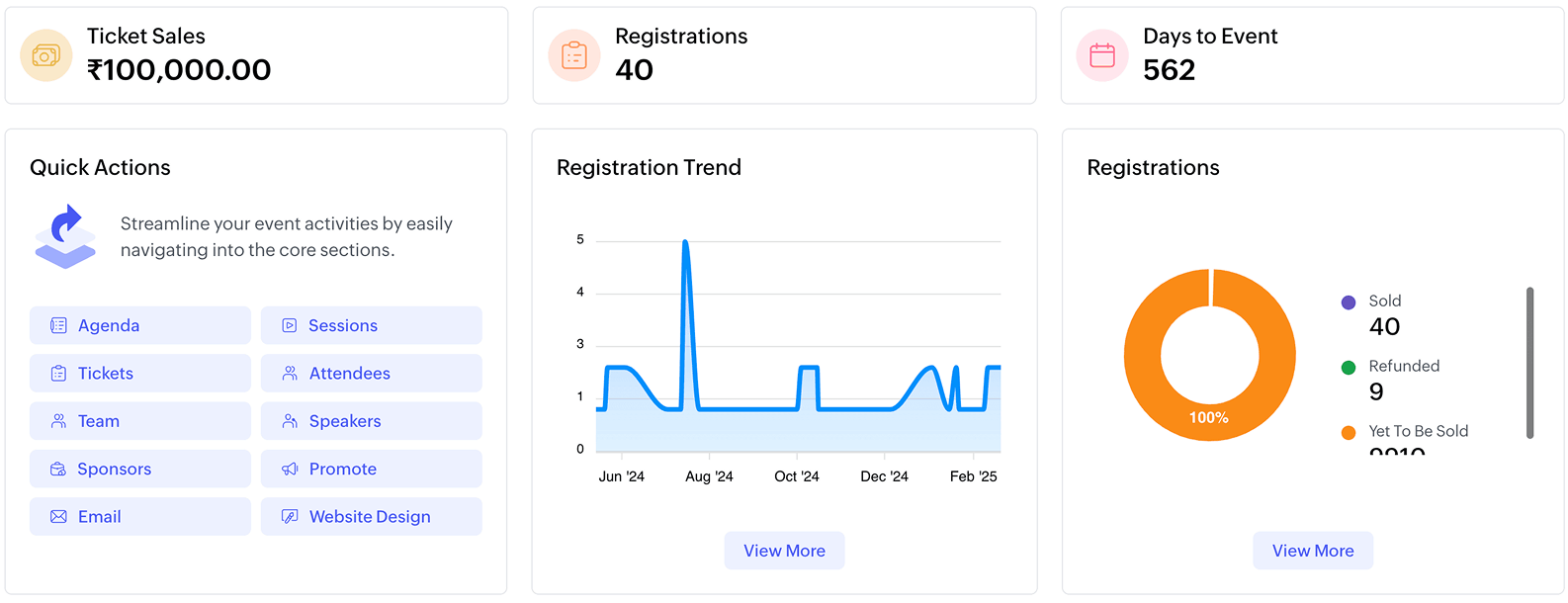
Platforms like Zoho Backstage offer real-time data analytics and reporting. This means that you can track every single interaction the audience has with your event collaterals and activities.
You'll have end-to-end visibility, from performance of your event website's performance, revenue from ticket sales, to how much individual speakers are able to hold audience attention.
Some analytics capabilities built-in on your platform include:
Integrated tools for tracking on the event landing page(s)
Post-event analysis on content downloads, re-visits etc.,
This vital insight helps you re-design your event experience when needed, and course-correct early, so you can maximize the outcome from your event.
"Our favorite thing about Zoho Backstage is the ability to track ticket sales and watch the money come in! The ease of use in terms of editing the agenda and speaker details is also impressive."
As Matt describes, you will have a singular dashboard to rack all your baseline metrics from sales revenue to session summary. That's the power of event management software—through data analytics, you get to view your event directly from the attendees' lens.
9. Measure event success and ROI tangibly
A big challenge that event organizers have at the end of every event? Reporting the overall event success and ROI back to leadership. Teams across the organization expect different outcomes from the event. Marketing teams ask about brand affinity, sales might request a lead list, and the C-suite looks for the larger picture.
In such cases, the event management software can be your lifesaver. Every single data point is automatically collected, stored, and quantified within its numerous dashboard.
In Zoho Backstage, for example, you have multiple options to derive both qualitative, and quantitative outcomes. Here are features in your event management software that help you measure your event ROI:
Dashboards that analyze registrations, ticket sales etc.,
CRM integration for automatic lead syncing
Post-event feedback collection and survey tools
Audience engagement analytics
No matter what you want to measure—ticket sales revenue, new leads, NPS (Net Promoter Score) from the audience—there are options to do so.
This singular view of your entire revenue, engagement and audience numbers take you a great way forward, in measuring the net success of the event.
10. Scale operations for future expansion
Events are, as we discussed, the fastest growing spend for businesses today. That means you'll be wanting to scale your event strategy multifold, across various event formats, types and audiences.
A big advantage that event management software gives you is repeatability and reliability. You can templatize everything from floor plans to entire speaker sessions, duplicating them instantly across multiple events.
With event management software like Zoho Backstage, you can conveniently handle large volume and velocity of events effortlessly. Amazon's Smbhav event, for instance, had about 4,000+ attendees managed with Backstage, and that's just the start.
You can even switch context between event types. It takes just one click to convert a virtual event to an onsite or hybrid event. Here are some scalability options to help you build more events:
Event duplication and cloning for recurring events
Flexible conversion between virtual, in-person, and hybrid formats
Multi-user scalability for enterprise teams
Large attendee volumes with unlimited event creation
Integration with a suite of digital tools (CRM, campaigns, analytics)
The right event management software offers you maximum flexibility, and helps you scale your events from 1 to 100 without any hitches.
The future of event management technology with Zoho Backstage
We've seen the various present-day benefits of an event management software. In the future, as AI-native processes take over the world, the events space will be no exception. With increased competition over all other advertising channels, we'll arrive at a point where the businesses that create the best event experiences will win.
With technology being at the epicenter of event growth, choosing the right solution can make a tangible impact on how you approach event management in the future. And with Zoho Backstage, you'll always be on the right side of technological and cultural growth, so you can continue crafting memorable event experiences that become a business growth asset.
You need an event management software when you run more than 2-3 events annually, or when disjointed tools prevent you from directly connecting planning steps to revenue, lead generation, and business outcomes.
An event management software improves by budgeting by cutting costs from redundant software subscriptions and increasing staff efficiency by up to 40% through task automation (registration, budgeting, data entry).
The biggest risk of not using an event management software are data fragmentation and security lapses. Using multiple digital tools creates security risks, compliance gaps (GDPR/CCPA), and prevents accurate, unified measurement of attendee behavior and brand activation metrics.
Some key business-value features of event management software include ticketing, automation, real-time analytics and CRM Sync. The system must provide instant, unified data on sales and engagement, which then feeds directly into your CRM for immediate, qualified sales follow-up.