Budgeting for an event: A complete beginner's guide

A step-by-step guide to planning, tracking, and optimizing event budgets for maximum impact.

All events, whether virtual or hybrid, corporate or personal, have one universal truth, it costs money to make them happen. Unlike what many people would like to assume, no event comes with an unlimited budget (wouldn't event planners love that!). Nor do the organizers and event managers have scope of increasing their budgets every year, even as the expectations grow.

But, in vain, almost 70% of event organizers surveyed around the world expected that their spend would increase in 2025. And they are right. Event costs often spiral without structure and it leaves the event planners feeling trapped. They face issues like rigid agreements that give them no flexibility on choosing vendors, and increasing fees from hotels and event venues.

So, as an event planner in 2025, a great event isn't just about content, venue, guest speakers, or giveaways, it's about delivering measurable impact on a limited budget. Whether you wish to host a conference, a hybrid summit, a product launch or a client workshop, if you have the budget discipline, you will stay away from cost overrun drama and deliver benchmark ROI on your event.

In this guide, we offer best practices, actionable tips and some leadership advice on how event budgeting is done right.

Event budgeting guide

A comprehensive guide on event budgeting

What is event budgeting?

Budgeting for an event means laying out a financial plan that helps you host events within the organization's financial limits, yet still achieve the event's objectives. Whether you're looking to increase revenue, encourage networking, or strengthen sponsor relationships, a proper event budget lets you stay on track. It helps you understand event cost breakdown, control your event expenses, measure the expected revenue, and ultimately, assess your event's return on investment (ROI).

What it really means is—event budgeting is an exercise that begins with planning and ideation of the event, and goes on till you assess how much it paid off, long after the event is over and you are planning the next one, based on the analytics and learnings gathered from it.

An event budget:

  • Is a structured framework that helps set up a clear event management process and guides resource allocation
  • Fosters accountability within the event delivery team
  • Keeps everyone aligned and allows for effective monitoring of spending
  • Ensures financial control
  • Contributes to a well-organized, successful, and impactful event
Why event budgeting is critical?

Every event must be evaluated based on two aspects. One is whether it aligns with the purpose it is supposed to serve, and second is whether it meets that purpose without leaving a vast gap between expected ROI and actual returns.

In that context, events are not just to break the monotony of business activities, they are investments—into brand visibility, lead gen, partner relationships, even internal alignment. A clear budgeting for events helps keep spending and outcomes masterfully aligned.

Budgeting for events also helps in avoiding what we call Scope Creep. This is a situation where what starts as a small idea gets blown out of proportion as more stakeholders get involved. Extra elements keep getting added at every stage.

For example, a sales event planned for 100-odd sales team members suddenly requires a guest speaker who might ask for additional perks, require additional planning, on-site branding - all these silently increase the costs.

With a well-crafted event budgeting, stakeholders like clients, leadership, and finance can maintain a transparent approach and clear visibility, leading to better control of costs as well as outcomes.Event budgeting is also crucial for maximizing ROI. With efficient use of funds towards organizing like selecting a venue, preparing internal and external teams, using the latest technology etc, can be planned ahead. This frees up resources later for better marketing of the event, enhanced guest experience,and even for scaling.

What are the typical cost categories in events?

So what does one budget for in an event? Irrespective of the type of event you are hosting- whether virtual, in-person, or a hybrid of both, these are the key cost centers that need to be laid out to give the formal cost and spend structure to the event.

  • Venue and logistics: Rental fees, insurance, security, permits, décor, furniture, transportation, accommodation (if needed), parking, networking zones, signage.
  • Technical and AV production: Stage setup, lighting, sound, live streaming / hybrid tech, video production, internet bandwidth, screens, translation equipment or simultaneous interpretation (if needed).
  • Catering and F & B: Meals, breaks, drinks, special dietary requirements, staff for serving, if food is plated vs buffet, beverage costs, service charges, gratuities.
  • Speakers and performing talent: Keynote fees, travel, hotel, rider requirements, honorarium, technical rehearsals.
  • Staffing and operations: On-site staff, volunteers, event managers, backstage crew, security, logistics staff, registration desk, badge printing.
  • Marketing and promotion: Event website / landing page, digital ads, printed materials, email campaigns, social media, influencer / speaker promotions, content marketing, signage.
  • Software and tools:Event registration & ticketing software, event app, CRM integrations, lead capture tools, analytics, attendee engagement tools.
  • Miscellaneous: Insurance, contingencies (weather, last-minute rentals), decoration, transportation delays, extra shipping, safety / health measures,regulatory compliance etc.

How to do budget allocation, forecasting, and contingency planning for an event?

A well crafted event budgeting plan shows that you are in control. Besides, efficient use of funds frees up your resources to bring the "wow" element in your events with better attendee experience and scope for scaling.

Here's a 6-step checklist with use cases to help you start with event budgeting for your next event:

  • 1. Start with your goals and priorities: For most events, you can start with a list of must-haves vs nice-to-haves when it comes to expected outcomes. We all want our events to leave a long-lasting impression on all stakeholders and are trendsetters in their category. But if achieving 500 high quality leads is more valuable than the latest sensational guest speaker, allocate your funds accordingly.
  • 2. Estimate and compare vendor quotes smartly: Not just external vendors, even for internal vendors, get a minimum of 2 or 3 quotes for all cost centers. Be it venue, tech, catering or staffing, make sure you know the going rate in the market to help you with negotiations and realistic forecasting.
  • 3. Set comparable and realistic estimates with known costs: When you research and check historical data on costs for the events similar to what you are planning to host, you’d realize that some costs are fixed and non-negotiable—like venue deposit, speaker fees. While the other variables like attendance, on-site extras, travel can be variable. For example, if your guest speaker is finalized early, an early ticket for them or a hotel reservation could help you get a discount.
  • 4. Include a contingency buffer: Expect +/- 5 to 10% of total budget is normal to be deemed as unexpected, last minute expenses. For large events or hybrid events, this number might go up to 15%. Planning for this variability helps you keep a check on your budget and reduces issues later.
  • 5. Forecast revenue streams: Till the event day, it may seem that all you do is spend money, but forecast revenue elements in the form of receiving registrations and sign-ups. The ticket sales, sponsorship, exhibitor sales start your inward cash flow, a much needed boost to otherwise a leaky event corpus. For example, for corporates, there is partnership or sponsor incomes, sometimes internal cost-budgets via different departments. For all kinds of events, historical data on past conversions, early registrations etc helps in forecasting revenue streams.
  • 6. Plan cash-flows: Close on the heels of forecasting revenues, you also need to plan when the payments will happen. Since most of your major payments like deposits for venue, speaker fee, staff salaries will go out a while before ticket revenue starts coming in, ensure that you don’t face any cash crunch initially.

How to track event expenses in real time?

Expenses come in different forms. And in the initial stage of your event, they come from all directions. It is hard to stay focused when the funds start trickling out from many holes. Here’s how you can keep track of event expenses in real time, while also keeping a tab on how much is being allotted to what.

Tools that can help budget expenses in real time

  • Create a single platform for registration, ticketing, site/app, marketing, and analytics- With a unified platform where all your customer interactions happen and cashflows are recorded, you can avoid duplication and misalignment between departments and vendors.
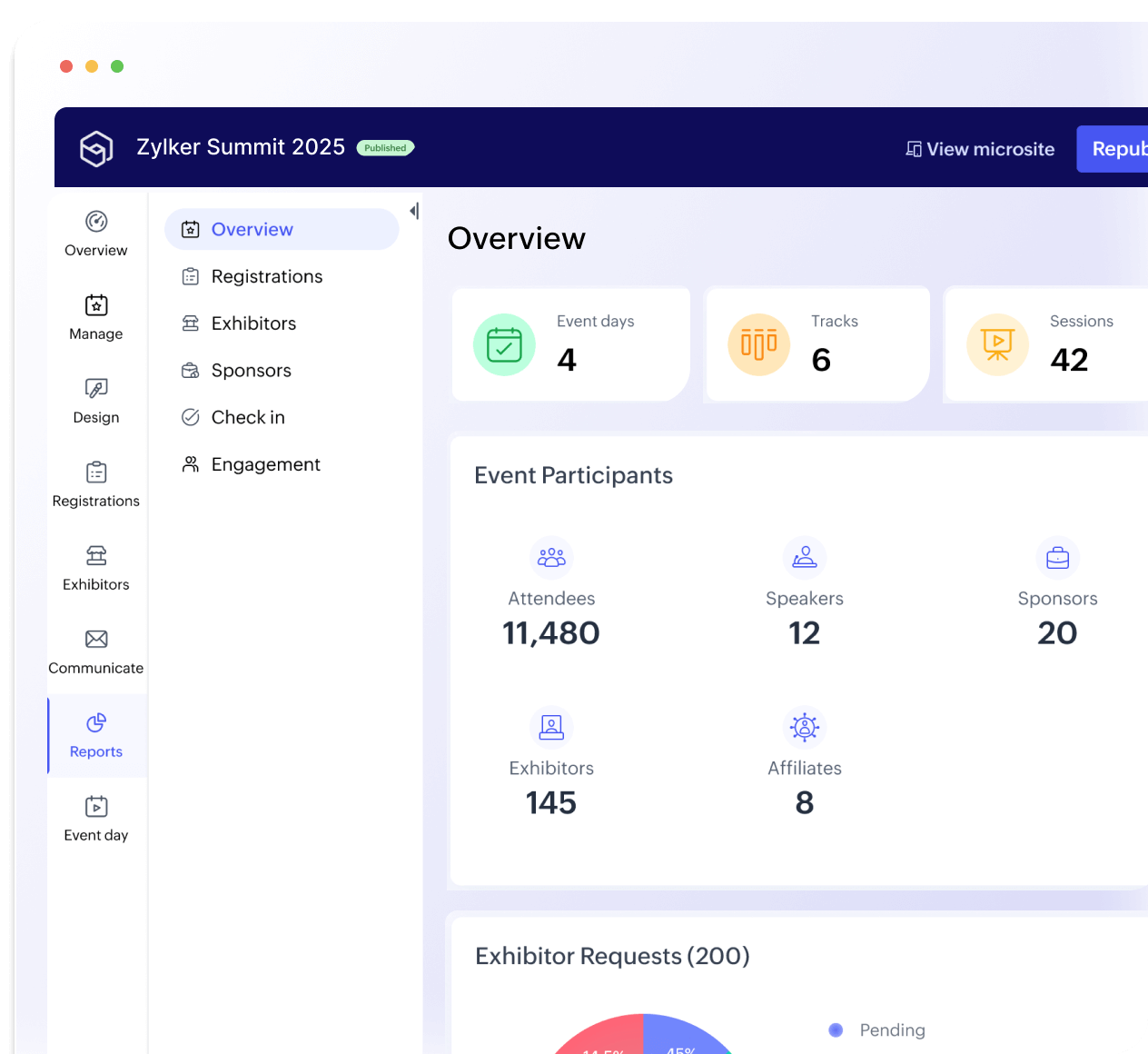
  • Choose an expense tracking dashboard that gives complete visibility- With most events, you’d prefer monitoring spend vs budget in real-time. Advanced event planning software like Zoho Backstage provides you tools that let you assign costs to categories, see burn rate, and event alerts you when your spending on a cost center is nearing budget cap.
  • Vendor contract and invoice management: When you start tracking deadlines, deposits, and amounts due to different vendors, you need to ensure everyone gets paid on time. This also helps develop a good rapport that might come in handy for your future events. Besides, invoice management ensures that you are not forgetting any important planning aspect which may cost you dearly, as last-minute add-ons to events come at premium charges.
  • Scenario modelling and event simulation: There are several ‘what-if’ scenarios that can reduce surprise bottlenecks and hiccups during execution later. For example, by simulating “what if we have 20% more attendees” or “ what if the speaker cancels at the last minute” could help you in planning for contingencies and unforeseen events beyond your control.
  • Post-event reporting and auditing: By comparing the actual spend with what was planned, assessing the variances, and rationale behind cost overruns, the budgeting and planning for your next event becomes more knowledgeable, aware, and error-proof.

Real-time tracking and reporting with the help of Zoho Backstage helps manage all aspects of event planning and budgeting from start to finish.

7 practical budgeting tips for organizing budget-friendly events

Strong negotiation skills, and meticulous advanced planning could help in keeping event budgets from overshooting and yet deliver maximum impact. Here are 7 actionable tips that can be implemented right away for your next event.

  • Negotiate for bundled services: If you can get one vendor for venue, tech, and catering, for example, you could negotiate for discounts applicable on packages and bundled bookings to reduce your cost.
  • Choose vendors that can scale up or down and offer tiered costing: Booking technulogy and production with tiers helps you start with a basic set up with a chance to go for optional upgrades. For example, if you have cost tiers for 0-1000 attendees, then from 1001-2500 attendees and so on, it helps you budget better.
  • Use early bird/ tiered pricing for attendees: Early bird discounts, pre-registrations, and tiered pricing encourages early cash-flow, and forecast attendance.
  • Leverage sponsorships smartly: Wherever possible, offer packages to sponsors that help offset costs for example, sponsor leads could be part of your lead base, and so do co-branding in exchange for fees. But ensure that you define and convey deliverables clearly and well in advance.
  • Ensure every line item is audited: There are several hidden costs that sneak in and add up. For example, taxes, service charges, government permit fees, travel and lodging, logistics and shipping. Make sure you utilize past data and current trends and keep track of all expenses that come to the fore only during the planning stage and include them in your budgeting.
  • Regularly monitor the spends and revise your estimates: As you get closer to the event date, keep a close eye on your spends and what you had actually estimated. Some costs may have gone up and may require you to squeeze them in your limited budget.

Bonus tip: This is where keeping a contingency plan helps. When you keep a provision for cost overruns, you can still settle the surprise inflated bills comfortably without overshooting your budget!

  • Keep a balanced approach towards building intangible value: While you can not put a price tag on things like attendee experience, brand consistency,and networking worth, sometimes overspending in these areas help amplify event results.Overlooking the intangible value that organizing an event offers may make your audience feel uninspired, leading to poor participation for the present as well as future events.

Case study: How ActionCOACH UK reduced event costs and improved visibility

ActionCOACH UK's flagship conference, BizX, brings together over 1,100 attendees, high-profile speakers, and sponsors every year. But managing multiple tools for registration, ticketing, and sponsor tracking created fragmented visibility and rising operational costs. Manual processes like pre-printed badges and hybrid sponsor management added further overheads and inefficiencies.

By adopting Zoho Backstage, the team consolidated their event operations from registration and ticketing to sponsor management, on a single platform. This helped them eliminate redundant tools, reduce manual labor, and gain real-time insight into spend across cost categories. Features like on-site badge printing and digital check-ins minimized wastage and cut material costs, while built-in analytics offered clearer visibility into revenue and expenses.

The result? A more streamlined, cost-efficient event with improved sponsor satisfaction and reduced risk of overruns- proof that the right event management platform can turn operational complexity into measurable savings.

Best practices and mistakes to avoid while budgeting for an event

Some of the must-have practices that work well irrespective of the type and scale of the event:

  1. Start budgeting early: For large events start budgeting at least 4-6 months in advance, even more for multi-day, multi-speaker or hybrid events.
  2. Use past event data to predict future outcomes accurately: Wherever possible, for example for attendance, cost per head, vendor costs, check the data from your past events and set realistic benchmarks and estimates
  3. Set up a cross-functional budget review: Ensure that all other departments like finance, operations, marketing, and event staff are aligned to avoid last minute cost surprises.
  4. Regular check-ins: Start with monthly check-ins and then move on to more frequent check-ins as you approach event day.

Common mistakes to avoid while budgeting for an event

Try and avoid these mistakes early on for effective event budgeting:

  1. Underestimating time costs associated with event staff: planning, coordination, training, and trial runs, all need to be planned and conveyed well in advance to ensure maximum participation.
  2. Ignoring hidden overhead costs: Higher costs of transportation, sudden changes in hotel rates and accommodation, or payment of local taxes or license fee are some examples of cost overruns that need to be factored in during budgeting.
  3. Overcommitment: Expensive tech or fragmented systems existing on different platforms could lead to poor event performance and increased costs.
  4. Not provisioning for contingencies and emergencies: These lead to last-minute premium charges that can ruin a well-planned event budget.
  5. Not maintaining real-time accurate updates of actual costs incurred: Could lead to inaccurate guesstimates and imbalanced resource allocation.

Budgeting for events isn't about number crunching or guesswork.It is the backbone of every successful event. It's about meticulously planning and ensuring that your events deliver measurable value without unexpected surprises. How early you plan, how well you anticipate and account for risks, and whether you use tools that give you real-time control is the actual difference between an event that runs smoothly and one that struggles with overruns. With a clear structure of cost categories, realistic forecasting, a buffer for surprises, and tools that give you visibility in real time, you turn what could be a financial risk into a strategic advantage.

How Zoho Backstage helps in event budgeting

Zoho Backstage addresses the most common budgeting challenges by bringing all the elements of event planning on a framework that's built into the platform itself. With Backstage, you can avoid underestimations using historical event data and real-time analytics, set realistic budgets and prevent last minute cost overruns. It also helps control hidden costs by centralizing vendor contracts, ticketing, and expense tracking so you don't lose visibility. By combining agenda planning, ticketing, attendee engagement, and financial tracking, Backstage makes it easy for event teams to stay on budget while still delivering impactful events.

FAQ

For a conference or hybrid event, tech/AV can consume anywhere from 15-25% of your total budget depending on scale (size of venue, virtual component, interactivity). Always get quotes early.

For major events (1,000+ attendees, high speakers, hybrid/virtual elements), begin 6-12 months in advance. For smaller internal workshops or events (<200 attendees), 3-4 months may suffice.

Virtual adds costs in streaming, platform, engagement tools, but physical has logistics, catering, venue, staff. Allocate separately, forecast attendance in both categories. Use hybrid models only when justified by revenue or strategy.

Use your contingency buffer; have backup vendors; negotiate with existing vendors (maybe remove or scale down some non-critical elements); also periodically review your contracts for flexible clauses.