- HOME
- BI & Analytics
- Progress Acquires Domo: A Customer's Guide to What's Changing and What's Next
Progress Acquires Domo: A Customer's Guide to What's Changing and What's Next
- Last Updated : August 17, 2026
- 156 Views
- 9 Min Read
When your analytics platform changes ownership, questions follow. Will the roadmap change? Will pricing hold? Should you renew?
Those questions matter now for the organizations running Domo, after Progress Software announced a $400 million deal to acquire Domo's analytics platform and related assets. If you rely on Domo for reporting, dashboards, embedded analytics, or AI insights, there's no reason to panic. Domo isn't shutting down, and Progress has said it intends to keep supporting and developing the platform.
Still, an acquisition is a natural checkpoint. This guide covers what happened, what to expect, the questions worth asking before you renew, and what to weigh if you decide to look at alternatives.
Before you continue
If you're a Domo customer, here's what you should know upfront:
- Your analytics environment isn't changing overnight. Existing Domo customers can continue using the platform during the transition.
- No immediate pricing or roadmap changes have been announced. More details are expected after the acquisition closes.
- If your renewal is approaching, this is a good time to evaluate your options. Review your analytics requirements before signing a new contract.
This guide will help you understand what to expect, what questions to ask, and how to compare BI platforms if you're considering alternatives.
What happened?
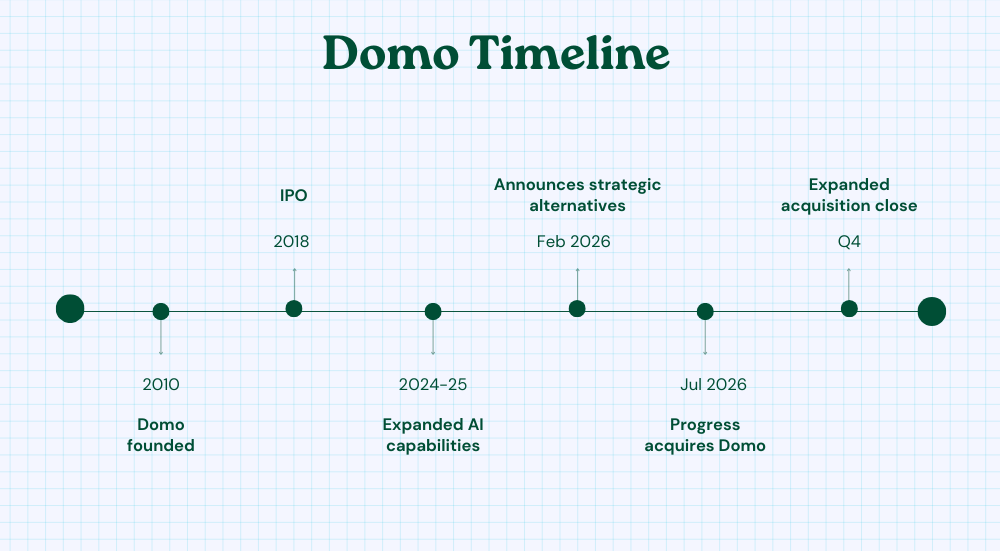
On July 16, 2026, Progress Software signed an agreement to acquire substantially all of Domo's operating assets for $400 million in cash, including the analytics platform, intellectual property, customer contracts, and employees.
The deal followed months of uncertainty. Earlier in the year, Domo disclosed it was exploring strategic alternatives after financial pressure and concerns tied to its lending agreements. Progress emerged as the buyer.
This is structured as an asset purchase rather than a traditional acquisition: Progress acquires the operating business while the existing public company retains certain assets, including cash and tax-related assets. For customers, what matters is that the platform continues under new ownership, backed by a company with a broader enterprise software portfolio.
Why Progress acquired Domo
Progress has spent recent years expanding its enterprise software portfolio through acquisitions across application development, infrastructure, file transfer, and data management. Domo adds a mature cloud analytics platform with AI capabilities and an established enterprise customer base.
The acquisition gives Progress a cloud-native BI platform, AI-assisted and natural language analytics, embedded analytics, data integration and data visualization technology, and more than 2,000 customer accounts.
How Progress shapes Domo's roadmap will become clearer once the deal closes and long-term plans are announced. Product investment, pricing, packaging, and integration priorities usually take shape then.
What changes today?
For most customers, very little changes right away. Reports run, dashboards stay available, and existing workflows, scheduled reports, and contracts continue until renewal.
Question | Current status |
| Is Domo shutting down? | No. Progress plans to continue the platform. |
| Can existing customers continue using Domo? | Yes. Existing services continue during the transition. |
| Are customer contracts still valid? | Yes. Existing agreements remain in effect until new terms are communicated. |
| Will support continue? | Progress has indicated that customer support will continue. |
| Will pricing change? | No changes have been announced. |
| Will the product roadmap change? | Future roadmap details are expected after the acquisition closes. |
The bigger questions tend to surface over the following months, as the new owner defines product investment, support, pricing, and integration plans. That's why many teams use this period to check whether their current platform still fits their reporting needs, data strategy, and budget.
Questions to ask before you renew
An acquisition doesn't mean you should replace your platform. It's a reason to check whether it still fits, especially if you renew in the next 6 to 12 months. A few questions worth raising with your team and your Domo representative:
Product roadmap
One of the first questions customers ask is whether product development will continue at the same pace. In many acquisitions, the acquired product becomes part of a broader portfolio. That can lead to new integrations, shared AI capabilities, or a wider customer base. It can also shift engineering priorities as teams work toward a common platform strategy.
If your business relies on specific Domo capabilities, it is worth asking your account team how those features fit into the long-term roadmap once Progress completes the acquisition.
Pricing and licensing
Existing contracts generally remain in place until renewal. Future licensing models and packaging usually become clearer over time. If your renewal is approaching, ask whether your current pricing is protected for the duration of your agreement and whether any licensing changes are expected after the acquisition closes.
Customer support
Support teams often continue operating as usual during the transition. Over time, support processes may move to the acquiring company's systems or customer success teams. Most organizations communicate these changes well in advance, but it's useful to understand how support will work after the transition.
Integrations
Every analytics platform connects with dozens or even hundreds of business applications. If Domo integrates with your CRM, ERP, marketing tools, finance systems, or custom applications, ask whether those data integrations will continue to receive updates and how new integrations will be prioritized under Progress.
AI investments
Both Domo and Progress have invested in AI capabilities. The acquisition could create opportunities to combine those investments, though the direction and timeline will depend on Progress's product strategy. Organizations planning long-term AI initiatives should keep an eye on future roadmap announcements to understand where those investments are headed.
Why some Domo customers may evaluate alternatives
Not every Domo customer will consider moving to another analytics platform. For many, the acquisition may have little immediate impact. However, organizations often review their BI stack during major business events such as contract renewals, acquisitions, mergers, or digital transformation initiatives.
Common reasons include:
- Reviewing pricing before renewal
- Expanding analytics to more teams
- Evaluating newer AI capabilities
- Consolidating vendors
- Improving governance and security
- Simplifying data connectivity
- Exploring embedded analytics
If you're weighing options, see our roundup of the top Domo alternatives in 2026, which compares Zoho Analytics, Power BI, Tableau, Looker, and others.
A practical checklist for evaluating any BI platform
If you're comparing analytics platforms, use the same evaluation criteria for every vendor. Rather than focusing on feature counts, look at how well each platform fits your reporting requirements, technical environment, and budget.
Area | Questions to ask |
Data connectivity | Does it connect to all your business applications without complex setup? |
Data preparation | Can business users clean and prepare data without relying on IT? |
AI capabilities | Does it help users explore data, identify trends, and answer questions faster? |
Dashboard creation | Can teams build reports without extensive technical skills? |
Governance | Does it support role-based access, audit controls, and data security? |
Embedded analytics | Can analytics be shared with customers, partners, or internal applications? |
Pricing | Is the licensing model clear and predictable as usage grows? |
Customer support | What implementation, onboarding, and technical support options are available? |
Vendor direction | Does the company's long-term product strategy match your organization's plans? |
Why organizations evaluate Zoho Analytics
Zoho Analytics is one of several BI platforms organizations consider when reviewing their BI strategy. For businesses already using Domo, our Zoho Analytics vs Domo comparison breaks down deployment flexibility, AI capabilities, pricing, and migration effort side by side..
Here's where Zoho Analytics is commonly evaluated:
- Connect data from across your business
- Build reports without relying on technical teams
- AI-assisted analytics
- Embedded analytics
- Flexible deployment
Connect data from across your business
Zoho Analytics connects with more than 500 business applications, databases, cloud storage platforms, and business systems. Teams can combine data from sales, finance, marketing, support, HR, and operations into a single reporting environment without building custom integrations for every source.
Build reports without relying on technical teams
Business users can create dashboards through a drag-and-drop interface while analysts retain the flexibility to build more advanced reports and calculations when required. This combination works well for organizations where both business users and technical teams work with the same data.
AI-assisted analytics
Ask Zia allows users to explore data using natural language questions, generate summaries, identify trends, and build visualizations without writing SQL. As organizations continue investing in AI, these capabilities help reduce the time required to answer everyday business questions.
Embedded analytics
For software companies, customer portals, and internal business applications, Zoho Analytics provides embedded dashboards that can be customized for different users while maintaining access controls.
Flexible deployment
Organizations can choose between cloud and on-premises deployment depending on their security and compliance requirements. This flexibility is particularly useful for businesses operating in regulated industries or regions with specific data residency requirements.
Planning a migration
Migrating from one BI platform to another is rarely a one-click process. Most successful migrations begin with an inventory of the existing analytics environment before any dashboards are rebuilt.
Use the checklist below to understand what should be reviewed before starting a migration project.
Reports and dashboards
- Dashboard inventory
- Report dependencies
- KPIs and scorecards
- Scheduled reports
Data preparation
- Data sources
- Data models
- ETL workflows
- Custom calculations
- Data refresh schedules
Users and security
- User accounts
- User roles
- Groups
- Row-level security
- Permissions
Automation
- Alerts
- Scheduled exports
- Email subscriptions
- APIs
- Embedded dashboards
Documenting these components early reduces surprises during implementation and makes it easier to estimate migration effort.
Your next renewal is a good time to ask better questions
The Progress acquisition gives Domo a new chapter under a larger enterprise software company. For many customers, day-to-day operations will continue without disruption while Progress shares more details about its plans for the platform.
For organizations approaching contract renewal or reviewing their analytics strategy, this is also a practical time to evaluate whether their current BI platform continues to meet business requirements. Looking at data connectivity, AI capabilities, governance, deployment options, pricing, and long-term product direction provides a stronger basis for that decision than focusing on the acquisition alone.
If you're exploring your options, Zoho Analytics offers migration guidance, a broad connector ecosystem, AI-assisted analytics, embedded BI, and flexible deployment options. Whether you decide to stay with Domo or move to another platform, taking time to review your analytics environment now can help you make a more informed decision before your next renewal.
Frequently asked questions
Is Domo shutting down?
No. Based on the information announced so far, Domo is not shutting down. Progress Software has acquired substantially all of Domo's operating assets, including its analytics platform, customer contracts, intellectual property, and employees. Existing customers can continue using the platform, and Progress has indicated that it intends to support and develop it. As more details about the product roadmap and future investments become available, customers should review those updates alongside their own business requirements before renewal.
Can I continue using Domo?
Yes. Existing customers can continue using Domo during and after the acquisition process. There is no indication that current dashboards, reports, or scheduled workflows will stop working because of the ownership change. If your contract is nearing renewal, it's a good time to discuss future roadmap plans, licensing, and support with your Domo account representative so you have clarity before making a long-term decision.
Will Domo pricing change?
At the time of writing, Progress has not announced any pricing or licensing changes for Domo. Existing agreements typically remain valid until renewal, and any future updates would usually be communicated in advance. If you're planning your next renewal, consider asking whether your current pricing is protected and if any licensing or packaging changes are expected.
Should I switch platforms because of the acquisition?
There isn't a single answer that applies to every organization. If Domo continues to meet your reporting needs and Progress's roadmap aligns with your long-term plans, remaining on the platform may make sense.
If your organization is already reviewing contracts, expanding analytics across departments, or evaluating AI capabilities, this may be a good opportunity to compare other BI platforms before making a long-term commitment.
What should I evaluate before choosing a BI platform?
Focus on:
- Data connectivity
- Ease of report creation
- AI capabilities
- Governance
- Embedded analytics
- Pricing
- Customer support
- Product roadmap
How difficult is migrating from Domo?
Migration complexity depends on the size of your deployment. Organizations with a small number of dashboards can often migrate relatively quickly, while enterprise deployments with hundreds of reports, custom calculations, embedded analytics, and automated workflows require more planning.
 Vinisha
Vinisha is a Marketing Analyst at Zoho Analytics with a strong passion for both marketing and data. She’s naturally curious about trends and loves diving into data to uncover what drives effective campaigns. She has a knack for simplifying complex information and presents insights in a relatable and engaging way that connects with audiences. Outside of work, she enjoys exploring the creative side of digital marketing.