- HOME
- All Topics
- Productivity in the workplace
- Why multitasking doesn’t work: How to redesign your workday for focus
Why multitasking doesn’t work: How to redesign your workday for focus
- Published : July 23, 2026
- Last Updated : August 20, 2026
- 96 Views
- 5 Min Read
What is multitasking?
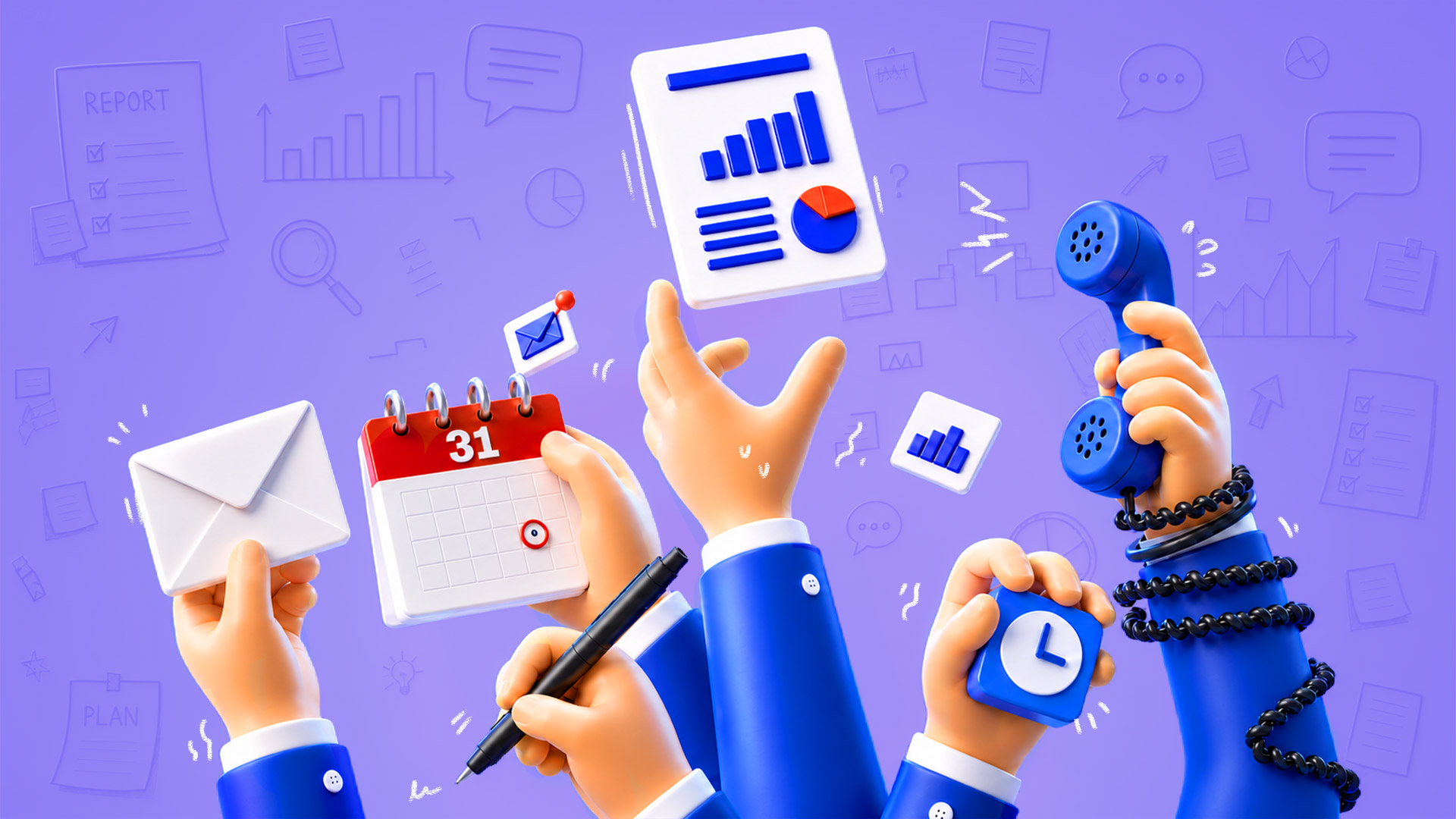
Multitasking is the act of switching rapidly between competing cognitive tasks. It’s one of the most common requirements in modern job descriptions. But decades of neuroscience research show that it’s not a skill. The human brain isn’t a parallel processor; it switches serially, and every switch costs time, accuracy, and mental energy.
Yet most workplaces still reward the appearance of constant availability. Productivity is stalling, burnout is at record highs, and the underlying cause is structural: We’ve built environments that demand fragmented attention. If your team feels overwhelmed, the problem isn’t discipline, it’s design.
This article covers what multitasking actually does to the brain, the financial cost it imposes on a business, and a practical framework leaders can use to design for focus instead.
What does multitasking actually do to your brain?
The prefrontal cortex, the part of the brain responsible for focused thought, processes tasks serially, not in parallel. What feels like multitasking is really micro-switching. The American Psychological Association describes it as a two-stage process: goal shifting (deciding to move from Task A to Task B), followed by rule activation (unloading the rules for Task A and loading the rules for Task B).
The cost compounds. Research by professor Sophie Leroy identified a phenomenon called attention residue: When you switch tasks, part of your attention stays anchored to the previous one. Glance at your team message while reviewing a contract, and a significant portion of your cognitive capacity can remain on that message for up to 20 minutes.
In a workday peppered with hundreds of micro-switches, you’re rarely operating with the full capacity of your brain.
Key takeaway: Multitasking isn’t parallel processing—it’s a series of expensive context switches, each one taxing attention long after the switch is over.
How much does multitasking cost a business?
For leadership, micro-switching isn’t a psychological curiosity—it’s a financial drain. Research by Gloria Mark at the University of California, Irvine shows it takes an average of 23 minutes and 15 seconds to fully return to a task after an interruption. Across a 40-hour week, heavy multi-taskers lose up to 40% of their productive time to switching costs.
- Productivity cost: On a team of 100 people, a 40% productivity loss is the financial equivalent of paying 40 employees who never show up.
- Cognitive impact: A study at the University of London found that workers distracted by emails and calls saw a 10-point drop in IQ—roughly twice the cognitive impact of smoking marijuana.
- Error penalty: In high-stakes work like coding, financial auditing, or strategic planning, fragmented attention introduces silent errors that compound into rework and lost opportunity cost.
Key takeaway: Multitasking doesn’t just slow people down. It produces lower-quality work and is one of the largest hidden line items in a company’s P&L.
What is performative responsiveness?
If the science is this clear, why is multitasking still the default mode of work? Most of the answer lies in a cultural pattern called performative responsiveness: the unspoken pressure to maintain the “green dot” of active status at all costs, treating reply speed as a proxy for productivity.
Three patterns define it:
- Visibility over value: Prioritizing reply speed to prove that work is happening, rather than the quality of the work itself.
- Green-dot anxiety: The pressure to appear active on chat apps so you aren’t perceived as being idle.
- Fragmented availability: Continuous partial attention across multiple channels, sacrificing depth for accessibility.
The tradeoff is impact (long-term value) for immediacy (short-term visibility). Notifications become currency, and most teams are spending more than they earn.
Signs your team has a multitasking problem
If three or more of the following statements are true, multitasking is costing your team meaningful productivity:
- More than 60% of internal messages arrive on a chat tool with a default sound or push notification.
- Meetings have no agenda, and reading the recap afterward would convey the same information.
- Employees keep more than 10 browser tabs open at once during typical work.
- Status updates are tracked across two or more disconnected tools (e.g., chat plus a separate project app plus email).
- Managers expect replies to non-urgent messages within an hour, including outside formal working hours.
- “Quick syncs” are scheduled in place of written updates more than twice a week.
How do you design a workplace without multitasking?
Willpower can’t fix a fragmented environment. Focus architecture is the intentional design of a digital workplace that protects cognitive flow over constant accessibility. It works on three levers: communication norms, deep-work boundaries, and tool consolidation.
1. Set a hierarchy of communication
Most workplaces operate on “real time by default”. Every message is treated as an emergency. Flip that by sorting communication into three tiers, each with its own tool and expected response time.
| Level | Mode and tools | Primary use case | Expected response | Focus cost |
| Synchronous (the exception) | Live calls, video meetings, direct pings | Live crises, urgent blockers, complex 1:1 feedback | Immediate | High |
| Semi-async (the engine) | Channel chat (Zoho Cliq), doc comments (Zoho Writer) | Progress updates, non-urgent questions, draft review | Minutes to hours | Medium |
| Deep async (the source) | Long-form docs, knowledge bases, Zoho WorkDrive | Strategy docs, technical specs, company policies | Hours to days | Zero |
2. Protect deep-work blocks
Here are two practical changes high-performing teams use:
- Policy-driven focus hours: Adopt “no-meeting Wednesdays” or daily focus blocks (e.g., 9:00 AM to 12:00 PM) where deep work is the only acceptable activity.
- Descriptive status: Replace the green dot with explicit signals like “In deep work—back at 2:00 PM.” Removing ambiguity removes the guilt of not replying instantly.
3. Consolidate tools to eliminate context-switching
Every hop between a document, a chat thread, and a project board is a context switch. A unified workspace like Zoho Workplace keeps email, chat (Cliq), documents (Writer), files (WorkDrive), and team posts (Connect) inside a single environment, so the system carries the retrieval burden instead of forcing employees to hunt across tabs. Fewer tabs means fewer switches, and fewer switches means more time inside flow.
4. Use AI as a cognitive shield, not a productivity multiplier
The most valuable role for AI in a focus architecture is filtering, not producing. Instead of an employee scanning a 200-message thread, an agent can summarize it, extract the action items, and surface only what requires a decision. AI shouldn’t just help teams work faster—it should help them stay in flow longer by absorbing the distractions.
Key takeaway: Focus architecture replaces willpower with structure: clear communication tiers, protected blocks, consolidated tools, and AI as a filter.
Why is attention the next competitive advantage?
As AI commoditizes execution, the durable human edge shifts to strategic synthesis—the ability to connect dots across long reading, deep thinking, and uninterrupted work. The next decade won’t belong to the multitasker juggling shallow threads. It will belong to the focused generalist, and to the leaders who build systems that protect attention so that work can happen.
FAQ
Is multitasking good for productivity?
No. Research consistently shows multitasking can reduce productivity by up to 40%. It creates the psychological feeling of being busy, but the cognitive cost of switching slows task completion and increases errors.
What is context switching?
Context switching is the mental process of moving between unrelated tasks; for example, jumping from a strategic document to a chat notification. Each switch forces the brain to unload one set of rules and load another, draining mental energy and reducing functional output.
Can anyone actually multitask effectively?
Rarely. Research by Watson and Strayer at the University of Utah found that only about 2.5% of people are “supertaskers” who can perform multiple high-cognitive tasks without a measurable drop in performance. For everyone else, multitasking degrades output.
What’s a better alternative to multitasking?
Single-tasking, or mono-tasking. The most effective approach combines time-blocking for deep work and batching smaller administrative tasks into a single window, which minimizes the number of switches across the day.
How can leaders reduce multitasking on their team?
Start with structure, not exhortation. Define which communication channels are synchronous vs. asynchronous, establish protected focus blocks, consolidate fragmented tools into a single workspace, and use AI agents to summarize threads instead of forcing people to read every message.
 Diksha Uniyal
Diksha works at the intersection of brand strategy, content marketing, and influencer collaborations, helping shape the stories behind modern workplace technology. She enjoys creating content that helps businesses communicate, collaborate, and grow more effectively. Outside of work, she spends her time reading, creating music, and finding inspiration in the small, often overlooked moments of everyday life.