- HOME
- All Products
- AI productivity: Why adoption is up, results are flat, and what leaders should do now
AI productivity: Why adoption is up, results are flat, and what leaders should do now
- Published : August 31, 2026
- Last Updated : August 31, 2026
- 2 Views
- 7 Min Read
Key takeaways
- AI productivity is real at the task level but consistently absent at the org level. The structure of how AI is deployed explains the gap.
- When AI speeds up tasks, workloads and expectations expand to absorb the gains. Speed without scope control produces more work.
- Teams that rely heavily on AI for core tasks lose the skills to evaluate and correct AI output—a compounding business risk.
- Most orgs measure AI adoption rate and task speed, but neither metric predicts business outcomes.
- Leaders need a deliberate playbook. Define the scope, protect skills, and tie AI use to real outcomes.
AI productivity is supposed to free up time but, for most organizations, it hasn’t. Teams are using AI tools daily, adoption dashboards look healthy, and the business metrics are flat. For managers, team leads, and business leaders who’ve already bought into AI and are now looking for results, this article will help you understand why that gap exists and what you can do to eliminate it.
What is AI productivity?
AI productivity is the measure of useful output that artificial intelligence enables relative to the time, cost, and human effort invested. In practice, it shows up as faster first drafts, quicker data analysis, shorter customer response times, and reduced time on routine tasks.
The gains at the individual level are real. Developers using AI coding assistants write code faster. Analysts process reports in a fraction of the time. Customer service teams handle more tickets per hour. These are well-documented.
The problem is what happens at the organizational level. A 2026 NBER study found that while 69% of firms actively use AI, 89% of executives report no measurable impact on labor productivity over three years. According to a Wall Street Journal analysis, 40% of workers reported that no time has been saved despite using AI regularly.
Individual speed and organizational outcomes are moving in different directions, and the gap is structural, not accidental.
Key takeaway: AI productivity at the individual task level is proven. It’s in the gap between individual productivity and business-level results where most organizations are losing ground.
Why do AI productivity gains disappear at scale?
The Jevons Paradox explains why: When a process becomes more efficient, demand for that process expands to consume the gain. When AI makes tasks faster, scope expands, timelines compress, and output expectations rise. The time saved gets absorbed before it reaches any metric that matters.
What does measuring AI productivity wrong actually cost you?
Most organizations track adoption rate and task speed. Neither connects to business outcomes.
Developers spend a fraction of their working time actually writing code. The rest goes to design, code review, meetings, and coordination. An AI coding tool that speeds up code generation doesn’t touch any of that. Sprint velocity, release quality, and defect rates reflect that.
McKinsey conducted a survey that found only 39% of organizations can trace any enterprise-level earnings impact to their AI spending. According to a report from MIT’s Project NANDA, 95% of enterprise generative AI pilots failed to reach production in 2026 despite showing task-level gains.
The deskilling problem and why it compounds
Deskilling is the less visible dimension of the AI productivity problem, and the more dangerous one for long-term organizational performance.
Skills develop through practice. When AI handles the practice, the skill doesn’t build. One 2026 survey found that 39% of workers say AI has weakened their skill set. Among workers under 30, that number is 46%. It’s worth keeping in mind that these are also the people currently being developed into your next senior-level layer.
The problem shows up in three specific ways.
Capability decline in core functions. A 2026 study of junior software engineers with AI access showed measurably weaker debugging, code comprehension, and conceptual understanding than peers without it. They were faster, but less capable. Another 2026 report found that 74% of healthcare clinicians said they worry about losing diagnostic ability from AI dependence, and early research supports that concern across functions, from analysts to project managers.
The evaluation gap. When team members lose the ability to do a task independently, they also lose the ability to evaluate whether AI did it correctly. Errors that experienced reviewers would catch end up passing through unchallenged. The team becomes dependent on a tool it can no longer audit.
Fragility under disruption.The GoTo Pulse of Work 2026 survey found 30% of workers say they can't function without AI tools. That's not a productivity gain — that's dependency. When a tool goes down, changes significantly, or produces errors the team can no longer catch, an AI-dependent team has no fallback. An AI-productive team does.
The effect compounds. A team that consistently delegates judgment work to AI stops developing the judgment to catch mistakes in AI output.
Key takeaway: Deskilling is a business risk, not a personal development concern. It quietly erodes quality, evaluation ability, and team resilience over time—until it isn’t quiet anymore.
A leader’s playbook for AI productivity
AI is already in the tools your team uses to draft, analyze, communicate, and decide.
The question for leaders isn’t whether to use it—that decision has already been made. The question is how to structure AI use so it delivers real productivity without quietly trading away skills, accountability, and judgment.
1. Govern AI like a business process
Governance means knowing which AI tools are in use, who approved them, what they’re used for, and who’s accountable when the output is wrong. Without that, AI scales without accountability and errors become untraceable.
Start with a simple AI register: a documented list of tools, use cases, owners, and risk level per function. It doesn’t need to be complex. It just needs to exist.
2. Assign accountability for AI output to a person
When AI generates a report, analysis, or decision input, who’s responsible for its accuracy? In most teams, the answer is unclear—which means no one is checking it carefully enough.
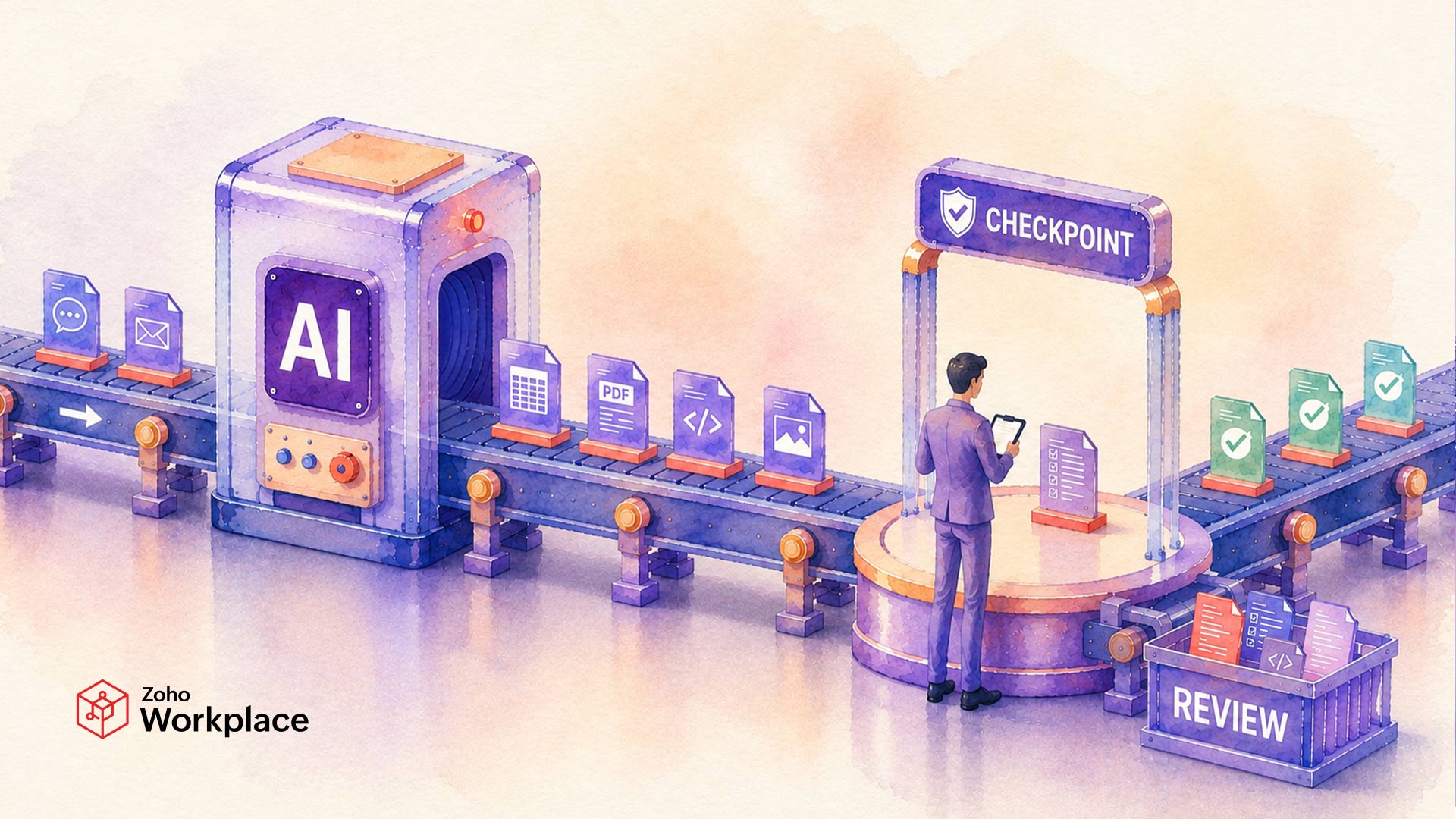
Make it explicit. The person who reviews and submits AI-generated work is accountable for it, regardless of how it was produced. This one decision changes how people interact with AI output. Reviewers stop approving automatically and start evaluating. Errors get caught. It also directly counters the evaluation gap that deskilling creates.
3. Build role-specific AI guidelines
A marketer generating campaign copy and an analyst building a financial model face entirely different risk profiles and skill considerations.
Define what AI should and shouldn’t do by role. Where speed is the priority and output is easy to verify, AI use can be broad. Where judgment, accuracy, and original thinking define the value, set tighter limits. The process of mapping this per role also surfaces which skills your organization actually needs to protect—and where you’ve been substituting AI for thinking that still needs to be human.
4. Invest in AI literacy across every function
Most AI upskilling reaches technical roles. The skills needed to use AI productively—evaluating output quality, writing prompts that produce useful results, catching errors, knowing when not to use the tool—belong across every function.
The World Economic Forum projects that 60% of workers will need reskilling before 2027. Organizations that treat this as continuous learning embedded in daily work outperform those that run one-off training events. The goal is a team that uses AI critically, not automatically.
5. Create visibility into where human judgment is happening
In AI-heavy workflows, it becomes genuinely difficult to tell where original human thinking is contributing and where AI output is just being passed through. That visibility matters for quality, for skill development, and for knowing what your team is actually capable of.
Within Zoho Workplace, Zoho Connect keeps team discussions and decisions organized in structured threads. Zoho WorkDrive organizes the file versions and contributor history, and Zoho Writer lets teams track changes and leave comments directly on the work. When leaders can see who made which call and where AI output ends, they can manage team capability with real information rather than assumptions.
6. Review AI performance against outcomes every 30 to 60 days
Most organizations review AI adoption once a year, if at all. By then, a deployment that isn’t working has been running long enough that reversing it is expensive.
Set a shorter cycle. Every 30 to 60 days, check one outcome metric per AI-assisted function against the baseline before its deployment. Is output quality holding? Are skills developing as expected? Is the scope staying where you defined it? These reviews don’t need to be long. They need to be regular.
Wrapping up
AI productivity is real, uneven, and measured inaccurately. Organizations closing the gap are using it with clearer scope, protecting the skills that create long-term value, and measuring against outcomes that matter. The tools exist. The playbook is here. What most organizations are missing is the decision to use it.
FAQ
What is AI productivity?
AI productivity is the measure of useful output that AI tools enable relative to the time, cost, and human effort invested. It shows up as faster task completion, higher output volume, and reduced time on routine work. The key distinction is between task-level productivity (individual speed gains) and organizational productivity (business outcomes). Most AI deployments deliver the former and miss the latter.
Why isn’t AI productivity showing up in business results?
The most common cause is the Jevons Paradox: As AI speeds up tasks, workloads and expectations expand to absorb the time saved. A separate factor is measurement. Tracking adoption rate and task speed doesn’t predict business outcomes. If outcome metrics haven’t moved since AI adoption began, the scope and measurement need to change before the results will.
What is the AI productivity paradox?
The AI productivity paradox is the gap between high AI adoption and the absence of measurable productivity improvement at the organizational level. Workers complete tasks faster; workloads expand to consume the time saved; business outcomes stay flat. The paradox closes when organizations control the scope, protect skill development, and tie AI use to real outcomes.
How does AI deskilling affect organizations?
When AI handles tasks that require human judgment and practice, those skills atrophy in the people who would have developed them. Organizations face three specific risks: declining output quality, a reduced ability to catch AI errors, and fragility when tools are unavailable or under perform. The effect compounds over time and is harder to reverse the longer it’s allowed to go on.
How should leaders measure AI productivity?
Tie metrics to business outcomes such as conversion rates, error rates, decision quality, and customer satisfaction, depending on the function. Adoption rate and task speed confirm the tool is being used, not that performance is improving. Set one outcome metric per AI-assisted function and give it 90 days before evaluating its effectiveness.
 Diksha Uniyal
Diksha works at the intersection of brand strategy, content marketing, and influencer collaborations, helping shape the stories behind modern workplace technology. She enjoys creating content that helps businesses communicate, collaborate, and grow more effectively. Outside of work, she spends her time reading, creating music, and finding inspiration in the small, often overlooked moments of everyday life.