WorkDrive DLP: Looking at how Data Loss Prevention secures organizations
- Last Updated : December 24, 2025
- 458 Views
- 5 Min Read

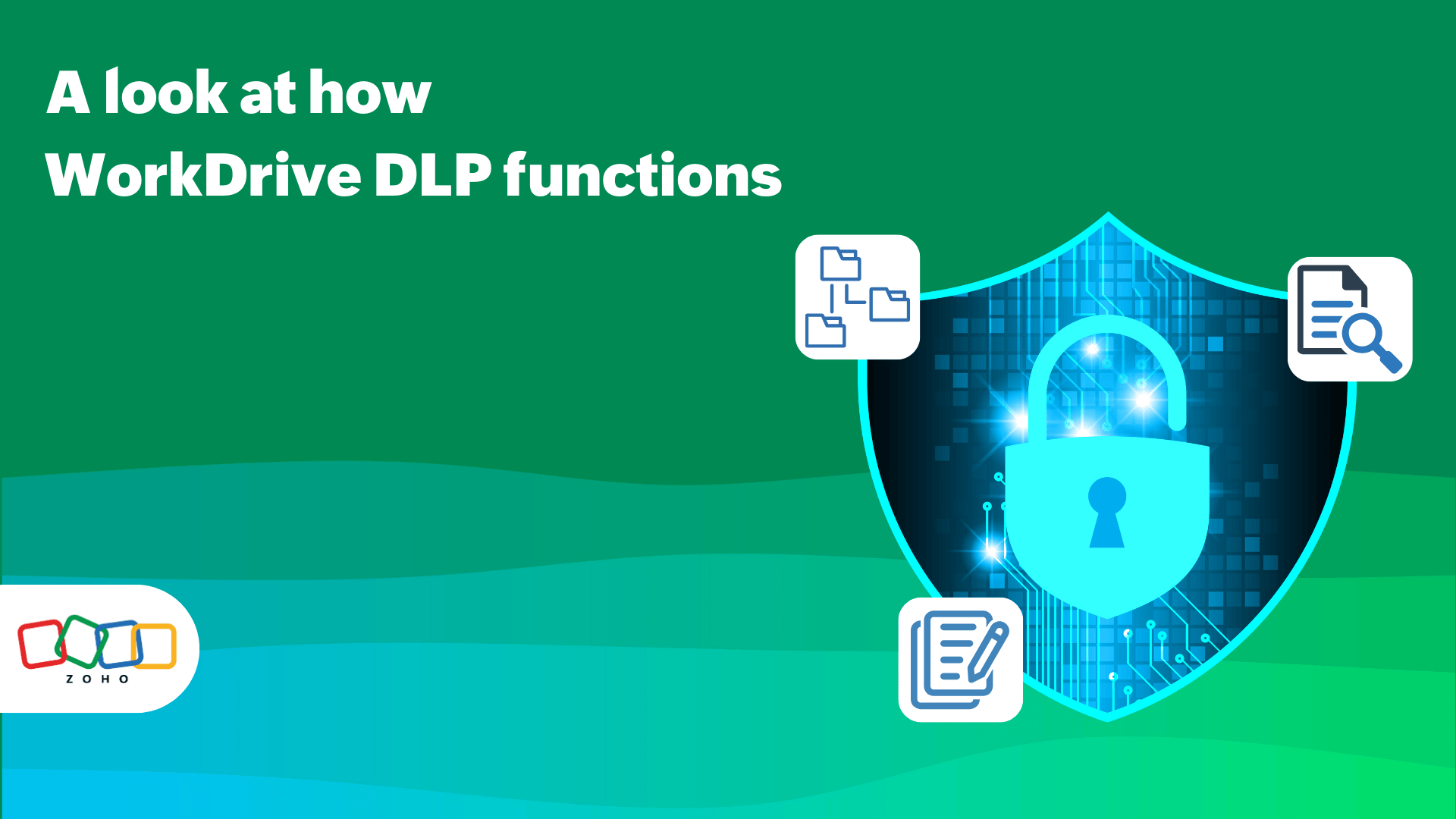
A secure environment is always one of the first priorities for an organization. However, maintaining a standardized system for handling sensitive data becomes harder as the scale increases. This is where a policy like Data Loss Prevention (DLP) comes into play.
We had discussed DLP’s functionalities in depth in a previous blog. Now, let's take a look at how WorkDrive DLP’s flexible features help it seamlessly support organizations regardless of size, region or, industry!
Case 1: Educational institutions
Educational institutions often have to deal with overlapping regulatory frameworks when it comes to structuring files and data for administration and compliance purposes.
If you a consider a university, for example: It needs to comply different frameworks to secure student’s educational and financial information, and all types of PII under separate regulations such as HIPAA or other applicable compliance standards.
Even in a digital environment, maintaining all this information is challenging. And there are several areas that require support, such as:
Student records: Educational institutions maintain detailed records on each student such as their grades, addresses, family contact information, and academic history.
Payment information (Bank accounts, card data): Whether via online banking or credit card payments, educational institutions are constantly processing payments to and from multiple financial institutions. All this information needs to be logged for compliance and record-keeping and must be stored securely.
Research data: Colleges and universities maintain research IP in the form of both offline and online datasets. Such data is also very valuable and needs to be protected against data breaches.
Third-party vendor tools and information: With nearly every institution utilizing third-party tools for specific use cases, they need a standardized method of whitelisting approved apps and making necessary tools available to users within the institution's network.
In all of these cases, ensuring proper control over which users within the network get access to specific datasets is essential.
Using WorkDrive, administrators can automatically classify students' records using the correct identifiers, with many regional identifiers already included in the platform. Manual classification of labels is also easy, with built-in oversight features to ensure data changes are reviewed by an assigned admin.
Case 2: Secondary loan providers or non-banking financial companies (NBFC)
Aside from both private and government banks, NBFCs serve critical roles in financial markets, providing credit to small and medium enterprises as well as to individuals who might be unable to qualify for a bank loan.
While not defined as a bank, these institutions are still overseen by regulators in each country and subject to relevant compliance rules.
Any errors in a financial firm task could break down its system and then its reputation so there are several things to look out for:
Security against both internal and external threats: Customers’ loan information should never be exposed, and data breach risks aren't limited to external threats. Data can also be compromised from not just external breaches but also from temporary or employees on their notice periods. A proper level of control has to be maintained to ensure such things never occur.
Customer confidentiality: NBFCs must maintain each customer's PII, such as their names, addresses, income details, employment history, identification documents, credit histories. Proper policies need to be established so that PII is only accessible to those who are authorized to view the data for legitimate business purposes.
Data localization laws based on region: Most NBFCs operate in a specific region or focus on other specific niches or targeted industries. This means that the NBFC has to adhere to its region’s data localization laws accordingly.
Data control and encryption of media and additional information: An NBFC employee works with sensitive data all the time, sometimes even with removable storage devices. Proper mandating of device data encryption or IP-based restriction has to be done accordingly,
Mobile app standard maintenance: NBFCs have increased mobile banking and mobile lending capabilities within apps over time. DLP policies need to address data protection for mobile platforms. in these cases, admins need the ability to require end-to-end encryption for all data transmitted through mobile applications, secure storage of customer data on devices, and remote wipe capabilities.
In the case of NBFCs, many of the slower, more grueling data tasks can be successfully handled with automated DLP policies. While reviewing and approval can be done manually, you can easily set up automatic approvals based on various factors. Maintenance of mobile app forms can also be handled in the same way. Admins can directly oversee critical aspects of DLP, such as unplanned data wipes for lost devices or IP restrictions based on current circumstances.
Case 3: International trading companies
International trading companies face hurdles over regulations governing both data protection and trade controls. These companies handle sensitive information including technical specifications, export-controlled technologies, and customer data, all of which require simultaneous protection across multiple frameworks.
Such trade companies operate within a multifaceted regulatory environment. The General Data Protection Regulation (GDPR), which handles personal data interactions involving EU citizens and businesses, and the USA's Export Administration Regulations (EAR) are prime examples. Likewise, other countries and regions have their own specialized regulatory frameworks, which can vary based on the items that are being traded.
With every new regulatory framework adding new benchmarks, there’s a couple of things to look carefully into, such as:
Data identification and classification of goods (and services): Export-controlled technical information includes source code, blueprints, manufacturing specifications, design documents, and technical manuals related to controlled products. Policies have to be implemented that automatically identify and classify this technical data.
License tracking and validation: When technical data is shared with international partners or foreign nationals, applicable export licenses or Technical Assistance Agreements (TAAs) must authorize the transfer. DLP policies in WorkDrive can enforce controls to prevent technical data transfers unless a valid corresponding license exists.
Supply chain information: International trading companies routinely share technical specifications and manufacturing information with suppliers, manufacturing partners, and logistics providers. DLP policies control data sharing based on partner authorization status and export license scope.
Regionally-specific access: Certain companies based in the US or the EU enforce regional limitations even for their own employees if they aren’t located in a specific geographical region. For such cases, DLP policies that address this restriction need to be put into place.
Compliance automation: Trading companies across multiple jurisdictions must apply different data protection rules in different regions. Such DLP policies should automatically apply appropriate security measures based on data classification and destination jurisdiction.
With complex internal and external data sharing and security with a growing total volume of data being created, smart use of automation is required—and that includes setting up the correct DLP policies. Specialized labeling with a high level of customization enables such organizations to ensure appropriate oversight and accountability.
This also applies to tracking and validation of licenses for both internal resources and third-party elements. WorkDrive provides the flexibility admins and users need to support a combination of manual reviews and automated screening processes based on the organization’s rules.
There will always be some risk of errors—either human or procedural, but WorkDrive can pick up on those and send problematic data to be reviewed immediately.
All industries rely on data being able to move quickly. With precise profiling and classification, you can not only ensure better input and management of data but also ensure that the data remains secured once it’s in your system.