- HOME
- Know Your Tech
- No-code AI platform market size and growth trends
No-code AI platform market size and growth trends
- Last Updated : July 1, 2026
- 140 Views
- 8 Min Read
Highlights:
- Market growth: The no-code AI platform market will reach approximately $24.7 billion by 2029, reflecting strong adoption as organizations seek simpler ways to build AI-enabled applications.
- Rising adoption across teams: Business users, analysts, and operations teams are increasingly participating in application development through visual development platforms.
- Demand for faster development: Organizations are turning to no-code tools to reduce development timelines, automate workflows, and respond more quickly to operational needs.
- Changing application development practices: No-code AI platforms allow teams to prototype faster, collaborate across departments, and build applications tailored to real workflows.
- Future evolution of no-code AI platforms: Deeper AI integration, stronger governance features, broader integrations, and AI-assisted development are expected to shape the next phase of platform growth.
Building artificial intelligence (AI) applications once required specialized developers, data scientists, and significant investment. As a result, many organizations found it difficult to experiment with AI because the tools and expertise needed weren't always readily available.
Today, the growing demand for accessible AI tools has shifted how teams approach application development. No-code AI platforms enable organizations to build AI-powered solutions without complex programming.
This blog post explores the no-code market size, the trends shaping its growth, and the key factors influencing adoption. You'll also learn how these platforms are changing application development and what the future of no-code AI looks like.
What the no-code AI platform market looks like today
The no-code AI platforms market is about to reach around $9 billion this year, showing how quickly organizations are adopting tools that simplify AI application development.
For many teams, this growth represents a clear shift, as building AI-powered applications is no longer limited to specialized engineering teams. This change reflects how organizations are changing the way they develop software and experiment with AI.
Here are some of the trends that show how the no-code AI platform market is changing today:
- AI capabilities are becoming part of development platforms: Many no-code AI platforms now include features like data analysis and predictive capabilities within their development environments.
- Business teams are taking a more active role in software creation: Product managers, analysts, and operations teams are contributing to application development alongside engineering teams.
- Development platforms are moving beyond web applications: Many tools now support mobile apps and integrations within a single platform.
- Organizations are exploring AI-powered automation: Teams are finding ways to automate routine processes, analyze operational data, and improve customer experiences using AI-driven applications.
Key forces behind the growth of no-code AI platforms
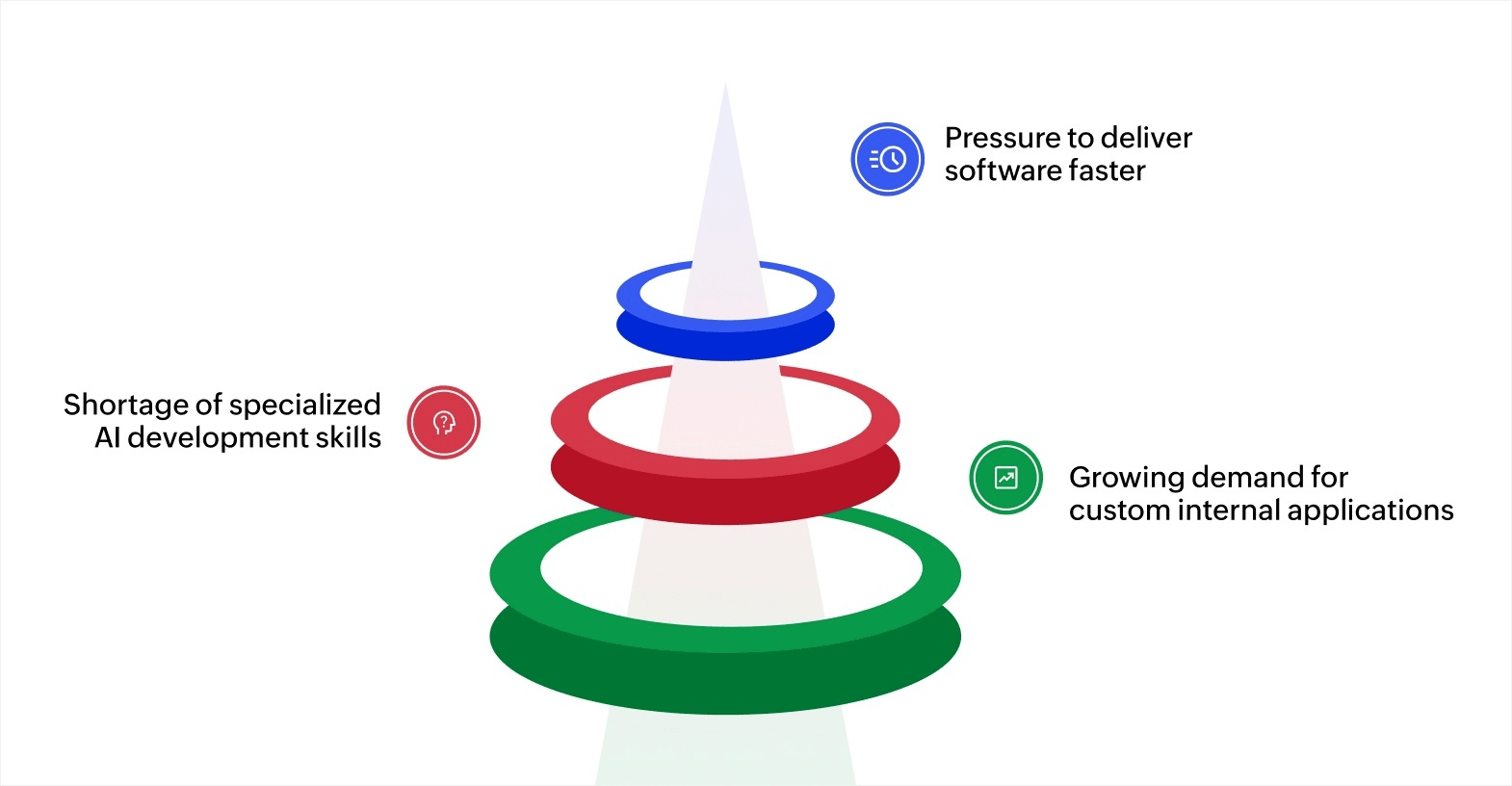
The rapid growth of the no-code AI platform market is no coincidence. Shifts in how teams build software, use AI, and manage operations are encouraging organizations to adopt simpler development tools.
Below are the key drivers behind the current growth of no-code AI platforms:
Pressure to deliver software faster
When your team needs to launch internal tools or automate workflows, traditional development cycles can slow progress. Projects often sit in engineering backlogs for months before you can start testing solutions.
No-code AI platforms help your team move faster by letting you build and test applications without writing large amounts of code. This helps teams in several ways:
- Faster time to deployment: Move from an idea to a working application in days or weeks, not months.
- More room to experiment: Test new ideas and refine workflows without rebuilding entire systems.
Shortage of specialized AI development skills
Building AI-powered applications usually requires expertise in machine learning, data engineering, and software development. Many organizations struggle to find enough specialists to support growing AI initiatives.
No-code AI platforms reduce that dependency by offering visual development tools and built-in AI capabilities. This expands adoption because:
- Projects don't rely entirely on scarce technical talent: Your team can start building solutions without waiting for specialized developers.
- AI experimentation becomes easier: You can prototype AI-enabled applications without complex infrastructure.
Growing demand for custom internal applications
Teams often need software that fits how their organization actually works. Standard tools may not align with internal workflows, including approvals, reporting, and operational tracking.
No-code AI platforms let you create applications designed around your specific processes. This supports adoption because:
- Tools are tailored to workflows: Custom applications reflect how your operations really run.
- Applications can change as needs change: Update workflows or add features without rebuilding the system.
- Rely less on rigid off-the-shelf software: Custom solutions provide flexibility for different departments.
A practical example shows how this works.
ACI Design, a professional services firm, struggled with off-the-shelf software that disrupted its internal workflows. Using Zoho Creator, the company built a custom asset management platform that improved operational efficiency, reduced manual errors, and delivered better customer experiences.
This example shows how no-code AI platforms can help teams build software that matches their real operational needs.
How no-code AI platforms are changing application development
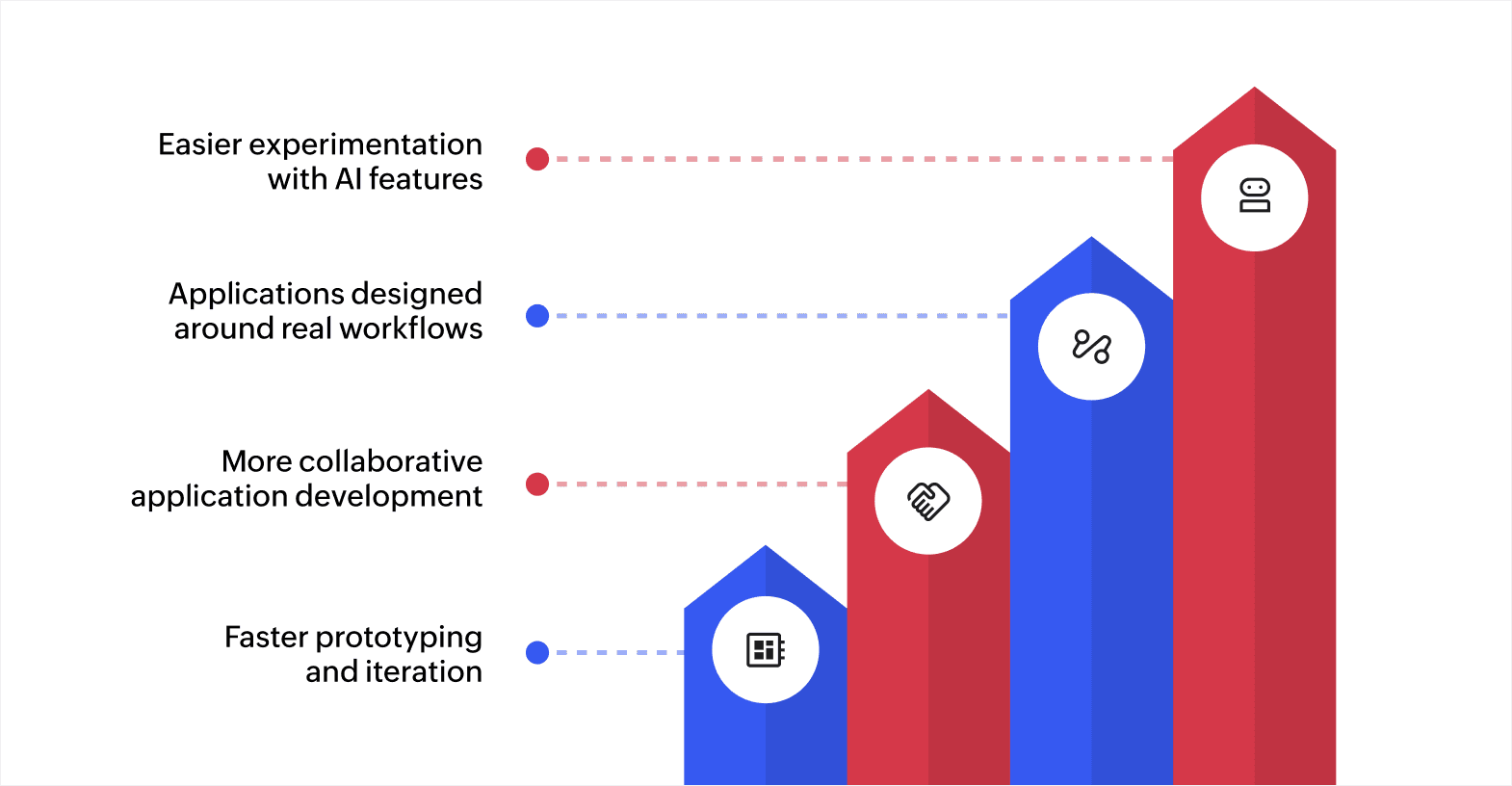
Building applications used to require specialized developers and long timelines. But no-code AI platforms are changing that by enabling your team to design, test, and improve applications with visual tools and built-in AI capabilities.
As these platforms grow, they're changing how teams approach application development:
Faster prototyping and iteration
No-code AI platforms enable you to prototype applications quickly and refine them as your needs change. This improves development workflows because:
- Ideas can be tested earlier: Your team can quickly build prototypes to evaluate new workflows.
- Updates can be applied quickly: Features and processes can be refined without rewriting large sections of code.
- Applications improve through continuous iteration: Teams can adapt tools as operations change.
More collaborative application development
No-code AI platforms allow more people in your organization to participate in development. This improves collaboration because:
- Business teams can help design applications: Analysts, operations teams, and project managers can contribute their workflow knowledge.
- Technical and non-technical teams work together: Collaboration improves how applications are planned and built.
- Development reflects operational expertise: People who manage daily processes help shape the application.
Applications designed around real workflows
No-code AI platforms help you build applications that match how your team actually works. This creates practical improvements because:
- Applications support real operational processes: Workflows reflect how tasks move across teams.
- Tools can be upgraded with changing needs: Features and workflows can be updated as operations change.
- Adoption improves across departments: Teams are more likely to use tools that match their daily work.
Easier experimentation with AI features
No-code AI platforms make it easier for you to explore AI features within your applications. This encourages innovation because:
- AI capabilities can be introduced more easily: Teams can test automation, predictions, and data analysis within workflows.
- Prototypes can be evaluated in real scenarios: Your team can observe how AI features perform during daily operations.
- Applications improve through experimentation: Teams refine AI-enabled features as they learn from usage.
As no-code AI platforms reshape application development, organizations must address the challenges that come with adoption.
Common challenges in adopting no-code AI platforms
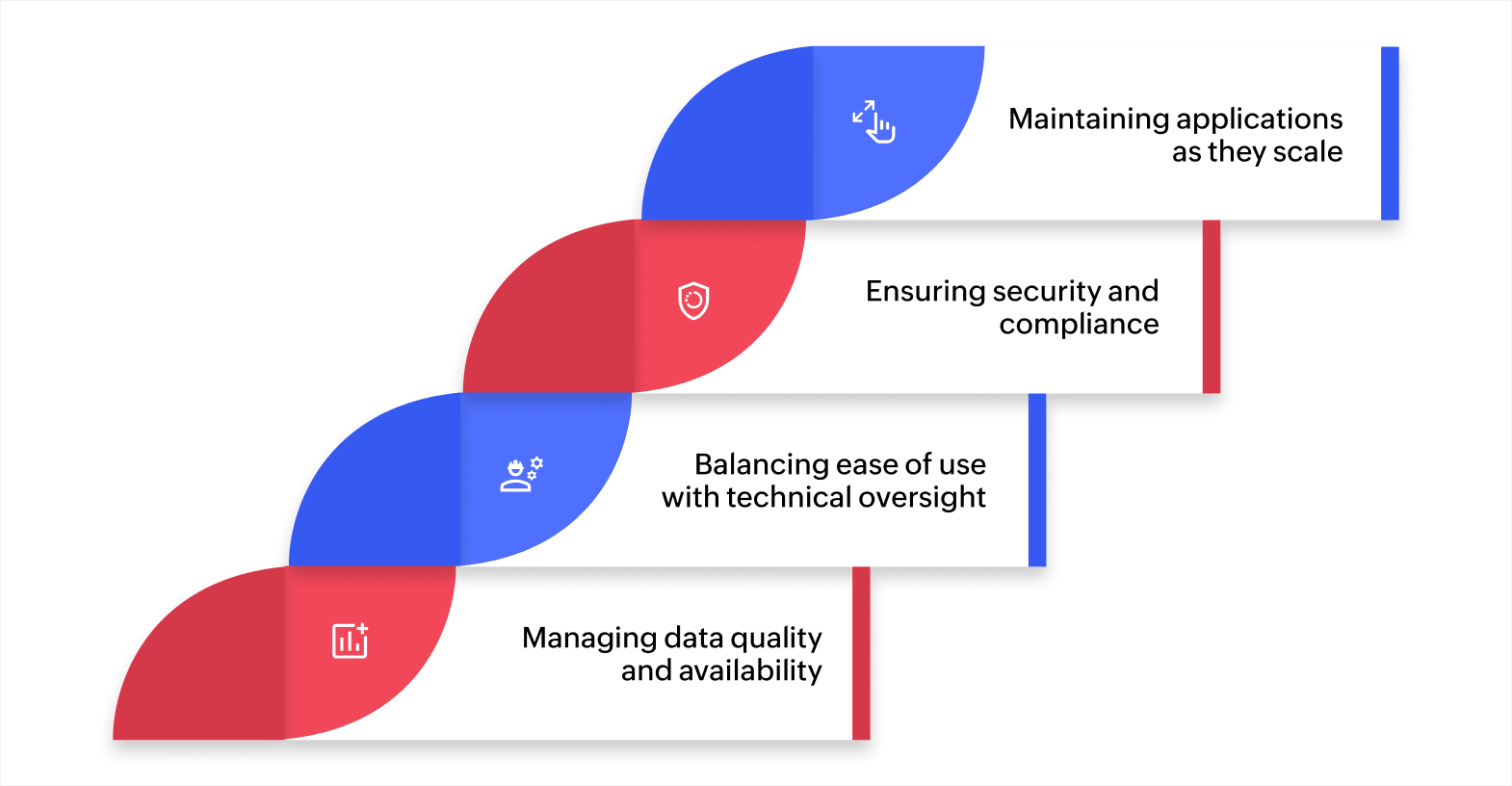
No-code AI platforms make application development easier, but successful adoption still requires planning and clear processes. When your team understands the common challenges, you can prepare for them and use these platforms more effectively.
Below are some challenges teams often face when adopting no-code AI platforms, along with how they usually address them:
Managing data quality and availability
AI-powered applications rely heavily on data. If your organization’s data is incomplete, inconsistent, or spread across multiple systems, AI features may not produce reliable results.
This challenge often happens because teams start building AI-enabled applications before organizing their underlying data.
Teams usually address this by:
- Improving data preparation processes: Clean and structure datasets before integrating them into applications.
- Centralizing important data sources: Connect key systems to ensure applications have access to consistent information.
- Establishing data governance practices: Set standards for data collection and management.
Balancing ease of use with technical oversight
No-code AI platforms let more people build applications, which speeds up development. However, without proper oversight, teams may create applications that don't follow broader technology standards.
This challenge arises when development moves beyond traditional IT governance. Organizations typically address it by:
- Establishing governance guidelines: Set clear rules for building and maintaining applications.
- Encouraging collaboration with IT teams: Technical teams review integrations, security, and architecture.
- Providing internal training: Help teams learn how to design applications responsibly.
Ensuring security and compliance
Applications that handle operational data must meet security and compliance requirements. As more teams build applications, organizations must ensure that proper safeguards remain in place.
This challenge arises because application development is becoming more distributed across departments. Teams address it by:
- Defining security policies for applications: Establish guidelines for data access and user permissions.
- Working closely with IT and compliance teams: Ensure applications follow organizational standards.
- Using built-in security features: Many platforms provide role-based access controls and audit capabilities.
Maintaining applications as they scale
As more teams build applications, organizations must maintain and update those systems over time. Without clear processes, managing multiple internal applications can become difficult.
This challenge arises when applications are built quickly, but long-term maintenance isn't planned. Teams typically address this by:
- Documenting application workflows: Keep clear records of how applications function.
- Assigning ownership for each application: Make sure someone is responsible for updates and improvements.
- Reviewing applications regularly: Evaluate whether tools still meet operational needs.
When organizations combine the right governance practices, data management strategies, and development platforms, they can reduce these barriers and build applications more effectively.
Future trends shaping no-code AI platforms
The no-code AI platforms market is expected to reach $24.7 billion by 2029, showing how quickly teams are adopting tools that simplify application development and AI integration.
As adoption grows, these platforms are also changing to support more complex use cases and involve a wider range of team members in the development process.
Here are the trends that are likely to shape the development of no-code AI platforms in the coming years:
- AI capabilities will become more integrated into development platforms: No-code tools are expected to expand built-in AI features like predictive analysis, automation, and natural language processing within their development environments.
- Citizen development will continue to grow: More employees outside traditional IT teams will build internal tools using visual development platforms that simplify application creation.
- Governance and security controls will become stronger: As more teams build applications, organizations will need clearer policies, monitoring tools, and access controls to maintain security and compliance.
- Integrations between systems will expand: No-code AI platforms will continue to improve connectors and APIs, enabling applications to interact with business tools, data platforms, and external services.
- AI-assisted application development will become more common: Platforms will increase the use of AI to help teams design workflows, generate logic, and automate parts of the application development process.
These trends also highlight the importance of choosing a solution that aligns with your organization’s goals and workflow needs.
No-code AI made simple with Zoho Creator
Building AI-powered applications often feels complex when your team relies on traditional development tools. Many teams want to automate workflows or analyze operational data, but limited technical resources can slow progress.
Zoho Creator is an AI-powered low-code platform that helps you build custom applications, automate workflows, and integrate artificial intelligence into everyday processes without extensive coding.
Using its visual development environment, you can design forms, configure workflows, and connect data across systems in a structured way.
The platform also supports automation and application development with features like workflow rules, scheduled tasks, mobile app creation, and 1,000+ integrations that connect your existing tools and data sources.
With Zoho Creator, you can build applications that support real operational workflows, experiment with AI-powered features, and scale solutions as your organization grows.
FAQ
1. What is the no-code market size for AI platforms?
The no-code market size for AI platforms is projected to grow from $4.06 billion in 2025 to $10.43 billion by 2030, reflecting a 20.78% CAGR.
2. Why is no-code AI becoming so popular?
No-code AI platforms are making AI development more accessible, allowing businesses to build powerful applications without needing technical expertise, saving time and money.
3. What are the main drivers of no-code AI adoption?
The demand for automation, a shortage of skilled developers, and the need for faster, more efficient development processes are key reasons why businesses are adopting no-code AI solutions.
4. How does no-code AI help businesses?
No-code AI enables businesses to innovate faster, reduce development time by up to 90%, and deploy applications quickly, without extensive coding knowledge.
5. What industries are using no-code AI?
Industries like BFSI (banking, financial services, and insurance), healthcare, and ecommerce are increasingly adopting no-code AI platforms to streamline processes, enhance customer experience, and boost productivity.
 Bharathi Monika Venkatesan
Bharathi Monika Venkatesan is a content writer at Zoho Creator. Outside of work, she enjoys exploring history, reading short novels, and cherishing moments of personal introspection.