- HOME
- Know Your Tech
- Low-code/no-code movement: What it is and why it matters
Low-code/no-code movement: What it is and why it matters
- Last Updated : July 2, 2026
- 119 Views
- 7 Min Read
Highlights:
- The low-code/no-code movement represents a shift in who builds software, giving business users the tools to create apps without requiring deep technical skills.
- Low-code platforms need minimal coding for customization, while no-code platforms use fully visual interfaces with no programming required.
- These platforms help businesses reduce IT backlogs, speed up delivery, and lower development costs through drag-and-drop builders and prebuilt components.
- Modern low-code/no-code platforms support enterprise-grade security, including data encryption, role-based access, and regulatory compliance features.
- Choosing the right platform depends on scalability, integration options, ease of use, and long-term cost of ownership.
Your team needs an app to track purchase orders, but IT is already stretched across higher-priority projects. So the process stays manual, and follow-ups go unanswered.
The low-code/no-code movement is a response to exactly this kind of bottleneck. It's called a movement because it represents a broader shift in who builds software. Business users, often called citizen developers, can now create their own apps using visual tools, reducing the dependency on centralized IT teams.
This blog post explains what the movement is, how these platforms work, and why adoption is accelerating. You'll also learn about common misconceptions and tips to choose the right platform for your needs.
What is the low-code/no-code movement?
The low-code/no-code movement is a sweeping change in how businesses approach software development. Instead of relying entirely on professional developers to write code from scratch, organizations now use visual platforms that let a wider range of people build applications.
Low-code platforms provide visual development tools with the option to add custom code when needed. They're designed for users who may have some technical knowledge and need flexibility to handle more specific requirements.
No-code platforms remove coding entirely. They use drag-and-drop interfaces, prebuilt templates, and visual logic builders so anyone can create functional applications without writing a single line of code.
The movement has grown rapidly. Industry data shows the global low-code platform market stood at $37.39B USD in 2025 and is expected to climb to $376.92B USD by 2034 at a 29.10% CAGR. That pace of investment signals just how central these platforms have become to modern business operations.
The impact of the low-code/no-code movement on app development
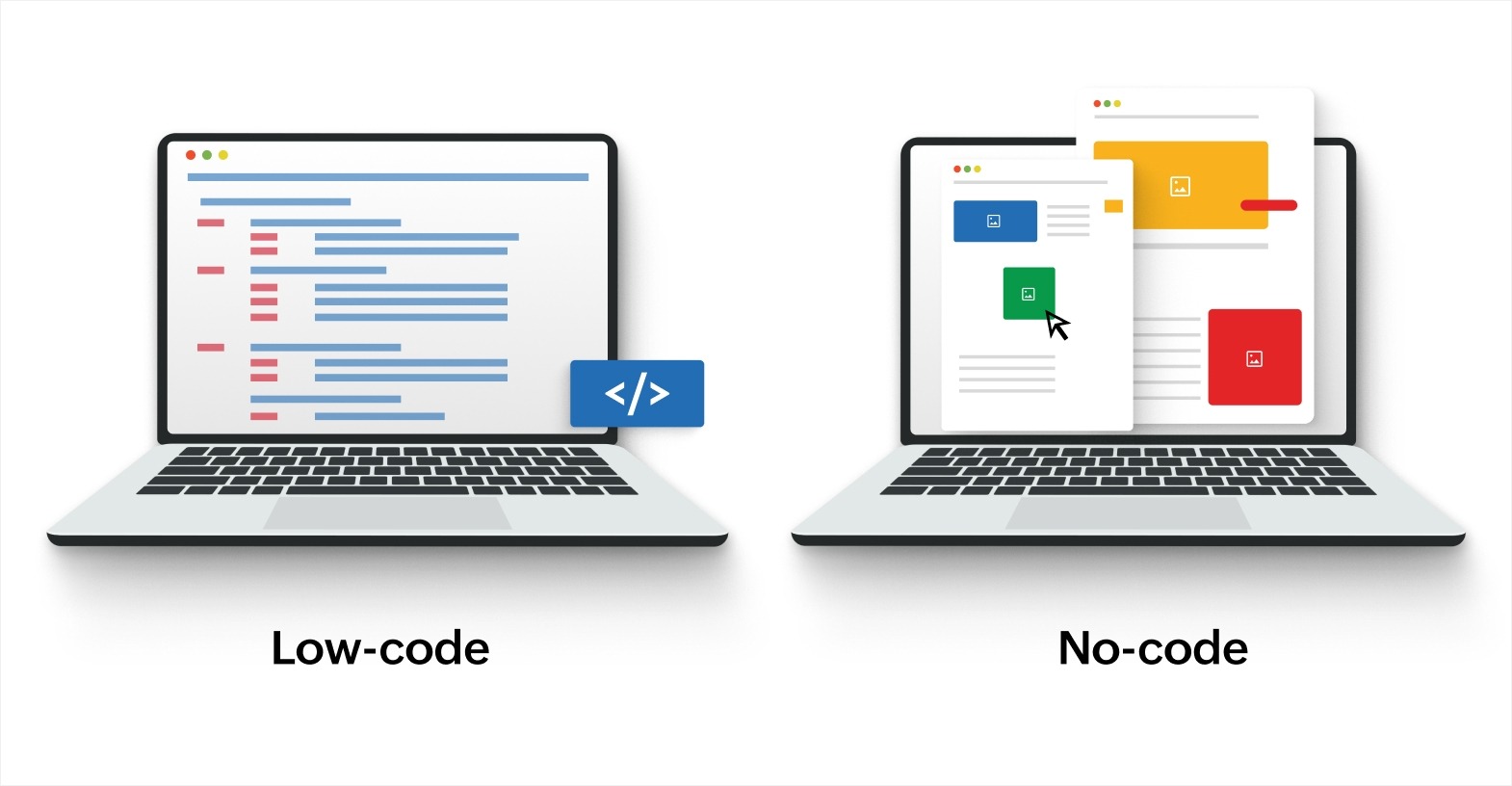
The low-code/no-code movement has fundamentally changed how applications are developed, focusing on making software creation accessible to non-technical users. With visual interfaces and prebuilt components, businesses can now build custom applications without needing to write extensive code. This movement is reshaping business operations by enabling teams to address unique challenges and innovate without depending heavily on IT.
- Low-codeplatforms require minimal coding, offering flexibility for developers to customize applications as needed.
- No-codeplatforms eliminate coding entirely, focusing purely on visual interfaces and predesigned templates.
This shift addresses the growing demand for rapid application development and the shortage of skilled developers. To better understand the impact of the low-code/no-code movement, let’s see how they work.
How low-code and no-code platforms work
These platforms provide intuitive interfaces, allowing users to design, customize, and deploy apps using drag-and-drop features. By focusing on visual tools, they simplify complex tasks like workflow automation, integration, and application logic.
- Drag-and-drop builders: Users assemble app screens, forms, and workflows by placing visual elements on a canvas instead of writing code.
- Prebuilt templates: Ready-made app structures for common use cases like project tracking, inventory management, or customer portals help teams get started quickly.
- Visual logic and workflow design: Business rules, approval chains, and automated actions are defined through visual flow builders rather than programming scripts.
- Deployment across devices: Apps built on these platforms typically run on web browsers, iOS, and Android devices, without separate development efforts.
Integration capabilities are also a key feature, allowing applications to connect seamlessly with existing systems and third-party services. This integration ensures that businesses can automate processes and synchronize data across platforms.
Also read:Understanding low-code vs no-code development platforms
Why businesses choose low-code and no-code platforms
Low-code and no-code platforms provide tangible benefits that can significantly improve a business's operational efficiency and agility. With these platforms, businesses can develop applications more quickly, lower costs, and simplify workflows, all without needing to rely heavily on IT teams.
- Faster development and deployment: These platforms drastically cut down development time, enabling businesses to deploy applications much faster than traditional methods.
- Reduced reliance on developers and IT teams: Non-technical employees can take charge of building and managing apps, which reduces the pressure on IT departments.
- Cost savings: By lowering the need for a large development team and cutting down on development time, businesses can significantly reduce costs.
- Improved collaboration: With the ability to create apps directly, business users can work closely with IT teams to ensure the application aligns with company goals.
These platforms make it easier for businesses to adapt and create custom solutions without the usual barriers of traditional development.
Common misconceptions about low-code/no-code platforms
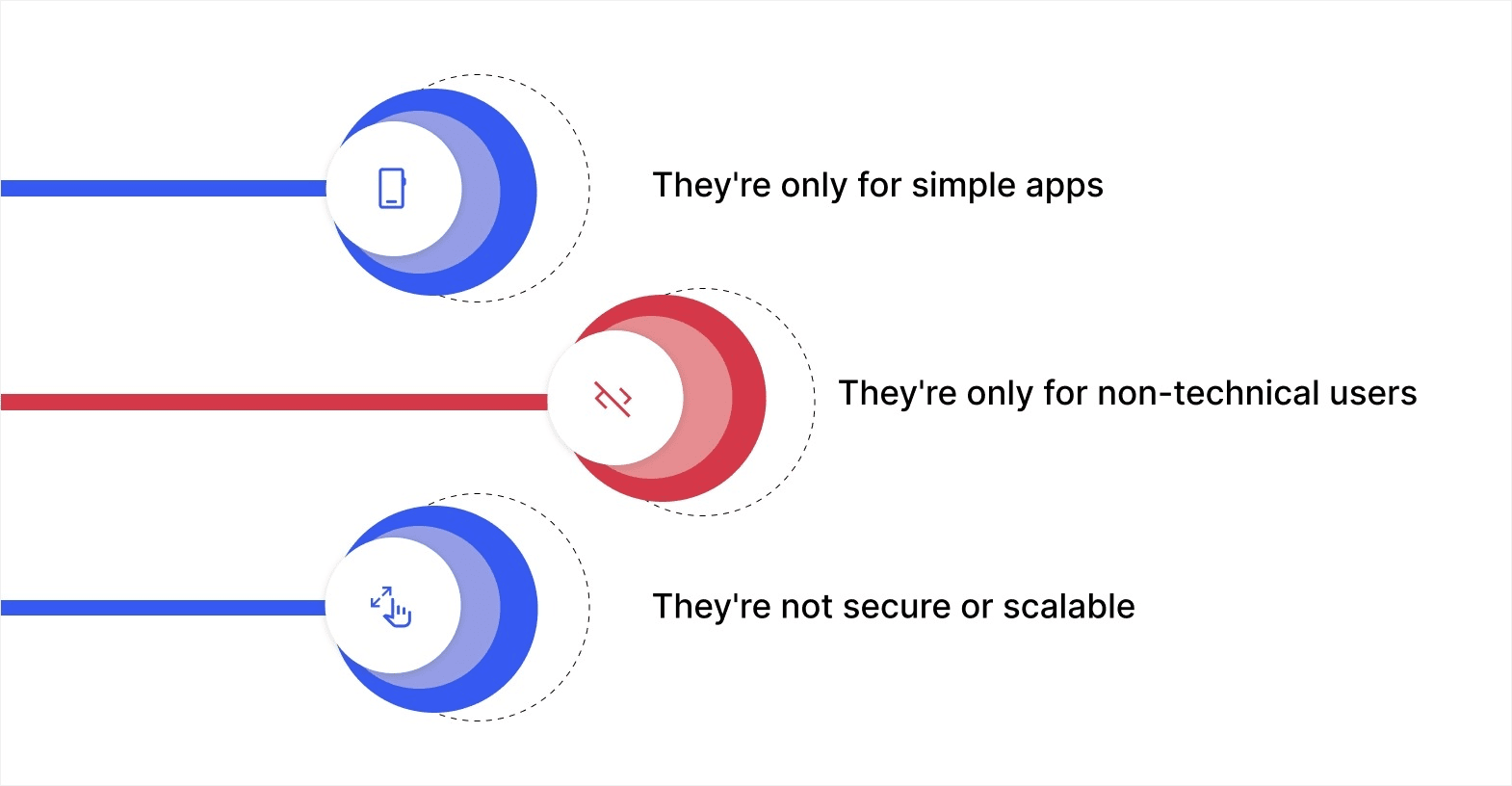
Several myths still hold organizations back from exploring what these platforms can do. Here are the most common ones:
They're only for simple apps
Early low-code/no-code tools were limited to basic forms and workflows. Modern platforms have evolved well beyond that. Many now support complex data models, multi-step approval processes, custom scripting, API connections, and enterprise-grade application logic. While they're often best suited for departmental tools and workflow apps, they're increasingly capable of handling larger, more complex use cases as well.
They're only for non-technical users
Low-code platforms are designed to serve both business users and developers. Business users can build apps through visual interfaces, while developers can extend functionality using custom code, APIs, and backend integrations. This makes these platforms versatile across teams with different technical skill levels.
They're not secure or scalable
Modern low-code/no-code platforms are built with enterprise-level security features, including data encryption, role-based access controls, audit logs, and compliance with regulations like the General Data Protection Regulation (GDPR) and Health Insurance Portability and Accountability Act (HIPAA). These platforms are also designed to handle increasing data volumes and user numbers as organizations grow.
The future of the low-code/no-code movement

The low-code/no-code movement continues to gain momentum, offering businesses a more accessible way to develop applications and automate workflows. As more organizations adopt these platforms, the range of use cases continues to grow across various sectors. Here's how the future of low-code/no-code movement is shaping up:
Expanding industry usage
Low-code/no-code platforms are becoming essential in industries like finance, healthcare, and retail. These platforms enable teams to automate processes, build custom applications, and manage data without needing deep technical expertise.
By lowering the barrier to entry, businesses can innovate faster and respond to market demands more efficiently.
Integration of AI and machine learning
The integration of artificial intelligence (AI) and machine learning (ML) is enhancing the capabilities of low-code and no-code platforms. AI and ML algorithms can power smarter decision-making, predictive analytics, and automation. This integration adds a layer of intelligence to workflows, allowing businesses to optimize operations and improve overall efficiency.
Continued market growth
The market for low-code and no-code platforms is set to expand further, as more businesses recognize their potential to speed up development and reduce costs. And as platforms evolve, they'll become even more powerful, offering more features and integrations that allow businesses to scale rapidly without relying on dedicated IT teams.
The growing demand for faster app development continues to fuel the evolution of these platforms, enhancing their role in business operations. Forrester predicts that the low-code market has the potential to hit $50 billion by 2028, driven by this increasing demand for faster app development and the growing adoption of low-code/no-code platforms across industries.
Looking ahead, the role of low-code and no-code in digital transformation will only grow. Businesses that embrace these platforms will be better positioned to innovate, adapt, and thrive in an increasingly competitive market.
Build custom business apps with Zoho Creator
Many organizations struggle with platforms that are either too rigid for their needs or too complex for their teams to adopt confidently.
Zoho Creator is an AI-powered, low-code application development platform that helps businesses build, deploy, and manage custom apps without heavy coding. Its visual drag-and-drop builder, combined with AI-assisted development, lets both business users and developers create apps that match their exact requirements.
With Zoho Creator, you can design business processes visually, set up automated workflows with approval chains and notifications, and connect to over 1,000 existing tools through built-in integration flows.
With enterprise-grade data security and flexible pricing, Zoho Creator grows with your business. Sign up for free today and start building the apps your teams actually need.
FAQ
1. How can low-code and no-code platforms support large enterprise applications?
Low-code/no-code platforms are primarily designed for simpler applications, but many platforms are now evolving to meet the needs of larger enterprises. They offer integration with enterprise systems and support scalability, but highly complex or mission-critical applications may still require collaboration with developers for advanced customizations.
2. What are the customization limitations of low-code and no-code platforms in sensitive industries?
While low-code platforms offer considerable customization, businesses in regulated industries may find limitations when tailoring applications to meet stringent compliance standards. Additional validation might be required to ensure the platform aligns with industry-specific regulations.
3. How can you evaluate the long-term cost implications of using low-code and no-code platforms?
Evaluating the long-term cost of low-code and no-code platforms requires considering both the initial licensing fees and the ongoing maintenance costs. You should also assess whether the platform provides value as your business scales, including additional costs for custom integrations, scaling, and upgrading.
4. What role do developers play at a business using low-code and no-code platforms?
Developers still play a key role in overseeing governance, maintaining system architecture, and handling complex integrations. While business users manage day-to-day app creation, developers are essential for ensuring platform security, scalability, and more advanced functionality that goes beyond the capabilities of low-code/no-code platforms.
 Rohith Krishnan S
Rohith is a product marketer at Zoho. He writes about low-code, workflow automation and follows the latest digital transformation trends. Outside work he enjoys spending time with family, watching football matches and reading about futuristic trends, in no specific order.