How to leverage the second-screen economy during live sporting events
- Last Updated : July 16, 2026
- 1 Views
- 5 Min Read
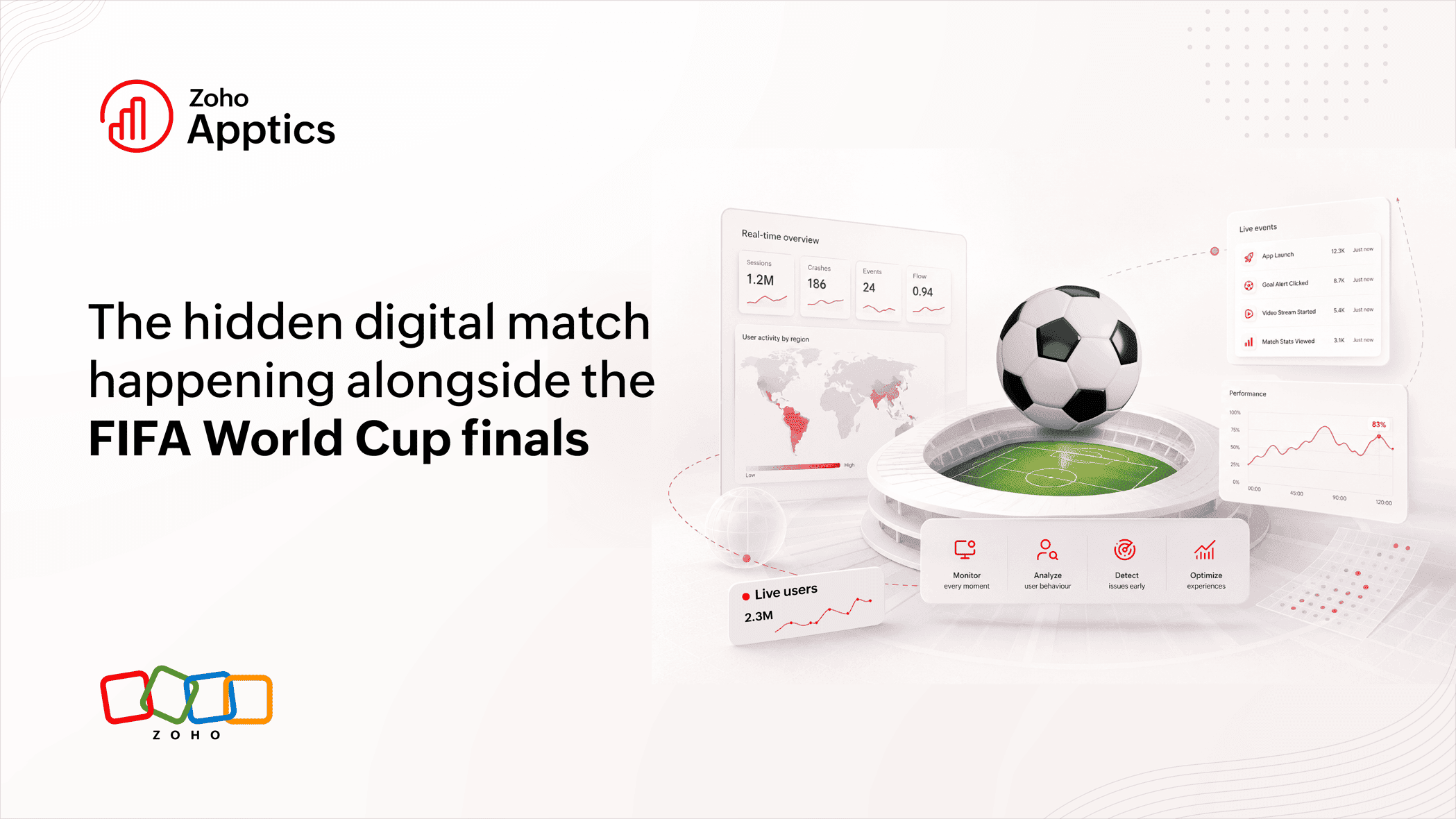
Millions of fans tune in to watch the 2026 FIFA World Cup™. That means there are millions of users with apps open: ordering food, buying jerseys, booking rides, sharing reactions, and checking live stats.
One football match leads to millions of app sessions. That's the second-screen economy. For product, engineering, and marketing teams, it's as high stakes as anything happening on the pitch.
What is the second-screen economy?
Second-screen behavior is what happens when people consume live content and interact with digital experiences at the same time.
According to Deloitte's Sport Fan Insights report, 77% of fans do at least one additional activity related to a game while watching from home. Watching sports rarely means watching only the match anymore.
A typical fan during the final might order dinner before kick-off, browse jerseys after a goal, check live player statistics, share reactions on social media, search for match highlights, and book a ride after the final whistle.
For businesses, every one of those interactions is either an opportunity or a risk, depending on whether you were ready for it.
Why second-screen behavior matters for businesses
Sport events like the FIFA World Cup™ are synchronized moments when millions of people behave in remarkably similar ways. That creates predictable demand across industries that might not even think of themselves as sports adjacent.
According to IBM's 2025 global research, multi-device usage to follow sporting events is growing year over year. This trend is reshaping how fans experience every match, and for consumer apps, it's an opportunity.
Industry | What happens during the final |
Food delivery | Orders spike before kickoff and at halftime |
eCommerce | Merchandise sales increase after memorable moments |
Streaming | Traffic surges for live coverage and highlights |
Social media | People share, comment, and add live reactions |
Travel & ride-hailing | There's increased demand around stadiums and watch parties |
Payments | Stores see higher transaction volumes |
Sports & fantasy | Users engage in real time throughout the match |
The businesses that capitalize on moments like these are the ones that saw the moment coming and knew exactly what to do when it arrived.
The hidden challenge
When thousands or even millions of users arrive within minutes, teams need to answer questions like:
- Can our APIs handle the surge?
- Is checkout still performing well?
- Are users abandoning purchases?
- Did crash rates increase after our latest release?
- Are push notifications reaching users on time?
- Which features are people actually using during the event?
This is where product analytics becomes essential.
Five things every product team should monitor (before, during, and after)
Knowing a spike is coming is not enough. The question is: what do you do with that knowledge before kickoff?
Many brands focus on attracting users during major sporting events, but it's also important to ensure the experience lives up to expectations. Successful event-day strategies balance performance, reliability, engagement, customer feedback, and continuous optimization based on real-time feedback.
So what decisions should teams actually make? Here's how high-performing teams translate analytics into action across five areas:
1) Validate infrastructure before the first user arrives
The worst time to discover your APIs can't handle the load is during the match. Nothing frustrates users more than an app crashing during a live event.
That's why it becomes even more important to monitor technical performance and stability. You need to track crashes, errors, device-specific issues, low-network compatibility, scalability, API latency, and more.
💡Tip: Run load tests against your peak projections. Check checkout performance under traffic multiples. Identify the features that will see the highest concurrent usage—such as live scores, order flows, and payment processing—and stress-test those specifically.
2) Time your campaigns to the match moments, not the calendar
The traffic during a live event moves with the game. Each window creates a different user intent. A fan browsing jerseys at halftime is in a different mindset than one checking out immediately after the final whistle. When campaigns are timed to these windows meaningfully, users convert better.
💡Tip: Look at engagement data from previous live events. When did open rates peak? When did users abandon? Use that to sequence your notifications.
3) Adjust messaging based on real-time signals
Real-time data is decision-making fuel for marketing and product teams. Most teams plan their event-day messaging in advance and send it as scheduled, regardless of what's actually happening. However, what often gets missed is every moment that happens before, during, and after the match is a new window for re-engaement.
That's when you see push notifications saying:
"Limited-edition jerseys available!"
"50% off on match-day meals."
After sending notifications like these, you need to measure the delivery, open rates, conversions, notification fatigue, and more. This helps you get live feedback about user preferences and taste.
💡Tip: Define triggers. If open rates on your halftime notification drop below a threshold, have a fallback. If a push campaign generates a spike in uninstalls, pause it. If one segment is converting at three times the average, double down there.
4) Find the friction before users do
Look at your funnel at every stage. Here are some examples:
- A notification that gets opened but doesn't convert points to a landing page problem.
- A cart that doesn't reach checkout points to friction in the flow.
- A product page with high dwell time but low add-to-cart suggests intent without confidence.
Each drop-off point is a specific, actionable diagnosis.
💡Tip: Map your funnel before the event, not after. Know which drop-off points are acceptable and which are red flags. During the match, watch for any stage that deviates significantly from your baseline to identify friction points in real time.
5) Combine quantitative data with live feedback
Live events generate immediate reactions. Users often leave on-the-spot reviews in moments when an app crashes during checkout, a live stream buffers on the winning goal, or a delivery arrives late.
Each review is timestamped to one of your high-traffic days of the year. That is when a rating becomes a verbatim record of what users experienced at peak stress, in their own words.
💡Tip: Cross-reference that feedback with your crash reports, funnel drop-off data, and session metrics from the same window of time. The patterns you find there are more instructive than almost any post-event survey. Explore how you can collect live in-app feedback from users without being intrusive.
A winning strategy that goes beyond the event
Surviving a spike and learning from one are different things. High-performing teams go an extra mile: they monitor while the event is still unfolding, adjust campaigns in real time, catch stability issues before users notice, and read funnel data as it moves.
After the event, they ask questions like: What broke under load? Where did users drop off? Which campaigns didn't land?
That's the difference between analytics as a reporting function and analytics as a competitive advantage.
This is exactly what Zoho Apptics is built for. Whether it's real-time session analytics, crash monitoring, push notification performance, funnel tracking, or user feedback, you can do it all in one place, across both mobile and desktop.
You can set it up within 15 minutes, so that when the match kicks off and your traffic doubles, you're not switching between five dashboards trying to piece together what's happening. You're watching the full picture and acting on insights as everything unfolds.
Final thoughts
The FIFA World Cup Final lasts just a few hours, but the data it generates can influence product decisions for months.
While fans remember the goals, product teams remember what happened behind the scenes and exactly what to do differently next time.
 Supraja Gayathri S
Supraja is a Product Marketer at Zoho Apptics with 5+ years of experience in breaking down complex concepts into easy-to-digest, detailed blogs. She loves blending technical content and data with creative storytelling.