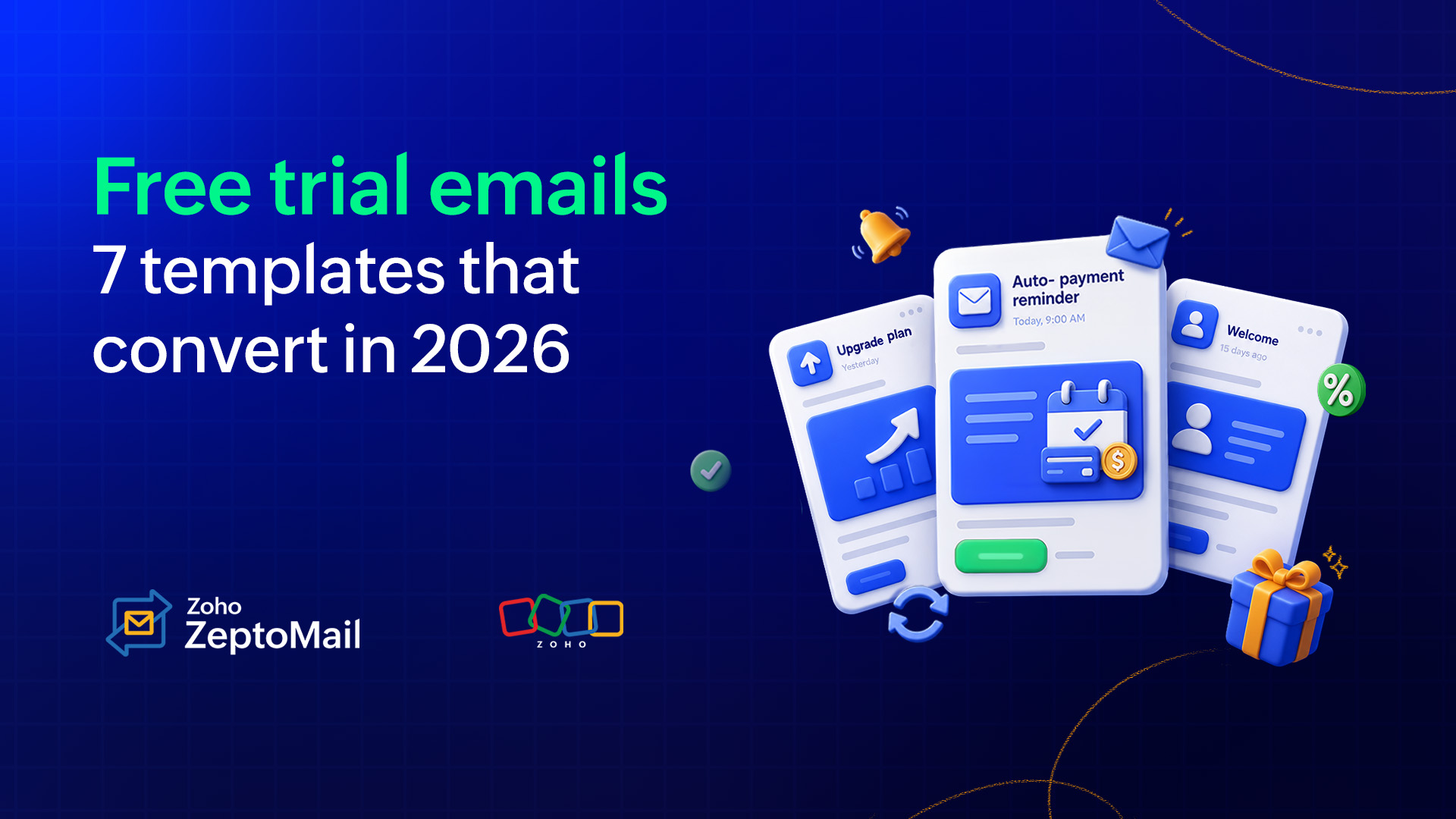
Free trial emails: 6 templates that convert in 2026
- Published : May 30, 2026
- Last Updated : May 30, 2026
- 380 Views
- 10 Min Read

Free trials are no longer just “try-before-you-buy” offers. Now they're onboarding experiences, trust builders, and conversion engines powered by a few carefully timed emails.
A free trial is the user’s first real hands-on experience with your product. And your trial emails play a major role in shaping that experience.
In this article, we’ll explore everything you need to know about free trial emails, including why they matter, the different types of trial emails, templates that convert, subject lines, timing strategies, and some best practices.
What is a trial email?
A trial email is an automated transactional email sent to users during a product’s free trial period. These emails help users:
Get started
Discover important features
Stay engaged
Complete key actions
Upgrade to a paid plan
Trial emails are usually behavior-based and time-sensitive. They guide users from curiosity to confidently investing in a product or service.
For example:
A SaaS company may send a welcome email immediately after signup.
An eCommerce platform may send setup tips during the first few days.
A project management tool may remind inactive users before their trial expires.
What should you focus on in a trial email?
Before crafting a trial email sequence, it’s important to understand your audience, the nature of your product, and how your trial model works.
Not all free trials work the same way. Some businesses offer a completely free trial for a limited number of days, while others require users to add their card details upfront with the option to cancel anytime. These details directly influence how users perceive your product and should be communicated clearly throughout the trial journey.
Aspect | Free trial emails | Paid trial emails |
User intent | Exploring and evaluating | Already financially committed |
Main focus | Onboarding and activation | Retention and long-term value |
Tone | Helpful and educational | Outcome-driven and confident |
Goal | Convert users into customers | Prevent cancellations and improve retention |
Common CTA | “Get started” | “Continue your plan” |
Why do trial emails matter for your business?
Many companies lose trial users not because the product is bad, but because users never fully understand its value. Here’s why trial emails matter for your business.
1. Users expect guided experiences
Users no longer want to figure things out entirely on their own. They expect guided onboarding, quick wins, and personalized assistance throughout their trial experience. Trial emails play a major role here by helping users feel informed, supported, and confident while exploring the product.
2. Attention spans are shorter
In today’s world of reels and consumption of short-form content, attention spans have become shorter than ever. If users don’t experience value within the first few days of a trial, they’re likely to lose interest and move on. Trial emails help maintain momentum by consistently guiding users toward meaningful actions and quick wins.
3. AI-powered personalization is changing expectations
Generic onboarding sequences no longer perform as effectively as they once did. Now users expect emails that feel relevant to their behavior, role, goals, or usage patterns. People want to feel seen, understood, and welcomed rather than treated like just another signup in an automated flow.
4. Trial emails directly impact conversions
A well-optimized trial email sequence directly influences how users engage with your product and whether they convert into paying customers. The right emails can increase activation rates, reduce churn, improve feature adoption, and boost conversions by helping users experience the product’s value at the right time.
5. They shape first impressions
Trial emails help shape the first impression users have of your brand and product. Helpful, timely, and supportive emails build trust and confidence, while overly pushy or sales-heavy emails can create resistance and disengagement.
What should every trial email include?
A trial email should do more than just remind users that their trial is active. Every email in the sequence should help users understand the product better, guide them toward value, and make the overall experience smoother and more confidence-building.
Here are eight key elements every effective trial email should include.
1. Clearly convey the purpose of the email
Every trial email should have one clear goal. Whether it’s welcoming the user, introducing a feature, reminding them about trial expiration, or encouraging an upgrade, the purpose should be immediately understandable. Confusing or overloaded emails can reduce engagement.
2. Explain what the product or service does
A trial period is often the user’s first real interaction with your product. This is the perfect time for a quick introduction to what your product does, the problem it solves, and how it can help the user achieve their goals.
3. Include educational content
Users should never feel lost during a trial. Helpful resources such as setup guides, walkthroughs, tutorials, videos, use cases, and feature tips can help users explore the product with confidence and experience value faster.
4. Mention how much trial time is left
Users appreciate transparency. Clearly mentioning how many days are left in the trial helps create urgency and encourages users to actively explore the product before access ends.
5. Explain what happens after the trial ends
Avoid surprising users. Let them know if:
Their account will be downgraded.
Features will be restricted.
Access will end completely.
Data will remain available for a certain period.
This helps build trust and reduces frustration.
6. Guide users on how to upgrade or use free credits
If your product includes free credits or upgrade options, explain them clearly. Users should know:
How to continue using the product
Where to upgrade
How free credits work
What benefits do they receive after upgrading?
7. Notify users about auto-pay or cancellation details
If automatic billing is enabled, inform users before the trial expires. Clearly explain:
When billing starts
How to cancel
How to avoid unwanted charges
Transparent communication improves customer trust and reduces negative experiences.
8. Provide easy access to support
Users should always know where to get help during the trial period. Include:
Support email or chat options
Help center links
Direct reply options
Onboarding assistance
Quick support can often make the difference between a converted customer and an abandoned trial.
6 types of trial emails in a high-converting sequence with templates
1. The welcome email
The welcome email is the most important trial email because it sets expectations and creates the first impression of your product and brand. It’s often the very first touchpoint users receive after signing up for the trial. A good welcome email should make users feel excited, guide them toward the next step, and reassure them that they’re in the right place.
Purpose: To onboard new users, set expectations, and guide them toward their first meaningful action in the product.
Pro tip: Avoid overwhelming users with too many links. One clear action performs better.
Subject:
Welcome to {{Product Name}}🎉
Your trial account is ready 🎉
Welcome aboard! Enjoy your {{x}} days trial from today!
Template example:
Hey {{First Name}},
You’re in! Welcome to {{Product Name}} ✨ We’re so excited to have you here.
Your free trial is now active, and this is where your journey with us begins. Over the next few days, you’ll get to explore how {{Product Name}} can help make your work simpler and more efficient.
Here’s the first step to get started:
{{Set up my account}}
If you need any help along the way, we’re just one click away:
> Watch a quick walkthrough
> Browse setup guides
> Reply directly to this email
We’re excited to have you with us! Glad to be a part of your journey! 😊
Regards,
Team {{Company Name}}
2. Educational email
This email helps users understand the product better through guides, tutorials, use cases, walkthroughs, or helpful tips. Instead of directly pushing users toward conversion, the focus is on educating them and helping them feel confident while using the product.
Purpose: To help users discover features, understand product value, and achieve success during the trial period.
Pro tip: Instead of teaching every feature, focus on one specific use case that helps users solve a real problem.
Subject:
Here's how to get more from your trial!
A quick guide to using {{Product Name}}
Learn how to make the most of your {{Product Name}}
Template example:
Hi {{Name}},
We noticed you’re exploring {{Product Name}}.
Here’s a feature that many successful customers use to save time and improve results.
Feature Spotlight: {{Feature Name}}
With this feature, you can:
✔ {{Benefit 1}}
✔ {{Benefit 2}}
✔ {{Benefit 3}}Getting started takes just a few minutes.
{{Try this Feature}}
Need additional guidance?
Check out our step-by-step guide or watch our quick tutorial video.
If you have any questions, simply reply to this email and we’re happy to help. 😊
Regards,
Team {{Company Name}}
3. Social proof
Social proof emails build trust by showing how other customers have successfully used your product and the results they achieved.
Purpose: To build trust and credibility by showcasing customer success stories, testimonials, reviews, or use cases.
Pro tip: Include specific numbers, outcomes, or customer achievements whenever possible. Concrete results are more persuasive than generic praise.
Subject:
See how customers are succeeding with {{Product Name}}
Why businesses choose {{Product Name}}
Real results from real customers
Template examples:
Hey {{First Name}}
Glad you’re getting the hang of using {{Product Name}}. Are you wondering how others are using {{Product Name}}?
Here’s how {{Customer Name}} transformed their workflow using our platform:
"Using {{Product Name}}, we reduced manual work by 60% and improved our team’s productivity significantly."
✔ Reduced time spent on repetitive tasks.
✔ Improved operational efficiency.
✔ Scaled without increasing workload .Thousands of businesses trust {{Product Name}} to streamline their operations. Yours can too.
{{Explore customer stories}}
Regards,
Team {{Product Name}}
4. Upgrade email
Upgrade emails encourage users to move to a paid plan by highlighting premium features, benefits, and the value they’ll continue to receive after the trial ends.
Purpose: To encourage users to convert to a paid plan by highlighting premium benefits and the value they’ve already experienced.
Pro tip: Don’t simply say "upgrade now." Connect the upgrade to the progress users have already made during the trial.
Subject:
Upgrade today and keep the momentum going, {{Name}}
Continue where you left off!
Your trial is ending soon for {{Product Name}}
Template example:
Hi {{Name}},
We’re glad you’ve been enjoying {{Product Name}} during your trial.
Your free trial will be ending soon, but your journey doesn’t have to stop here. Upgrade your account today to continue using the features you love and keep building on the progress you’ve already made.
With a paid plan, you'll continue to enjoy:
✔ Unlimited access to key features.
✔ Advanced capabilities and integrations.
✔ Reliable performance and enhanced security.
✔ Priority support whenever you need help .Don’t lose momentum. Upgrade now and continue getting the most out of {{Product Name}} without interruption.
{{Upgrade Now}}
Have questions about our plans? We’re here to help.
{{Contact us}}
Thank you for trying {{Product Name}}. We’re excited to continue supporting your journey.
Team {{Product Name}}
5. Auto-pay email
Auto-pay emails or payment reminder emails remind users that automatic billing is enabled and provide transparency about upcoming charges before the trial ends.
Purpose: To inform users about upcoming billing, maintain transparency, and reduce surprise charges or cancellations.
Pro tip: Be transparent about billing details, renewal dates, and cancellation options. Clear communication builds trust and reduces frustration.
Subject:
Reminder: Your trial ends soon
Upcoming subscription renewal notice
Your account will be charged on {{Date}}
Template example:
Hi {{Name}},
This is a friendly reminder that your free trial of {{Product Name}} will end on {{Trial End Date}}.
Because automatic billing is enabled for your account, your selected subscription plan will renew automatically on {{Renewal Date}}.
Subscription Summary :
Plan: {{Plan Name}}
Amount: {{Amount}}
Renewal Date: {{Renewal Date}}If you’d like to make changes to your subscription or billing preferences, you can do so before the renewal date.
{{Manage Subscription}}
Thank you for choosing {{Product Name}}.
Regards,
Team {{Product Name}}
6. Trial expiration email
Trial expiration emails notify users that their free trial has ended or is about to end and encourage them to upgrade to maintain uninterrupted access.
Purpose: To create urgency and motivate users to upgrade before or immediately after their trial access ends.
Pro tip: Create urgency by focusing on what users will miss if they don’t upgrade, while reinforcing the value they’ve already experienced.
Subject:
Your trial ends today!
Last chance to continue using {{Product Name}} without interruption!
Action Required: Upgrade before your trial expires.
Template example:
Hi {{Name}},
Your free trial of {{Product Name}} is ending today.
We hope you’ve had a chance to explore the platform and see how it can help you achieve your goals.
Once your trial expires, you'll lose access to:
✔ Premium features.
✔ Saved configurations and workflows.
✔ Advanced reporting and analytics .Upgrade to continue using {{Product Name}} without interruption.
{{Upgrade Now}}
Thank you for trying {{Product Name}}. We’d love to continue supporting your business as it grows.
Regards,
Team {{Product Name}}
Trial email cadence and sequence timing
Behavior-based emails usually perform better than fixed sequences.
For example:
Send setup help if onboarding is incomplete.
Trigger feature suggestions after product activity.
Send upgrade prompts after users experience value.
Day | Email type | Goal |
Day 0 | Welcome email | Activation |
Day 1 | Educational | Early success |
Day 3 | Feature discovery | Engagement |
Day 5 | Social proof | Trust building |
Day 10 | Upgrade email | Conversion |
3–5 days before trial ends | Auto-pay email | Reduce cancellations |
On the last day or | Trial expiration email | Urgency to purchase more |
Best practices for crafting trial emails
1. Timing is key
Even the best email content can fail if it reaches users too late. Trial emails should arrive at the right moment based on user actions and trial duration. Automating your email flow helps maintain consistency and ensures that users receive timely guidance throughout the journey.
It’s equally important to use a reliable email service provider like Zoho ZeptoMail so your time-sensitive emails consistently land in inboxes without delays.
2. Personalize the user experience
Modern users expect personalized experiences. Instead of only promoting product features, focus on helping users understand how the product fits into their workflow and solves their problems.
Use personalization based on:
User behavior
Industry
Role
Product activity
Goals or interests
People connect more with experiences than product descriptions.
3. Add helpful resources and onboarding content
Users should never feel lost during a trial period. Include:
Help center links
Setup guides
Video tutorials
FAQs
Product walkthroughs
Educational content helps users explore the product confidently and experience value faster.
4. Clearly mention expiration and renewal details
Transparency builds trust. Always communicate:
Trial expiration date
Remaining trial days
Renewal process
Billing information
Auto-pay details
Cancellation options
Users appreciate clear communication and dislike unexpected charges or sudden account restrictions.
5. Keep the subject line and email content aligned
Your subject line should accurately reflect the purpose of the email. Misleading or overly clickbait-style subject lines may increase opens temporarily, but they reduce trust and engagement over time.
If the email is about trial expiration, onboarding help, or feature discovery, make that clear immediately.
6. Focus on one primary CTA
Too many email CTAs can confuse users and reduce conversions. Every trial email should focus on one main action such as:
Completing the setup
Exploring a feature
Upgrading the account
Watching a tutorial
You can still include subtle navigation links for support resources, but the primary CTA should remain clear and prominent.
Common mistakes to avoid in trial emails
1. Oversharing too much information
Trying to explain every feature at once can overwhelm users. Instead of sending too much information, focus on sending relevant and timely content based on the user’s stage in the trial journey.
Simple and focused emails perform much better than overloaded ones.
2. Skipping testing and optimization
Trial emails should never be a “set it and forget it” process. Always test:
Subject lines
CTA placement
Email timing
Personalization
Email length
Even small improvements can significantly impact conversions and engagement.
3. Using spammy language
Spam-heavy language can hurt deliverability and reduce trust. So it’s important to avoid words and phrases that sound overly promotional or spam-like such as:
“Act now!!!”
“Guaranteed results”
“Limited offer”
“100% free forever”
4. Making mistakes in numbers and dates
Incorrect dates, pricing details, billing amounts, or trial duration information can quickly damage customer trust. Always double-check:
Trial expiration dates
Renewal charges
Discount percentages
Free credit balances
Billing timelines
Accuracy is especially important in transactional and trial-related emails because users rely on them for critical account information.
Wrapping up
A well-crafted trial email sequence can make the difference between a user who leaves after the trial and one who becomes a loyal customer. By sending timely, relevant emails throughout the trial period, you can guide users toward experiencing your product’s value, build trust, and encourage conversions. Use these templates as a starting point and refine them based on your audience’s needs and engagement.