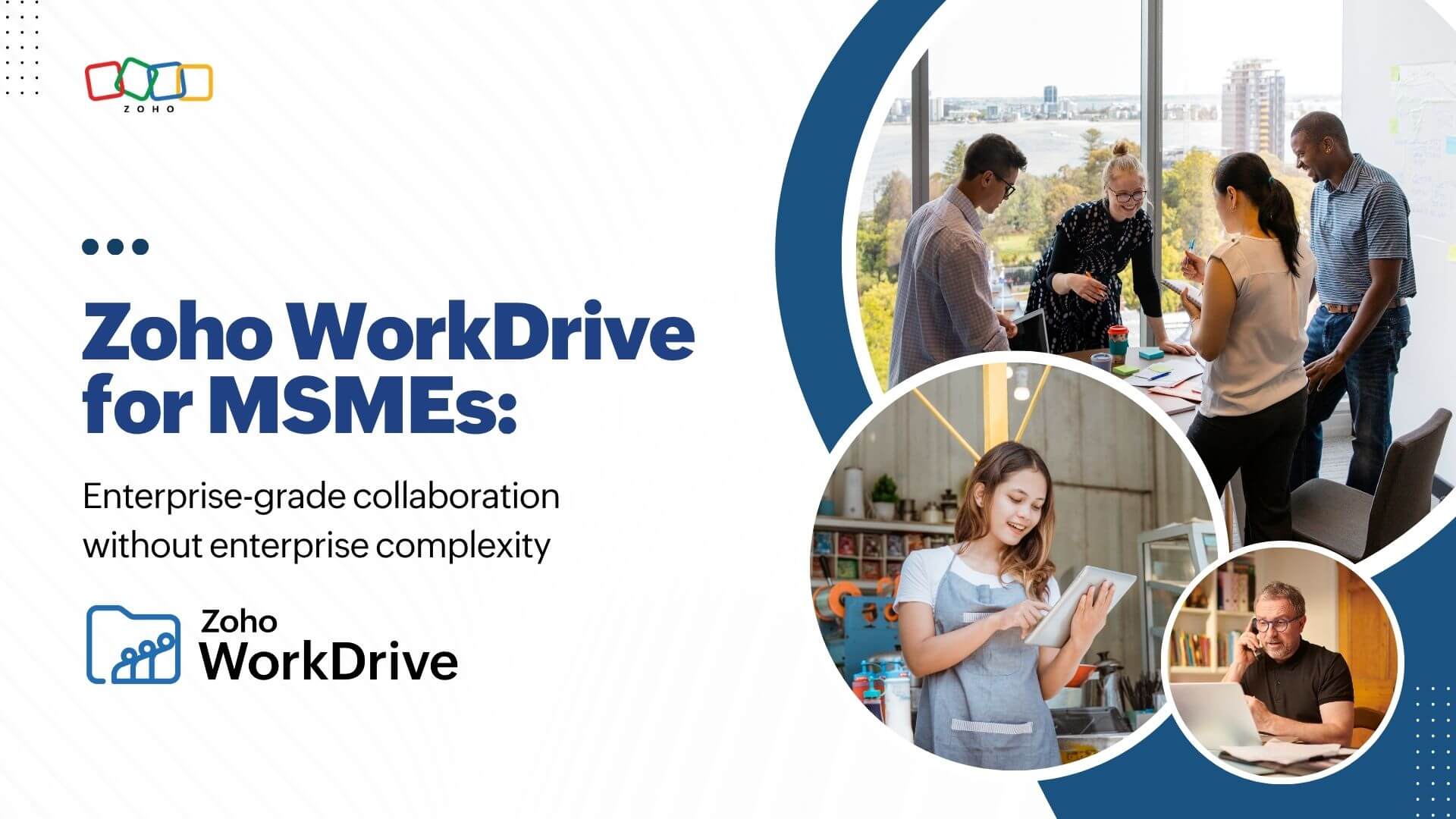
Zoho WorkDrive for MSMEs: Enterprise-grade collaboration without enterprise complexity
- Last Updated : June 26, 2026
- 158 Views
- 7 Min Read

Growth has a hidden cost that many MSMEs underestimate: complexity.
The more a business expands, the harder it becomes to keep information organized, collaboration efficient, and processes consistent. What begins as a small team sharing files through email, chat apps, and personal drives often evolves into a maze of scattered information, disconnected workflows, and growing security risks.
As teams grow, so do the number of clients, vendors, partners, and business-critical documents. Processes that once felt simple begin to slow down.
Files become spread across email threads and WhatsApp conversations. Teams struggle to identify the latest version of a document and approvals take longer. Sensitive information is shared without proper controls. Employees spend more time searching for information than acting on it.
Many business owners assume these are inevitable growing pains.
They are not.
The real challenge is that many MSMEs continue to rely on tools designed primarily for file storage when what they actually need is a system for collaboration, centralized content management, and operational consistency. As businesses scale, cloud storage alone is no longer enough. They need enterprise-grade collaboration without enterprise complexity.
What does enterprise-grade collaboration mean for MSMEs?
Enterprise-grade collaboration helps teams organize information, collaborate securely, manage access, streamline workflows, and maintain operational consistency as they grow.
For MSMEs, the challenge is finding a solution that delivers these capabilities without requiring expensive infrastructure, dedicated IT teams, or complex implementations. In other words, businesses need tools that enable:
Faster collaboration without IT complexity
Secure sharing with clients and vendors
Centralized knowledge and documentation
Consistent processes across teams
Affordable scalability as the business grows
Why growing businesses outgrow basic cloud storage
Traditional cloud storage solutions solve one problem well: storing files.
However, growing businesses face challenges that extend far beyond storage. As teams expand, information becomes distributed across multiple systems—documents stored in different folders, files shared through messaging apps, approvals managed over email, and business knowledge trapped with individual employees.
The result is operational fragmentation: Businesses spend more time managing information than using it to move work forward.
As discussed in our previous article on the shift from cloud storage to intelligent content management, modern organizations increasingly require platforms that support collaboration, governance, and business processes—not just file storage.
The real cost of disorganized work
Disorganized information is often seen as a minor inconvenience. In reality, it quietly affects productivity, customer experience, security, and decision-making across the business.
Time lost searching for information
A sales team preparing a proposal shouldn't have to spend thirty minutes looking for the latest pricing sheet. A project manager shouldn't have to search through email threads and chat conversations to locate a client-approved document.
Yet these situations occur daily in many growing businesses.
As information gets scattered across drives, emails, messaging apps, and desktops, employees spend valuable time searching for information instead of using it. What appears to be a small inefficiency quickly becomes a recurring productivity drain across the organization.
Increased security risks
Consider a business that shares contracts, financial reports, or customer information through public links or personal email accounts.
As teams grow, tracking who has access to what becomes increasingly difficult. Without centralized controls and visibility, businesses risk exposing sensitive information, creating compliance challenges, and increasing the likelihood of accidental data leaks.
Collaboration bottlenecks
An agency waiting for client approvals, a manufacturing company coordinating supplier documentation, or a consulting firm reviewing project deliverables all face the same challenge: collaboration slows when information is fragmented.
Teams spend more time coordinating work than completing it. Approvals get delayed, decisions take longer, and projects move slower than they should.
Lack of process consistency
Many MSMEs operate successfully with informal processes during their early stages. However, as headcount and business volume increase, those same processes become difficult to manage.
Without standardized workflows, every approval, review, and document-sharing process depends on the habits and availability of whoever owns the task. This creates inconsistencies, delays, and operational risks that become more pronounced as the business grows, which is when enterprise-grade collaboration becomes essential.
Why traditional cloud storage falls short for MSMEs
Cloud storage transformed the way businesses store and access files. However, most traditional storage solutions were built to manage documents—not to support the growing operational needs of modern businesses.
As MSMEs scale, they need greater visibility, governance, collaboration, and process consistency. This is where traditional cloud storage begins to show its limitations.
Limited governance and visibility
Most startups store contracts, customer information, financial records, employee documents, and other sensitive data in cloud storage tools. Managing access to these assets becomes increasingly important as teams expand.
Traditional storage platforms often provide basic access controls but lack the governance capabilities needed to monitor, manage, and secure information at scale.
Fragmented access and permissions
When files are shared across multiple channels, businesses lose visibility into who has access to critical information.
Documents can end up in personal drives, email attachments, and messaging platforms, making access management difficult and increasing security risks.
Manual processes that don't scale
Many MSMEs still rely on email chains and manual follow-ups to manage approvals, reviews, and document workflows.
While this may work for a small team, it becomes increasingly inefficient as more stakeholders become involved. The lack of workflow automation introduces delays, inconsistencies, and unnecessary administrative effort.
Collaboration without context
Collaboration requires more than sharing files: Teams need to review documents, provide feedback, track changes, and work together in real time.
Without collaborative workspaces and version control, businesses often struggle with duplicate files, conflicting edits, and limited visibility into ongoing work. The result is simple: businesses spend more time managing information than using it.
What modern MSMEs actually need
Modern businesses need more than storage capacity. They need a platform that helps teams work together efficiently while maintaining security, visibility, and control.
Team folders that create a single source of truth
As businesses grow, information fragmentation becomes a major challenge. Different departments create their own storage systems, making it difficult to locate documents and maintain consistency.
Centralized team folders help businesses organize content by department, project, client, or function, ensuring everyone works from the same source of truth. Instead of asking where files are stored, teams know exactly where to find them.
Secure external sharing with clients and vendors
Collaboration increasingly extends beyond internal teams. Businesses regularly share proposals, contracts, designs, reports, and project deliverables with clients, suppliers, and external partners.
Secure sharing capabilities allow organizations to:
Control who can access files
Set expiration dates for links
Restrict downloads
Monitor access activity
Protect sensitive information
This ensures collaboration remains efficient without compromising security.
Simplified file collection through file requests
Many business processes involve collecting documents from external parties like clients and vendors. These documents may include:
Vendor onboarding
Client asset collection
Invoice submissions
HR document gathering
Compliance documentation
Traditional methods rely heavily on email exchanges and manual follow-ups.
File request capabilities streamline the process by providing a secure, centralized way to collect information without requiring recipients to access internal systems.
Workflows that scale operational efficiency
Growth introduces complexity. More stakeholders become involved in approvals, reviews, and decision-making processes. Without structured workflows, teams rely on manual coordination, leading to delays and inconsistencies.
Workflow automation helps businesses standardize repetitive processes such as:
Document approvals
Contract reviews
Content publishing
Vendor onboarding
Compliance reviews
Instead of chasing approvals, teams can focus on moving work forward.
Real-time collaboration through integrated office productivity tools
Modern work is collaborative by nature. Documents, spreadsheets, and presentations are rarely created by one person. Real-time collaboration allows multiple team members to work together simultaneously, reducing version conflicts and accelerating decision-making.
Comments, suggestions, and collaborative editing help teams stay aligned without endless email chains.
Mobile accessibility for modern business operations
Business doesn't stop when employees leave the office. Sales representatives, field teams, consultants, and business owners need access to critical information wherever work happens. Mobile accessibility enables teams to:
Access files on the go
Review documents remotely
Approve requests quickly
Collaborate from anywhere
This flexibility becomes increasingly important as businesses embrace distributed and hybrid work environments.
Admin controls that strengthen governance
As organizations grow, maintaining visibility becomes more difficult. Business leaders need confidence that information is secure, access is properly managed, and collaboration remains compliant. Administrative controls provide:
Role-based permissions
Access management
User governance
Activity tracking
Audit visibility
These capabilities help businesses maintain control without introducing unnecessary complexity.
AI-powered search and insights
One of the biggest hidden productivity drains in growing organizations is information discovery. Employees often know a file exists but struggle to find it. AI-powered search helps users quickly locate relevant documents, conversations, and content, reducing time spent searching and increasing time spent working.
Instead of remembering where information was stored, teams can simply ask for what they need.
Version history and recovery
Mistakes happen. Files get edited accidentally. Content is overwritten. Important information is deleted. Version history ensures businesses can recover previous versions and restore critical information when needed.
This provides operational resilience and reduces the risk of costly mistakes.
Enterprise collaboration doesn't need enterprise overhead
For years, businesses associated enterprise collaboration with expensive software, lengthy implementations, and constant support from dedicated IT teams.
Those assumptions are changing.
Today's collaboration platforms provide enterprise-level capabilities while remaining accessible to growing businesses.
Traditional Enterprise Systems | Modern MSME Collaboration Platform |
Complex deployment | Quick setup |
Heavy IT dependency | Easy administration |
Expensive licensing | Scalable pricing |
Long onboarding | Fast adoption |
Fragmented tools | Unified collaboration |
Businesses no longer need to choose between simplicity and sophistication.
They can have both.
How WorkDrive helps MSMEs scale efficiently
Growing businesses need systems that bring structure without introducing complexity.
Zoho WorkDrive is an intelligent content management platform that helps MSMEs centralize knowledge, streamline collaboration, and scale operations through a secure and unified workspace.
Key capabilities include:
Team folders: Create centralized workspaces for departments, projects, clients, and business functions. Teams always know where information resides, reducing duplication and improving accountability.
Secure external sharing: Collaborate confidently with clients, vendors, and partners through permission-based access controls, password protection, download restrictions, and expiry links.
Collect files: Collect documents from customers, suppliers, candidates, and external stakeholders without relying on endless email exchanges or manual follow-ups.
Workflow automation: Automate document approvals, reviews, and business processes to improve consistency and reduce administrative overhead as teams grow.
AI-powered search and insights: Locate files instantly, summarize content, and retrieve relevant information faster, helping teams spend less time searching and more time executing.
Admin controls and governance: Manage permissions, monitor activity, and maintain visibility across the organization's content ecosystem without increasing operational complexity.
Version history and recovery: Restore previous versions, recover deleted content, and protect business-critical information from accidental changes or loss.
Integrated office suite: Create, edit, review, and collaborate on documents, spreadsheets, and presentations in real time—eliminating version confusion and accelerating decision-making.
Mobile accessibility: Access files, approve requests, and collaborate from anywhere toenable productive work across distributed and field-based teams.
Instead of managing files across disconnected systems, MSMEs can centralize knowledge, streamline collaboration, strengthen governance, and establish scalable processes from a single platform.
WorkDrive helps businesses operate with the speed of a startup and the structure of an enterprise.
The future of MSME growth depends on smarter collaboration
The next generation of MSMEs will compete on speed, adaptability, and operational efficiency. Growth will increasingly depend on how effectively businesses manage information, collaborate across teams, and maintain consistency as they scale.
Cloud storage may help businesses save files. But sustainable growth requires something more: intelligent content management.
Businesses that invest in structured collaboration today will be better equipped to scale tomorrow because growing businesses don't just need more storage—they need a smarter way to work.
Zoho WorkDrive is built for growing businesses to operate with the speed of a startup and the structure of an enterprise.