- HOME
- Work Management
- 5 operational challenges in marketing agencies and how to overcome them
5 operational challenges in marketing agencies and how to overcome them
- Last Updated : May 13, 2026
- 348 Views
- 4 Min Read
Planning, execution, and tracking form a continuous loop at digital marketing agencies, and this cycle only becomes more complex as you grow. More clients, more tools, more collaboration, and more reporting requirements increase operational pressure. And while team members may understand their responsibilities, the absence of a structured operational system gradually introduces inefficiencies.
This article explores the common challenges faced by marketing agencies that operate without an operational layer and how Zoho Tables addresses them effectively.
The operational gap in marketing agencies
Planning → Execution → Tracking
Every agency operates within these three phases, but they rarely function as a connected system.
Stage | Current Setup | Key Limitation |
Planning | Decks, docs, chats, emails | Strategy and decisions aren't captured in a structured system |
Execution | SEO tools, design tools, automation platforms | Disconnected tools limit visibility and coordination |
Tracking | Spreadsheets, data exports, reporting decks | Manual reporting delays insights and decision-making |
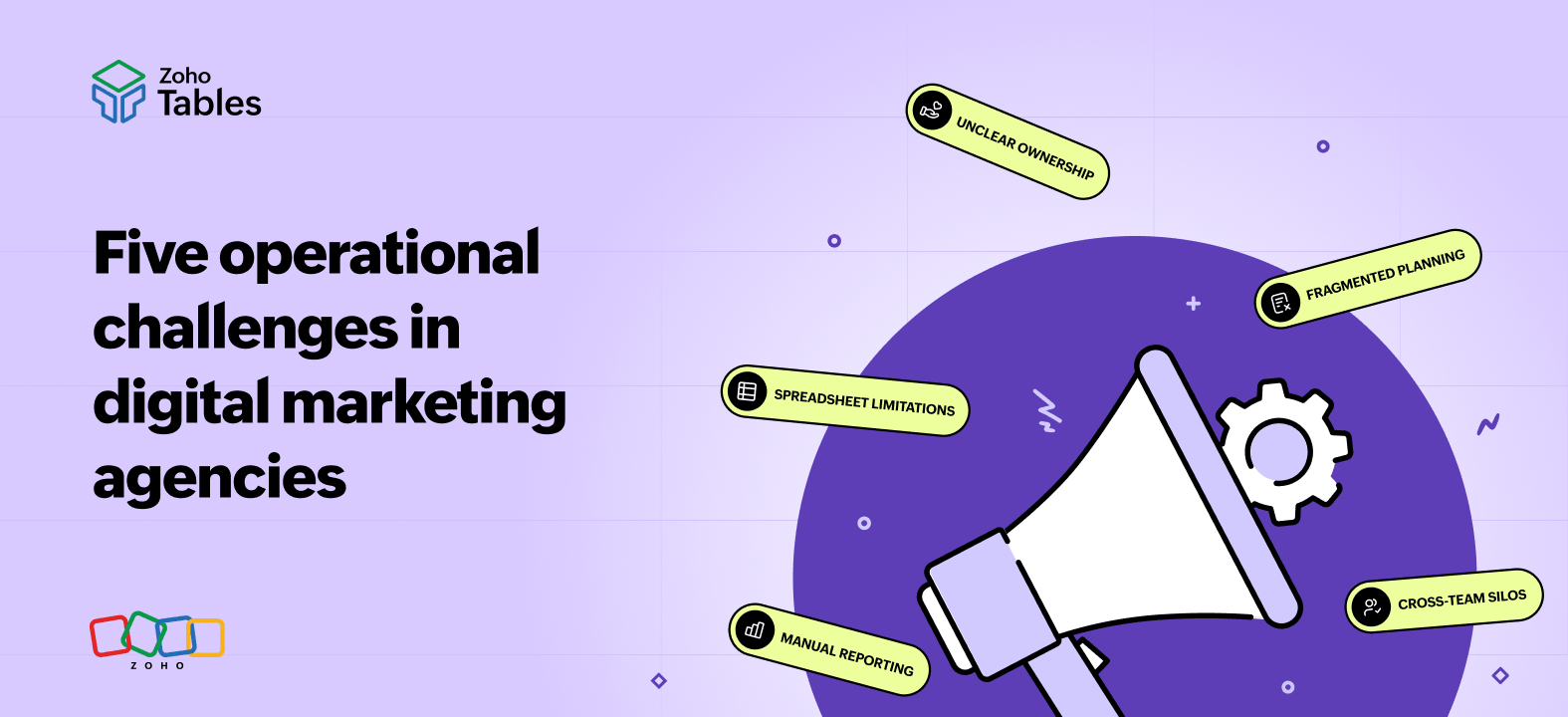
5 challenges faced without an operational layer
1. Fragmented planning
Planning, execution, and tracking details are spread across tools with no unified system, and this fragmentation leads to misalignment between strategy and execution. There's no structured record of what the team has committed to deliver. Over time, execution begins to drift away from strategy because nothing links them in a dynamic way.
2. Unclear ownership
Tasks are often assigned during meetings without proper documentation or clearly defined expectations. Simply assigning a name doesn't establish true ownership. Without defined deliverables, deadlines, and outcomes, responsibilities become ambiguous. This leads to duplicated efforts, missed timelines, and uneven workload distribution.
3. Cross-team silos
Marketing execution involves collaboration between content, performance, design, marketing operations teams, and sometimes external partners. Without shared visibility,
- Teams operate independently.
- Delays occur due to repeated follow-ups.
- Managers find it difficult to identify bottlenecks or understand where work is stuck.
4. Manual reporting
Reporting at many digital marketing agencies involves pulling data from multiple tools, consolidating it in spreadsheets, and manually preparing presentations. This recurring effort consumes valuable time, increases the risk of errors, and delays client reviews. Over time, this reduces the agency’s ability to make proactive, data-driven decisions.
5. Spreadsheet limitations
As the need for a structured operational system becomes clear, many digital marketing agencies continue to rely on spreadsheets. While familiar and convenient, spreadsheets are often used as the primary operational tool, without considering the limitations they introduce at scale.
- Data scattered across multiple sheets without a unified structure
- Limited contextual visibility across campaigns, tasks, and owners
- Limited to basic data views, with no native support for views like kanban or gallery
- No logical relationships between the data
- Manual updates that increase the risk of errors
- Difficulty scaling as data volume and collaboration grow
- Poor mobile usability for real-time updates
Zoho Tables as the operational layer
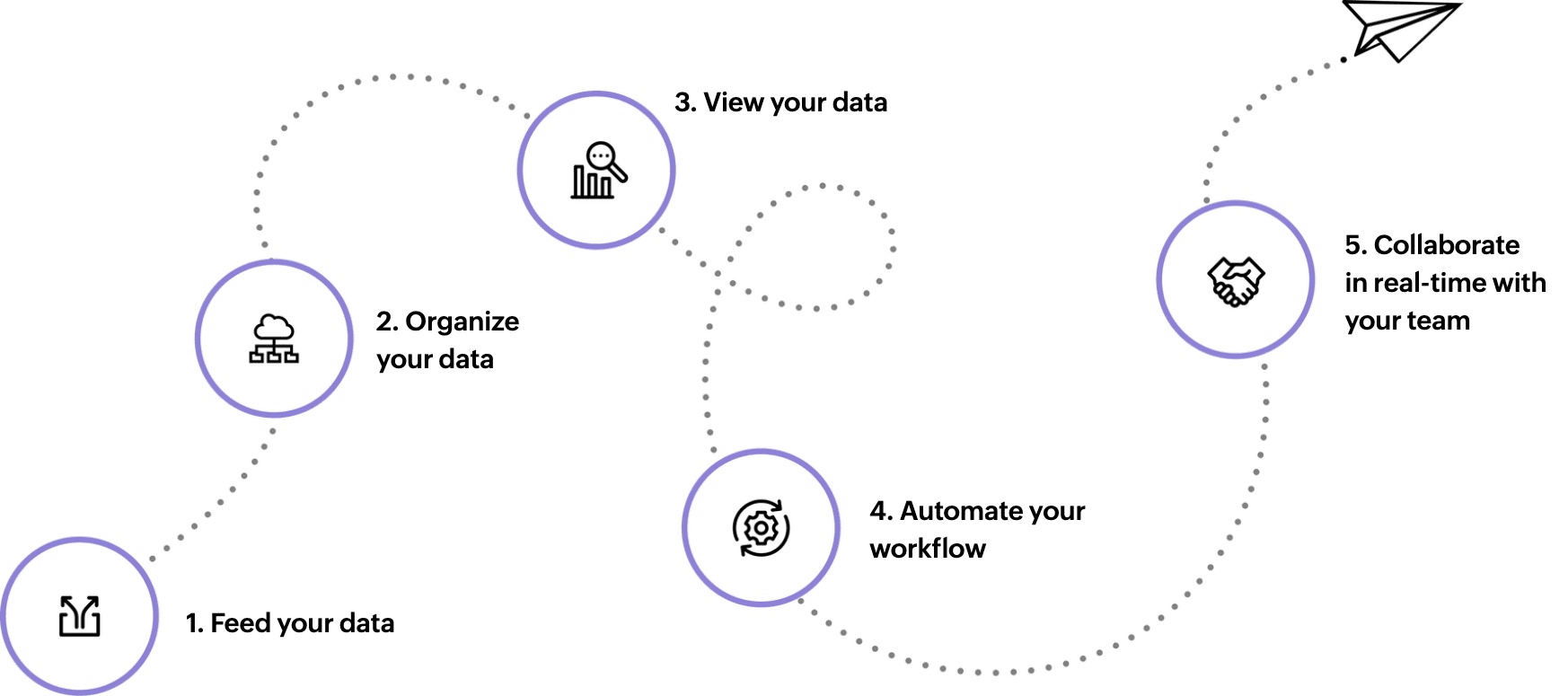
Centralized campaign databases
Zoho Tables enables marketing agencies to create structured campaign records instead of relying on static documents. Objectives, budgets, timelines, owners, and performance targets can be separate columns with defined field types. Planning becomes structured and continuously updated. Every task and activity can link directly to the campaign record, ensuring alignment between strategy and execution. This removes fragmentation and establishes a single source of truth.
Relationally connected data
Zoho Tables allows campaigns, tasks, budgets, channels, and owners to be relationally connected. A campaign can link to multiple tasks across teams. Budgets can be tied directly to campaign records. This relational structure enables managers to track progress from strategic planning to operational execution without manual cross-referencing.
Clear ownership and accountability
Structured task records make ownership explicit. Each task includes an assigned owner, due date, priority, and status. Dependencies can be defined, workloads can be balanced, and duplicate efforts can be avoided.
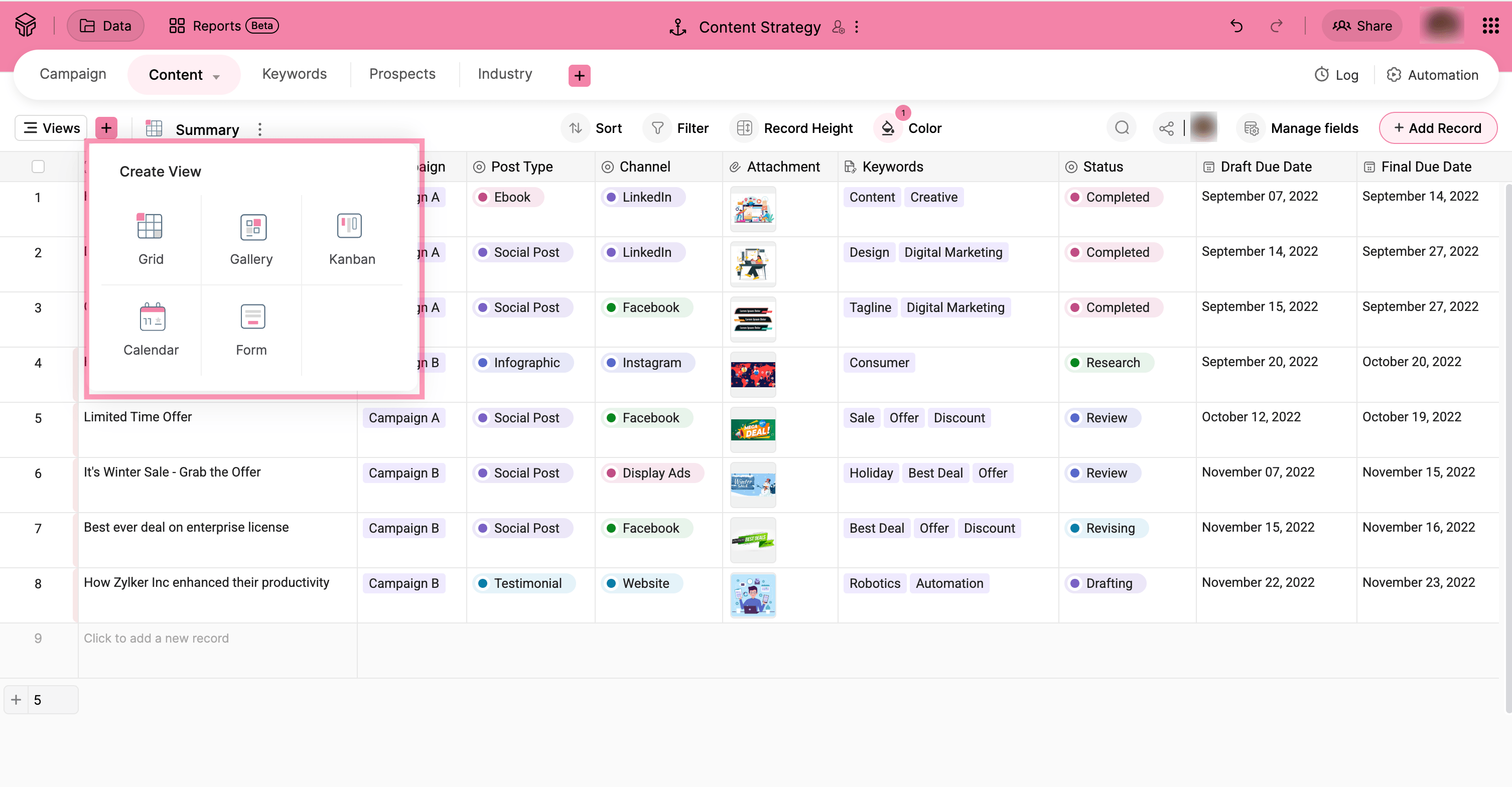
Multiple views for different stakeholders
Different roles require different perspectives. Team members need task-level clarity, and managers require campaign-level visibility. Zoho Tables supports customizable views so stakeholders can access relevant information without maintaining separate tracking sheets.
Automation and reduced manual reporting
Reporting becomes significantly easier as the operational data is already structured. Automation rules can generate tasks, update statuses, and send reminders. Managers can use filtered views and dashboards instead of manually compiling data every week. The focus shifts from collecting data to analyzing results and making decisions.
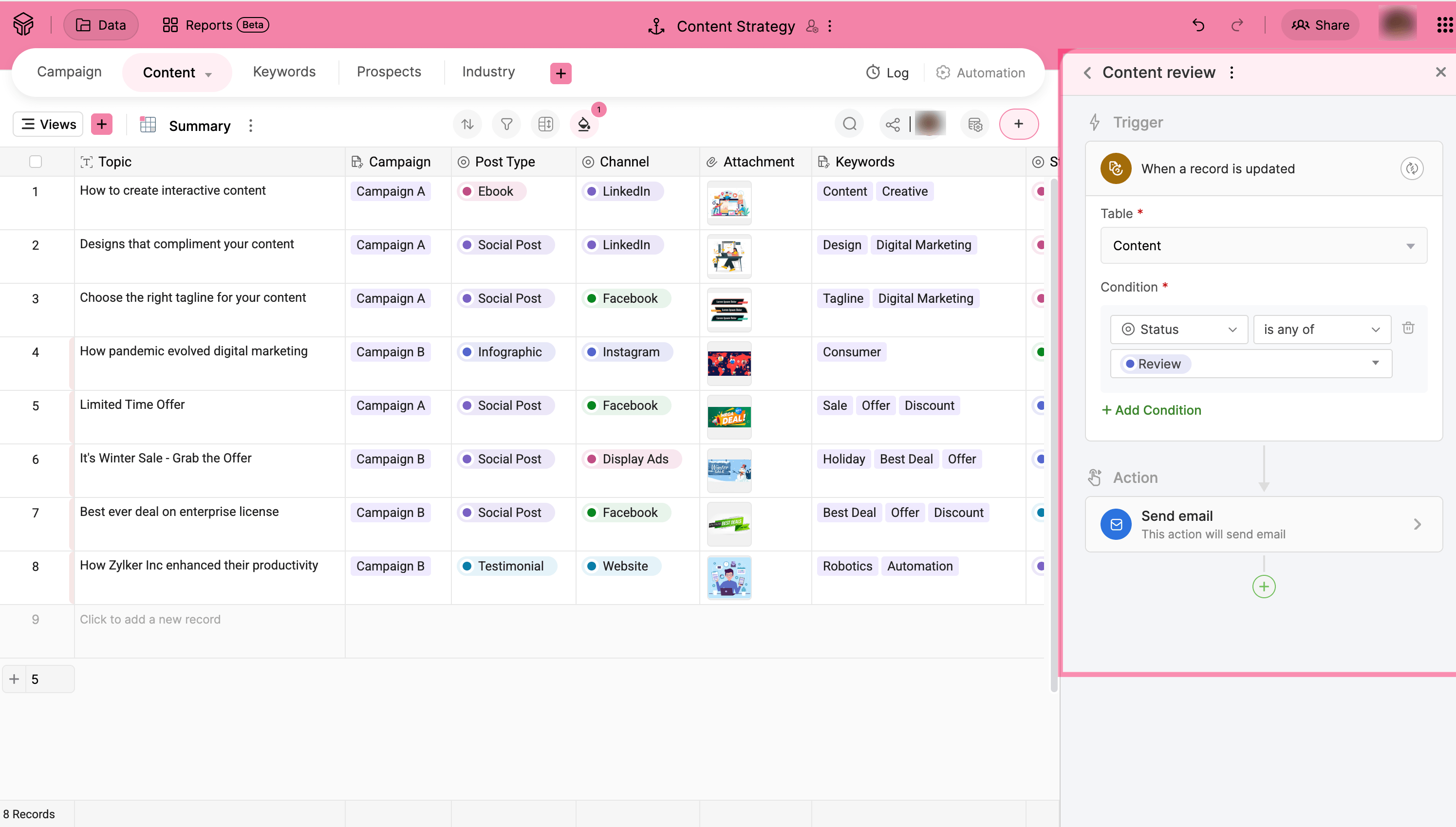
Mobile apps for real-time updates
On marketing teams, ideas and updates can't wait. Campaign changes, client approvals, or task updates often happen outside the office. With the Zoho Tables' mobile app, teams can stay connected to operational data wherever they are, reviewing campaign progress, updating task statuses, adding notes, and capturing new information directly from their devices.

How to get started with Zoho Tables
Getting started doesn't require rebuilding existing workflows. Teams can choose the approach that fits them best:
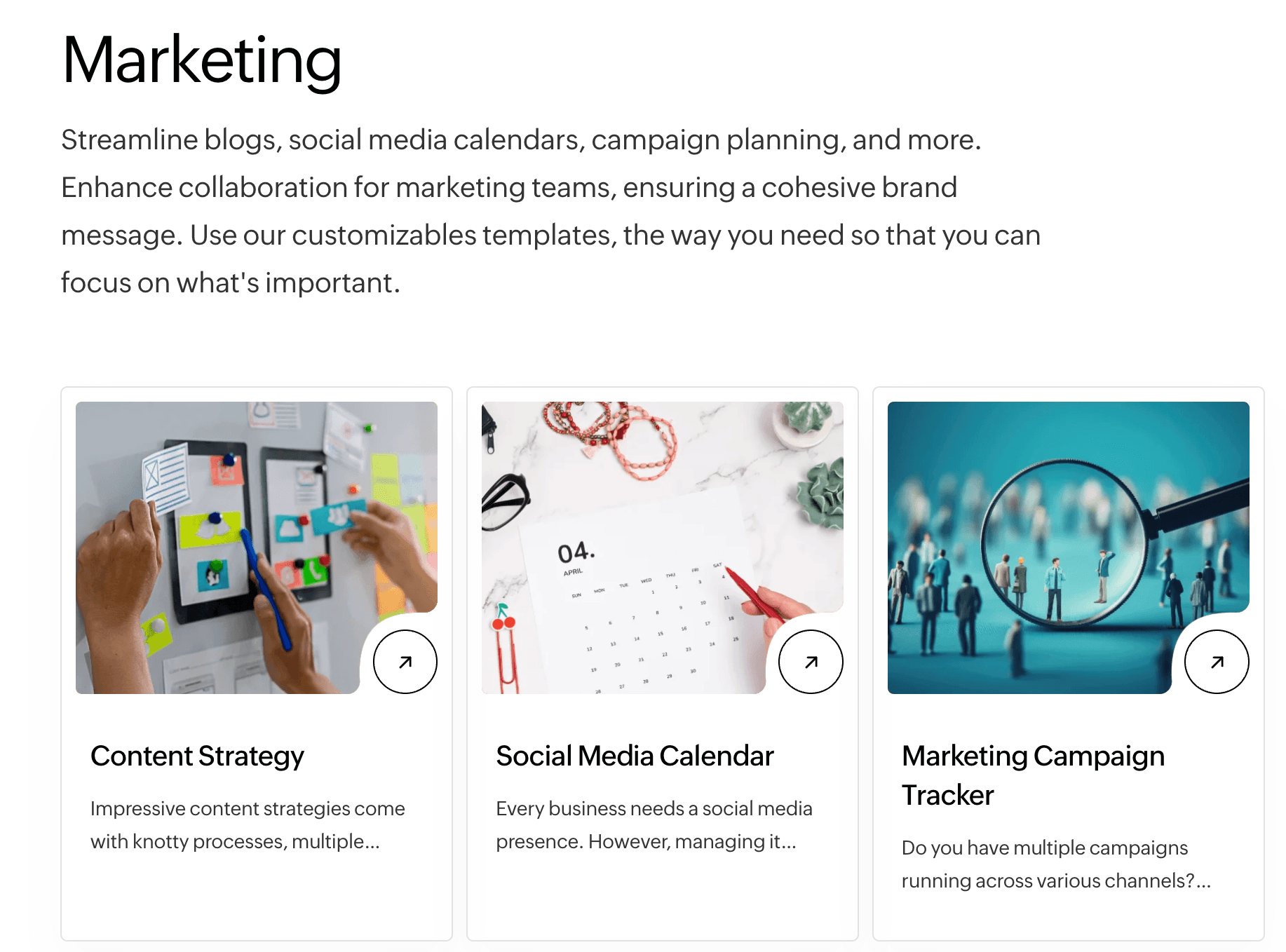
Use ready-made marketing templates
Start with prebuilt templates for campaign tracking, content calendars, and lead management.
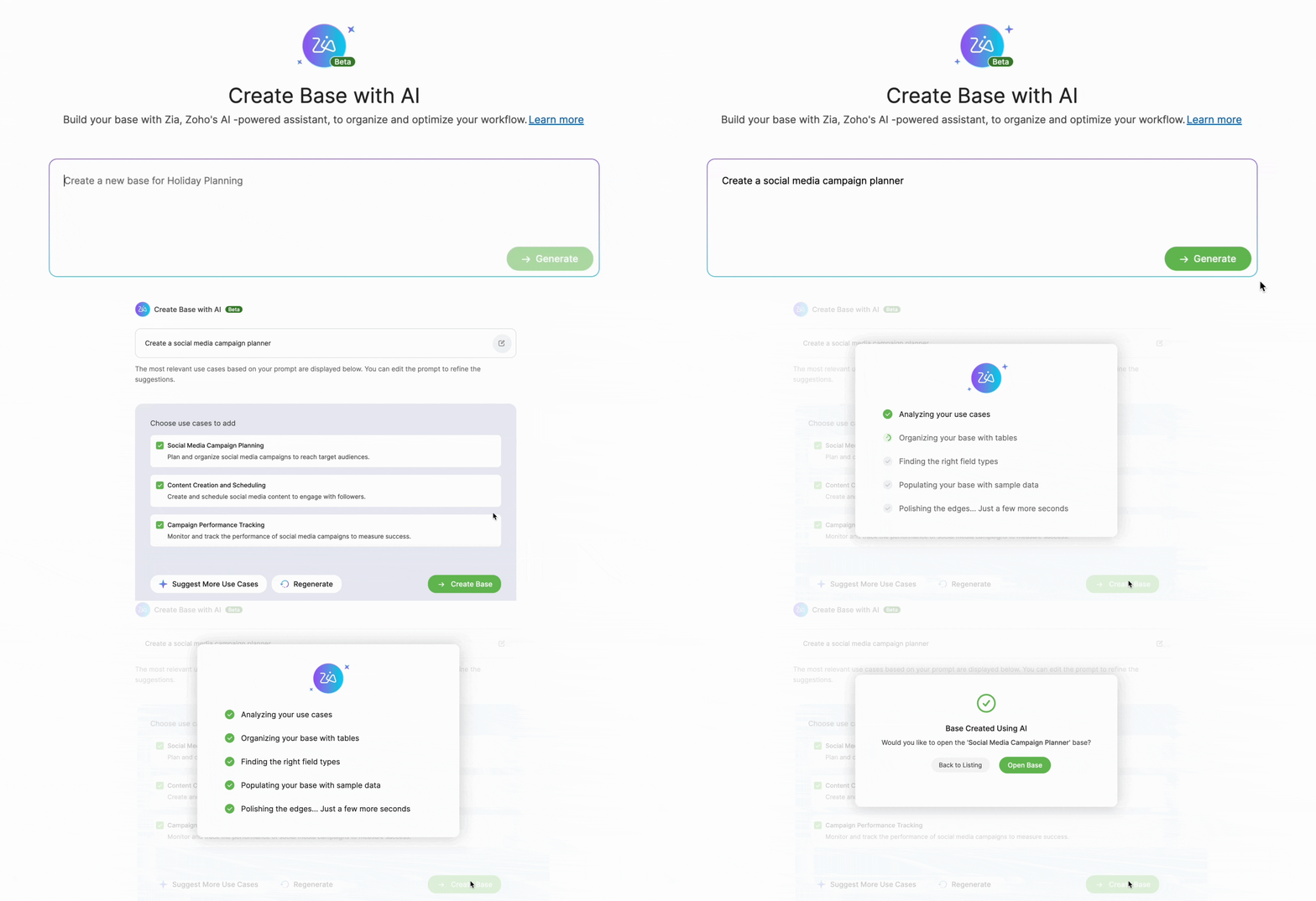
Create a base with AI
Use the create base with AI option to generate a structured base tailored to specific marketing workflows within minutes.
Import existing spreadsheets
Upload current spreadsheets and convert them into a relational, structured system without losing existing data.
Digital marketing agencies grow on creativity and speed, but scale depends on operational clarity. By centralizing data and enabling structured execution, Zoho Tables brings everything together in one system.
Simplifying operations for digital marketing agencies
Get Started
 Haripriya S
Developer turned marketer. Balancing parenting and marketing, and loving every bit of it.