- HOME
- Know Your Tech
- Legacy ERP and low-code: Choosing the right path to modernization
Legacy ERP and low-code: Choosing the right path to modernization
- Last Updated : June 9, 2026
- 261 Views
- 7 Min Read
This is a guest post by Sam. K, CEO of Office Hub Tech, a Zoho Authorized Partner.
Highlights
- Legacy ERP systems remain effective for managing transactions, governance, and financial control, but struggle to keep pace with modern demands for agility, real-time integrations, and automation.
- Excessive customization within ERP systems increases complexity over time, making updates, enhancements, and maintenance slower and more difficult.
- ERP modernization is increasingly shifting from replacement to extension, where new workflows, integrations, and user experiences are built outside the ERP core.
- Low-code platforms enable businesses to extend ERP capabilities through custom applications, API-driven integrations, and cross-system automation without disrupting core operations.
- An extension-based approach helps organizations balance ERP stability with business agility, allowing them to modernize incrementally while preserving existing systems and processes.
Most ERP systems aren't broken—they're simply misaligned with how modern businesses operate.
For decades, enterprise resource planning platforms were designed to ensure control, accuracy, and governance. They became the financial backbone of organizations, managing procurement, inventory valuation, compliance reporting, and operational control with consistency.
And at many companies, the ERP continues to serve as the single source of transactional truth; but business velocity has changed.
Today’s enterprises operate within interconnected ecosystems driven by APIs, automation, real-time analytics, and AI-assisted decision-making. Customer expectations are immediate, supply chains are dynamic, and decision cycles are shorter than ever.
This shift isn't a failure of ERP systems but a mismatch between what they were designed for and what businesses now require.
At this moment, organizations must decide whether to continue embedding change within rigid system cores, or to extend their ERP through external layers that allow for faster adaptation without compromising stability. The choice made here will shape how the business evolves over the next decade.
Where legacy ERP systems start to fall behind
Legacy ERP systems were built for an era where operational predictability mattered most. Their core principle was centralized control, with finance, procurement, manufacturing, and inventory tightly integrated into a single system.
This design delivers exactly what ERP systems are known for: strong data integrity, financial governance, and audit compliance. But that same tight coupling also makes change inherently complex.
Because everything is interconnected, even small updates require careful coordination. A modification in one area can affect workflows, reports, or integrations elsewhere. Over time, this slows down the pace at which the system can evolve.
And this rigidity becomes most visible when organizations try to customize their ERP.
When customization starts slowing ERP down
Customization often begins with valid business needs like approvals, compliance rules, pricing logic, or reporting enhancements.
Individually, these changes are manageable. But as they accumulate, they start to reshape the system itself.
Business logic gets embedded deep into the core. Reports depend on modified data structures. Integrations are built around altered workflows. What began as targeted improvements gradually increases complexity across the system.
The result is not failure but friction.
Updates take longer. Enhancements require more validation. Even small changes demand significant effort. And IT teams find themselves spending more time maintaining stability than enabling progress.
At this point, the challenge is no longer about adding more customization. It becomes about rethinking where the changes should happen.
ERP modernization isn’t about replacement but about extension
Instead of continuing to layer complexity into the ERP core, many organizations are shifting toward an extension-based approach.
In this model, the ERP remains responsible for transactions, financial control, and data integrity. New workflows, integrations, and user experiences are built outside the core, in a separate layer designed for flexibility. This separation changes the equation.
The ERP continues to provide stability, while adaptability moves to an environment where changes can be made faster, tested independently, and deployed without disrupting core operations.
Rather than forcing the system to evolve beyond its design, the architecture evolves around it.
Low-code platforms: Extending ERP without adding complexity
Low-code platforms play a key role in making this extension model practical. They're often seen as faster development tools—but the platforms' real value lies in architectural decoupling.
They don’t replace ERP systems. Rather, they abstract volatility away from them.
Instead of embedding change within the core, low-code platforms externalize workflows, interfaces, and integrations into a separate layer. This allows the ERP to continue handling transactions and governance, while adaptability moves outward.
Zoho Creator exemplifies this model. It operates as an API-first, event-driven layer that connects with ERP systems through secure integrations and real-time triggers.
For example, an ERP event can trigger validation logic, orchestrate workflows through tools like n8n, and update the system only after defined conditions are met.
Low-code doesn't eliminate governance, it repositions it.
It doesn't dilute system authority, it distributes operational flexibility.
By shifting change outside the ERP core, organizations gain a more resilient architecture, where updates are modular, faster to implement, and easier to manage.
Legacy ERP and low-code platforms
The key difference between legacy ERP systems and Zoho Creator comes down to how they're built and used. ERP systems centralize business logic and govern transactions, while Zoho Creator orchestrates workflows across systems.
This difference becomes clearer when viewed structurally.
But please note: The comparison isn't about which system is superior, but which role each system is best suited to play.
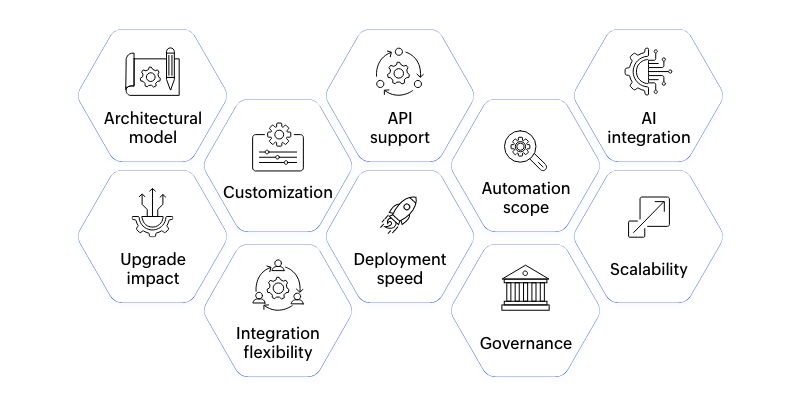
Comparison criteria | Legacy ERP | Zoho Creator |
Architectural model | Monolithic, tightly coupled modules | Distributed orchestration layer |
Customization | Proprietary coding, consultant-driven | Visual logic, modular configuration |
API support | Limited or add-on dependent | |
Automation scope | Module-based workflows | Cross-system event-driven automation |
AI integration | External add-ons required | Embedded AI agents within workflows |
Upgrade impact | Customization complicates upgrades | ERP core remains untouched |
Integration flexibility | Middleware-heavy | API-first, open ecosystem |
Deployment speed | Months to years | Weeks to months |
Governance | Centralized but rigid | Distributed yet role-governed |
Scalability | High but expensive | Subscription-based |
Integration ecosystems: The connected enterprise
Modern enterprises no longer operate within isolated software systems. They function as connected ecosystems where ERP, CRM, accounting, HR, analytics, and communication tools must continuously exchange data.
Legacy ERP systems weren't designed for this level of interoperability. Integration is often handled through batch jobs, module-based APIs, or extension layers that add delay and complexity. As a result, real-time coordination across systems is limited.
Zoho Creator addresses this gap by acting as a bridge between ERP systems and modern applications. It connects ERP data with external tools using APIs and webhooks, enabling event-based workflows instead of static data transfers.
For example:
ERP invoice creation triggers a webhook to Zoho Creator.
Data is validated and enriched with CRM context from Zoho CRM.
Payment status updates synchronize with Zoho Books.
Metrics are pushed into Zoho Analytics in near real time.
Customer notifications are dispatched through Zoho Mail or Zoho Campaigns.
Beyond Zoho applications, third-party systems, like HubSpot and QuickBooks, and external logistics platforms can participate through structured API gateways. n8n orchestration engines coordinate multi-step logic chains across systems, while AI agents evaluate exception conditions before automated actions are executed.
The ERP remains the ledger authority and the ecosystem becomes operationally intelligent.
Workflow intelligence
Legacy ERP systems are designed for deterministic execution. Purchase orders follow fixed approval paths, journal entries follow predefined rules, and inventory updates follow structured logic. They prioritize consistency and control.
But modern enterprises need systems that can respond to changing conditions.
Traditional ERP workflows are limited to module boundaries and static triggers. When processes span finance, operations, CRM, and customer communication, organizations often rely on customization or external tools to bridge gaps.
But with Zoho Creator, workflows extend beyond these limits. They respond to events, apply business rules in context, and coordinate actions across systems in real time.
For example, a high-value sales order created in your ERP can trigger validation in Zoho Creator. Based on payment history and risk signals, approval workflows are initiated. Once approved, updates flow to accounting, inventory, and CRM systems, and customer notifications are sent automatically.
ERP remains the system of record. Workflow execution happens externally.
This allows businesses to handle exceptions and cross-functional processes without modifying the ERP core, making automation more flexible and responsive.
When to extend and when to upgrade an ERP system
Many organizations assume upgrading is the default path to modernization—but that assumption deserves closer scrutiny. The real question is:
Is the ERP failing at its core function, or is it being pushed beyond its intended scope?
Extension is appropriate when:
The ERP remains financially stable and compliant
Core transactional processes continue to operate reliably
APIs or integration points are available
The primary need is greater agility and cross-system coordination
In these cases, upgrading introduces unnecessary disruption. It increases data migration risk, requires relearning systems, and slows down operational improvement during transition.
Upgrading becomes necessary when:
The ERP cannot support reliable integrations
Compliance or architecture limits future scalability
Vendor constraints block meaningful evolution
Total cost of ownership exceeds modernization value
Even then, extension often plays a role as a transitional layer during migration.
For most organizations, the most resilient approach is evolutionary rather than disruptive. Stability remains in the ERP, while adaptability is enabled externally.
Zoho Creator as the ERP extension layer
The comparison between legacy ERP systems and low-code platforms isn't about choosing one over the other; it's about redefining architectural roles. Traditional ERP platforms remain powerful systems of record, delivering transactional accuracy and financial control. However, modern enterprises demand more than transactional stability—they require real-time integration, adaptive automation, AI-assisted workflows, and cross-platform orchestration.
This is where Zoho Creator reshapes the equation. Rather than competing with ERP systems, it complements them. It acts as an orchestration layer that externalizes workflow intelligence, enables API-first connectivity, supports webhook-based automation, and integrates seamlessly with platforms like Zoho CRM, Zoho Books, Zoho Analytics, and third-party systems.
By enabling distributed process logic and modular innovation, Zoho Creator empowers organizations to modernize without destabilizing core systems. It bridges stability with agility. It transforms rigid enterprise architecture into adaptive operational ecosystems.
 Zoho Creator
With over 20 years of experience, Zoho Creator is an AI-powered low-code development platform used to build custom business applications. It enables users to create powerful, scalable solutions with minimal coding expertise. Stay tuned for more insights on low-code and digital transformation.