Healthcare content governance explained: Why UAE healthcare organizations need to think beyond storage

Digital transformation, AI, and evolving regulations are changing how healthcare organizations manage enterprise content. Here's why governance—not storage—is becoming the next strategic priority.
Healthcare organizations have spent years digitizing information. Electronic medical records (EMRs), cloud technologies, health information exchanges, and AI are transforming how clinicians deliver care and how healthcare providers collaborate. Yet as digital transformation matures, many organizations are discovering that the next challenge isn't creating more information—it's governing the information they already have.
The scale of this challenge continues to grow. According to the World Economic Forum, healthcare is among the world's most data-intensive industries, with hospitals generating vast volumes of structured and unstructured information every day. While electronic medical records capture clinical data, much of an organization's operational knowledge exists as enterprise content spread across documents, images, policies, contracts, and collaborative workspaces.
Modern healthcare generates far more than structured patient data. Every care journey also produces consent forms, referral letters, diagnostic images, discharge summaries, insurance documentation, clinical policies, quality reports, procurement records, supplier contracts, research files, training materials, accreditation evidence, and operational procedures. Together, these assets form the institutional knowledge that supports clinical excellence, regulatory compliance, continuity, and informed decision-making.
Across the United Arab Emirates (UAE), this information ecosystem is expanding rapidly. National initiatives such as the UAE Digital Government Strategy, We the UAE 2031, and the National Strategy for Artificial Intelligence 2031 continue to accelerate digital transformation across industries, with healthcare emerging as one of the country's most strategic sectors. As organizations adopt cloud collaboration, connected care, and AI-powered workflows, enterprise content is growing in both volume and importance.
This evolution is reshaping information management. For years, healthcare leaders focused on digitization and storage. Today, the more strategic question is how to keep enterprise content secure, accessible, compliant, and trustworthy as it moves across the organization. The answer lies not in storing more, but in governing it effectively.
Providers that recognize this shift will be better positioned to strengthen compliance, improve collaboration, and prepare for an AI-driven future.
The UAE's healthcare industry is entering a new digital era
The UAE has positioned healthcare as a pillar of its long-term national development agenda. Significant investment in infrastructure, smart hospitals, medical research, and digital public services has transformed care delivery. Rather than simply converting paper records, providers are redesigning clinical and operational workflows around connected technologies and data-driven decisions.
One of the most visible examples of this transformation is the adoption of health information exchanges. Malaffi in Abu Dhabi and NABIDH in Dubai enable licensed healthcare providers to securely exchange patient information across hospitals, clinics, laboratories, pharmacies, and other healthcare organizations. These initiatives improve continuity of care while reducing duplicate testing and fragmented patient records.
The digitization of healthcare extends well beyond clinical applications. Providers now depend on cloud collaboration platforms, digital workflows, enterprise communication tools, AI-powered applications, and connected medical technologies in all aspects of their operations. Clinical teams work across hospitals and specialties, while finance, procurement, quality, legal, compliance, research, and administrative departments rely on shared digital resources to support daily operations.
Every digital initiative creates more information. Even a simple telemedicine consultation generates clinical notes, patient consent documentation, billing records, and follow-up instructions. Procurement creates supplier contracts, technical evaluations, approvals, and audit documentation, while accreditation activities generate policies, evidence files, meeting minutes, corrective action plans, and quality reports.
As a result, providers are no longer managing thousands of documents but millions of interconnected content assets. This scale has changed the priority for healthcare leaders: storage capacity matters less than keeping content organized, secure, discoverable, and trustworthy across connected care environments.
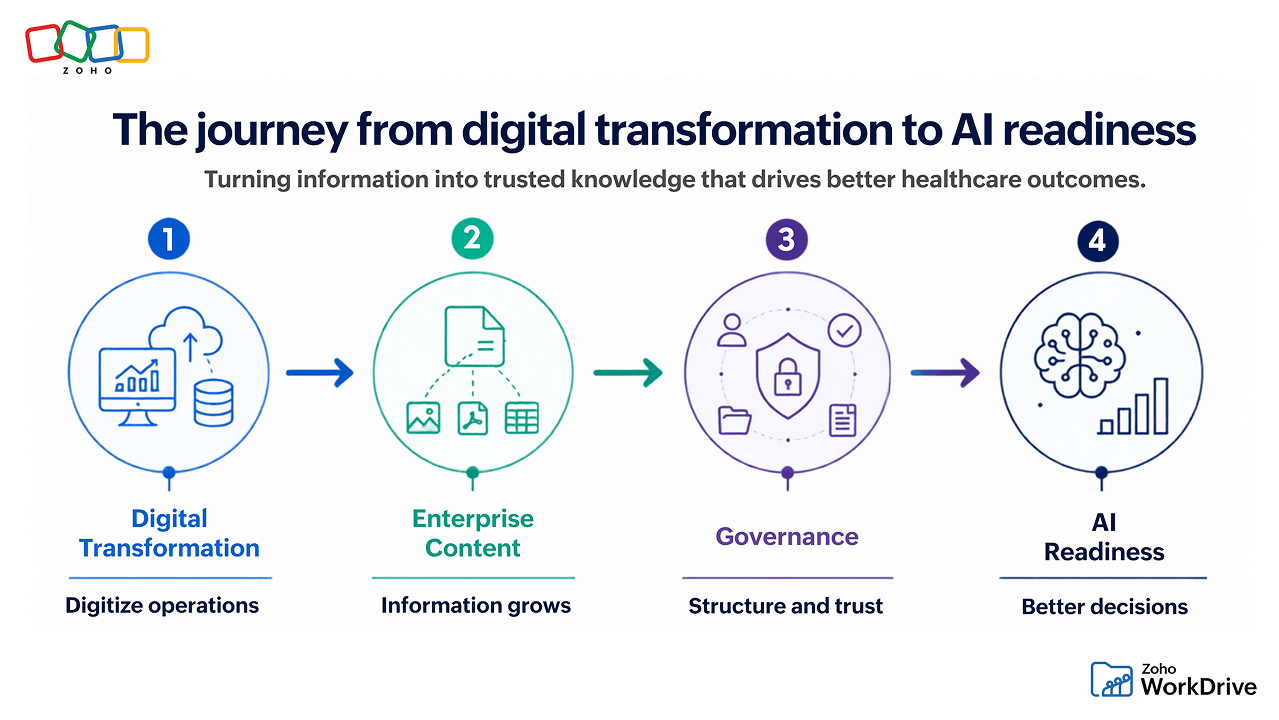
Figure 1. Digital transformation generates enterprise content; governance turns it into a trusted foundation for AI readiness.
Healthcare doesn't just produce data—it creates enterprise content
Discussions around healthcare information management often center on structured data.
Electronic medical records, laboratory systems, pharmacy platforms, and billing applications generate structured data that supports diagnosis, treatment, reporting, and analytics. This information is essential because it enables clinicians to make informed decisions and organizations to monitor operational performance.
Yet structured records represent only part of the picture.
Consider a patient admitted for cardiac surgery.
The electronic medical record captures the patient's diagnosis, medications, laboratory results, treatment plan, and clinical observations. Alongside that structured data, the hospital also creates informed consent forms, referral letters, diagnostic images, surgical safety checklists, nursing assessments, discharge instructions, insurance authorizations, procurement documentation, equipment maintenance records, quality assurance reports, multidisciplinary meeting notes, and regulatory documentation.
Together, these documents provide the operational context that enables safe, compliant, and coordinated healthcare delivery.
This broader mix of documents, images, policies, contracts, reports, presentations, emails, videos, and operational records constitutes enterprise content.
Health information management extends beyond maintaining patient records to encompass the governance, accessibility, security, quality, and lifecycle management of healthcare information. This broader perspective is reflected across guidance from organizations such as the Healthcare Information and Management Systems Society (HIMSS), which emphasizes information governance, data quality, interoperability, and responsible information management across healthcare.
These assets support nearly every function within a healthcare institution. Clinical teams depend on approved treatment protocols and standard operating procedures. Quality departments maintain accreditation evidence and audit records. Procurement manages supplier contracts and equipment certifications. Human resources oversees staff credentials and training, while research teams maintain ethics approvals, study files, and regulatory submissions.
Unlike structured clinical data, enterprise content is often distributed across shared drives, email inboxes, departmental applications, cloud storage platforms, and collaboration tools. Different teams may maintain different versions of the same document, apply inconsistent naming conventions, or follow separate retention practices.
As organizations grow, this fragmentation creates uncertainty around document ownership, version control, information quality, and compliance. This introduces extra risks. A clinician referencing an outdated clinical policy, a procurement team relying on an expired supplier agreement, or a compliance officer preparing for an audit with incomplete documentation can all affect operational performance and patient care.
These assets are more than documents to store; they are strategic resources that require clear ownership and oversight.
From data residency to information governance
As providers modernize their technology infrastructure, regulatory compliance has become a central consideration in cloud adoption and information management.
In the UAE, Federal Law No. 2 of 2019 concerning the Use of Information and Communication Technology (ICT) in Health Fields established the legal framework governing digital health information. The law generally requires that health data generated within the UAE remain inside the country unless an approved exception applies. Ministerial Decree No. (51) of 2021 further clarifies the circumstances under which health data may be transferred outside the UAE, while the UAE Personal Data Protection Law (PDPL) establishes broader requirements for protecting personal information.
Together, these rules have reshaped how providers evaluate cloud technologies. The discussion has moved beyond whether the cloud is secure to whether enterprise applications can meet local residency expectations without limiting collaboration.
UAE-hosted infrastructure now gives providers greater flexibility to pursue both objectives. However, meeting data residency requirements is just one part of information governance in healthcare.
Keeping healthcare information inside the UAE addresses an important infrastructure requirement, but it does not determine who owns information, who can access it, which version of a document is authoritative, how long records should be retained, whether changes are auditable, or whether sensitive information is shared appropriately across departments and external stakeholders.
Consider a hospital preparing for an accreditation assessment. Auditors are unlikely to ask only where documents are stored; they are equally concerned with whether policies are current, approvals are documented, access is appropriately controlled, document histories are maintained, and information can be produced quickly when required.
These expectations concern governance, not storage alone.
The distinction is fundamental.
Data residency answers where healthcare information should be stored.
Information governance determines how that information is managed, protected, and transformed into trusted organizational knowledge.
Future-ready healthcare requires both.
Why AI raises the stakes for healthcare information governance
Artificial intelligence is rapidly becoming part of everyday healthcare operations. Healthcare providers are exploring AI to support clinical decision-making, automate administrative workflows, improve medical imaging analysis, accelerate document retrieval, and enhance patient engagement. According to the World Health Organization (WHO), AI has the potential to improve healthcare outcomes when implemented responsibly with appropriate governance, transparency, and human oversight.
Discussions about AI often focus on algorithms and large language models, yet outcomes depend equally on the content those systems access. An AI application cannot know that a clinical policy is outdated when multiple versions appear equally authoritative, or distinguish an approved procedure from an obsolete draft without clear ownership and version history. Its reliability ultimately reflects the quality of the information environment in which it operates.
Imagine a clinician using an AI-powered enterprise search assistant to locate the latest infection prevention protocol before a procedure. If outdated policies remain accessible alongside the current version, the AI may retrieve conflicting guidance. The technology has performed exactly as intended. The problem lies not with AI, but with the governance of the underlying enterprise content.
The same issue extends beyond clinical care. Compliance teams preparing accreditation evidence, procurement teams summarizing supplier contracts, researchers retrieving study files, and administrators searching organizational policies all depend on reliable material. AI delivers greater value when that content is current, well classified, and governed from creation to archival.
AI readiness begins long before deployment. It starts with information governance.
Frameworks such as the NIST AI Risk Management Framework and the WHO's guidance on Ethics and Governance of AI for Health consistently emphasize accountability, transparency, trustworthy information, and risk management as essential components of responsible AI adoption.
The practical question is simple:
Can we trust the information our AI systems will use?
Where confidence is lacking, strengthening content governance may be the most valuable first step.
Building a governance-first healthcare organization
Information governance should no longer be treated solely as an IT or compliance function. It is an enterprise capability that protects sensitive material, improves collaboration, supports regulatory obligations, and prepares the organization for future innovation.
The first step is to treat enterprise content as an organizational asset rather than a by-product of everyday work. Clinical policies, accreditation evidence, contracts, quality reports, research files, procurement records, and operational procedures collectively represent institutional knowledge. Clear ownership, version control, retention rules, and consistent oversight help employees work from authoritative sources.
Organizations should also standardize practices across departments. Teams often develop independent methods for naming documents, assigning permissions, retaining records, and organizing files. While these approaches may work locally, they create complexity when material must be shared enterprise-wide or produced during an audit. Common standards improve discoverability, reduce duplication, strengthen accountability, and simplify collaboration.
Secure collaboration is equally important. Healthcare depends on material flowing between clinicians, laboratories, insurers, suppliers, researchers, and regulatory bodies. Role-based permissions, audit trails, retention controls, and policy-driven access help the right people use the right resources at the right time without weakening control.
Leaders should also connect governance to future innovation. AI initiatives, workflow automation, enterprise search, and operational resilience all depend on dependable content. Establishing that foundation today lowers risk and gives providers greater confidence when adopting emerging technologies.
Like healthcare itself, governance needs to evolve alongside technology, regulation, and organizational needs.
Moving beyond storage with Zoho WorkDrive
Digitization is only the first stage; healthcare providers must now turn information into governed, usable knowledge.
Healthcare providers do not need another repository. They need a system that applies policy-driven control to everyday work, so content can be created, shared, reviewed, retained, and found without relying on disconnected repositories or manual processes.
Zoho WorkDrive is a governance-first intelligent content management platform that embeds policy-driven control into everyday collaboration, helping organizations operationalize oversight at scale. Within a unified environment, teams can organize, review, secure, retain, and discover business-critical content without separating governance from daily work.
Capabilities such as role-based access controls, version history, audit logs, document review workflows, metadata management, intelligent search, workflow automation, and enterprise content lifecycle controls support consistent governance without interrupting how teams work.
For UAE healthcare providers, Zoho offers local data centres in Dubai and Abu Dhabi, enabling eligible customer data to be hosted within the country. This option helps align cloud deployments with local residency objectives while retaining the flexibility of cloud collaboration.
Local infrastructure, however, is only part of the solution.
Organizations must also control how content is created, approved, retained, audited, shared, and eventually disposed of. This discipline builds confidence that critical material remains accurate, accessible, compliant, and suitable for future AI initiatives.
Data residency addresses location. WorkDrive helps govern how content is created, shared, protected, retained, and prepared for AI. Together, these capabilities provide a reliable foundation for compliance, collaboration, and future innovation.
As the sector modernizes, operational documentation can become authoritative organizational knowledge that supports clinical excellence, resilience, and AI-ready decisions.
Final thoughts
Digital progress in healthcare is often measured by electronic medical records, cloud platforms, health information exchanges, and artificial intelligence.
The long-term value of these investments, however, depends on the quality and oversight of the content that supports them.
For providers in the UAE, local residency is an important cloud milestone, but the larger opportunity is to convert enterprise content into reliable organizational knowledge for compliance, collaboration, and AI-assisted decisions.
Institutions that invest in this capability will be better equipped to respond to evolving regulation, work across connected ecosystems, and adopt new technologies with confidence.
The future of healthcare will not be defined by how much information organizations create: it will be defined by how well they govern it.
Frequently asked questions
What is healthcare content governance?
Healthcare content governance is the discipline of organizing, protecting, controlling, and overseeing business-critical material so it remains accurate, secure, compliant, and readily available for clinical, operational, and regulatory use.
How is enterprise content different from healthcare data?
Healthcare data usually refers to structured records held in electronic medical records, laboratory systems, and billing applications. Enterprise content covers documents, images, contracts, emails, policies, reports, presentations, and other unstructured material that supports operations.
Why is information governance becoming more important in the UAE?
In the UAE, cloud adoption, AI, and connected care increase both regulatory obligations and the need for consistent control. Governance supports compliance, collaboration, operational efficiency, and readiness for intelligent systems.
Does storing healthcare information in the UAE automatically ensure compliance?
No. Data residency addresses location; compliance also depends on access controls, audit trails, retention rules, version management, and other oversight practices.
Why is governance important for AI?
AI systems depend on authoritative material. When content is outdated, duplicated, or poorly controlled, applications may surface inaccurate or inconsistent results. Strong governance improves reliability and confidence in AI-assisted decisions.
How can Zoho WorkDrive help healthcare organizations?
Zoho WorkDrive helps providers centralize business-critical content, collaborate securely, maintain version histories, automate workflows, support auditability, and manage records from creation to archival. Combined with Zoho's UAE data centers, it can align cloud collaboration with local residency objectives and a governance-first operating model.

Comments