- HOME
- More
- Best Practices
- A complete guide to using dunning emails to reduce churn
A complete guide to using dunning emails to reduce churn
- Published : December 30, 2025
- Last Updated : December 30, 2025
- 618 Views
- 7 Min Read

Businesses often put in hours, days, and years of work into acquiring customers, and then a few more into retaining them. With so much time and resources spent on every customer, churn is every business's worst nightmare. To battle this, businesses employ a host of strategies and tools. One key practice that closely relates to churn and revenue is dunning. In this article, we’ll see what dunning is, how it’s done through emails, and how best to use them.
What are dunning emails?
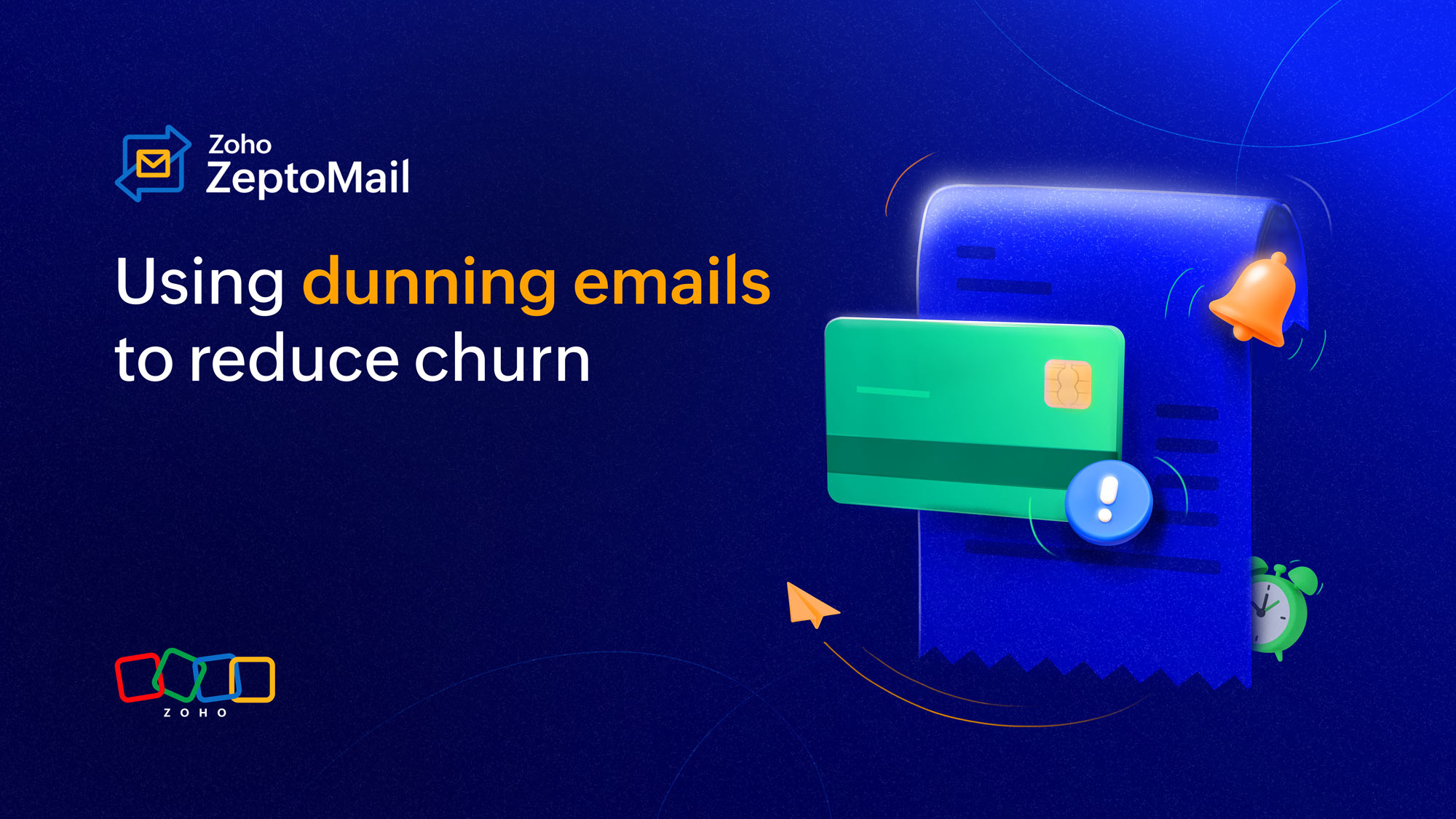
In medieval times, dunning meant debt collectors persistently approaching borrowers to claim what they were owed. In today's SaaS world, dunning is a much gentler process. Dunning emails are automated messages that notify customers of overdue or failed payments primarily in a recurrent payment or subscription-based system. The primary purpose is to remind customers to take corrective actions to avoid service disruptions. From the business's perspective, it’s a key tool in accounts receivable management.
When are dunning emails sent?
Any payment issue that could disrupt service can trigger dunning emails. Here are some common triggers.
Failed recurring payment
In case of recurring payments, dunning emails are triggered when the transaction fails. This failure could happen for many reasons, including:
Outdated credit card information: More often than not, credit cards are used for recurring payments. The transaction could fail if the customer has changed or blocked their credit card and forgotten to update the information for the recurring payment.
Incorrect payment method information: It’s possible that details of the payment method is wrong, like the account number or the pin for the payment mode. This can lead to a failed transaction.
Bank authentication issues: Sometimes, due to authorization issues or suspected fraudulent activity, the processing bank will deny the transaction. In this case, the customer will be notified to resolve the issue.
Insufficient funds: The recurring payment could fail due to insufficient funds, in which case the customer will be required to replenish their account or give an alternative payment method.
Technical issues: In rare cases, even when all of the details are right, a technical glitch on the customer's end or your business end could fail the transaction.
Subscription renewal
Some forms of subscription will be a manual renewal rather than a recurring payment. In this case, dunning emails will be sent notifying the customer to navigate to your business website and complete the overdue renewal process.
Policy change
If a business is updating the terms of payment, dunning emails will serve as a notification. This is especially useful if the policy change requires an action from the customer for continued service, like updating billing information.
Why dunning emails are important
More often than not, a missed payment or renewal is simply human error. Dunning emails allow your customers to rectify the situation before they face any service disruption and allows your business to collect revenue effectively. Here are some ways in which dunning emails will help your business.
Reduce involuntary churn
Involuntary churn happens when cancelation of the subscription or leaving the business occurs due to a mistake or oversight rather than a conscious decision. A failed recurring payment or subscription renewal could simply be an oversight. A good dunning email will gently remind your customer to take action before it escalates to a service interruption.
Recover lost revenue
Cash flow is important for any business and most of this cash flow often comes from recurring payments and renewals. Dunning emails, when done right, can help you recover cash flow before it becomes lost revenue.
Automate collection
Manual verification and payment collection would mean spending valuable time and resources on a process that could be automated. By setting up automated dunning emails, the time and resources will be freed up to use for core functionality tasks. An automated process will also help businesses handle the recovery of many overdue payments efficiently and with fewer errors.
Improve customer experience
Without the nudge of a dunning email, customers could face service interruptions due to simply missing a deadline. They would then have to reach out to your customer support and get it sorted out. A simple dunning email sequence could help avoid your customers having to go through all of that. This, in turn, will improve customer experience and retention.
Build trust and transparency
A good dunning email notifies the customer at the right time and is often personalized. A well-crafted dunning email that strikes the right tone will make the customer feel like your business values their relationship and takes timely communication seriously. This will build trust with your business.
Comply with regulations
In certain industries, documented proof of contact attempts can support collection processes, contract enforcement, and other regulatory compliances. Dunning emails are well documented and have an electronic trail. This makes them a good compliance tool.
The psychology behind effective dunning emails
A well-crafted dunning email sequence uses psychological cues to increase recovery rates and customer satisfaction.
Loss aversion: Dunning email motivates customers to avoid missing out on access to your service.
Urgency and deadlines: Gentle reminders escalate gradually to trigger action.
Clear and simple: Too much information can be an overload. Concise instructions will help with conversion.
Successful dunning emails use these behavioral triggers by maintaining a polite tone, reminding customers of their commitment, the benefits of your service, transparency about the transaction failure reason, and making the next steps easily available.
Best practices to write good dunning emails
Content best practices
Here’s a basic structure that a good dunning email should follow and the best practices that each element should include:
Subject line
Keep the subject line relevant to the email content/purpose.
Personalize the subject line.
Convey the level of urgency of the email in the subject itself.
Test different subject lines to find the one that works best.
Greeting
Maintain a professional and friendly tone to make the customer feel valued.
Personalize the greeting with the customer's name if possible.
Body
Keep the body of the email short and clear.
Use bullet points to convey information to make it more digestible.
Clearly convey the issue that caused the failed payment.
If the exact reason isn’t available, give the customer a list of possible reasons so they can look into it.
Mention details of the payment, like invoice details or payment amount if available.
Provide multiple modes of payment options to complete the payment.
Don’t use overly technical language and avoid jargons.
Give clear instructions for the next steps to be taken by the customer.
When appropriate, mention the consequence of failure to take corrective action.
If there’s a deadline for the action, make sure it stands out from the other details.
Call to action
Make sure that the CTA is placed prominently both content-wise and design-wise.
The label of the CTA should reflect the action that it will lead to and can also be a nudge for immediate action. For example, "Pay now".
Closing
End the email on a optimistic note.
Express gratitude for their support.
Give them contact information for customer support or any team that can help if they’re facing difficulties in making the payment.
Tone best practices
Polite and professional
The email should be empathy-driven and solution-focused instead of coming across as a mistake or blame. Relationships built through conflict resolution could leave a lasting impression on your customer, so remember to provide as many solutions as possible to the customer while showing compassion.
Escalate urgency gradually
Dunning is split across different stages and phases. Going in with all guns blazing from the first email could come across as attacking or overwhelming. It’s best to increase the urgency in your email gradually. It should go from a gentle reminder to a more urgent notification closer to the payment deadline.
Timing
Email sequence
Don’t bombard your customers by sending too many dunning emails. This could hurt your relationship rather than retain customers because it could overwhelm them.
Time
Every business has a different audience and every audience has a different peak time. Study yours and pick good engagement times to send your dunning emails.
Frequency
Depending on the impact of the service disruption and previous analysis, you should decide on two key factors—frequency and dunning period. While three emails over 14 days is a general rule of thumb, the time gaps between these emails and the overall duration needs to be tailored to your audience.
General best practices
Automate: To avoid human error and save valuable time and resource, always automate the dunning email sequence.
Brand voice: Whether it’s the content or design, make sure to stay consistent with your brand voice used across other communications like website content and marketing collaterals.
Segment: If logical groupings are possible for your audience, segment them into smaller groups and tailor your dunning campaign for each group.
Multi-channel: Use a multi-channel dunning strategy by employing SMS and in-product notification, along with email notifications.
Test: Try out different versions of your dunning strategy to find the one that works for you.
Track and analyze: Track important KPIs after sending out the dunning emails and use the insights to refine your email content and strategy.
Post-resolution: Make sure to send a thank you email to your customer once the corrective measure has been taken to end the communication on a positive note.
Compliance: Ensure compliance with data protection laws and debt collection regulations.
Conclusion
Dunning emails are more than payment reminders. They’re an essential part of customer retention and revenue recovery. A well-designed dunning strategy ensures:
Lower involuntary churn.
Improved customer experience.
Clear communication.
Fewer billing disputes.
Higher overall lifetime value.
By implementing thoughtful automation, a polite escalation strategy, and customer-friendly messaging, businesses can significantly increase recovered revenue while maintaining trust and satisfaction.