- HOME
- All Products
- Collaboration
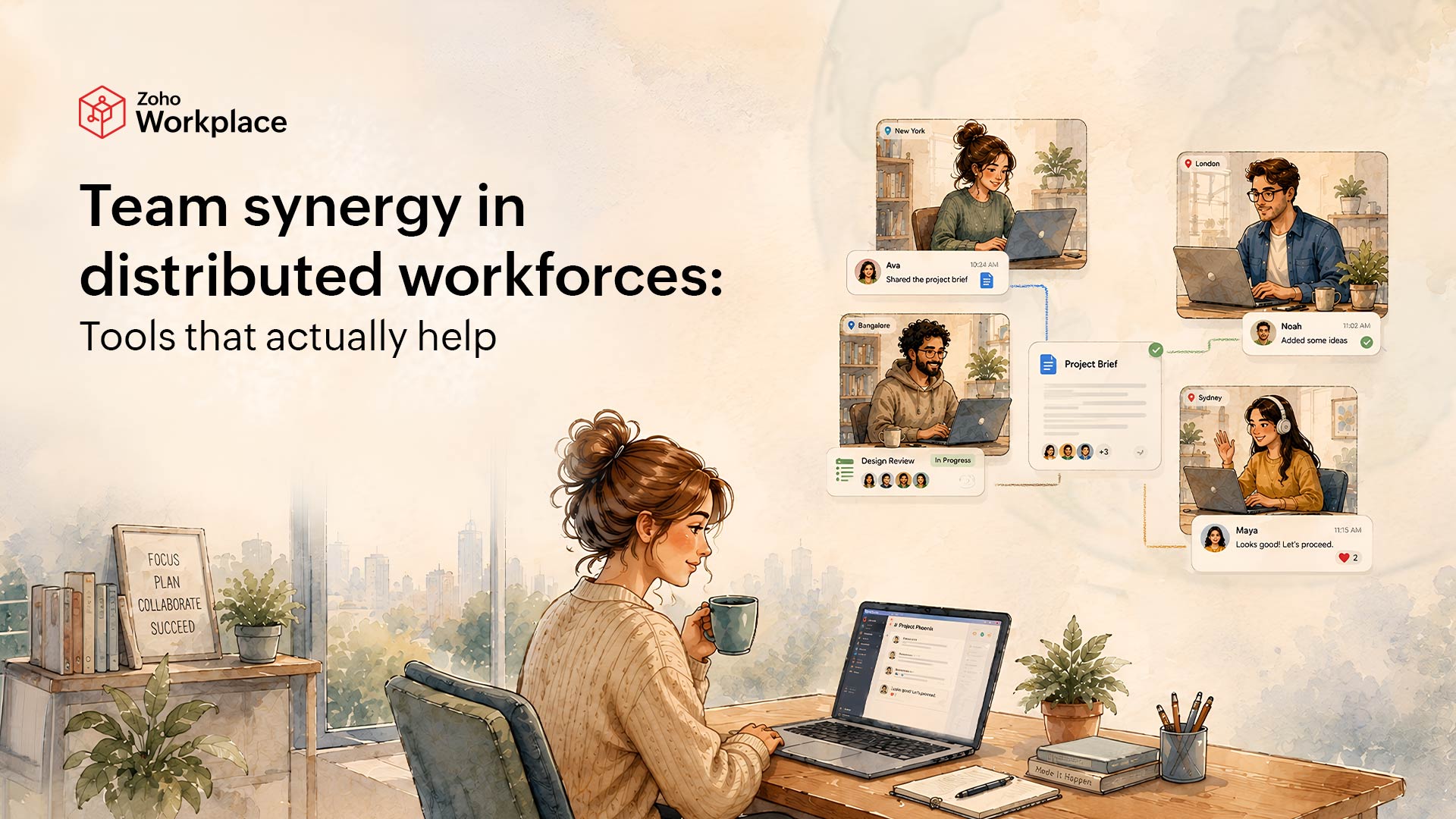
- Team synergy in distributed workforces: Tools that actually help
Team synergy in distributed workforces: Tools that actually help
- Published : June 1, 2026
- Last Updated : June 2, 2026
- 774 Views
- 7 Min Read
Distributed work offers plenty of perks—things like flexibility, wider talent pools, and less time spent commuting. But there are some notable downsides, too.
A big one? Team synergy. When teams aren’t sharing physical space, they need to be way more intentional about communicating, collaborating, and feeling like a tight-knit group.
It’s a challenge—but, fortunately, it’s one you can do something about. This guide covers what team synergy is, why it’s tougher for distributed teams, and the tools you can use to keep everybody working in sync.
What exactly is team synergy?
Team synergy is what happens when a group of people works together so effectively that the result of their teamwork is greater than what any of them could have produced individually.
It sounds simple enough, but it's one of those things that's easier to feel than to define—and it’s also easier to notice when it's absent than when it's present.
In practical terms, a team with strong synergy often:
- Shares a clear understanding of goals and priorities.
- Communicates openly.
- Trusts each other to follow through.
- Makes decisions without excessive back-and-forth.
Maybe you’ve experienced strong team synergy before yourself. It’s that feeling when your work together flows—problems are tackled early, people understand how their work fits into the bigger picture, and the whole thing just clicks.
It's worth noting that synergy isn't the same as harmony. Teams can disagree, debate, and push back on each other and still be highly synergistic. What matters is that the friction is productive rather than purely problematic.
Why synergy is harder on distributed teams
As straightforward as it might sound, building genuine team synergy is hard—and that’s especially true when your team is spread across different locations, time zones, and schedules. It’s just the reality of what physical distance does to the natural groove of collaboration.
That’s because a lot of what drives synergy in co-located teams happens passively. Overhearing a conversation and realizing it’s relevant to your work. Picking up on someone’s mood or body language before a difficult meeting. Asking a quick question on your way to the coffee pot. None of that exists in a distributed setup, which means teams have to be deliberate about things that used to just happen.
Plenty of data backs this up:
- Research published by Stanford's Institute for Economic Policy and Research found that fully remote work is associated with 10–20% lower productivity compared to in-person work, with communication gaps and reduced real-time collaboration identified as key factors.
- A 2023 HBR-commissioned survey found that 79% of respondents considered in-person meetings more effective than virtual ones for team-building, underscoring how remote settings create real gaps in collaborative connection.
- According to McKinsey's State of Organizations 2023 report, while 90% of companies have adopted hybrid work, executives consistently list cultural erosion and communication challenges as their top concerns — with enabling effective collaboration named as one of the leading pain points of the hybrid model.
This does more than hinder productivity—it can contribute to a real sense of loneliness. According to Gallup's State of the Global Workplace report, fully remote employees report significantly higher levels of loneliness (25%) than those who work exclusively on-site (16%). And when people feel isolated, it only makes sense that trust, openness, and easy communication would start to fall apart.
Even if distributed team members do manage to feel connected to each other, the tools meant to support that connection can do more harm than good.
Most distributed teams rely on a patchwork of apps for messaging, file sharing, project tracking, and meetings (tool sprawl is real). Switching between those platforms demands a lot of time and energy, but it also makes synergy significantly harder to achieve.
When conversations, files, decisions, and updates are scattered across tools, teams lack the foundation of synergy: shared context. People miss important updates, duplicate work, and make decisions without the full picture. Soon, it feels like everyone is working in their own silo—even if they’re technically on the same team.
What’s the cost of lackluster team synergy?
It’s tempting to think of weak team synergy as nothing more than a morale problem. Sure, strong synergy makes work a little more satisfying, but its impact won’t show up anywhere that matters, right? That’s not true—and the data proves it.
Employee engagement is one of the biggest risks. When synergy breaks down, people become increasingly disconnected from their teammates, their shared goals, and the work itself. According to Gallup's State of the Global Workplace report, global employee engagement fell by two percentage points in 2024, costing the world economy an estimated $438 billion in lost productivity.
Connection is often the antidote for disengagement. Additional Gallup research shows that employees with strong collaborative relationships at work are significantly more likely to stay engaged.
A lack of synergy often leads to communication breakdowns, too. Grammarly's State of Business Communication report found that ineffective communication costs U.S. businesses up to $1.2 trillion annually—or roughly $12,500 per employee. Communication already requires more deliberate effort on distributed teams, making this problem even costlier.
And, while the human impacts might be harder to put a number on, they’re still significant. Teams that lack synergy tend to see higher stress, lower morale, and eventually, higher turnover. It’s expensive to lose an employee—especially when you consider the loss of institutional knowledge, team chemistry, and momentum that walks out the door with them when they leave.
Fortunately, these don’t have to be unavoidable realities of distributed work. With the right infrastructure in place, distributed teams can build the kind of synergy that makes all of these risks far less likely.
Supporting team synergy: The tools that actually help
Tools themselves don’t create team synergy. But using the wrong ones can absolutely hold it back.
That’s why it’s so important to be thoughtful when building your collaboration tech stack. Doing so helps you foster an environment where communication is clear, context is shared, and nothing important falls through the cracks. Here are the categories of tools that help you make that happen.
Real-time messaging
A reliable messaging platform is table stakes for distributed teams. And, while having somewhere to casually chit-chat is important, messaging tools quickly become central to how remote employees work together. For that reason, look for:
- Channel-based organization, so conversations are grouped by team, project, or topic. This makes them easy to find later, rather than scrolling through endless messages buried in a single feed or a cluttered email thread.
- Threaded replies to keep focused discussions from derailing the main channel.
- Searchable message history so decisions and updates don't disappear.
- Async voice and video messages for when tone and nuance matter, but a live call isn't necessary. This is especially useful across time zones.
Document collaboration
While they might not be the first thing to spring to mind, shared documents are where a lot of alignment and collaboration happen. When everyone is working from the same source of truth, there's less room for mismatched assumptions or stepping on toes. Look for:
- Real-time co-editing so multiple people can work in the same document simultaneously without any versioning chaos.
- Inline comments and annotations to keep feedback contextual rather than scattered across separate email threads.
- Version history so changes are trackable and nothing is ever truly lost.
- Centralized storage with clear permissions, so the right people always have access to the right files.
Project and task visibility
One of the most common synergy problems in distributed teams is the feeling that nobody quite knows what everyone else is working on. A good project management tool solves this by giving the whole team a shared view of priorities, progress, and workflows. Keep an eye out for:
- Task assignment and ownership so there's no ambiguity or confusion about who's responsible for what.
- Multiple views—such as list, Kanban board, or Gantt chart—so individuals and managers can see work in whatever format is most useful for them.
- Dashboards and status updates that show roadblocks and progress at a glance, without requiring a status meeting to get the picture.
- Activity feeds that keep the team informed of updates (without people needing to chase them down).
5 tips to build synergy on your distributed team
Tools set the stage, but the habits and norms your team builds around them are what actually bring people together. Here are a few practices that make a difference:
1. Default to async communication when possible: Not every question needs a meeting, and not every update needs an immediate response. Building an async-first culture reduces interruptions, respects different time zones and working styles, and gives people the space to do their focused work. Keep synchronous time reserved for the conversations that genuinely benefit from it.
2. Make expectations explicit: In a co-located setting, a lot of context gets communicated informally. But, in a distributed one, that context has to be written down. Clearly documenting goals, roles, and decisions means everyone is working from the same understanding. You can’t have synergy without being on the same page.
3. Build in regular rituals: Consistent touchpoints (think things like a weekly stand-up meeting, a brief retrospective at the end of a project, or a regular one-on-one) keep people aligned and connected over time. These don't need to be long. They just need to be consistent.
4. Create space for informal connection: Synergy isn't purely functional. The trust and ease that make teams click tend to develop through the casual, unstructured interactions just as much as the work itself. A dedicated channel for non-work conversations, a virtual coffee chat, or a few minutes of small talk at the top of a meeting may feel like small gestures—but they add up over time.
5. Normalize giving and receiving feedback: Teams with strong synergy tend to communicate openly, which means feedback flows in all directions. Establishing clear norms around how feedback is given and received—and modeling it from the top down—creates the psychological safety that open communication depends on.
Support synergy (even when you’re spread out)
Distributed work isn't going anywhere, and neither is the challenge of keeping teams aligned across distance, time zones, and competing priorities. But that challenge is way more manageable than you might think.
The teams that get it right are intentional about everything: the tools they use, the habits they build, and the culture they cultivate. They recognize that team synergy isn’t something that just occurs—it’s something you orchestrate.
Stop stitching together single-purpose apps. Zoho Workplace brings everything into one connected platform, so your team always has the shared context they need.
 Kat Boogaard
Kat is a freelance writer focused on the world of work. She writes for both employers and employees, and mainly covers topics related to the workplace such as productivity, entrepreneurship, and business success. Her byline has appeared in The New York Times, Fast Company, Business Insider, Forbes, and more.