A detailed Guide to Internet of Things
- Last Updated : September 9, 2026
- 0 Views
- 12 Min Read

The First IoT Device

Long before anyone used the phrase “Internet of Things,” a Coca-Cola vending machine on the third floor of Wean Hall at Carnegie Mellon University became what is now widely recognised as the first IoT device. In 1982, a group of graduate students in the Computer Science Department David Nichols, Mike Kazar, John Zsarnay and Ivor Durham among them grew tired of walking down to the machine only to find it empty or stocked with warm bottles. So they connected it to the department network, which was in turn connected to the ARPANET, the research precursor of today’s internet.
The engineering was characteristically hands-on. The students fitted micro-switches inside the machine to detect which of the six delivery columns held bottles, and added logic to track how long each column had been refilled a proxy for how cold the Coke was. A small program on one of the department’s servers polled the machine and exposed its state over the Finger protocol. Anyone with access to the network could type finger coke@cmua from their terminal and instantly see which columns were full and whether the bottles had been in the machine long enough to be cold.
The Coke machine is not just a charming campus story. It is the first known example of every idea that now defines IoT. The Wean Hall machine ran for years and inspired a lineage of networked oddities Carnegie Mellon later instrumented an M&M dispenser, and in 1990 John Romkey and Simon Hackett demonstrated a toaster that could be turned on and off over the internet at the Interop conference, often cited as the first actuator on the internet. But the Coke machine came first.
A brief history of IoT
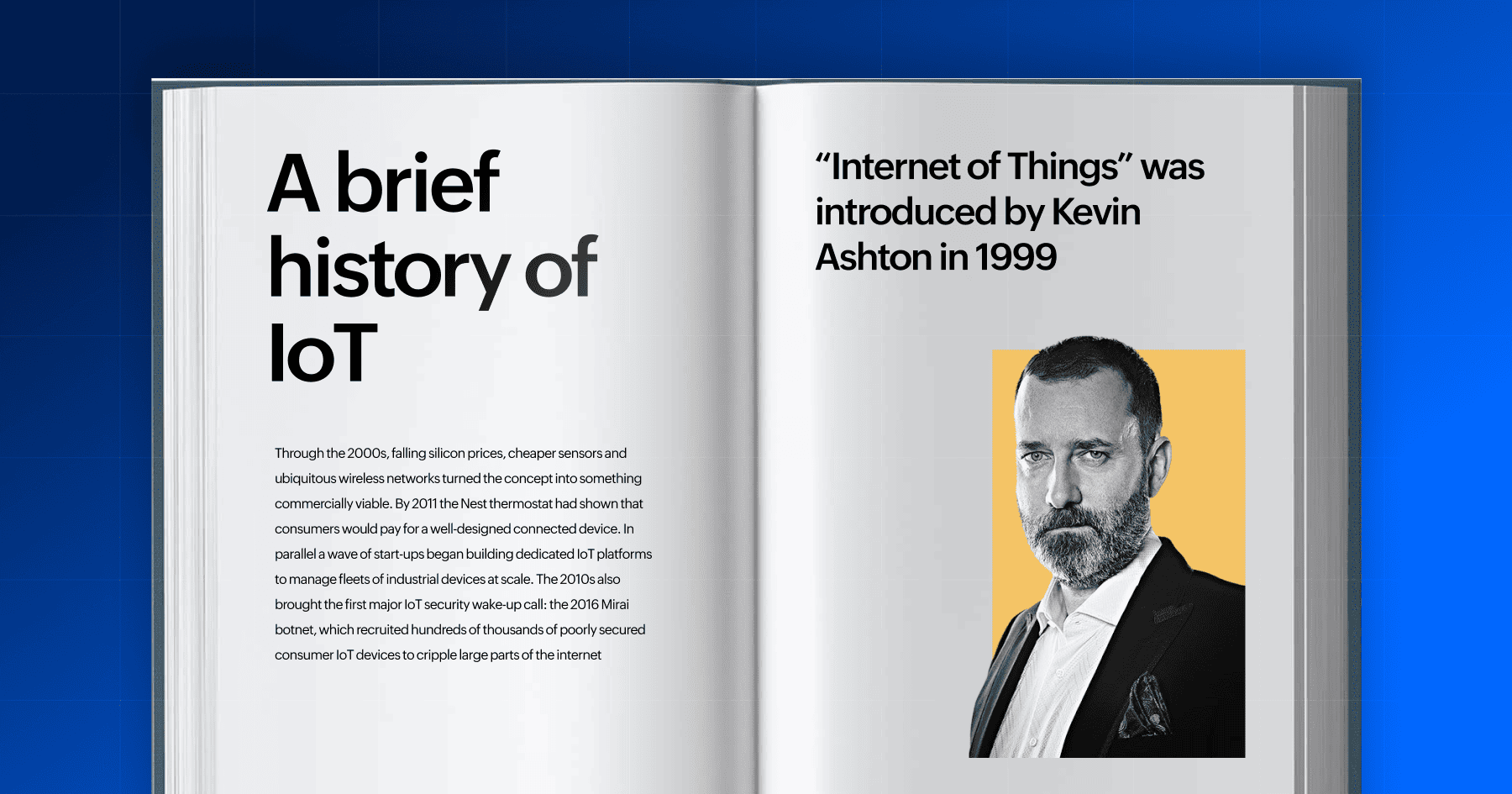
The phrase “Internet of Things” itself was introduced by Kevin Ashton in 1999 to describe a world in which computers could understand the physical world through sensors and RFID tags, rather than relying on humans to type data into them. Two decades later, IoT has moved from a research concept into a foundational technology for manufacturing, energy, logistics, buildings, healthcare and smart cities.
Through the 2000s, falling silicon prices, cheaper sensors and ubiquitous wireless networks turned the concept into something commercially viable. By 2011 the Nest thermostat had shown that consumers would pay for a well-designed connected device. In parallel a wave of start-ups began building dedicated IoT platforms to manage fleets of industrial devices at scale. The 2010s also brought the first major IoT security wake-up call: the 2016 Mirai botnet, which recruited hundreds of thousands of poorly secured consumer IoT devices to cripple large parts of the internet.
According to IoT forecasts that there will be more than 40 billion connected IoT devices by 2030, generating an IoT market worth in excess of US$1.56 trillion by 2029 with a projected CAGR of 10.17% between 2025 and 2029.
What is IoT?
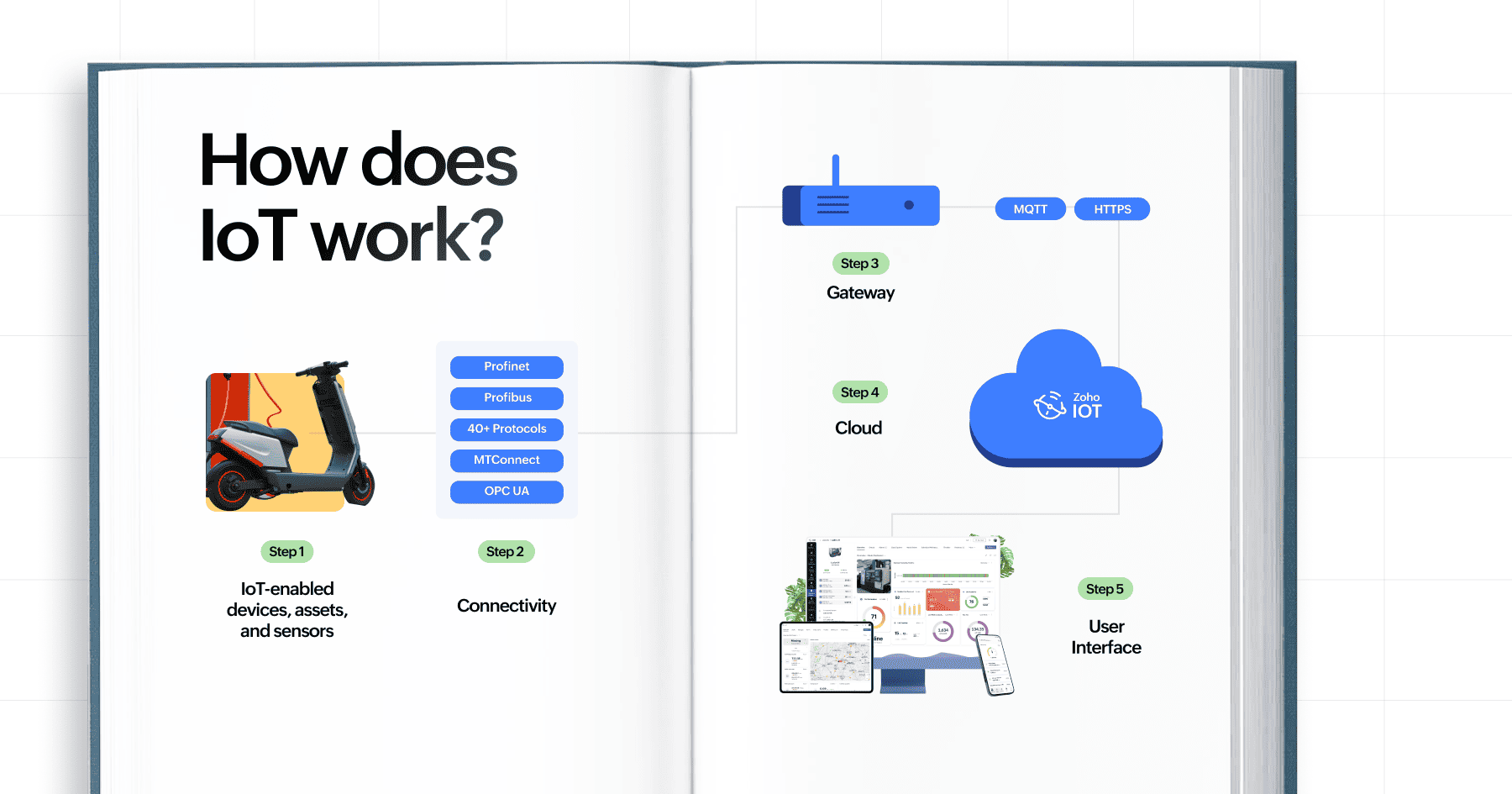
IoT is all about real-time data in action. It works by collecting data from numerous devices and processing the data in the cloud to give a visualization.
The IoT-enabled assets, devices, and machines gather data from the physical world like temperature, motion, speed, humidity, and send it to the cloud via IoT gateways. Here, the data can then be tracked, monitored, and controlled in the IoT platform. There is an exciting feature called IoT edge agents, With IoT edge agents, some data processing happens right at the source, making your response time faster than ever.
Essentially, 4 main components make IoT possible`:
- IoT-enabled devices, assets, and sensors: These components talk to machines and collect data like temperature, pressure, vibration, humidity, motion, and much more.
- Connectivity: A communication layer, it acts as a bridge between assets and the cloud. The data travels to the cloud (or to an edge device) through gateways, using connectivity protocols such as MQTT, HTTPS, Bluetooth, Wi-Fi, cellular, or LPWAN
- Data processing: An IoT platform in the cloud (or at the edge) ingests the data, applies rules, runs analytics and machine-learning models, and stores it for historical analysis.
- User interface and action: The results are shown on dashboards, sent as notifications, or fed back to devices as commands closing the loop between the physical and digital worlds
Some data processing is moving closer to the device itself. Edge computing runs analytics on a gateway or on the device to reduce latency, keep sensitive data local and lower cloud bandwidth costs. An IoT system typically uses the edge for real-time control and the cloud for historical analytics, model training and cross-site reporting.
IoT architecture
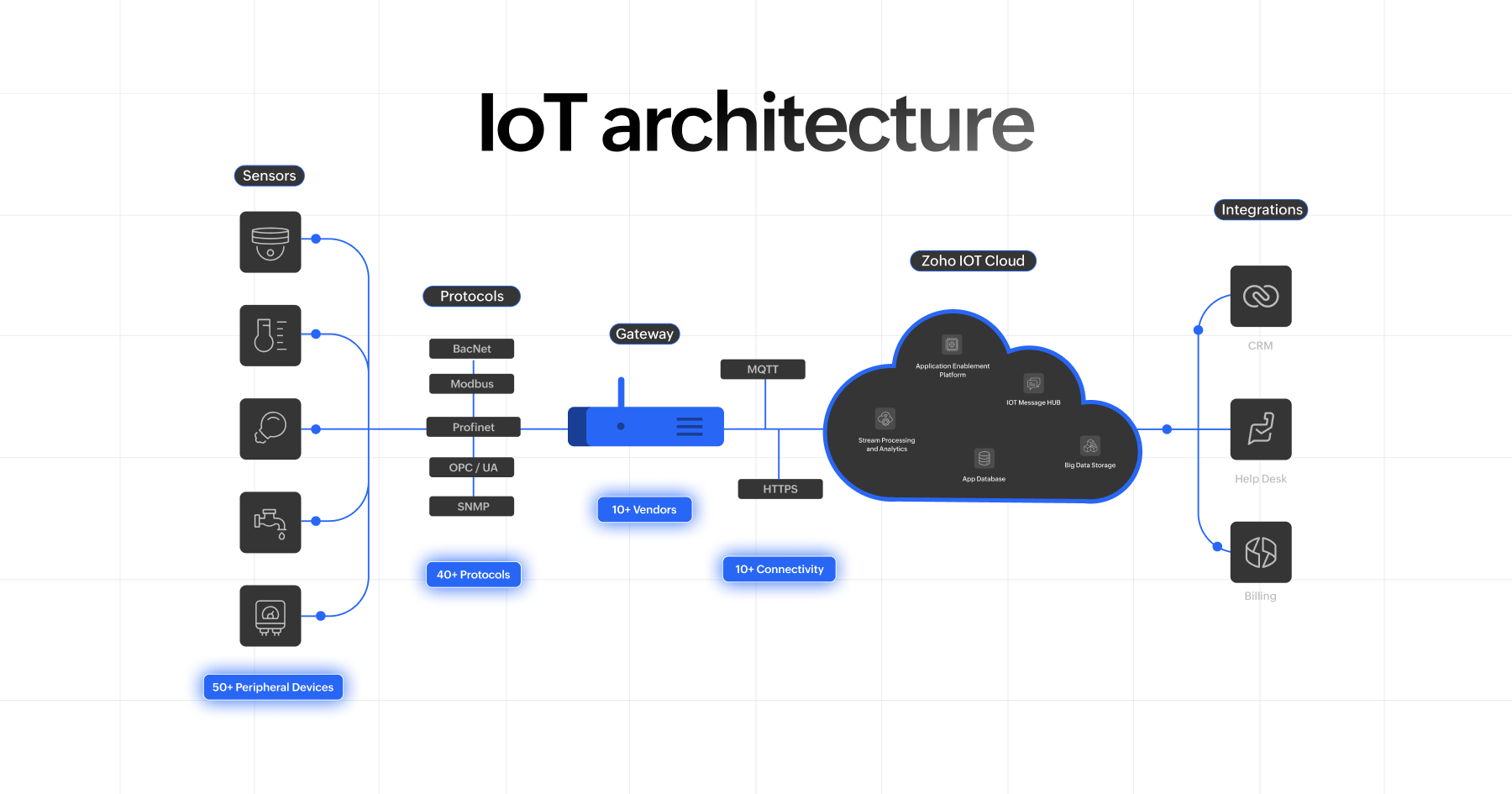
Most modern IoT deployments are described using a five-layer architecture. Each layer has a specific job and a specific set of technologies.
- Perception layer (devices and sensors): The physical interface with the real world. This layer includes sensors, actuators, RFID tags, cameras and PLCs that generate data and perform actions. Design concerns here are power consumption, form factor, and accuracy.
- Network layer (connectivity): Moves data from devices to gateways and from gateways to the cloud. Technology choices depend on range, bandwidth, power budget and cost: Wi-Fi, Ethernet, industrial fieldbuses, 4G/5G, NB-IoT, LTE-M, LoRaWAN.
- Edge layer (gateways and edge compute): Gateways translate between local device protocols (Modbus, BACnet, OPC UA, Profinet) and internet protocols (MQTT, HTTPS). Edge compute performs pre-processing, aggregation, protocol translation and time-sensitive control so data is acted on where it is produced.
- Processing and data management layer (the IoT platform): This is the core of an IoT system. The platform ingests streams, stores time-series data, runs rules and analytics, manages device identity and state, and exposes APIs for applications. Typical components include an ingest broker, a stream-processing engine, a time-series database and a rule engine.
- Application layer: The business-facing surface: dashboards, mobile apps, alerts, reports, workflows and integrations into CRM, ERP, ticketing, billing and BI systems. This is where IoT data finally becomes business decisions and revenue.
IoT communication protocols
IoT devices speak many different languages. Choosing the right protocol depends on range, power, bandwidth, reliability and security requirements. The table below summarises the protocols you are most likely to encounter.
| Protocol | Typical range | Best for | Notes |
| MQTT | Internet | Device-to-cloud messaging | Lightweight publish/subscribe protocol, TCP-based, very efficient for constrained devices. The de facto standard for IoT messaging. |
| CoAP | Internet | Constrained devices | UDP-based, REST-like, designed for low-power microcontrollers. Pairs well with 6LoWPAN. |
| HTTPS / REST | Internet | Occasional connections, integrations | Easy to integrate with web apps but heavier than MQTT for always-on devices. |
| OPC UA | Plant / LAN | Industrial automation | Industry 4.0 standard for machine-to-machine data in manufacturing; rich information model and strong security. |
| Modbus / BACnet / Profinet | Plant / LAN | Machines, building systems | Legacy industrial and building protocols typically bridged to MQTT by a gateway. |
| Wi-Fi / Wi-Fi HaLow | ~50-500 m | High-bandwidth devices | Fast but power-hungry. Wi-Fi HaLow (802.11ah) extends range at lower speeds for IoT. |
| LoRaWAN | 2-15 km | Low-power wide-area | Unlicensed spectrum; ideal for battery-powered sensors sending small messages over long distances. |
Applications of IoT
Industrial Internet of Things (IIoT): IIoT instruments factories, refineries, warehouses and plants. Vibration sensors predict bearing failures days in advance; energy meters expose the real cost of every production run; RFID and computer-vision cameras track goods through every handoff. The value pool is enormous: the World Economic Forum has repeatedly identified industrial IoT as one of the defining technologies of the Fourth Industrial Revolution.
Smart Building: In commercial real estate and facilities, IoT unifies HVAC, lighting, access control, occupancy, energy and maintenance into a single operating system for the building. Landlords use it to bill tenants by actual usage; facility teams use it to schedule work where it is needed rather than on calendar cycles; tenants get comfort and air quality as a measurable service.
Energy Management: Corporate net-zero targets, regulatory disclosure regimes such as EU CSRD and customer pressure have turned energy management from a cost-saving exercise into a strategic one. IoT meters every significant load, correlates consumption with production and weather, detects anomalies and produces the audit-ready data that sustainability reports require.
Fleet Management: Connected vehicles, telematics dongles and driver-facing apps turn a fleet from a black box into a live system. Operators see location, fuel use, driver behaviour, geofence events and vehicle health in real time and use that stream to cut fuel bills, reduce accidents, improve delivery reliability and run usage-based insurance programs.
AIoT (AI + IoT): Applying machine learning to IoT data turns descriptive dashboards into predictive systems. Anomaly detection flags a motor that is about to fail; computer vision pipes video feeds into defect detectors; foundation models turn unstructured maintenance logs into structured failure-mode analysis. AIoT is where most of the next wave of IoT ROI will come from.
Industries benefiting from IoT
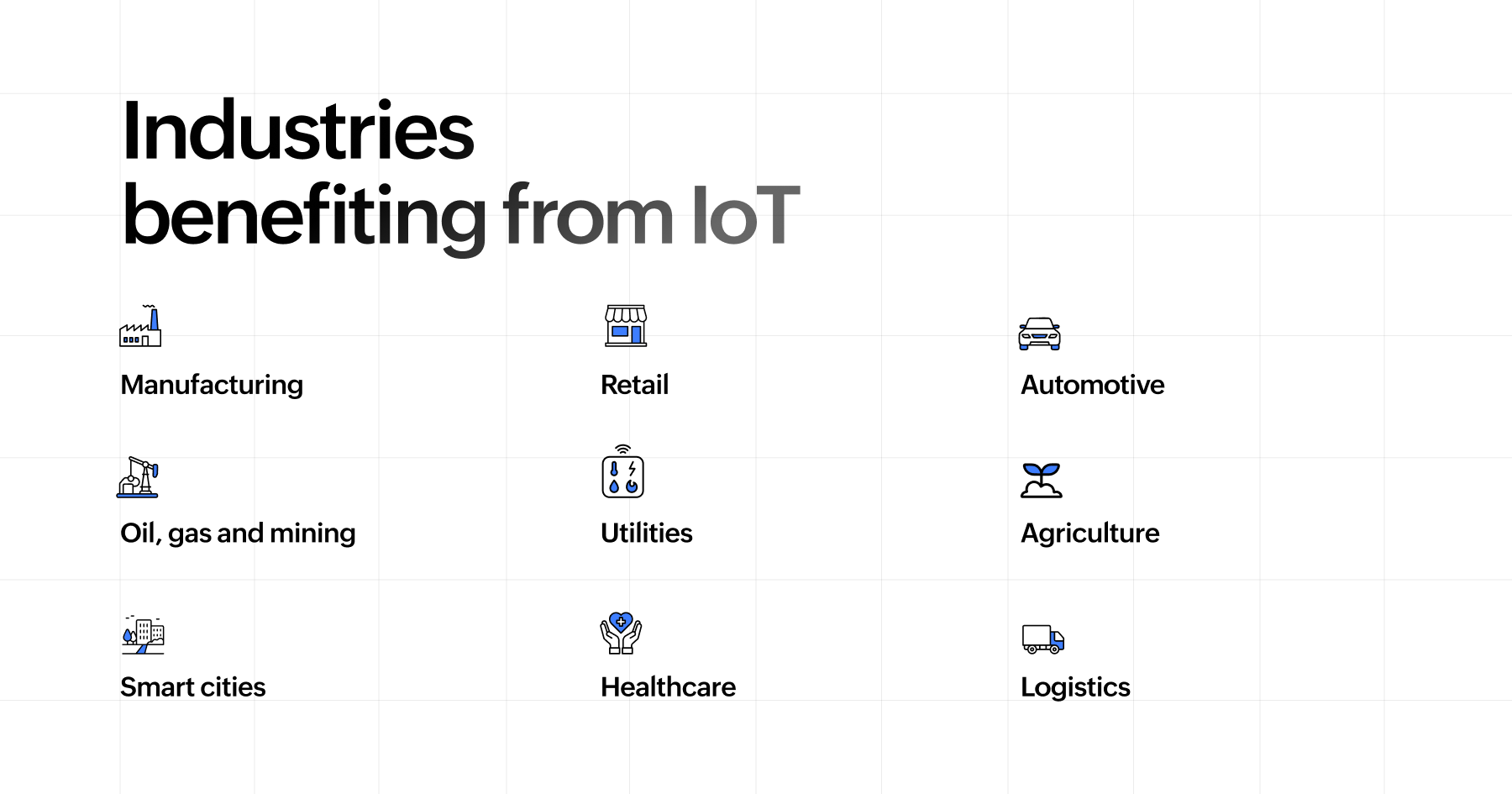
IoT has matured into a cross-industry capability. What changes from one sector to the next is the unit of measurement widgets, kilowatt-hours, patients, deliveries, hectares but the pattern of instrumenting, measuring and acting is constant. A few industry-specific examples:
Manufacturing: OEE dashboards, predictive maintenance, digital traceability, energy-per-unit costing and computer-vision quality inspection.
Retail: RFID and smart shelves for inventory accuracy, cold-chain sensors for perishables, footfall analytics and smart checkout.
Oil, gas and mining: worker safety through gas detection, lone-worker tracking in confined spaces, and pipeline and pump condition monitoring.
Utilities: smart metering for electricity, water and gas; outage detection; grid balancing with distributed energy resources.
Automotive: connected production lines inside the plant and connected vehicles for predictive maintenance, remote diagnostics and over-the-air updates.
Agriculture: soil-moisture and weather sensors, livestock wearables, precision irrigation and yield optimisation at the field or even the plant level.
Logistics: end-to-end shipment visibility, cold-chain temperature logging and geofenced delivery confirmation.
Healthcare: remote patient monitoring, connected medical devices, real-time asset tracking inside hospitals and medication-adherence platforms.
Smart cities: intelligent traffic signals, smart parking, air-quality networks, waste-collection optimisation and connected street lighting.
What are the benefits of IoT for business?

The IoT ecosystem is crowded with benefits, but the cleanest way to think about the payoff is in four buckets efficiency, availability, experience and new revenue.
Efficiency: IoT collapses the time between something changing in the physical world and someone or something responding to it. Manual rounds, spreadsheet-based monitoring and scheduled inspections are replaced by continuous, exception-driven work. Industry studies routinely report 20-30% efficiency improvements across affected processes.
Availability: Condition-based monitoring replaces scheduled or reactive maintenance. Machines tell you when they need attention, not a calendar. The result is fewer unplanned outages, longer asset life and, in many industries, insurance premiums that reflect a demonstrably lower risk profile.
Experience: IoT is quietly rewriting the customer experience in dozens of categories. Tenants expect air-quality data in their lobby; logistics customers expect live tracking with minute-level granularity; healthcare patients expect remote monitoring rather than weekly hospital visits. The bar for "good" is moving, and IoT is what meets it.
New revenue models: Perhaps most interestingly, IoT unlocks business models that were impossible without it. Pay-per-use of industrial compressors, usage-based auto insurance, outcome-based aviation-engine contracts and "equipment-as-a-service" offerings all rely on IoT to meter the underlying usage and health of the asset. In many sectors, the IoT project is really a business-model project in disguise.
What are IoT technologies?
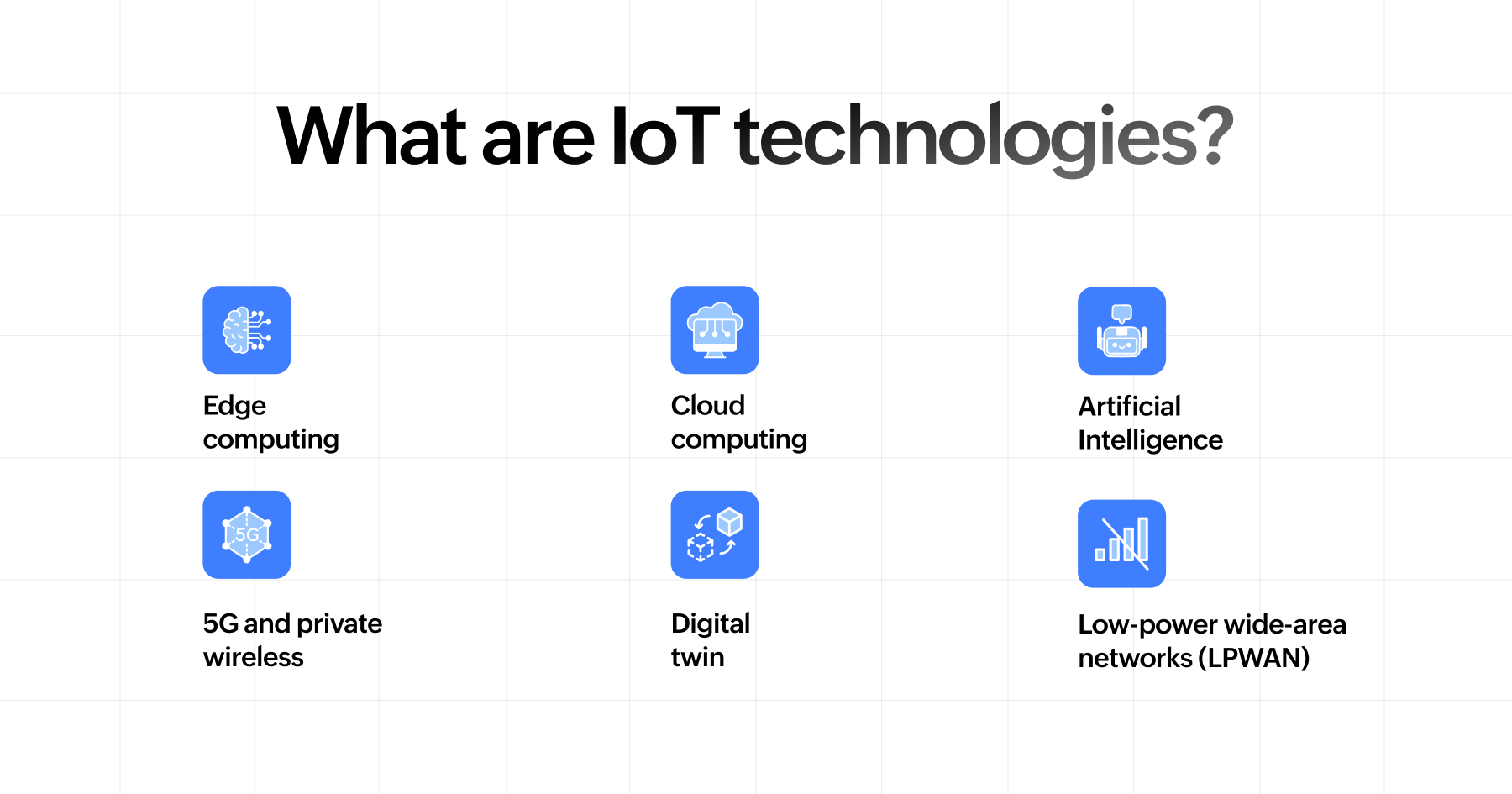
Edge computing: When data is acquired from an asset, it goes to the cloud where the data gets processed, and it is sent back to the dashboard. There would be a delay during this process, here is where the edge agent comes in, real-time insights without the wait. It processes data right where it’s created, no round-trip to the cloud needed.
Cloud computing: For data storage and IoT device management, a huge infrastructure setup and initial cost are required for on-premise setup. Here, cloud computing Cloud keeps your IoT infrastructure light and agile. Cloud allows businesses to scale faster, store more, and access from anywhere
Artificial Intelligence: IoT in itself would bring in a lot of automation, detection, and workflows. AI can boost operations from smart predictions to conversational commands, it amplifies your IoT setup with proactive, automated intelligence.
5G and private wireless: 5G networks inside factories and campuses delivers higher bandwidth, lower latency and more devices per square kilometre than Wi-Fi or 4G, unlocking mobile robotics, remote control and AR-assisted work.
Digital twin: A digital twin is a live virtual replica of a physical asset, process or system, continuously updated by IoT data. Operators use twins to simulate “what-if” scenarios, optimise operations and train AI models safely.
Low-power wide-area networks (LPWAN): LoRaWAN, NB-IoT and LTE-M extend IoT reach to long-range, battery-powered devices.
IoT security and risks
How to secure an IoT deployment
- Give every device a unique, cryptographic identity; never share credentials across a fleet.
- Encrypt all data in transit (TLS 1.3) and at rest.
- Sign and verify every firmware update, and support remote over-the-air (OTA) patching.
- Apply Zero Trust principles: authenticate every device, every session, every request.
- Segment IoT networks from corporate IT using VLANs, firewalls or private APNs.
- Maintain an accurate, live inventory of devices and decommission retired hardware promptly.
- Monitor devices for anomalies unusual traffic, unexpected commands, firmware tampering.
IoT standards and regulations
Buyers and regulators increasingly expect IoT deployments to conform to recognised standards.
- ISO/IEC 30141: IoT reference architecture.
- NIST IR 8259 and SP 800-213: Cybersecurity guidance for IoT device manufacturers and federal agencies.
- EU Cyber Resilience Act (CRA): Mandatory security requirements for products with digital elements sold in the EU.
- ETSI EN 303 645: Baseline security requirements for consumer IoT.
- GDPR and regional privacy laws: Govern any IoT system that processes personal data.
- Matter (Connectivity Standards Alliance): Cross-vendor interoperability for smart homes.
- IEC 62443: Cybersecurity for industrial automation and control systems.
Challenges of IoT adoption
While the promise of IoT is compelling real-time visibility, automation, predictive insights the path to adoption is rarely straightforward. Organizations often encounter a mix of technical, operational, and strategic hurdles that can slow down or even derail implementation if not addressed early.
Fragmented Device Ecosystems: One of the most immediate challenges is dealing with a highly fragmented hardware landscape. Different vendors, communication protocols, and data formats make it difficult to create a unified system. Integrating legacy equipment with modern IoT platforms adds another layer of complexity, often requiring custom connectors or middleware.
Data Overload Without Direction: IoT systems generate massive volumes of data, but more data does not automatically translate into better decisions. Without a clear strategy for data filtering, processing, and analysis, organizations can end up overwhelmed. The real challenge lies in converting raw data into meaningful, actionable insights rather than just collecting it.
Connectivity and Reliability Issues: Reliable connectivity is the backbone of any IoT deployment. In industrial or remote environments, maintaining stable network connections can be difficult. Intermittent connectivity, bandwidth limitations, and latency issues can disrupt data flow and affect real-time decision-making capabilities.
Security and Privacy Concerns: With multiple connected devices comes an expanded attack surface. Each endpoint can become a potential entry point for cyber threats if not properly secured. Ensuring device authentication, secure communication, firmware updates, and data protection requires a well-defined security framework, which many organizations underestimate initially.
Integration with Existing Systems: IoT does not operate in isolation, it needs to integrate with ERP, CRM, MES, and other enterprise systems. Achieving seamless integration can be complex, especially when dealing with older systems that were not designed for real-time data exchange.
High Initial Investment and ROI Uncertainty: Although IoT can deliver strong long-term benefits, the initial investment in hardware, connectivity, platform setup, and system integration can be significant. Organizations often struggle to justify this investment due to unclear or delayed ROI, especially when outcomes depend on process changes and user adoption.
Skill Gaps and Organizational Readiness: IoT adoption requires a blend of skills across hardware, software, networking, and data analytics. Many organizations lack in-house expertise, leading to reliance on external vendors. Additionally, internal teams may resist change, especially when IoT introduces new workflows or disrupts existing processes.
How has IoT transformed businesses?
| Without IoT | With IoT | |
| Connectivity | Manual processes and isolated systems, lead to inefficiencies and siloed data. | Facilitate connectivity between systems, people, and processes for data exchange and collaboration. |
| Limited Insights | Businesses lacked visibility into operations and customer behaviors. | Businesses leverage IoT-generated data for actionable insights, enabling informed decision-making and predictive analytics. |
| Maintenance challenges | Equipment maintenance lead to costly downtime and slow operations. | IoT-enabled predictive maintenance reduces downtime and extends the lifespan of equipments. |
| Process | Tedious manual process tasks such as data collection, monitoring, and analysis. | Automate routine processes and improving operational efficiency. |
| Security | Inadequate security measures lead to vulnerable cyber threats and data breaches. | Robust security with encryption and authentication to protect data and devices. |
| Data collection | Data is collected and stored in disparate systems and databases, making it difficult to access and integrate. | Integrate data from various sources with a unified view of operations and enabling seamless data exchange between systems & devices. |
Why IoT is the next big thing?
IoT has moved well past the hype cycle, but the next five years will look very different from the last five. A handful of shifts are already underway:
- AIoT everywhere: Sensor data is becoming the default training set for operational AI. Expect most IoT dashboards to be replaced by models that recommend or act, not just show.
- Edge AI: Inference moves from cloud to gateway to microcontroller as low-power silicon gets smarter. Latency-sensitive and privacy-sensitive workloads will run entirely at the edge.
- Digital twins become mainstream: From a niche concept to a standard layer above IoT data, used for simulation, optimisation and training.
- Cellular IoT grows: NB-IoT, LTE-M and 5G RedCap displace proprietary wireless for a growing share of enterprise and outdoor deployments.
- Sustainability-as-a-service: IoT-backed carbon, water and waste reporting becomes a procurement requirement, not a differentiator.
- Stronger regulation: The EU Cyber Resilience Act, FDA medical-device cybersecurity rules and US executive orders on critical infrastructure will raise the baseline for what "secure IoT" means.
- Outcome-based business models: More vendors will sell guaranteed uptime, kilowatt-hours saved or patients monitored made measurable, and therefore sell able, by IoT.