The Boring Truth Behind Why Customers Stay With Zoho IoT
- Last Updated : May 29, 2026
- 107 Views
- 7 Min Read

"No magic. No God mode. No miracles. Just a quiet discipline of fewer mistakes, and the customers who refuse to go anywhere else." - Zoho IoT
People keep asking me why Zoho IoT is doing well.
And honestly, I would be glad to say that we have not done anything extraordinary.
No moonshots. No "AI will run your factory while you nap" pitch deck. No "God mode" dashboard that promises to read minds, predict markets, and possibly also do your taxes. We do not sell the impossible. Partly because we have never figured out how to ship it, and partly because we have watched too many customers buy the impossible and end up with a pricey paperweight.
What we have done is much less glamorous. We have quietly reduced the operational mistakes our customers were already making. That is it. That is the strategy.
And somehow, through some quiet, almost embarrassing mechanism, that is the reason they stay.
Customers do not buy IoT. They buy a better operating day.
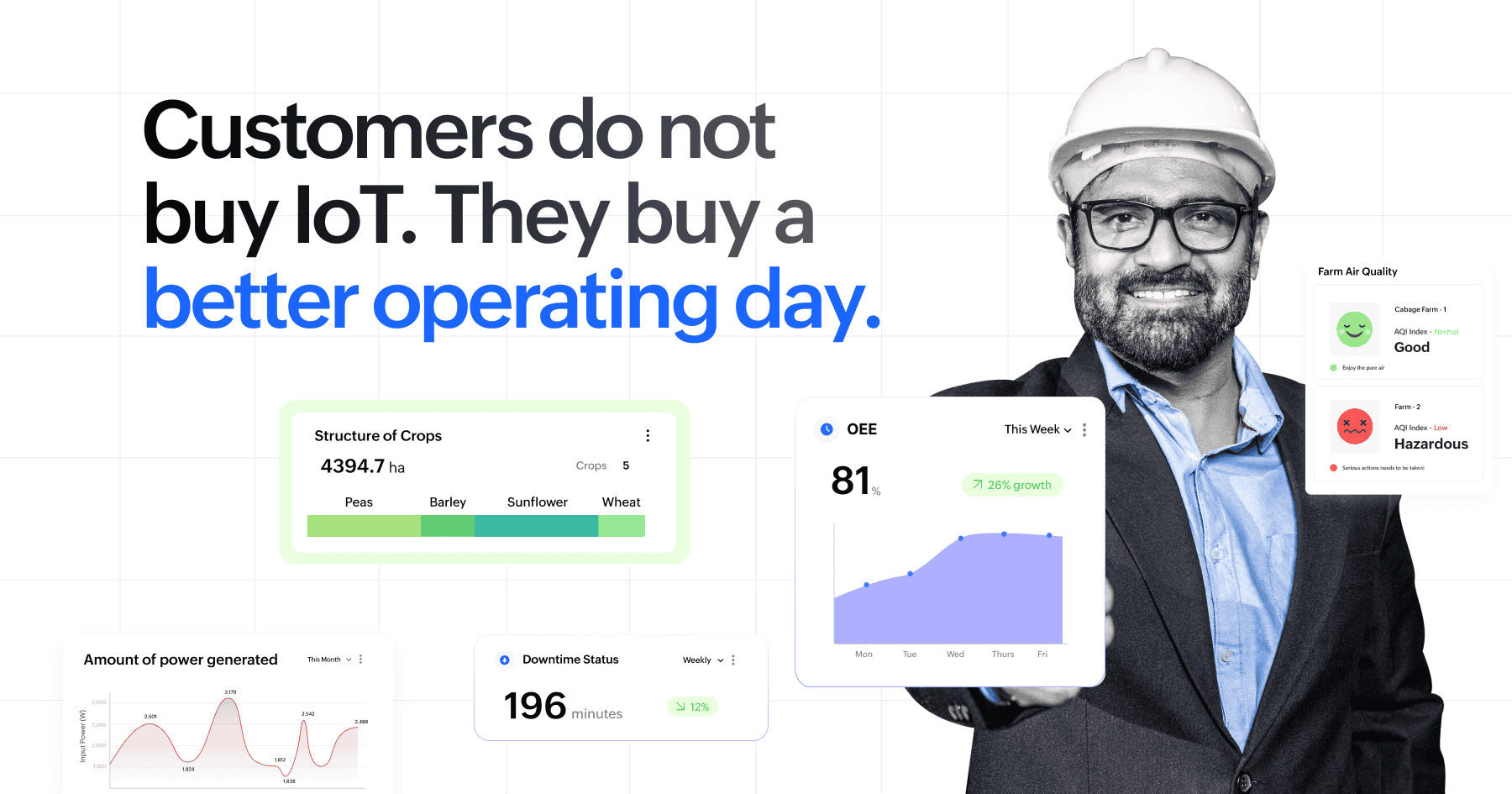
This is the part most of the industry has stopped saying out loud.
Nobody walks into a procurement meeting excited about an enterprise IoT platform. They walk in tired of false alerts, tired of dashboards nobody trusts, tired of "transformation" projects that promised a new world and delivered a new login screen. What they actually want is a calmer operating day. Fewer surprises on the shop floor, fewer 2 AM phone calls, fewer line items they cannot explain to their CFO.
Zoho IoT is built around that simple, slightly boring truth. We are not here to dazzle the operator. We are here to make the operator's day quieter.
We did not reinvent the wheel. We just stopped letting it wobble.
There is an old line in engineering circles. "The best invention is the one you did not have to make." Most of what we ship at Zoho IoT falls into that category. We do not go around inventing physics. We do not develop features that require a customer to retrain their team, replace their stack, and pray to the uptime gods.
Instead, we look at where customers were already getting hurt. Small, repeating, expensive operational mistakes that nobody had bothered to fix because they were not brave enough to put in a keynote. And we built around those. As Peter Drucker put it, "the most important thing in communication is hearing what is not said." The same is true in industrial IoT. The most important thing in software is fixing the problem the customer is too tired to keep complaining about.
"We did not chase extraordinary ideas. We focused on solving the ordinary operational problems customers had been waiting years for someone to take seriously."
Zoho runs on Zoho, so the mistakes happen to us first
There is a principle that runs through every product we build at Zoho. We use it before we sell it. Our CRM runs on Zoho CRM. Our finance runs on Zoho Books. And Zoho IoT runs on our own campuses, and infrastructure long before it shows up anywhere near a customer.
This is not a marketing line. It is a discipline, and honestly, a survival mechanism. Every new capability in Zoho IoT reaches us first. Our facilities team. Our energy team. Our IT team. And trust me, they are ruthlessly unimpressed by anything that decides to fail at 2 AM.
By the time a feature reaches a customer, it has already survived months of being yelled at by our own engineers. We have eaten our own cooking, burned our own tongues, and only then offered the menu to anyone else. The old saying still holds.
"If you would not run your own house on it, do not ask your customer to run their plant on it."
We do not compete with the giants. We compete with our last milestone.
There is a temptation in IoT to wake up every morning and compare yourself to the hyperscalers and the enterprise giants. We tried that once. It was deeply unproductive, like comparing your home garden to the Amazon rainforest.
So we picked a different scoreboard. The only version of Zoho IoT we are trying to beat is the version we shipped last quarter. Fewer false alerts, cleaner data pipelines, sharper predictive maintenance signals, faster onboarding. Step by step. As James Clear writes in Atomic Habits, "you do not rise to the level of your goals; you fall to the level of your systems."
Our system is small and steady improvement.
Our goal is the customer's operational efficiency. The two have started compounding.
And somewhere quietly, without us ever needing to say so, the reader can probably guess which part of the industry has been so busy chasing the next headline that the basics started slipping. We will not name names. The basics do not have a marketing budget, but they have a long memory.
The underrated reason customers stay. We walk with them.
Here is the part most IoT vendors miss entirely, and the part our customers tell us matters most.
A digitization journey is long. It is rarely tidy. It involves people who are nervous about change, machines older than the engineers maintaining them, and timelines that bend in ways nobody predicted in the kickoff deck. The platform is maybe 30 percent of the success. The other 70 percent is the people who show up when things get hard.
This is where firms like Wipro, Infosys, Deloitte, and PwC genuinely excel. They engage deeply with very large enterprises and walk every step of that journey alongside them. We have real respect for that work.
What is different about us is who we can do it for. Because Zoho IoT comes with a pre-built platform and pre-built verticals, our engagement time and cost drop dramatically. That lets us sit alongside a mid-sized manufacturer, a regional utility, or a single-campus operator. Customers the giants often cannot reach without a multi-crore engagement. And we give them the same quality of partnership. Same depth. Same patience. Smaller footprint. We are also actively working toward partnerships with services firms like PwC and Deloitte, so that as our customers grow, the engagement quality grows with them.
Most IoT projects do not fail because of the platform. They fail because somewhere around month seven, the customer realizes nobody is walking with them anymore.
What this looks like on the ground
In smart manufacturing, the mistakes are rarely dramatic. They are small and expensive. A sensor that drifts and nobody catches it until a batch is scrapped. A maintenance alert calibrated for a manual the machine no longer matches. An OEE dashboard that looks healthy on screen but hides three shifts of micro stoppages.
Zoho IoT is built to surface these earlier. Not through magic, but through cleaner data, calibrated alerts, and context the operator can actually act on. Predictive maintenance, done in a way that makes the maintenance engineer's job easier rather than louder.
In energy and connected operations, the mistakes compound quietly. A misconfigured meter. An alarm flood that trains operators to ignore the screen. The operational equivalent of "the boy who cried wolf," except the wolf is a transformer about to fail. We have run our own buildings and campuses on energy monitoring long enough to know which alerts matter, which are noise, and which quietly predict failure two weeks out. That judgment is baked into how Zoho IoT presents information. Fewer false positives, sharper signal, decisions an engineer can defend in a review meeting.
" In our recent deployments, Eveready reduced avoidable energy losses by approximately 20-30% through Zoho IoT's real-time monitoring and proactive alerting. "
" Zoho reduced its facility management costs by 25% by replacing manual oversight with real-time automation "
" Raptee elevated rider experience and operational efficiency by building a connected EV ecosystem with Zoho IoT "
The founder said it best.
If any of this sounds like a philosophy invented for a blog post, it is not. It is the same philosophy our founder has been quietly living for nearly three decades.
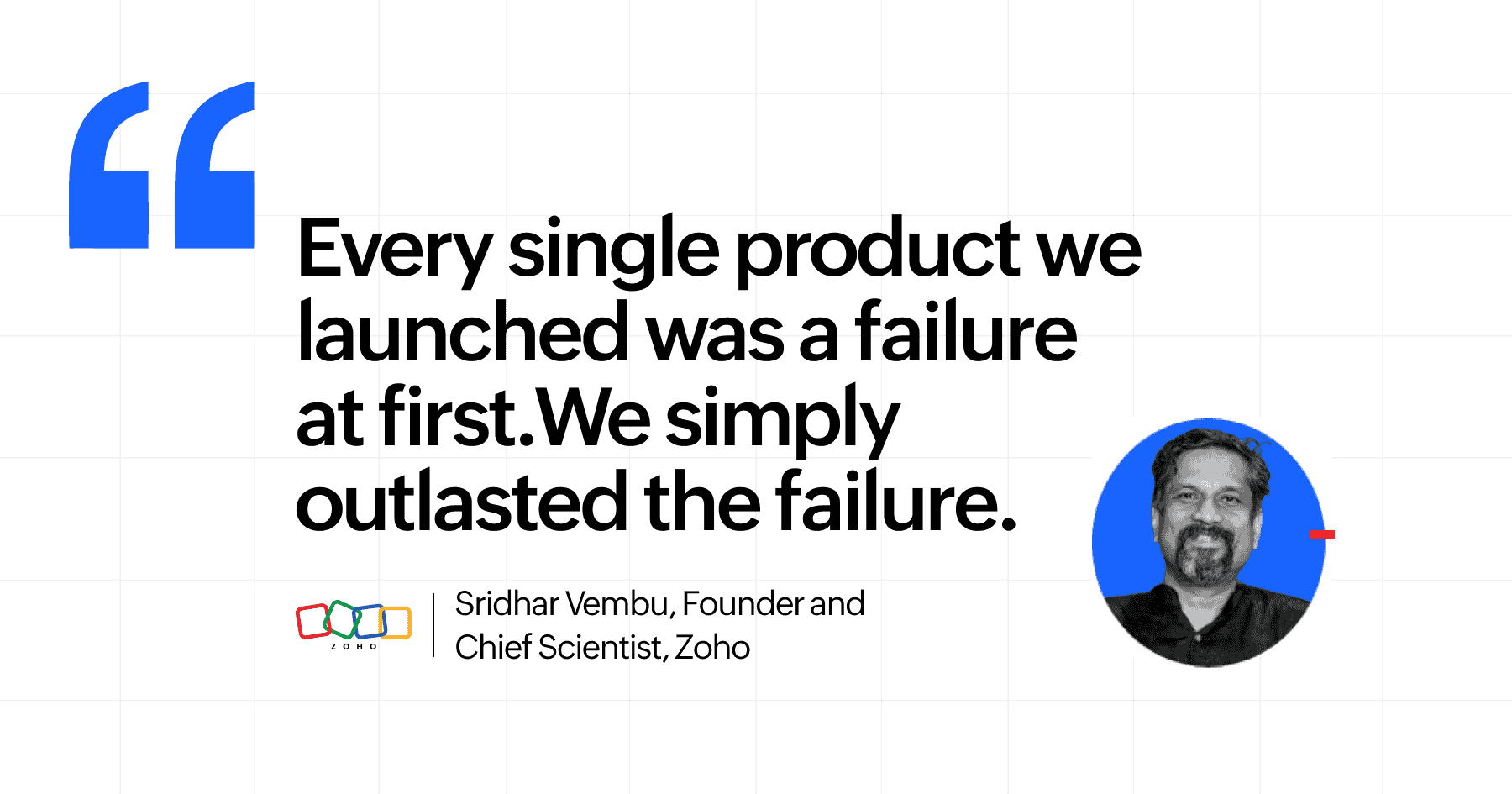
“Every single product we launched was a failure at first.
We simply outlasted the failure.” Sridhar Vembu, Founder and Chief Scientist, Zoho
He mentioned the importance of patience, persistence, and India’s ability to build world-class Al and technology products despite failures.
That single sentence carries every lesson this post has tried to share. We do not win by being extraordinary in the moment. We win by being patient, persistent, and present through the long arc of every failure.
"Zoho IoT was not born great. It became useful, then dependable, then trusted, one quiet correction at a time."
That is the only kind of progress we know how to make. And it turns out, it is the kind customers want to walk alongside.
Not God level. The best of human level.

At the end of every customer conversation, this is what it comes down to.
We are not selling miracles. We are not selling a brain. We are not pretending the software is a god dressed up as a dashboard. We are a team of humans who have made our share of mistakes, learned from each one, fixed them on ourselves first, and then offered the result to customers. With people who stay on the call long after the proof of concept is signed.
That is the boring truth behind why customers stay with us.
They have worked with the wizards. They have watched the demos that promised the moon. They have seen what happens when the magic wears off six months in and there is nobody on the other end of the email. And then they came to us. And discovered something almost old fashioned. A product that does what it says, a team that picks up the phone, and a quiet promise that we would rather get one thing right than promise ten things we cannot deliver.
It is not God level. It is the best of human level. And in IoT, that is the difference between a platform that impresses you and a platform that stays with you.
Conclusion
If you have read this far, you already know what kind of partner you are looking for.
Come talk to us. We will not dazzle you. We will just be there. Long after the dazzle would have worn off anyway.
Curious about how Zoho IoT could quietly reduce the operational mistakes in your business? Talk to us or See it in action