- HOME
- More
- Industry insights
- The security risks that will define 2026
The security risks that will define 2026
- Last Updated : March 6, 2026
- 770 Views
- 8 Min Read

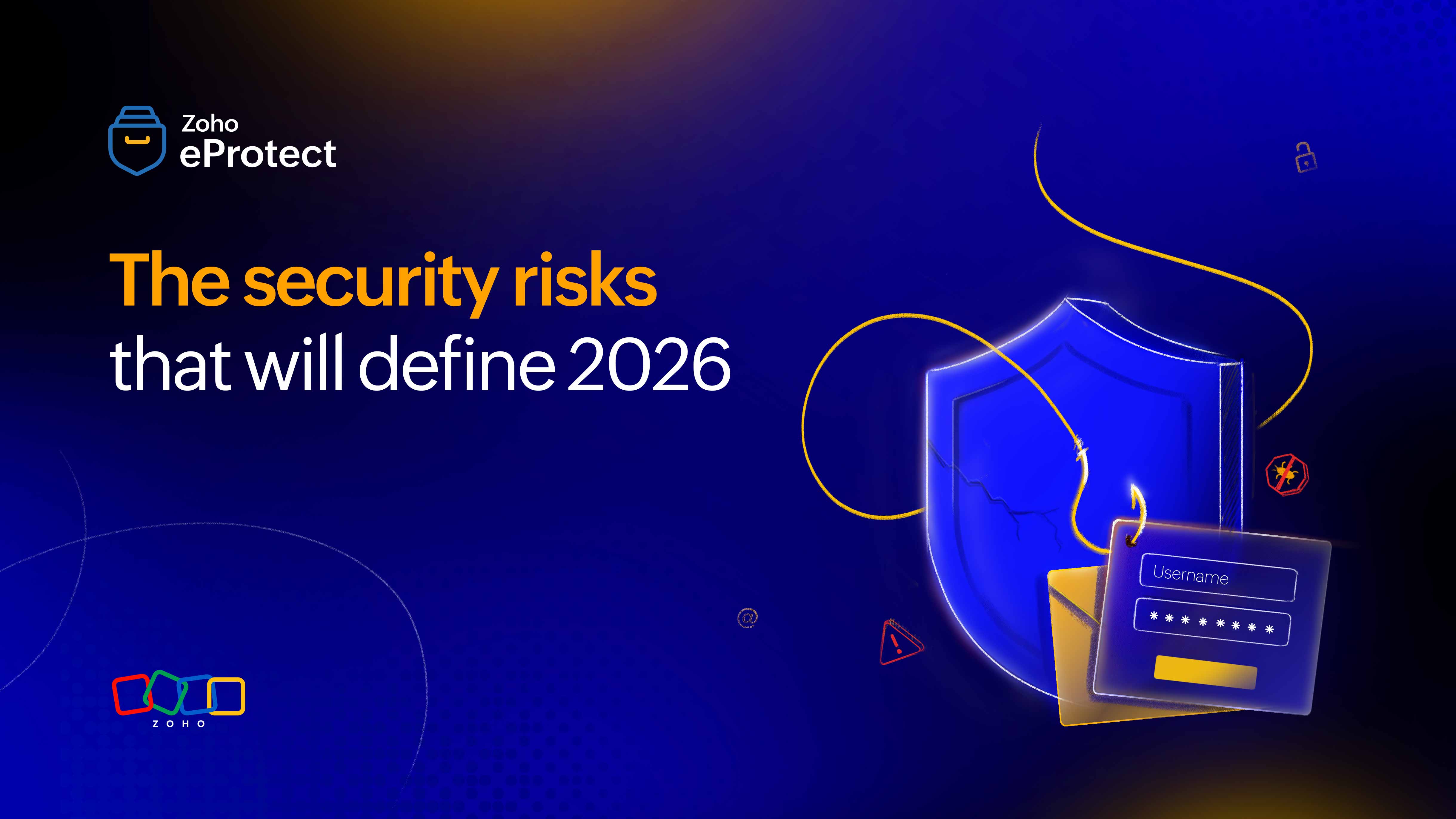
Cyber threats in 2026 won’t necessarily look new. They’ll be harder to detect and faster to scale. Instead of relying solely on software vulnerabilities, malware, or zero-day exploits, attackers are increasingly exploiting legitimate access, trusted identities, and human behavior. Security teams are seeing a clear shift away from “breaking in” toward simply logging in.
This evolution is driven by several other factors, such as widespread credential reuse, the explosion of SaaS and cloud-based tools, increasingly complex authentication flows, and the growing use of automation and AI by attackers. Email remains at the center of many of these attacks. Even though it's not always the initial delivery vector, it's used as the system attackers exploit after access is gained.
In 2026, organizations must prepare for these threats that border on malicious and legitimate activity. In this article, we'll explore the attack types that reflect this shift and represent the most impactful risks security teams should be watching closely and preparing their organizations for.
Identity-based attacks
For years, cyberattacks followed a familiar pattern. Attackers scanned for vulnerabilities, exploited a weakness, infiltrated defenses, and then attempted to move deeper into the environment. This pattern is gradually being replaced. These days, attackers simply log in.
Identity-based attacks focus on gaining control of legitimate user accounts and abusing the trust that comes with them. Stolen credentials, compromised authentication flows, MFA fatigue, MFA bypass, or hijacked cloud identities allow attackers to enter systems in ways that appear entirely normal.
Once inside, the attacker inherits the access and credibility of the compromised user. Because the activity is tied to a valid identity, traditional perimeter defenses fail, and security alerts are either subtle or non-existent. There's no malware execution, exploit attempt, or suspicious attachment to analyze in these attacks. Because the attack blends into everyday workflows, attackers maintain access for extended periods while quietly observing how the organization operates.
In this model, compromising a single account can be far more valuable than exploiting a single system.
Protection tips
- Strengthen authentication by enforcing strong password policies and MFA consistently.
- Monitor identity behavior after login, including unusual access times, locations, devices, and sudden privilege changes.
- Limit the blast radius of compromised accounts by applying least-privilege access and regularly reviewing permissions.
- Watch for signs of account misuse, such as unexpected mailbox rule changes, OAuth app grants, or abnormal activity across SaaS tools.
- Assume credential exposure will occur and prioritize rapid detection and response over prevention alone.
Token theft and session hijacking
As authentication mechanisms evolve, attackers target the tokens that prove a user is already authenticated. Rather than stealing credentials, adversaries are capturing session tokens, refresh tokens, OAuth tokens, and similar authentication artifacts that grant ongoing access.
Token theft and session hijacking involve intercepting or exfiltrating these tokens from browsers, memory, endpoints, or network flows and replaying them to impersonate users. Because session tokens effectively bypass the need to re-enter a username or password, attackers can access systems without triggering MFA or obvious login alerts.
The rise of token-based attacks is measurable. In 2023, Microsoft reported detecting 147,000 token replay attacks. This signals an increase of 111% year-over-year, underscoring how attackers have shifted toward reusing valid tokens to bypass defenses.
Once an attacker owns a valid session or refresh token, they can move laterally, impersonate users without generating failed logins, and remain undetected. Token theft is particularly effective in modern environments where session lifetimes are long and federated authentication is common. Unlike passwords, which are changed regularly or locked after repeated failures, session tokens may remain valid until expiry or revocation, granting persistent access long after the initial compromise.
Protection tips
- Reduce token validity windows and enforce periodic reauthentication for high-risk services to limit persistence of stolen tokens.
- Monitor token usage patterns for anomalies, such as reuse from unexpected locations, devices, or IP addresses.
- Revoke active tokens proactively when credentials are reset, MFA configurations change, or unusual activity is detected.
- Secure endpoint environments where tokens are stored by controlling extensions and minimizing unnecessary sessions.
Infostealer malware
Infostealer malware has become one of the most prolific enablers of cybercrime in recent years. These lightweight payloads quietly infiltrate systems to harvest sensitive information such as credentials, session data, cookies, and personal identifiable information, and then send that data to attackers for reuse or resale.
In 2025, more than 1.8 billion credentials were stolen in the first half of the year alone as attackers leveraged information-stealing malware at an unprecedented rate. That represents a roughly 800% increase in credential theft via these tools.
These infections typically begin with social engineering or trojanized downloads. A user may open a malicious attachment, install a seemingly innocuous program from an untrusted source, or interact with a compromised website. Once executed, the infostealer scours the victim’s digital environment for login data and other valuable artifacts. With this harvested information, attackers simply use what they’ve stolen to gain legitimacy across systems.
The extracted data is packaged into “stealer logs” and traded on underground markets or consumed by initial-access brokers. These access credentials then fuel phishing campaigns, business email compromise, account takeover, and ransomware intrusions.
The prevalence and sophistication of infostealers have also increased detection challenges. Many variants use obfuscation and anti-analysis techniques to evade endpoint detection, and because the stolen data is sent out quietly over legitimate protocols, network-based defenders hardly notice suspicious traffic.
Protection tips
- Enhance endpoint hygiene by restricting the execution of untrusted code, applications, and macros, and ensure strong anti-malware coverage with behavioral analysis.
- Limit credential exposure by avoiding persistent storage of passwords in browsers and using password managers like Zoho Vault that segregate sensitive data.
- Enable network segmentation and least privilege so that even if credentials are stolen, access to critical systems is constrained.
- Monitor authentication anomalies, such as impossible travel, suspicious access times, unusual credential usage, and unexpected device access, to detect misuse.
- Educate users on infection vectors, emphasizing the risks of unofficial downloads, pirated installers, and unfamiliar attachments.
Business email compromise
Business email compromise (BEC) is one of the most financially damaging email threats today because it doesn’t rely on obvious malware or mass phishing tactics. Instead, BEC attacks exploit trust, timing, and legitimate-looking communication to manipulate employees into transferring money or sharing sensitive information.
In a typical BEC attack, criminals either spoof a trusted sender or compromise a real mailbox and take over an active conversation. Once they gain access, they often monitor email threads quietly, study communication patterns, learn internal processes, and wait for the right moment to act. These attacks are not rare. According to the FBI’s 2023 Internet Crime Report, BEC resulted in $2.9 billion in reported losses across 21,489 complaints, making it one of the costliest cybercrime categories tracked.
Modern BEC also goes beyond “fake invoice” scams. Attackers commonly use techniques like conversation hijacking, vendor impersonation, payment diversion, and mailbox rule manipulation to hide replies or redirect important messages. In some cases, compromised accounts are used to send internal phishing emails from a real employee, increasing the success rate dramatically.
Protection tips
- Verify changes to payment details or bank information using an unusual communication method (phone or verified system), not email threads.
- Monitor for mailbox rule changes, unusual forwarding behavior, and suspicious sign-in patterns tied to email accounts.
- Limit who can approve financial transactions and enforce dual verification or authorization for high-value transfers.
- Train teams to recognize high-pressure, urgent requests that bypass normal approval processes.
- Treat email compromise as an incident that needs investigation quickly, since BEC typically escalates through trusted internal workflows.
Ransomware and data extortion
Ransomware is no longer just about encrypting files and demanding payment. Modern ransomware groups operate like organized businesses, with clear playbooks. In many cases, encryption is only one part of the pressure tactic. Attackers first steal sensitive data and use it as leverage, threatening to leak it publicly or notify customers and partners.
Most ransomware attacks today begin with access. Attackers frequently enter through compromised credentials, exposed remote services, or access purchased from initial access brokers. Once inside, they spend time studying the environment and infiltrating the infrastructure. By the time ransomware is deployed, the intrusion is already deep.
Ransomware activity continues to be widespread and costly. According to the FBI’s 2023 Internet Crime Report, IC3 received 2,825 ransomware complaints with adjusted losses of more than $59.6 million.
Data extortion adds an additional layer of risk. Even if an organization restores systems from backups and avoids paying for decryption, stolen data can still be used for blackmail, regulatory pressure, and repeated extortion attempts. This makes ransomware a long-term incident and recovery isn’t complete until the risk from stolen data is addressed.
Protection tips
- Limit the impact of compromised accounts by enforcing least privilege and controlling admin access.
- Monitor for early ransomware signals such as abnormal privilege escalation, bulk data exports, suspicious remote tools, and unusual authentication patterns.
- Protect backups with immutability and segmentation so attackers can’t delete or encrypt recovery points.
- Detect and block data exfiltration attempts, since extortion often happens before encryption.
- Prepare incident response playbooks ahead of time, including isolation steps, communication plans, and recovery priorities.
AI-powered social engineering
Social engineering has always worked because it targets people, not systems. What changes in 2026 is the speed and realism attackers can achieve using AI. Instead of sending generic phishing emails at scale, attackers can now generate highly convincing messages, mimic writing styles, translate lures instantly, and personalize outreach using scraped data from social media or previous breaches.
AI makes phishing and impersonation attempts harder to spot because the usual red flags are disappearing. Grammar mistakes, awkward tone, and poor formatting are no longer reliable indicators. Attackers can craft messages that replicate vendor language and write context-aware prompts that sound like legitimate invoice approvals, file requests, HR updates, or password resets.
AI also enables more believable impersonation beyond text. Voice cloning and synthetic media are increasingly being used in vishing and executive impersonation scams. IBM notes that the average cost of creating a deepfake is just $1.33, while the expected global cost of deepfake fraud in 2024 is projected at $1 trillion.
The biggest risk in 2026 is that social engineering becomes more targeted, more consistent, and more scalable, reducing the time defenders have to detect and stop it before damage occurs.
Protection tips
- Build verification into workflows by confirming payment changes, sensitive requests, and access approvals through secondary verification methods.
- Reduce exposure of employee information online and treat public-facing details as usable attacker intelligence.
- Train employees to look for behavioral red flags (unexpected urgency, secrecy, process bypass), not just spelling mistakes.
- Monitor for suspicious internal email behavior such as sudden tone shifts, unusual request patterns, or new recipients in existing threads.
- Take executive impersonation attempts seriously and establish clear escalation paths for verification.
Conclusion
In 2026, the most dangerous attacks won’t look like attacks at all. They’ll look like normal logins, routine email threads, and everyday requests. The best defense is to treat identity and inbox activity as high-risk surfaces, deploy email security solutions, detect anomalies early on, and respond fast enough to stop small compromises from turning into major incidents.
eProtect is a cloud-based email security and archiving solution that provides an additional layer of security for email accounts. The solution offers advanced threat detection mechanisms that can secure on-premise and cloud email accounts from evolving email threats. eProtect is the security solution that powers Zoho Mail, a platform that millions of users trust.