- HOME
- Threat types
- Account takeover: types, detection, and prevention measures
Account takeover: types, detection, and prevention measures
- Last Updated : March 6, 2026
- 727 Views
- 8 Min Read

Threat actors continually evolve their techniques to achieve their objectives, whether that’s making money, stealing confidential information, conducting corporate espionage, or damaging an organization’s reputation. Traditional attack methods like spam emails, phishing, spoofing, and malware distribution continue to be common routes for gaining unauthorized access. However, with users becoming more aware of these classic tactics, cybercriminals are shifting toward more sophisticated methods.
One such method is account takeover (ATO). It’s a tactic in which attackers stealthily gain access to legitimate user accounts, often without raising suspicion. Unlike typical phishing attacks that rely on tricking users, ATO exploits valid credentials, making it significantly harder to detect and far more damaging once successful.
This shift has made account takeover one of the most prevalent threats today. According to a 2024 report, 80% of Fortune 1000 companies have experienced at least one compromised account. In this article, we’ll explore the different types of account takeover attacks, how they’re detected, and the measures organizations can implement to prevent them.
What is an account takeover?
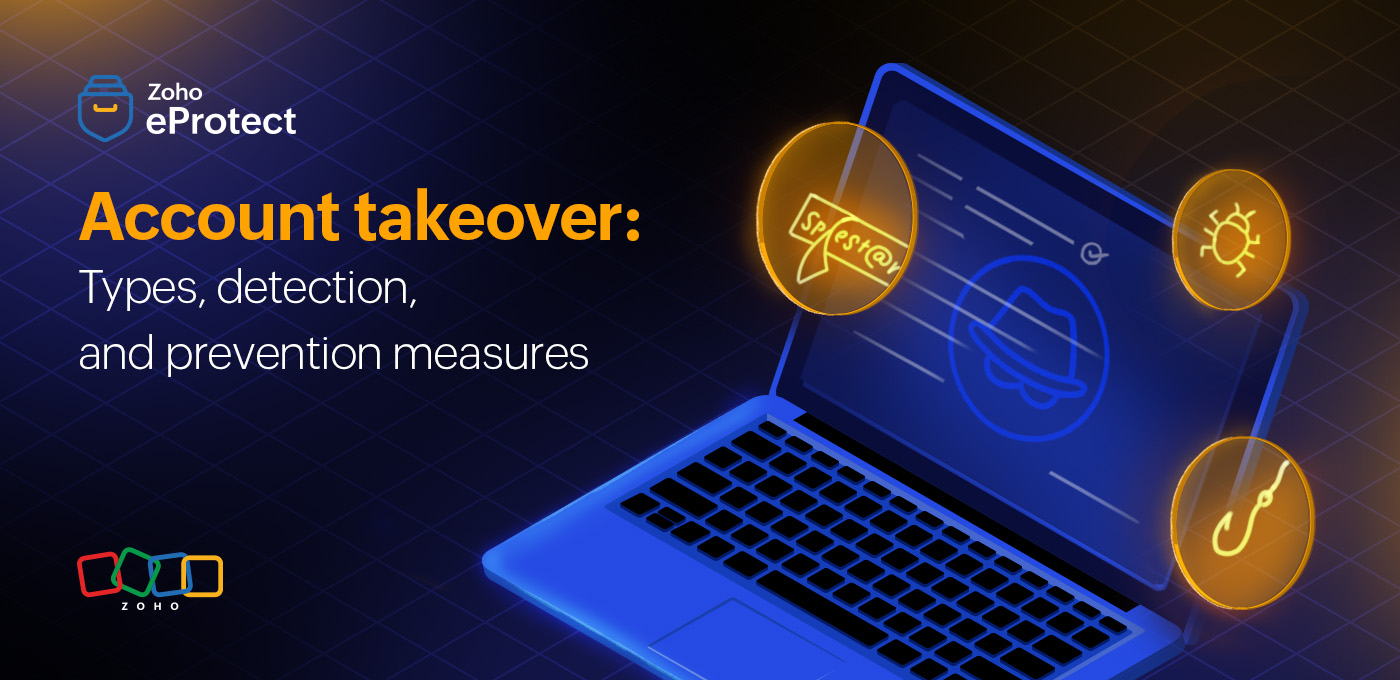
Account takeover is a cyberattack in which threat actors gain unauthorized access to a user’s account, most commonly email, with the intention of stealing money, exfiltrating sensitive data, or manipulating ongoing communication. Once inside, attackers silently observe account activity, studying communication patterns, frequent contacts, financial workflows, approvals, and other behavioral cues they can later exploit.
Although high-privilege users and C-suite employees are common targets, attackers often compromise lower-level accounts first and then move laterally to more valuable ones. What makes ATO especially dangerous is that the attacker operates using a legitimate identity. When they send emails, request information, or initiate financial transactions from the compromised account, recipients see the real user’s name and trust the request, making them far more likely to comply.
This blend of legitimacy and insider-level visibility makes account takeover one of the most effective tactics for enabling fraud, data theft, and business email compromise.
Phases of an account takeover attack
An account takeover attack is planned and carried out in multiple phases. Let's go through the stages of this attack.
Obtaining access
Threat actors begin by acquiring valid user credentials through phishing, credential stuffing, password spraying, malware, or data breaches. At this stage, their goal is simply to obtain a foothold, often using automated tools to test large volumes of stolen username–password pairs across multiple applications.
Initial access
Once the attacker successfully logs in, they work quietly to avoid detection. They may disable security alerts, add forwarding rules, or register new devices. They ensure they can continue accessing the account without raising suspicion or triggering authentication challenges.
Identifying potential attacks
With stable access established, the attacker studies the victim’s communication habits, financial workflows, contacts, approvals, and ongoing projects. This reconnaissance helps them determine the most profitable or least detectable attack path, such as payment fraud, data theft, or internal impersonation.
Attack execution
The attacker now leverages the compromised account to carry out their objective. This may include sending fraudulent emails, manipulating invoices, requesting sensitive documents, or exfiltrating data. Because they use a legitimate identity, their actions appear authentic, significantly increasing the likelihood of success.
Claim rewards and exit
After achieving their goal, completing a fraudulent transfer, obtaining confidential data, or compromising additional accounts, attackers attempt to erase traces of their presence. They may delete emails, clear logs, or maintain silent access for future attacks. Some exit immediately; others continue exploiting the account long-term.
Types of account takeovers
Attackers use a wide range of techniques to compromise user accounts, often combining multiple methods to increase their chances of success. The following are the most common approaches used in ATOs.
Credential stuffing
Attackers use stolen username–password pairs from past data breaches and test them across multiple services, exploiting reused credentials. Automated tools accelerate these attempts, making it easy to compromise accounts at scale when users rely on the same password across platforms.
Session hijacking
In session hijacking, attackers steal active session tokens through malware, unsecured Wi-Fi, or browser exploits. With a valid token, they bypass authentication entirely and gain access as the user, often without triggering alerts or MFA challenges.
Brute force attacks
Brute force attacks involve systematically guessing passwords using automated scripts. Variants like password spraying try common passwords across many accounts to avoid lockouts. Weak or predictable passwords make these attacks significantly more effective.
Man-in-the-middle (MITM) attacks
In MITM attacks, the attacker intercepts communication between the user and the application. By capturing credentials, session cookies, or MFA codes in transit, they gain unauthorized access. Techniques often involve spoofed Wi-Fi networks or compromised routers.
Application vulnerabilities
Poorly secured applications may expose insecure session management, or weak API protections. Attackers exploit these gaps to escalate privileges or access accounts without credentials to impersonate legitimate users.
Social engineering attacks
Social engineering relies on manipulating users into revealing credentials or approving access requests. Attackers may impersonate IT teams, vendors, or colleagues to build trust, tricking victims into sharing sensitive information or granting access they shouldn’t have.
Phishing
Phishing attacks use deceptive emails or websites that mimic trusted services to steal credentials. Attackers create convincing login pages that capture usernames, passwords, and sometimes MFA codes, enabling them to access accounts immediately.
Malware
Malware like keyloggers, infostealers, and remote access trojans captures credentials, session cookies, or authentication data directly from the device. Once installed, it provides attackers with continuous access, often before security tools detect the compromise.
Detecting account takeovers
Attackers often blend into normal user behavior, making early indicators subtle and easy to miss. The following signs help security teams pinpoint potential compromises before they escalate.
Monitor for signs of unusual activity
Continuous monitoring of authentication activity is critical for detecting account takeovers. Indicators include login attempts from unfamiliar IP ranges, unusual device fingerprints, suspicious travel patterns, atypical access times, or repeated MFA challenges. Security teams should correlate identity logs, email access logs, and SIEM alerts to identify deviations from a user’s established baseline. Behavioral analytics greatly improves detection accuracy in this stage.
Unwarranted emails
Compromised accounts often exhibit abnormal outbound and inbound emails. This includes sudden spikes in email volume, messages sent outside typical working hours, communication with unfamiliar contacts, or emails containing atypical requests such as payment instructions or file-sharing links. Analysts should inspect mailbox rules, forwarding configurations, and SMTP logs because attackers frequently create automated rules to hide their activity or redirect sensitive information.
Unauthorized transactions or access
ATO incidents may involve attempts to access systems, files, or applications the user doesn’t normally interact with. Examples include unexpected financial transactions, privilege escalation attempts, mass data downloads, or unusual API calls. Monitoring transaction logs and audit trails can help correlate suspicious behavior with a potential compromise. Anomalous access patterns often signal lateral movement or fraud in progress.
Settings or information changes
Attackers often modify account settings to maintain persistence or evade detection. Common indicators include changes to recovery email addresses, phone numbers, MFA configurations, or security questions. They may also alter mailbox rules, disable alerts, or add unauthorized OAuth applications. Regular auditing of configuration changes and correlating them with authentication events helps detect silent compromises before the attacker performs more damaging actions.
Securing from account takeovers
Even though ATOs are difficult to detect, there are a few steps organizations can take to secure and preserve their data. We'll discuss them in the following section.
Configure a strong password policy
A strong password policy limits the attacker’s ability to compromise accounts through credential stuffing, brute force, or password spraying. Enforce minimum complexity requirements, block the use of previously breached passwords, and encourage the adoption of long, unique passphrases.
Regular audits help identify outdated policies or exceptions that weaken enforcement. Pairing the policy with enterprise password managers like Zoho Vault ensures that users follow best practices without creating usability friction. Strong credential hygiene remains a foundational layer of ATO prevention.
Mandate MFA for logins
MFA significantly reduces successful ATOs, even when credentials are exposed. Prioritize phishing-resistant MFA options such as FIDO2 keys or passkeys, and avoid SMS-based OTPs where possible. Enforce MFA across all applications and cloud services to eliminate authentication blind spots.
Organizations should also monitor MFA fatigue attempts, where attackers bombard users with approval requests to trick them into confirming access. Adaptive MFA, triggered during high-risk logins, adds an additional layer of defense without affecting user experience during routine activity.
Enforce zero trust
Zero trust eliminates implicit trust from the authentication process. Every access request is evaluated continuously based on user identity, device posture, network signals, and risk scores. This ensures that even if attackers obtain credentials, they cannot move freely or escalate privileges without triggering security checks.
Implementing zero trust and continuous validation limits the blast radius of compromised accounts. When integrated with IAM systems and SIEM tooling, zero trust architectures provide real-time visibility into suspicious activity across the environment.
Protect from session hijacking
Session hijacking is a common way attackers bypass MFA using stolen cookies or tokens. Enforce secure, short-lived session tokens tied to device fingerprints or IP reputation. Ensure that all applications use HTTPS and block mixed content that may expose session data.
Monitoring for unusual or duplicated session tokens helps identify hijacking attempts early. Admins should also invalidate active sessions after password resets, policy changes, or suspicious authentication events, reducing the attacker’s ability to maintain stealthy persistence.
Always verify high-value transactions
High-value transactions such as payments, wire transfers, and approval workflows are prime targets during ATOs. Implement step-up authentication, out-of-band verification, or secondary approvals for any action that involves financial or administrative risk. This limits the attacker’s ability to execute fraudulent operations using a trusted identity.
Monitoring transaction logs and correlating them with identity anomalies gives early warning of potential abuse. Security controls should flag deviations from normal transaction patterns, preventing attackers from manipulating financial workflows unnoticed.
Educate users about threats
Human behavior remains a major factor in account compromise. Regular training helps users identify phishing attempts, malicious OAuth prompts, unusual MFA requests, and suspicious login notifications. Focus on real-world examples rather than generic awareness modules to improve recognition and response.
Encourage users to report anomalies such as unexpected MFA prompts, unfamiliar devices, or mailbox rule changes immediately. When security teams receive early input from users, they can contain compromises before attackers escalate privileges or initiate fraudulent activity.
Monitor and review policies regularly
Security controls lose effectiveness when configurations remain static. Conduct periodic reviews of authentication requirements, allowed OAuth apps, password rules, and conditional access policies. Align these reviews with emerging threat patterns to ensure that defenses stay relevant and layered.
Centralized log monitoring across identity, email, and device systems helps detect policy gaps or overlooked attack paths. Regular red-team exercises and simulated phishing campaigns also validate the organization’s readiness against evolving ATO tactics.
Deploy an email security solution
Modern email security solutions provide advanced detection for account takeover behaviors such as unusual login locations, suspicious mailbox rules, unauthorized forwarding, and anomalous email-sending patterns. These systems use behavioral analytics and identity signals to detect compromise early.
Beyond detection, they block phishing attempts, malicious links, and spoofing attempts that often serve as the entry point for ATOs. Integrating email security with IAM and SIEM tooling ensures end-to-end visibility, improving response times and reducing the impact of compromised accounts.
Wrapping up
Account takeovers are difficult to spot and highly damaging because attackers operate through trusted identities. Preventing them requires strong authentication, continuous monitoring, and informed users. With layered security controls and proactive detection in place, organizations can significantly limit the impact of ATO attacks and protect their accounts from unauthorized access.
eProtect is a cloud-based email security and archiving solution that provides an additional layer of security for email accounts. The solution offers advanced threat detection mechanisms that can secure on-premise and cloud email accounts from evolving email threats. eProtect is the security solution that powers Zoho Mail, a platform that millions of users trust.