Practical collaboration frameworks for teams spread across Africa
As of 2024, just 43% of Africans had internet access compared to a global average of around 70%. Urban centres in South Africa, Kenya, Nigeria, and Egypt are meaningfully better connected than that number suggests, but the gaps that matter most for distributed business teams are the reliability gaps.
In March 2024, a suspected underwater rockslide off the coast of Côte d'Ivoire severed four subsea cables, knocking out connectivity across 13 West and Southern African countries. And it's not the first time this stretch of the continent's subsea infrastructure has been cut. This critical cable infrastructure that carries nearly all international internet traffic for the continent is shared, fragile, and expensive to repair. Businesses building collaboration systems that depend on consistent, high-speed uptime are assuming the infrastructure supports it.
South Africa adds its own layer. Load shedding and scheduled power cuts that rotated across the country for most of 2023 and 2024 forced remote workers to manage their connectivity around power schedules, not just work schedules. A team member who knows Stage 4 load shedding starts at 10 AM will structure their morning accordingly. A manager expecting a live response at 10 AM will be confused about why they haven't received one.
"The teams I see struggle most in Africa are not the ones with bad tools. They are the ones whose managers still expect a live response within the hour. That expectation is designed for an office in London. It does not survive contact with intermittent connectivity, time zones spread across six countries, and the weekly reality of South African load shedding."
— Vaishnavi Soundarrajan, Head of Marketing - Middle East and Africa, Zoho
Async-first is an infrastructure response
Async-first means the default mode of communication doesn't require both parties to be available at the same time. Updates are written, decisions are documented, and status is visible without a meeting. Synchronous time, calls, standups, and reviews are reserved for things that need real-time discussion.
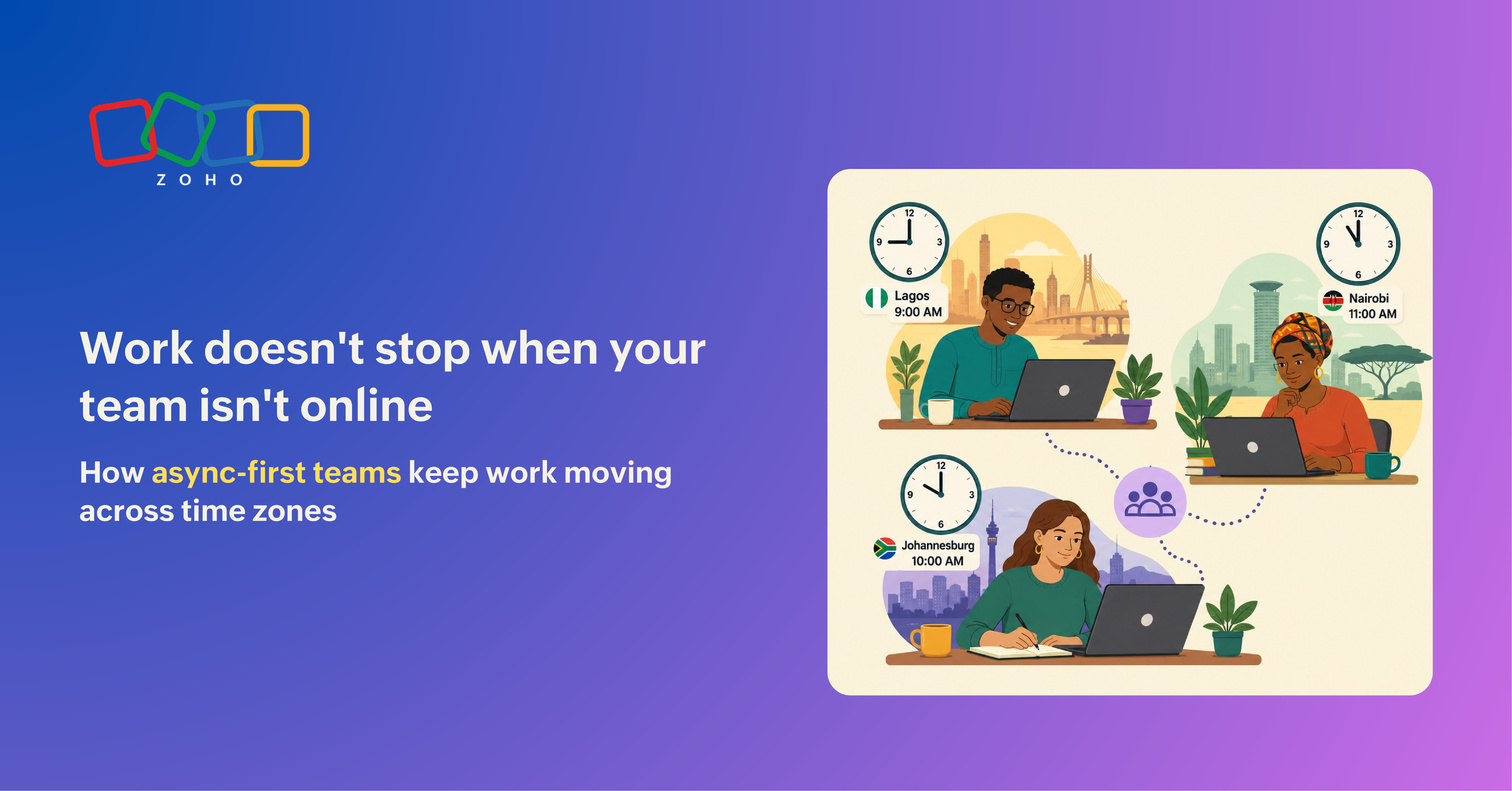
The productivity case for this is well established, independent of connectivity concerns. Employees working asynchronously report 29% greater productivity and 53% greater focus than those in primarily synchronous setups. For African teams, those benefits come with an additional practical advantage: when a team member in Lagos is on mobile data and a colleague in Johannesburg is on inverter power, an async update at 9 AM is simply more reliable than a video call at 10 AM.
The shift requires three things that most organisations underinvest in: clear documentation norms, a single source of truth for decisions, and explicit communication windows that replace the assumption of constant availability.
Four layers for African distributed teams
Written-first communication: Every decision, update, and project change is documented before it's communicated verbally. This is about ensuring that the team member who missed a call due to load shedding can reconstruct what happened in five minutes rather than spending an hour piecing it together from others. Zoho Cliq's channel structure with threaded conversations, searchable history, and document pinning is built for context that travels with the conversation.
Defined response windows rather than constant availability: A Lagos-based team member working with colleagues in Johannesburg, Nairobi, and Cairo spans three time zones and at least two different load-shedding realities. Expecting responses within four hours during working hours—rather than within thirty minutes—removes the anxiety that comes from uncertain connectivity without losing meaningful collaboration speed.
Lightweight status visibility without meetings: Daily written standups posted in a shared channel—what each person completed, what they're working on, and what is blocked—replace the live 15-minute call that requires everyone to be online at the same time. This is one of the highest-impact changes for distributed teams. For Africa-based teams, it has the additional benefit of being readable during a connectivity window rather than requiring a connectivity window at meeting time.
Documentation as institutional memory: When a key team member leaves or a new person joins the office, the knowledge needs to be accessible somewhere. This means decisions get documented in a shared space—like Zoho WorkDrive or an equivalent—not in WhatsApp threads or email chains that live on individual devices. Africa has some of the world's fastest-growing tech talent ecosystems in Lagos, Nairobi, Accra, and Cape Town. As professionals move between companies, documentation becomes the only thing that keeps critical knowledge from leaving with them. Teams that document well retain institutional knowledge even when people move organisations.
Productivity checklist for African distributed ops teams
- Map your load shedding and known connectivity windows per office. Build meeting schedules around them.
- Define response time expectations explicitly. Four hours is a reasonable default for cross-country African teams.
- Establish a single written channel per project. Make sure every decision made in a WhatsApp thread gets moved to a documented record within 24 hours.
- Switch daily standups to a written format. Post in a shared channel at the start of your local day.
- Use lightweight, low-bandwidth tools where possible. Video calls on 4G mobile data burn through a team member's personal data budget, but a well-written update does not.
- Build a backup communication channel for outages. If the primary platform is cloud-hosted and the subsea cable is down, know what you're using instead.
Document the team's communication norms in writing. New joiners in Accra or Dar es Salaam shouldn't need a two-week orientation to understand when and how the team communicates.
The collaboration frameworks that work in African distributed teams are not fundamentally different from those for any other distributed team: document decisions, define response windows, and make statuses visible without meetings. The African context makes the stakes of getting this wrong more visible; a missed connection due to load shedding exposes process gaps that a high-bandwidth office environment papers over. Fix the process, and the infrastructure gaps become manageable. Leave the process broken, and even the best connectivity cannot save the team.
One platform designed for every connection speed
Zoho One gives distributed African teams a single platform for messaging, project tracking, document management, and HR. It's built to run on the connectivity your team actually has, not the connectivity a product demo assumes.
See how Zoho One helps distributed teams work better
FAQs
How do you manage distributed teams across Africa?
The most effective approach treats infrastructure variability as a design constraint. This means building async-first workflows where updates are written, decisions are documented, and visibility doesn't require a live connection. Define explicit response windows per team (four hours across time zones is a reasonable default), establish a single written record for all decisions, and build standups into written channel updates rather than live calls. Teams operating across South Africa, Nigeria, Kenya, and Egypt also need a backup communication plan for subsea cable outages and load-shedding disruptions.
What is async-first collaboration, and why does it matter in Africa?
Async-first means the default mode of communication does not require everyone to be online simultaneously. Teams document updates, decisions, and progress in shared spaces instead of relying on live meetings. This approach is particularly valuable in Africa, where connectivity interruptions, load shedding, and varying internet quality make real-time collaboration less reliable than well-designed asynchronous workflows.
What tools work for remote teams with poor connectivity?
Tools that work well under variable connectivity share common characteristics: they store data locally and sync when connectivity resumes, they support lightweight text-based updates rather than requiring video, and they don't require constant background data usage to function.
Zoho Cliq for asynchronous messaging with searchable history, Zoho WorkDrive for document storage and offline access, and Zoho Projects for task tracking without live dashboards are practical choices for African distributed teams. The tool selection matters less than the workflow; any tool used asynchronously outperforms a high-bandwidth tool used synchronously when the connection is unreliable.
How does Zoho support distributed teams in Africa?
Zoho One gives African distributed teams a single platform for messaging (Zoho Cliq), project and task management (Zoho Projects), document storage (Zoho WorkDrive), and HR management (Zoho People) without requiring separate tools that fragment context across platforms. Zoho's presence in the MEA region, with offices in South Africa and across the Gulf, means regional support rather than escalating to a global help desk. For businesses concerned about data residency, Zoho's data centres in the UAE support MEA regional data requirements, and expansion into additional African markets is underway.
Does Zoho work in low-bandwidth environments?
Zoho's mobile applications are designed to work with variable connectivity, support offline operations, and use lightweight data. Zoho Cliq's text-first messaging model uses significantly less data than video-heavy platforms. Zoho WorkDrive supports offline file access that syncs when connectivity resumes. For teams in markets where mobile data is the primary connection and costs are high, a text-first, async-designed platform is materially more practical than collaboration suites built around video conferencing as the default interaction.
Which Zoho products are most relevant for African ops teams?
The core stack for an African distributed ops team typically covers four functions. Zoho Cliq for structured async communication with searchable history and document pinning; Zoho Projects for task ownership, progress tracking, and written standup integration; Zoho WorkDrive for shared document storage with offline access and access controls; and Zoho People for HR management across multiple countries and employment arrangements. Zoho One bundles all of these, along with more than 50 other applications, into a single subscription, helping teams avoid the tool sprawl that typically accumulates when each function is solved separately.