How to choose analytics software that fits the way your business works
Choosing analytics software shouldn’t start with features, dashboards, or pricing. It should start with a simple question: Can this tool help your business make better decisions?
Many Kenyan SMEs invest in analytics platforms expecting greater visibility into their operations. Instead, they often end up with more reports, more dashboards, and more confusion. The problem usually isn’t a lack of data. Most businesses already have plenty of it. The challenge is connecting information from different systems and turning it into something teams can act on.
The real challenge is connecting data
As businesses grow, information often becomes scattered across departments. Sales, finance, operations, and marketing may each rely on different systems, making it difficult to get a complete view of business performance.
For many Kenyan businesses, this challenge is familiar. Customer information may sit in a CRM, financial records in accounting software, campaign performance in marketing tools, and operational data in spreadsheets. While the information exists, finding the answers needed to make timely decisions becomes difficult.
PwC’s 2026 Digital Trends in Operations Survey found that 87% of operations leaders said poor data quality had limited the value they received from their digital investments.
The impact is felt every day. Teams spend hours collecting information instead of analysing it. Reports take days to prepare. Meetings focus on validating numbers rather than discussing actions. Opportunities are missed because insights arrive too late. The issue is that the data is disconnected.
When more dashboards make things harder
When reporting becomes difficult, the first instinct is usually to build another dashboard. Sales wants better visibility into pipeline performance, finance needs clearer reporting, and customer service teams want their own metrics, so new dashboards get added one after another.
At first, this seems to solve the problem. Each team gets the information they need. But as more reports are created, finding the right numbers becomes harder. As trust in reporting starts to slip, teams fall back on spreadsheets and manually compiled reports because they want a version of the data they feel confident using to make decisions.
Start with the decision
When evaluating analytics software, it’s easy to focus on features such as dashboards, visualisations, AI capabilities, and reporting tools. While these features matter, they shouldn’t be the starting point.
The more important question is whether the platform can help teams make better decisions.
Good analytics software should help businesses answer questions such as:
Which marketing campaigns deliver results?
Where are operational bottlenecks affecting growth?
Which customers are at risk of churning?
Which products generate the most revenue?
What trends require attention right now?
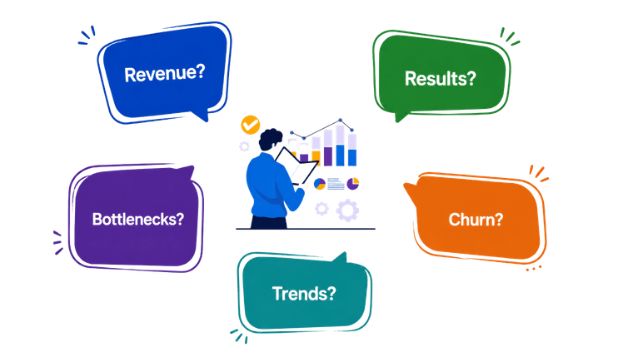
Analytics is about helping people make informed decisions faster. That’s where the FIT test becomes useful.
The FIT test for choosing analytics software
Before choosing an analytics platform, ask three simple questions.
F — Fit for decisions
Can it help answer important business questions?
Good analytics should help teams make better decisions, not just create reports.
I — Integrated data
Can it connect the tools you already use?
Bringing data together gives a clearer view of the business.
T — Team adoption
Will people actually use it?
The best platform is one that teams find easy to understand and use every day.
Get all three right, and the platform delivers a strong user experience from day one.
How Zoho Analytics passes the FIT test
Once you’ve identified what matters most, the next step is finding a platform that can support those needs without creating additional complexity. Zoho Analytics does this.
Fit for decisions : Make better decisions
Important decisions often depend on information scattered across multiple reports, spreadsheets, and systems. Zoho Analytics helps bring that information together and turns it into insights, forecasts, and next steps. This helps teams understand performance, identify trends, and make decisions with greater confidence.
Integrated data: Bring all your data together
This tool connects data from CRM systems, accounting software, marketing tools, databases, cloud platforms, and other business applications into a single view. Instead of spending time switching between systems, teams can focus on understanding what the data is telling them. With Zia, Zoho’s AI assistant, users can ask questions in plain language and receive instant reports.
Team adoption: Analytics people will actually use
This tool is designed for everyone, not just data specialists. With drag-and-drop reporting, intuitive dashboards, and built-in collaboration features, teams can explore data, share insights, and make informed decisions without depending on technical experts.
What this looks like in practice
As a healthcare provider, Ilara Health was pulling data from Zoho Billing, Zoho Inventory, and HubSpot CRM, and every month someone had to compile that into reports covering sales, customer churn, payment history, invoices, and more. They were using Google Data Studio, but writing queries and building query tables by hand was slow enough that the reporting cycle was becoming a job in itself. After consolidating everything in Zoho Analytics, reports were refreshed in real time, and productivity rose by around 20%.
“Some departments in our company like to use their own analytical tools, but, as much as possible, we like to analyse all our data with Zoho Analytics because of its seamless integration with Zoho and third-party apps.”
— Sameer Afzal Farooqi, Co-founder and COO, Ilara Health
The lesson isn’t that businesses need more reports; they need fewer barriers between their data and their decisions.
Clarity over complexity
Every business generates data. The difference is what happens next. The businesses that grow are the ones that can see what's happening, understand why it's happening, and act quickly. In Kenya's increasingly competitive business environment, that ability is what separates fast movers from the rest. In fact, a study of Kenyan SMEs found that 68% have already adopted digital transformation initiatives, and businesses with higher levels of digital adoption reported stronger revenue growth, improved operational efficiency, and better customer satisfaction.
When choosing analytics software, look beyond dashboards and feature lists. Focus on whether it helps your team make better decisions, connects the data across your business, and is simple enough for people to use every day.
FAQs
1. Why is it difficult to get insights from business data?
Business data is often spread across multiple applications and systems, making it hard to get a complete view of performance. Consolidating data helps uncover clearer insights.
2. How can I tell if my analytics process needs improvement?
If your team relies heavily on spreadsheets, spends too much time creating reports, or struggles with inconsistent data, it may be time to modernise your analytics approach.
3. How do I get started with Zoho Analytics?
Start by connecting your business data sources, then build dashboards and reports to track the metrics that matter most to your goals.
4. What is Ask Zia in Zoho Analytics?
Zia, AI-powered assistant in Zoho Analytics, powers the Ask Zia feature, enabling users to ask questions in natural language and receive instant reports, charts, and insights.
5. Can Zoho Analytics combine data from multiple sources?
Yes. Zoho Analytics brings data from different business applications into a unified analytics platform, helping teams make more informed decisions.