
- HOME
- Know Your Tech
- A complete guide to manufacturing workflow processes
A complete guide to manufacturing workflow processes
- Last Updated : March 30, 2026
- 366 Views
- 6 Min Read
Manufacturing operations come with a unique set of challenges that impact every aspect of the business. Managing machines, workers, and resources while ensuring consistent quality and efficiency requires constant oversight and precise coordination. As production becomes more complex, inefficiencies, delays, and errors can accumulate quickly, leading to increased costs and disruption to your operations.
Highlights
- Manufacturing workflow processes define task sequences from raw materials to finished products, improving consistency and reducing production errors.
- Workflow types—like discrete, process, batch, and assembly line—address specific production needs based on output and operational requirements.
- Automation and AI optimize production through robotics, predictive maintenance, and real-time quality checks to minimize downtime.
- Supply chain automation reduces inventory costs and ensures materials arrive when needed.
A well-organized manufacturing workflow process is essential to addressing these challenges effectively. By implementing clear, structured processes, businesses can allocate resources more efficiently, reduce delays, and improve communication across teams. With well-defined workflows, manufacturers can achieve a more predictable and organized production environment.
In this blog, we’ll explore manufacturing workflows, the various types that are commonly used, and how they can benefit your operations.
Types of manufacturing workflows

The structure of your manufacturing workflow depends on whether you're producing individual items, processing bulk materials, or managing batch production. Each approach addresses specific challenges in resource management and quality control.
- Discrete manufacturing workflows: Discrete manufacturing involves producing distinct items, such as car parts or electronics. Each product is tracked through production stages, ensuring precise management and accountability.
- Process manufacturing workflows: In process manufacturing, products are made in bulk, such as in food production or chemicals. The focus is on managing the continuous transformation of raw materials into finished goods.
- Batch manufacturing workflows: This workflow produces goods in defined groups or batches. Once a batch is completed, production halts, and the system is reset for the next batch. It's efficient for high-volume production with varying product types.
- Assembly line manufacturing workflows: Assembly lines are organized sequentially with each station performing a specific task. This type of workflow is ideal for mass production as it enables high efficiency and consistent output.
Each workflow type plays an important role in optimizing production. Selecting the right approach improves efficiency, resource management, and product quality.
Benefits of a manufacturing process workflow
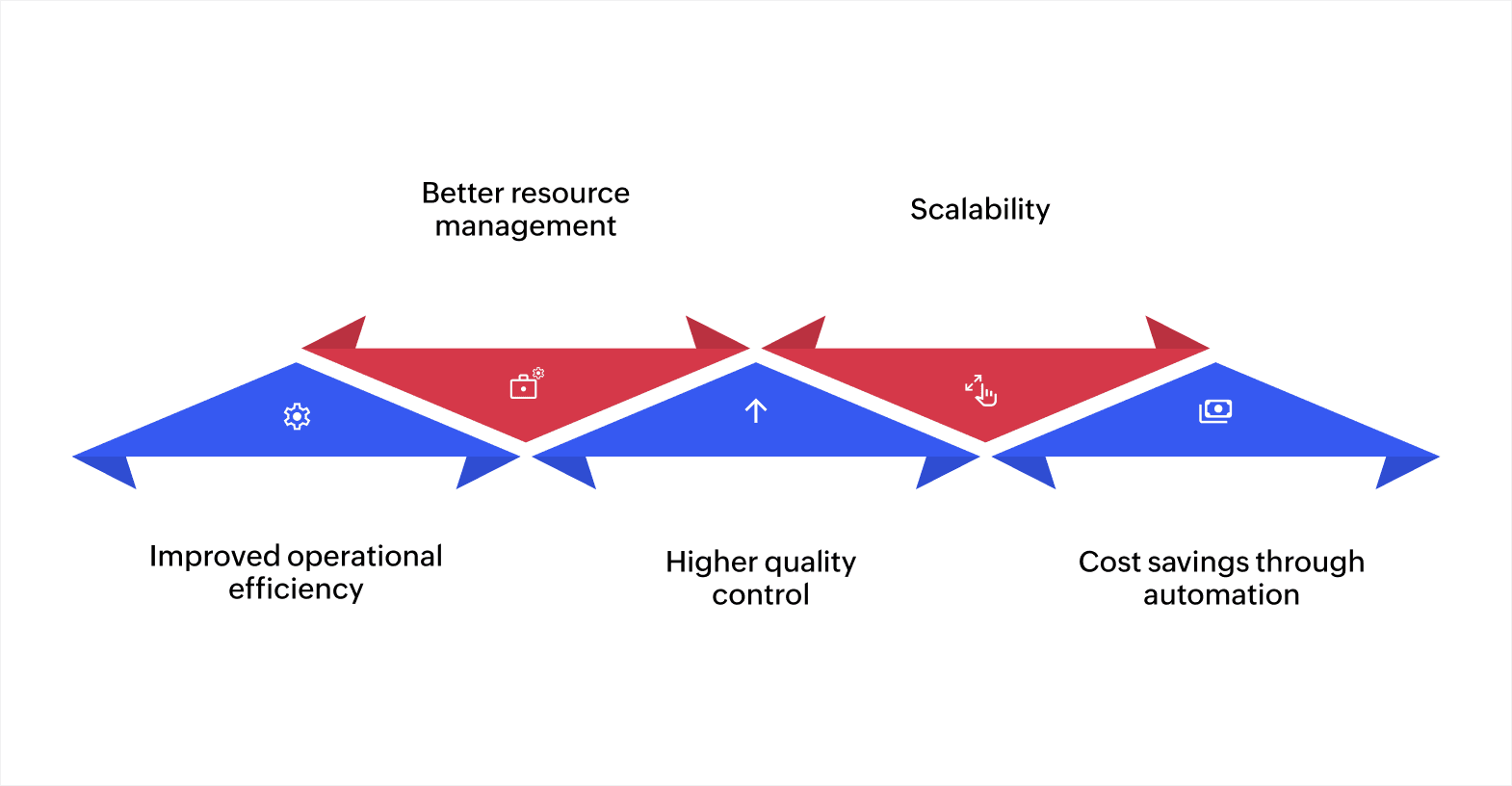
Regardless of the workflow type used, structured production processes bring measurable operational advantages. When manufacturing tasks are organized into clear, repeatable workflows, businesses gain better control over efficiency, resources, and product quality.
- Improved operational efficiency: When a manufacturing process is well planned, you can eliminate unnecessary steps, reduce idle time, and avoid bottlenecks, speeding up production.
- Better resource management: A defined workflow ensures that resources such as labor, materials, and equipment are used effectively, preventing wastage and ensuring proper allocation.
- Higher quality control: When each step of the manufacturing process is standardized and monitored, it becomes easier to maintain consistent quality.
- Scalability: A well-organized manufacturing workflow makes it easier to scale production without disrupting operations or compromising quality.
- Cost savings through automation: Automating tasks can reduce labor costs, increase production speed, and lower operational expenses, helping businesses maintain better financial forecasting and increase profits.
Challenges in manufacturing workflow management
- Communication gaps: Ineffective communication can result in mistakes, delays, and confusion among teams, making it difficult to keep production on track.
- Inflexibility: Rigid workflows that don't allow for adjustments can result in delays and increased downtime when unforeseen disruptions, such as machine failures, occur.
- Data silos: When data is stored in separate systems or departments, it becomes hard to get a clear, unified view of production, hindering decision-making.
- Quality inconsistencies: If workflows aren't standardized, there may be variations in quality between production stages, leading to defective products and customer dissatisfaction.
- High operational costs: Inefficient workflows often result in higher operational costs like excess labor costs, unnecessary inventory holding, extra downtime, and production delays.
How to build efficient manufacturing workflows
Understanding advanced technologies such as automation, AI, data analytics, and machine learning is key to driving efficiency and innovation in manufacturing. Here’s a detailed technical guide on building efficient manufacturing workflows.
The role of automation and AI in manufacturing workflows
Automation and AI are central to improving manufacturing workflows. Automation uses robotics, programmable logic controllers (PLCs), and automated guided vehicles (AGVs) to handle repetitive tasks, reducing the need for manual intervention. AI, particularly machine learning, enhances these systems by enabling predictive maintenance, real-time quality checks, and adaptive production processes.
Key areas where automation and AI improve efficiency
- Assembly lines: Robotics and CNC machines handle intricate tasks—such as welding, assembling, and packaging—with precision, minimizing human error and downtime.
- Quality checks: Automated vision systems equipped with machine learning algorithms can scan products at a high speed, identifying surface defects, dimensional discrepancies, or deviations.
- Inventory tracking and material handling: IoT-based RFID tags, sensors, and AGVs enhance material handling by transporting goods and updating stock levels in real time. The system automatically adjusts the supply chain based on production rates and demand.
- Predictive maintenance with AI: Machine learning algorithms analyze patterns in data collected from sensors to predict when equipment will fail. This proactive approach helps reduce downtime and optimizes the lifespan of machinery.
Data-driven optimization
Data-driven insights enable manufacturers to address inefficiencies before they become bottlenecks. Here’s how real-time data and predictive analytics can enhance operations.
- Real-time data collection: IoT sensors monitor critical production variables, such as temperature and pressure, feeding real-time data into centralized systems for immediate analysis.
- Optimizing workflows: AI-driven models use data to identify inefficiencies and predict machine wear, enabling smoother operations.
- Predictive analytics: Using statistical models, manufacturers can forecast production needs, machine maintenance schedules, and inventory levels, reducing delays.
Connecting manufacturing processes
Integrating manufacturing systems, such as ERP, MES, and WMS, ensures seamless data flow across departments, improving communication and operational efficiency. A unified system allows for real-time updates on production, inventory, and finance. Below are key integration strategies for optimizing workflows.
- API connections and cloud computing: RESTful APIs and cloud platforms like AWS allow for real-time data transfer between systems, enhancing scalability and remote monitoring.
Machine learning and AI for process optimization
Machine learning and AI are central to optimizing manufacturing workflows. These technologies provide real-time insights and predictions, enhancing decision-making and reducing operational disruptions.
- Machine learning for workflow prediction: Machine learning analyzes historical and real-time data to forecast inefficiencies and potential failures, allowing for proactive corrections.
- AI-driven quality control: AI and computer vision systems inspect products for defects, ensuring consistent quality and reducing scrap.
Supply chain and inventory management through automation
Automating inventory and supply chain management ensures materials arrive exactly when needed, reducing storage costs and excess inventory. Technologies like IoT, RFID, and blockchain facilitate real-time tracking and automated replenishment and transactions.
Securing manufacturing workflow systems
Implementing strong encryption, secure communication, and IoT security protocols is critical to safeguarding manufacturing systems.
- Cybersecurity and data protection: Use encryption protocols like AES and secure communication channels to protect sensitive information.
- IoT security: Implement network security protocols, including VPNs and intrusion detection systems, to secure connected devices from cyberattacks.
Optimize your manufacturing workflow process
Integrating technologies such as automation, AI, machine learning, and data analytics can significantly improve efficiency, minimize errors, and help you meet production demands with greater precision.
To implement these solutions, platforms like Zoho Creator provide an accessible, low-code approach to building custom applications. With Zoho Creator, you can create applications that support predictive maintenance, real-time monitoring, and inventory management, all without needing extensive IT resources.
Sign up for a free trial today and see how custom workflow applications can improve your manufacturing efficiency.
FAQ
1. How can small manufacturers benefit from implementing a manufacturing workflow process?
Small manufacturers can simplify production, improve resource allocation, reduce errors, cut costs, and speed up processes.
2. How can a manufacturing workflow process help improve operational efficiency?
A well-structured workflow process simplifies production by reducing unnecessary steps, preventing delays, and improving coordination between teams. By automating routine tasks and optimizing resource allocation, manufacturers can reduce downtime, minimize waste, and maintain consistent quality, ultimately leading to higher productivity and cost savings.
3. How can automation be integrated into existing manufacturing workflows without major disruptions?
Start by automating repetitive tasks like material handling and inventory tracking. Use modular systems that integrate easily with existing processes and train employees. Gradual implementation helps avoid disruptions.
4. How do you scale a manufacturing workflow as demand increases?
Scale by automating tasks, upgrading equipment, and using cloud-based ERP or MES systems for real-time tracking. Apply lean manufacturing principles to manage growth without compromising quality or efficiency.
 Ann Elizabeth Sam
Hey! I'm Ann, and I work as a content writer at Zoho Creator. I'm exploring the SaaS world through various forms of content creation. Outside of work, I love dancing and would give up anything to read a good murder mystery.