- HOME
- More
- Employee Engagement
- The hidden tax of making employees search, switch, and repeat
The hidden tax of making employees search, switch, and repeat
- Last Updated : August 28, 2026
- 6 Views
- 5 Min Read

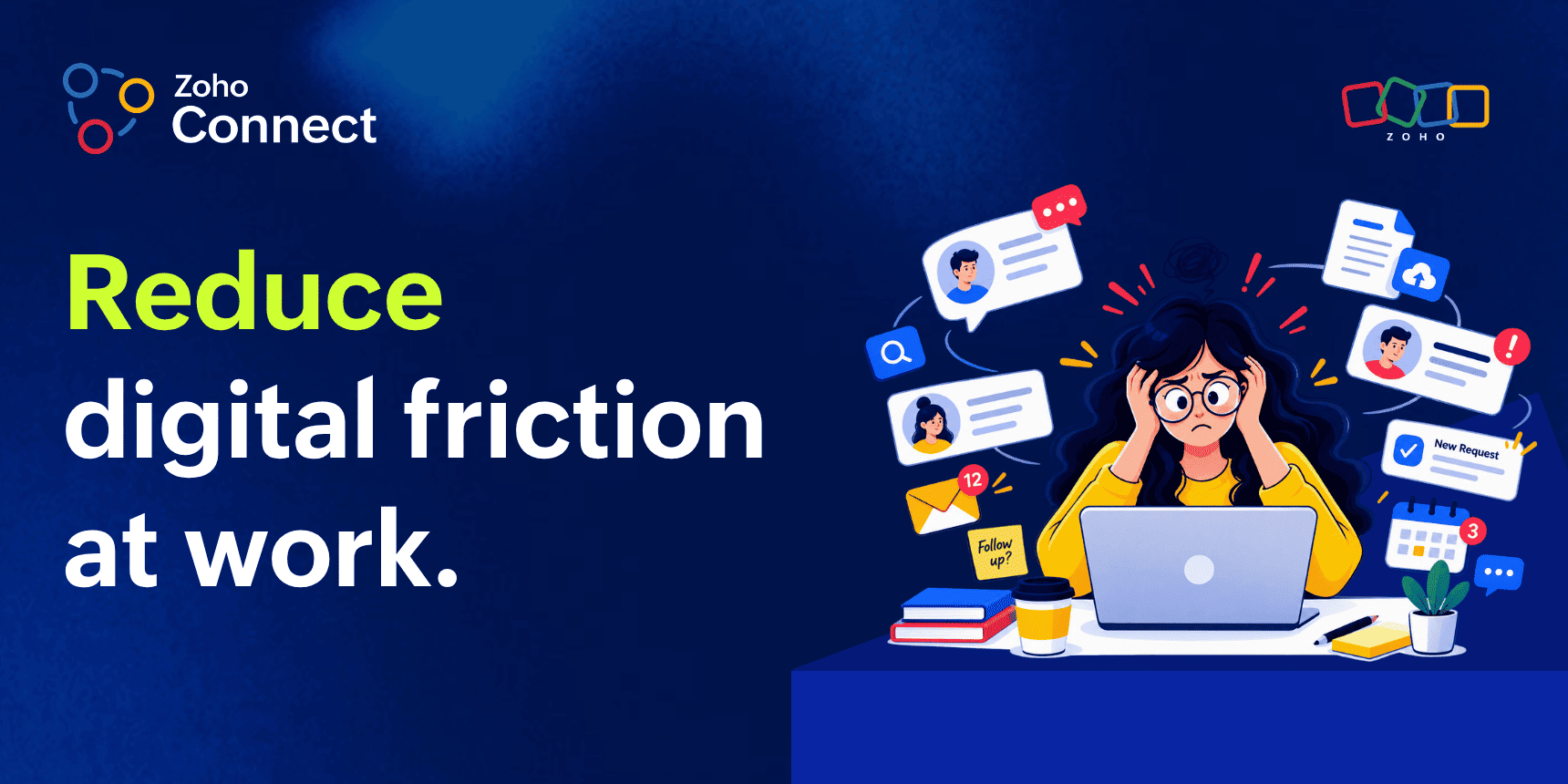
Employees don’t just lose time to meetings and busywork. A surprising amount of productivity disappears in much smaller moments: searching for information, switching between tools, and asking for answers that already exist.
APQC found that knowledge workers spend an average of 2.8 hours every week looking for or requesting the information they need to do their jobs. That’s valuable time spent finding information instead of using it.
Now add the time spent moving between email, chat, shared drives, HR systems, project tools, and internal portals. Each switch adds another layer of friction, and the cost adds up quickly.
But there’s another cost that’s harder to measure: the frustration of constantly having to figure out where to look, who to ask, and which version to trust.
This is the hidden tax of digital friction. And it’s becoming an employee experience problem, too.
When finding information becomes part of the job
Most organizations aren’t short of information. They have policies, processes, presentations, announcements, training materials, project updates, FAQs, and years of institutional knowledge.
The problem is that all of it can end up scattered across different places.
An employee looking for a simple answer may check their inbox first. Then a team chat. Then a shared folder. Then an HR portal. Maybe the intranet.
And if they still can’t find it, they ask a colleague. The information exists. But finding it has become part of the job. That’s where digital friction begins.
Five minutes doesn’t feel expensive until it happens every day
Consider a simple scenario.
An employee spends five minutes looking for a document. Later, they spend another five minutes finding an old announcement. Then they spend another ten minutes asking a colleague for information they couldn’t locate themselves.
None of these moments feels significant. But repeat them across a day, a team, or an entire organization, and the numbers change.
And the real cost isn’t always the minutes spent searching. There’s also the interruption. If someone is deep in a report, preparing for a client meeting, or working on a campaign, stopping to search for information breaks their focus. When they finally find what they need, they still have to return to the original task and rebuild their train of thought. A five-minute search can create a much longer productivity gap.
Every tool switch adds another layer
The average employee doesn’t work in one application. They move between email, messaging apps, cloud storage, project management software, HR systems, CRM platforms, knowledge bases, and more. Every tool may serve a purpose. The problem is remembering which purpose belongs where.
“Was that update in an email?”
“Did someone share the document in chat?”
“Where’s the latest version?”
“Which system has the policy?”
The more places employees have to check, the more effort goes into navigating work instead of doing it. Technology is supposed to make work easier. When employees have to switch between disconnected systems constantly, it can do the opposite.
When employees become the search engine
There’s another common workaround—asking someone who knows.
Every organization has them; the people who somehow know where everything is. They know which folder contains the old presentation. They remember when the policy changed. They can find the document everyone else has been searching for.
They’re helpful, but there’s a hidden cost. Every time someone asks them a question, they’re pulled away from their own work. And when the same question comes up again, the cycle starts over.
One person searches. Another person answers. Someone else asks tomorrow.
The organization keeps paying for the same piece of knowledge. That’s not a knowledge problem. It’s a knowledge-sharing problem.
Repetition is where the tax gets bigger
Searching and switching are only part of the problem. Then comes repetition.
HR answers the same benefits question for different employees. IT explains the same troubleshooting process again and again. Managers resend documents that have already been shared. Teams recreate files because they can’t find the original. New employees ask questions that experienced employees have answered many times before.
Individually, these tasks are small. Collectively, they create a significant drain on organizational time.The knowledge already exists. But because it isn’t easy to find or reuse, employees keep recreating the same work.
Digital friction becomes employee friction
It’s easy to think of this as a productivity issue. But it goes deeper. When employees repeatedly struggle to find information or complete simple tasks, they don’t think, “Our information architecture needs improvement.”
They think:
“Why is this so difficult?”
“Where am I supposed to find this?”
“Who should I ask?”
“Why do I have to do this again?”
Those moments shape how employees experience their workplace.Employee experience isn’t only about engagement programs, recognition, or company culture. It’s also about whether employees have the tools and information they need to do their jobs without unnecessary friction.
A workplace that makes everyday work easier can make employees feel more connected, informed, and empowered.
The answer isn’t adding another tool
Ironically, the solution to digital friction shouldn’t be another application employees have to remember.
The better approach is to create a connected digital workplace where employees have a clear place to find information, communicate with colleagues, collaborate with teams, and stay up to date.
That’s where an employee experience intranet like Zoho Connect can play an important role.
With Zoho Connect, organizations can bring communication, knowledge sharing, collaboration, and employee engagement together in one connected workplace.
Employees can follow company announcements, participate in communities, collaborate with teams, access organizational knowledge, and find important resources without having to search across multiple disconnected spaces.
It doesn’t mean every application has to disappear. It means employees have a clear digital home for the information and conversations that matter to them.
From repeated answers to reusable knowledge
One of the biggest opportunities is turning everyday communication into organizational knowledge.
A frequently asked question can become a FAQ. A useful discussion can become a resource. An important announcement can remain accessible instead of disappearing into an inbox. A process that employees repeatedly ask about can be documented once and shared with everyone who needs it.
This changes the way knowledge moves through an organization.
Instead of:
Ask → answer → forget → ask again.
you can move toward:
Ask → answer → capture → reuse.
That’s a much more scalable way to work.
What would your employees stop searching for?
The best way to uncover digital friction is to ask employees.
For example:
What information takes too long to find?
Which tools do they switch between most often?
What questions do they repeatedly ask colleagues?
Which processes involve unnecessary steps?
Where do they encounter outdated or conflicting information?
The answers can show you where your workplace is quietly losing time. Because you can’t remove friction you can’t see.
Make every search count for less
Digital friction rarely comes from one major problem. It comes from the accumulation of small ones.
A search here.
A tool switch there.
A repeated question.
A document request.
An old email.
Another “Can you send that again?”
Over time, these moments take attention away from the work that actually matters.
Your employees shouldn’t have to spend their day figuring out where work lives.
They should be able to focus on doing the work.
With Zoho Connect, you can create a connected employee workplace where communication, knowledge, collaboration, and engagement come together—helping your people spend less time searching and more time contributing.
Ready to make work easier to find and easier to do? Explore Zoho Connect and build a more connected workplace for your employees.