- HOME
- BI & Analytics
- White-Label Analytics: The E-Commerce Agency's Unfair Advantage
White-Label Analytics: The E-Commerce Agency's Unfair Advantage
- Last Updated : April 16, 2026
- 356 Views
- 9 Min Read
The Reporting Problem Nobody Talks About
You win a new DTC brand. Their Shopify store gets connected. You pull Meta Ads data, reconcile it against Google Analytics, chase down the Amazon numbers, and then spend four hours building a PowerPoint presentation that looks slightly different from last month's because a different team member put it together.
Four hours per client. Ten clients. That's forty hours a month of work nobody is billing for, and nobody is impressed by. The agency principal knows this math. So do the account managers who are doing it at 9 pm on a Thursday. But most agencies keep doing it anyway because they haven't found a better system that doesn't require a data engineer, a six-month implementation, or pricing that makes the whole thing unprofitable.
That's the gap Zoho Analytics fills for e-commerce agencies specifically. And the agencies that have figured it out are quietly widening the distance between themselves and competitors who are still running on spreadsheets and slide decks.
What White-Label Analytics Actually Means (And Why It Matters)
The term gets thrown around loosely, so it's worth being precise.
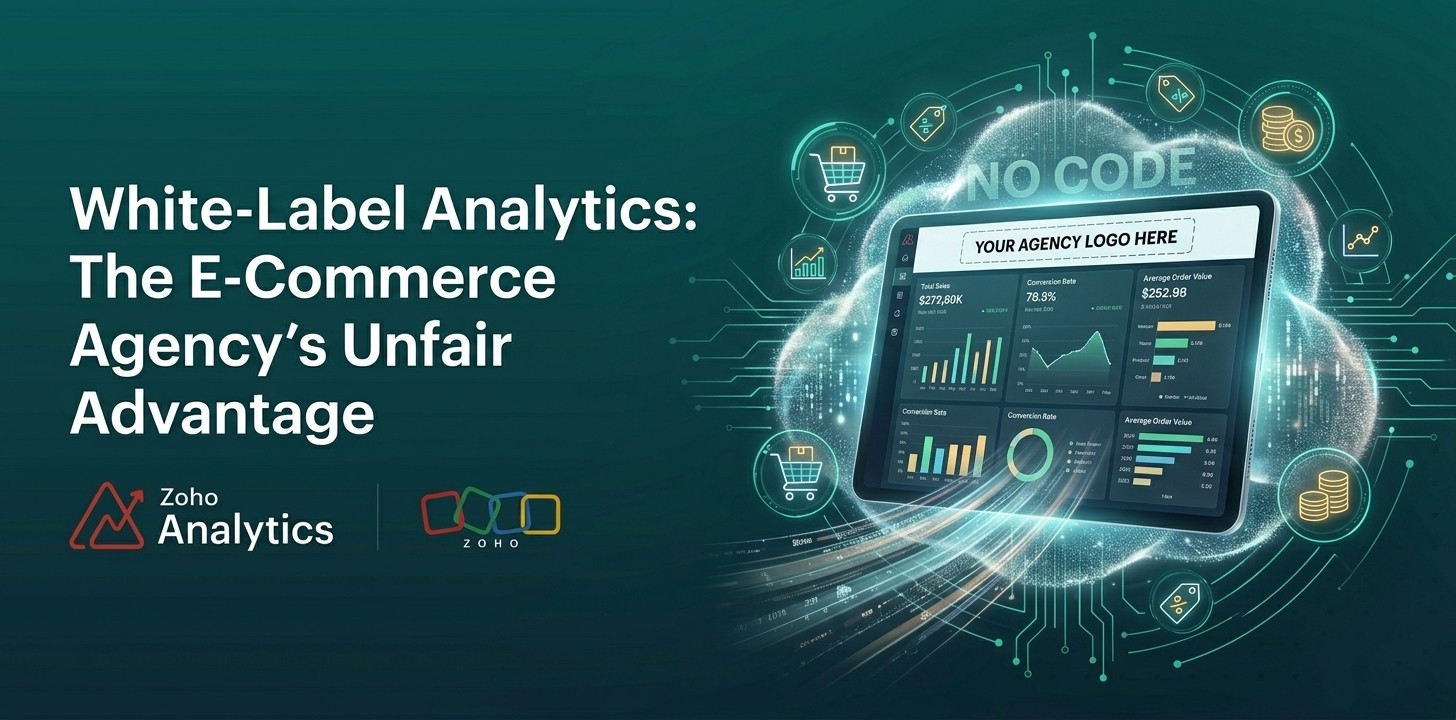
White-label analytics means your clients log into a reporting platform that looks like it was built by your agency. Your logo, your subdomain, and your brand colors on the login screen. No mention of any third-party software anywhere in the interface.
For an e-commerce agency, this changes the nature of the client relationship in three ways.
First, it signals capability. A client who sees a live, branded dashboard assumes your agency operates proprietary technology. That perception supports higher retainer pricing.
Second, it creates daily habit. A client who logs into your platform every morning to check yesterday's ROAS is far more embedded in the relationship than one who receives a PDF on the first of the month.
Third, it scales without adding headcount. Once the platform is configured, adding a new client is a setup task, not a project. You're not rebuilding the reporting infrastructure from scratch every time you sign someone new.
Zoho Analytics offers a white-label BI solution exclusively for agencies such as yours. It runs on your subdomain, carries zero Zoho branding, and gives each of your clients their own login and workspace. It is set up through a visual interface. No developers required.
Why E-Commerce Agencies Benefit More Than Most
E-commerce clients are unusually data-rich. A mid-market DTC brand running at any real scale might have:
- Thousands of Shopify orders per month
- Facebook and Instagram campaigns across dozens of ad sets
- LinkedIn Ads, Instagram Ads and YouTube Ads running simultaneously
- A Klaviyo account with revenue attribution across multiple flows
- Amazon Seller Central data if they sell on marketplace
- Inventory data from Zoho Inventory or a warehouse management tool
That data sits in five to ten disconnected systems. Right now, your team is either exporting CSVs, paying for a point-solution tool that only covers one platform, or using a generic BI product that requires someone technical to configure every time a new client comes on.
The e-commerce agency that can pull all of this into a single, live, branded dashboard has something genuinely useful to offer. Not just a reporting service but an actual analytical product.
What Zoho Analytics Gives You
Pre-Built Connectors to Every Platform Your Clients Use
Zoho Analytics ships with native, no-code connectors to the e-commerce and marketing platforms that show up in almost every agency client stack:
Storefronts: Shopify, WooCommerce, ShipStation, Amazon Seller Central, BigCommerce, Magento
Paid channels: Meta Ads, Google Ads, Microsoft Advertising, LinkedIn Ads, Instagram Ads
Owned channels and analytics: Google Analytics 4, Klaviyo
Connecting a new client's Shopify store takes under ten minutes through a guided wizard. No API credentials to configure, no custom scripts, and no tickets to your development team. A non-technical account manager can do it on day one.
Once connected, Zoho Analytics generates pre-built dashboards for each data source automatically. You're not starting from a blank screen.
Blended Reports Across Platforms
The individual platform dashboards are a starting point. The cross-platform reports are what clients actually care about.
Zoho Analytics lets you join data across sources through lookups, formulas and SQL queries. Useful e-commerce report types you can build this way:
True ROAS: Google Ads spend plus Meta Ads spend divided by Shopify revenue, in one chart, for a single date range. This is the number every e-commerce brand wants and almost nobody can show them accurately.
Email-attributed revenue: Klaviyo send data joined against Shopify orders, so you can show clients exactly how much their email program is generating versus last-click models that misattribute it elsewhere.
Cohort LTV by channel: Shopify customer data joined with GA4 acquisition source, so you can show which channels are bringing in buyers who actually stick around.
Paid versus organic contribution: Sessions by channel from GA4 blended with Shopify conversion value, so you can make the case for or against budget shifts with real numbers.
These are reports your competitors are still building in Google Sheets every month. Delivering them inside a live, always-refreshed, branded dashboard is a fundamentally different offer.
A White-Label Portal That Requires Zero Development Work
The White Label Portal is what the client actually sees and interacts with. Here is how it works:
Your portal lives on a subdomain you control. Something like insights.youragency.com. Clients go there to log in. The page shows your logo, and your colors. No indication of what software is running underneath.
Each client gets their own credentials and sees only their own data. You control what they can access. View-only dashboards for clients who just need to check in, or broader access for clients who want to run their own queries, create their own reports.
There is no SSO implementation required. No OAuth setup or SAML configuration. It runs on standard username and password login, which means you can get it live without involving a developer at any point.
Automated Report Delivery
Beyond live dashboards, you can configure Zoho Analytics to send branded reports to clients automatically. Set a schedule, pick a template, and the system generates and emails a PDF or HTML report with live data on whatever cadence you choose.
For an agency with ten clients getting monthly reports, this eliminates somewhere between ten and twenty hours of manual work per month. The report goes out without anyone at your agency touching it.
Zia: An AI Layer Clients Can Use Themselves
Zoho Analytics includes an AI analyst called Zia. Clients can type a question in plain English and get a chart as the answer. "Which products had high return rates last month?" returns a bar chart. No filter configuration. No request submitted to your team.
This matters for agency operations. A meaningful percentage of client requests are ad-hoc data questions that don't require strategic input. When clients can answer those questions themselves, your team stops functioning as a reporting helpdesk and starts having more substantive conversations.
How Fast Can You Actually Get This Live?
This is the question most agencies are skeptical about. The honest answer is faster than you expect.
Day 1: Sign up, configure your portal subdomain, upload your logo and brand colors. Your white-label portal is live and accessible by end of day.
Day 2: Connect your first client's Shopify, Google Ads, and Meta Ads accounts through the connector wizard. Pre-built dashboards populate automatically.
Day 3: Customize those dashboards, build your first cross-platform blended report, set up client user access.
Day 4: Soft launch to your first client. Gather feedback.
Days 5 through 10: Use the same template to onboard remaining clients. Each new client takes a few hours to configure, not days.
An agency with ten existing clients can realistically have all of them on the platform within two weeks. Without a developer, without professional services, and without a change management process.
The ROI Case for Your Agency
The business case for adopting a white-label analytics platform has two sides.
Cost reduction: Manual reporting at forty hours per month, priced conservatively at seventy-five dollars per hour, is three thousand dollars a month of absorbed cost. Automated dashboards and scheduled reports bring that close to zero.
Revenue expansion: Agencies that have launched branded analytics portals typically add a reporting or analytics tier to their service packages. At three hundred to five hundred dollars per client per month for ten clients, that is three thousand to five thousand dollars in additional monthly recurring revenue. The platform cost at that scale is under five hundred dollars.
Retention improvement: A client embedded in your analytics platform is not evaluating alternatives at renewal time the same way a client receiving monthly PDFs is. The switching cost is now real. That changes the renewal conversation.
Frequently Asked Questions
What e-commerce platforms does Zoho Analytics connect to?
Zoho Analytics has native, no-code connectors for Shopify, WooCommerce, Amazon Seller Central, ShipStation, BigCommerce, and Magento. Marketing channel connectors include Meta Ads, Google Ads, Microsoft Advertising, X Ads, LinkedIn Ads, Instagram Ads, Google Analytics 4, Klaviyo among others.
Does the white-label portal show any Zoho branding to my clients?
No. The Zoho Analytics White Label Portal is fully de-branded. Clients see your logo, your color scheme, and your subdomain. There is no Zoho branding anywhere in the client-facing interface.
Do I need a developer to set up the platform?
No. Connecting data sources, building dashboards, configuring the portal, and provisioning client access are all done through a visual interface. No technical background is required.
How quickly can an agency get clients live?
Most agencies can onboard their first client and have live dashboards running within two to three days. A full roster of ten to fifteen clients can typically be deployed within two weeks.
How does pricing work for agencies with many clients?
Zoho Analytics is priced on data volume and the number of users across your organization and your clients. This makes the cost structure significantly more favorable for agencies. Here's an illustration. You have 5 users in your org; 9 clients and each client has 5 users. That's 50 users in total. You can opt for the Premium plan which offers 15 users as your base which would cost you $115 per month, when billed yearly. You can buy 35 Viewer licenses for $3.2 per user per month, billed yearly. Which will bring your yearly bill to $2,724. Add white label licensing cost, and still you are looking at a sub $5,000 expense. You can charge $300 to $500 per client every month for the analytics portal as a value-add.
Can clients build their own reports, or do they only see dashboards you create?
This is configurable per client. You can restrict access to view-only dashboards, or give clients the ability to run their own queries. Zia, the built-in AI analyst, also lets clients ask data questions in plain English without needing to build reports manually.
What happens to client data if they stop working with the agency?
Each client's data lives in a separate workspace. It can be exported at any time in standard formats including CSV, Excel, and PDF. There is no proprietary lock-in on the underlying data.
The Bigger Picture
Agencies compete on output: creative quality, media performance, strategic thinking. Those things matter. But the agencies that hold onto clients longest are usually the ones that have made themselves operationally essential, not just strategically valuable.
A client who checks your branded dashboard before their morning standup is not going to quietly start evaluating other agencies over the weekend. You are already part of how they run their business.
Zoho Analytics is a practical path to that position for e-commerce agencies. The connectors cover the platforms your clients use. The white-label portal requires no development work to deploy. The pricing doesn't scale against you as you grow. And the setup timeline is measured in days.
The agencies winning e-commerce client relationships over the next few years will be the ones who turned reporting from a cost center into a product. This is how you do it.
Book an agency demo | See e-commerce dashboard templates
Zoho.com serves 1,000,000+ businesses globally. The White Label Portal for Agencies from Zoho Analytics is available on Standard plans and above. Connector availability and pricing are subject to change. Visit zoho.com/analytics for current details.
 Aravind
Aravind leads content and inbound marketing for Zoho Analytics, where he's focused on the embedded analytics and ISV segment. He's been writing about business intelligence, SaaS, and data products for Zoho since 2005, making him one of the longest-running voices in the Indian B2B SaaS content space. Connect with him on LinkedIn.