How to choose the right enterprise ETL platform
- Last Updated : September 9, 2026
- 0 Views
- 6 Min Read

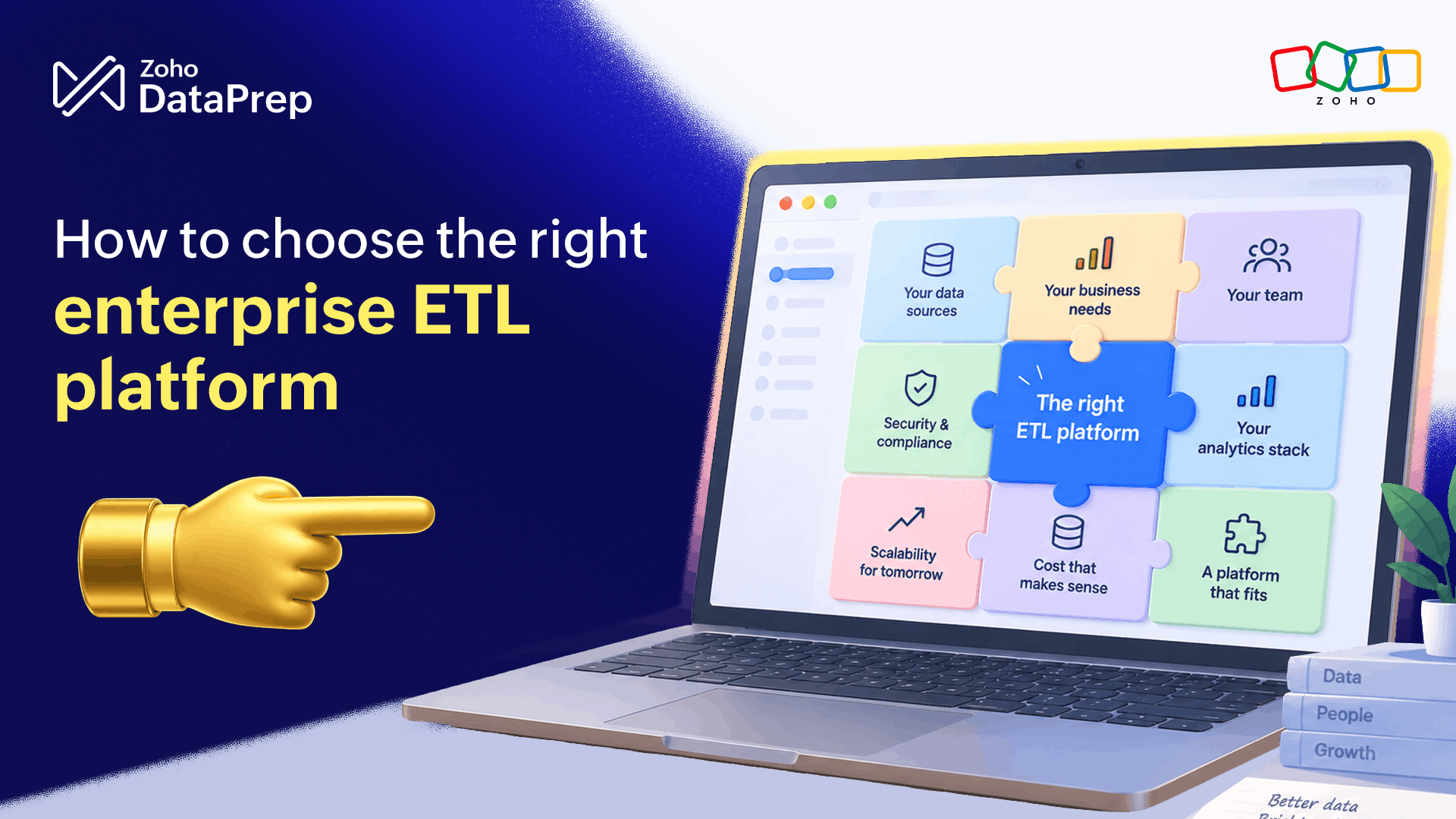
Choosing an enterprise ETL platform isn't an easy feat. Two ETL tools can have the same features on paper but deliver wildly different results. The platform that wins is the one that fits your sources, has the right data governance features, and has the capability to process the volume of data your business operates on.
Here's a practical checklist to help answer business questions before deciding on an ETL tool that best fits your business use case:
1. Start with your data sources
Every evaluation should begin here. A tool that can't reach your data isn't your right fit. Map out how many sources your data resides in; whether they're cloud apps, databases, files, APIs, or warehouses; and how frequently each one changes.
Then look for a wide connector library, genuine custom API support, and the ability to handle both structured and semi-structured data without a workaround. Pay close attention to how easily new data sources become a necessity and ensure the tool you want to work with is constantly adding new connectors to its library.
Tools that lean heavily on custom scripts for apps other than their native connectors become a maintenance burden for your engineers, who then will own every broken pipeline the next time there is an API change.
A strong sign is breadth on both ends of the pipeline. Being able to pull from all sources you want to fetch data from and push to all destinations—like files, cloud storage, databases, warehouses, and business applications—is important.
2. Evaluate transformation capabilities
Making data available is just one part of an ETL tool's capability. The real differentiator is what a platform lets you do to the data in transit. There's a meaningful split in this market between tools that mostly sync data and tools that genuinely transform it, and most enterprise teams need tools that can help prepare data.
To reduce reliability on developers, check for visual data preparation, cleansing, deduplication, joins and lookups, aggregations, and custom formulas. With the shift toward an AI culture, ensure there's AI-assisted transformation: the ability to describe what you want in plain language and have the tool generate the transforms for you.
Having reusable transformation templates is a crucial aspect. If your business runs the same cleanup logic across dozens of near-identical pipelines, being able to save a ruleset once and reuse it everywhere saves an enormous amount of repeat work.
3. Consider scalability
Your data volume today is not your data volume next year. Ask whether the platform can process millions of rows efficiently, whether performance holds up as pipelines multiply, whether it can run many pipelines at once, and whether it supports incremental loading so you're not reprocessing everything on every run.
Cloud-based processing that scales elastically with demand is a real advantage for enterprises. It reduces infrastructure dependency and lets you scale up or down with usage instead of provisioning for a peak you hit twice a year.
The best platforms in this space handle billions of rows in production without forcing you to re-architect.
4. Look at automation features
Manual data movement doesn't scale for growing businesses that need to handle millions of rows of data. Prioritize scheduled jobs, event-triggered pipelines, orchestration across dependent steps, automatic retries, and clear alerting.
Most enterprises benefit from these two capabilities:
Backfill: This is when a job fails. Can you cleanly identify the window that didn't load and fill just that gap rather than rerunning the whole thing?
Resilient retries: When failure happens, does your pipeline retry? This improves your run-success rate.
5. Check governance and security
For enterprise teams, this is often the deciding factor where compromise is not an option. Look for role-based access control, audit logs, encryption at rest and in transit, data masking, and version control on your pipeline logic.
Compliance certifications like GDPR, HIPAA, SOC 2, and ISO 27001 should be verified, not assumed. Ask for the current certificates rather than taking a marketing page at face value.
Confirm that collaboration doesn't come at the expense of privacy: sharing a pipeline or workspace with a colleague shouldn't mean handing over data they shouldn't see.
6. Monitor data quality
Good ETL keeps bad data from spreading downstream, where it quietly corrupts every report and model that touches it. One of the most common regrets teams voice after a deployment is treating data quality as an afterthought where pipelines run flawlessly but the issues in data compound.
Look for validation rules, schema-drift detection, null and duplicate detection, and data profiling. The strongest platforms surface quality before you build on top of the data: a quality summary for every column showing valid, invalid, and missing values; distribution histograms, pattern analysis, outlier detection and intelligent suggestions to fix what's broken.
When that profiling is front and center in the interface rather than buried in a report, problems get caught early instead of in production.
7. Deployment flexibility
Different organizations have different constraints, and the tool needs to bend to yours rather than the reverse. Check for cloud, on-premises, hybrid, and private-cloud options. For many enterprises, regional data residency is important. If you operate across jurisdictions, get specifics on where data is processed and stored, not just where it's hosted.
8. Integration with your analytics stack
The perfect ETL platform should fit into your existing ecosystem without friction. Common destinations include data warehouses, data lakes, BI tools, CRM systems, marketing platforms, and AI and machine-learning pipelines.
There's real leverage in choosing a tool that lives natively inside your analytics and business-application ecosystem. When prepared data flows straight into your BI layer and back out to operational systems via reverse ETL, you eliminate the need for an individual RevOps team.. If your team already spends most of its analyst hours cleaning data before analysis even begins, tight integration is where they can save time.
9. Ease of use
A powerful tool that only one engineer can operate is a bottleneck for your entire operation. Evaluate the visual pipeline builder, the low-code or no-code interface, the quality of documentation and debugging tools, collaboration features, and the honest learning curve.
In the end, ensure a business analyst can build and maintain a pipeline without opening a ticket. You need a live preview of each operation, the ability to audit data, and natural-language pipeline building to make it easy for most non-technical teams to adopt the ETL tool.
10. Total cost of ownership
Don't just factor in the license fee alone. There's implementation effort, ongoing maintenance cost, infrastructure, training, vendor support, and the cost of scaling later. A cheaper tool that demands constant engineering attention often ends up being an expensive one.
Watch pricing models especially closely, since this is where surprises hide. Consumption-based pricing that scales linearly and predictably with what you actually use is far easier to budget than models with cliffs and multipliers you only discover at renewal. Transparent, usage-based pricing that lets you scale up or down without renegotiating is worth a premium in peace of mind alone.
Enterprise ETL evaluation checklist
Questions you need answers to before short-listing your vendor
- Does it connect to all critical data sources?
- Can it handle complex business logic without coding?
- Can it scale with growing data volumes?
- Does it support scheduling, orchestration, and backfill?
- Does it meet compliance and governance needs?
- Can teams easily identify and resolve failures?
- Can business analysts build pipelines without coding?
Is the pricing sustainable and predictable as usage grows?
Questions to ask vendors during evaluation
- How many connectors are included, and what happens when I need one you don't have?
- How exactly is pricing calculated?
- What happens when a pipeline fails? Can I backfill just the missing window?
- How do you handle schema changes?
- Can transformations be reused across pipelines?
- What monitoring and alerting is available out of the box?
- Which security certifications do you currently hold?
- How long does a typical implementation take?
- Do you support incremental loading and change data capture?
What onboarding and support is included versus paid extra?
Final thought
The best ETL platform is the one that fits smoothly into your existing ecosystem, scales with your growth, keeps your data clean, and minimizes the operational overhead your team carries every day. Feature checklists get you to a shortlist; they don't get you to a decision.
Don't stop at the demo. Run a proof of concept with your own messy datasets and your real business workflows. The tool that makes your data ready for analysis with the least friction is the one worth buying, regardless of how it scores on anyone else's comparison grid.
Looking for a ETL solution, try Zoho DataPrep.