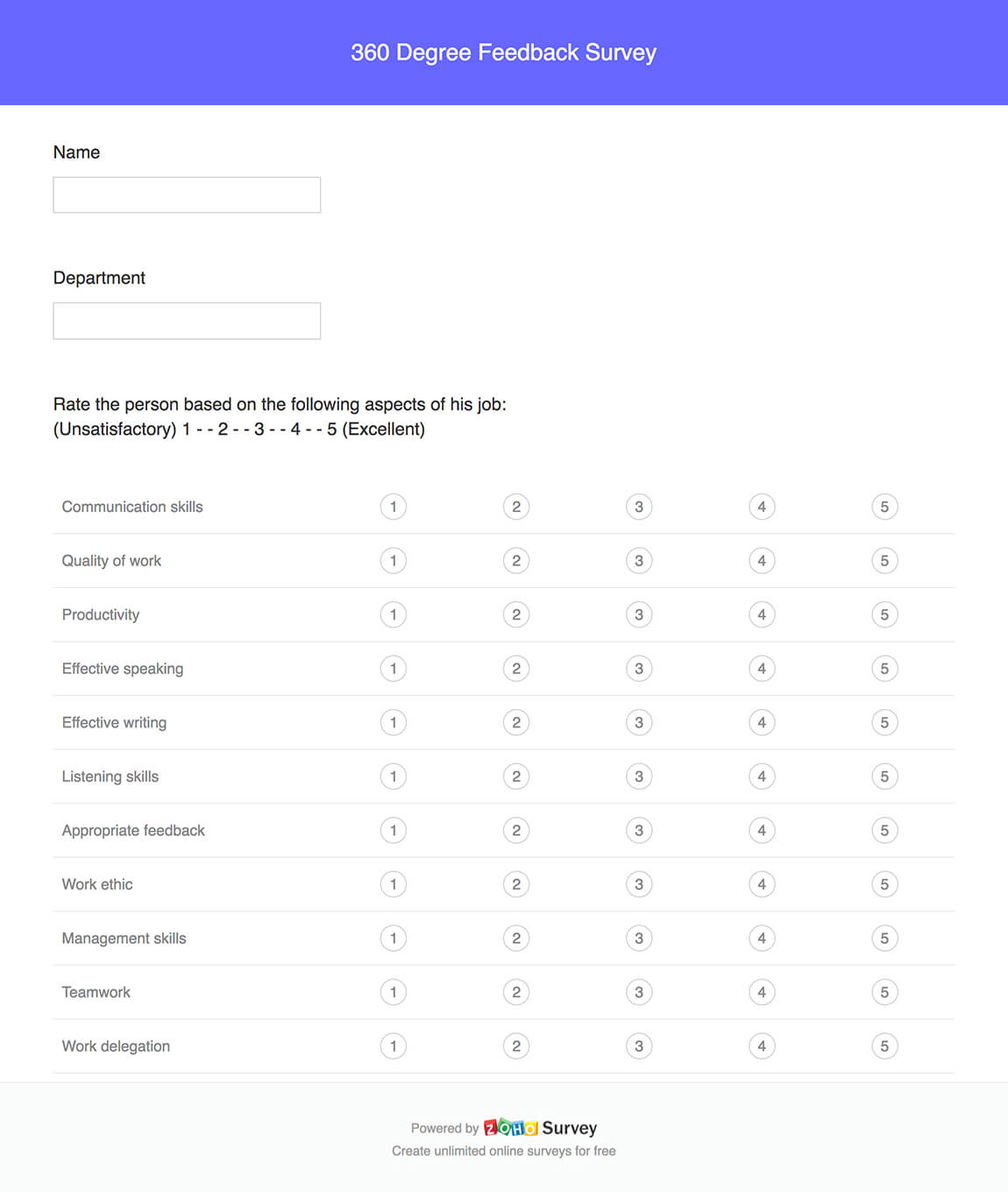
360° feedback survey template preview
Why 360° Feedback?
Gather feedback from all the angles –managers, peers, and direct reports.
Compare self and team perspectives that give you the right insights for decision making.
Keep workplace bias at bay by combining different perspectives for fairer reviews.
Improve employee development by tracking growth and suggesting new skills to acquire over time.
Encourage team collaboration and make your employees feel valued where it s needed the most.
How Zoho Survey works
Get started in minutes with a AI survey creation, pre-built template or a tailored one. Add questions for managers, peers, and self-assessment.
Set the flow right with advanced logic to provide personalized experience with no coding knowledge needed.
Once ready, launch via email, SMS, or shareable link and collect honest feedback anonymously.
No need to wait for hours or days for results. Easily find out areas of strength with visual dashboards and share report.
Start your actions with more confidence using insights to train, develop, and recognize team members.
No Credit Card Required
All-in-One 360° feedback system for better performance reviews
Accessible on any device
Zoho’s 360° feedback surveys are designed to work efficiently across all devices — smartphones, tablets, laptops, and desktop making it easy for your team to share feedback anytime, anywhere.
Org-specific questionnaire
Customize our feedback survey forms to match your organization’s unique needs based on structure, roles and the core goals that you and your teams have.
Truly anonymous responses
We value honesty and respect privacy and ensure all the responses remain confidential, making sure your staff can give open and genuine feedback without the concern for identification.
Crucial actionable insights
Our 360° feedback surveys are developed by professionals making it highly valuable to get business-relevant performance and behavioral insights.
Enterprise-grade data protection
Zoho Survey complies with GDPR and HIPPA standards and follows strict data security practices and you can be sure that every piece of information shared is protected.
Effortless integration across tools
Seamlessly integrates with your existing HR and business tools, letting you automate survey distribution and gather feedback for smoother performance management workflows.
Increased participation rate
Let your participants experience a hassle-free survey process with auto save, so they can pick where they left and complete at a suitable time without having to start over again.
360 degree feedback is a popular system used by organizations to provide honest, confidential, and anonymous feedback to its employees from those who work around them. Here's a sample you could try out right now.

An online survey is circulated among the person's immediate superior, co-workers, peers, and customers, usually limited to a total of around 15 people. The survey asks them to rate the person on various desirable attributes and provides space for written comments. The same survey is also provided to the person in question, asking her to rate herself.
Finally, the report containing the cumulative rating and the self-rating is then provided to the manager and the employee.
The clear comparison between self and cumulative rating gives her a clearer picture of how she is perceived. With an anonymous rating from everyone that she is in touch with, the employee gains a better understanding of her strengths and weakness. The rating could give her more confidence in her abilities, serve to humble her, or help her re-affirm her potential. In effect, the survey's report would give them extra insight to excel in their work.
360 degree feedback surveys are also used as a performance appraisal tool. When combined with the traditional yearly review and appraisal process by the manager, it can serve as a great way to provide a complete and fair review process. However, 360 degree feedback is ineffective as the sole measurement of an employee's performance, for reasons that shall be made apparent later.

The 360 degree feedback provides a 'subjective' perspective of the employee's performance from his peers. It gives an idea whether he is a team player, has a good character, and other such character nuances. A 360 degree feedback does not evaluate if an employee meets the basic job requirements. It doesn't tell you if the employee meets the business objectives or if she has the required skills. The appraiser must look elsewhere for an objective evaluation. When the 360 degree feedback is combined with the objective evaluation of a manager, it serves to provide evaluation of the employee and the team.
A 360 degree feedback survey can help your organization build a better, more motivated workforce. Use Zoho Survey to easily conduct these surveys and provide you with simple reports.
Frequently Asked Questions
360 degree feedback is a performance evaluation method where employees receive confidential, anonymous feedback from their managers, peers, direct reports, and sometimes customers. This comprehensive approach provides a well-rounded view of an individual's strengths, weaknesses, and areas for development.
Typically, 8-15 respondents provide the most balanced feedback. This should include the employee's direct manager, 3-5 peers, 2-4 direct reports (if applicable), and optionally external stakeholders or customers who interact regularly with the employee.
Yes, Zoho Survey ensures complete anonymity for all respondents. Feedback is aggregated and presented in a way that protects individual identities, encouraging honest and constructive responses while maintaining confidentiality.
Most organizations conduct 360 feedback surveys annually or bi-annually. This frequency allows enough time for employees to work on their development areas while keeping the feedback cycle relevant and actionable for performance improvement.
Absolutely. Zoho Survey allows you to fully customize your 360 feedback questionnaire. You can use our expert-designed templates as a starting point and modify questions to align with your organization's competencies, values, and specific evaluation criteria.