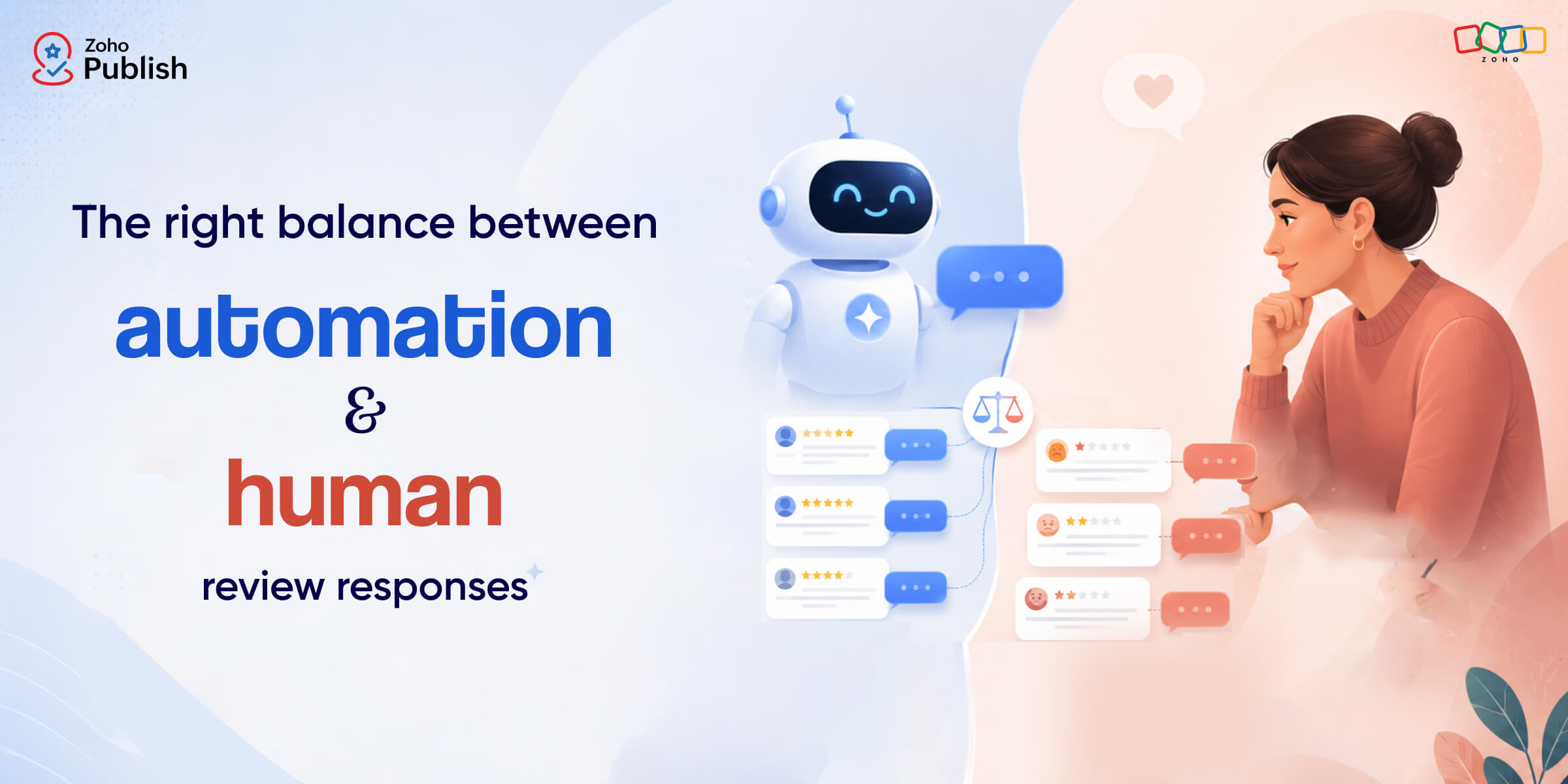
The right balance between automation and human review responses
- Last Updated : June 18, 2026
- 71 Views
- 5 Min Read

If you've ever tried contacting customer support and found yourself stuck in an endless loop of automated options, you probably know how frustrating it can be.
That reaction is not limited to phone systems. Many of us have encountered chatbots that fail to answer simple questions, automated emails that completely miss the point, or support responses that feel copied and pasted without actually addressing the issue. Those experiences have shaped how people think about automation.
It's one reason some businesses hesitate to automate review responses. Reviews are personal. Customers are sharing opinions, frustrations, compliments, and experiences that are now visible to anyone considering your business. A poorly handled response can make a business appear disconnected, even when its intentions are good.
At the same time, customer expectations have changed. Reviews arrive faster, across more platforms, and in greater volumes than ever before. Businesses that once received a handful of reviews each week may now receive dozens. Multi-location brands can receive hundreds every month.
How do you respond consistently without spending hours every week writing nearly identical responses? And, more importantly, how do you automate without sounding automated?
The answer is in understanding where each one adds the most value.
Should businesses respond to every review?
Before discussing automation, it's worth addressing a more fundamental question: Should businesses respond to reviews at all?
The answer is yes.
Every review is part of your public reputation. Long before a customer contacts your business, visits your location, or makes a purchase, they're often reading what others have said about you and evaluating how you interact with customers.
A response tells people that feedback matters and shows that someone is paying attention. Even a simple acknowledgment can reinforce trust.
This is one reason review management has become increasingly important in recent years. Reviews influence customer decisions, shape online reputation, and often impact how a business is perceived long before the first interaction happens.
Responding consistently also demonstrates accountability. Customers tend to notice businesses that engage with feedback, whether the review is positive or negative.
What businesses should automate
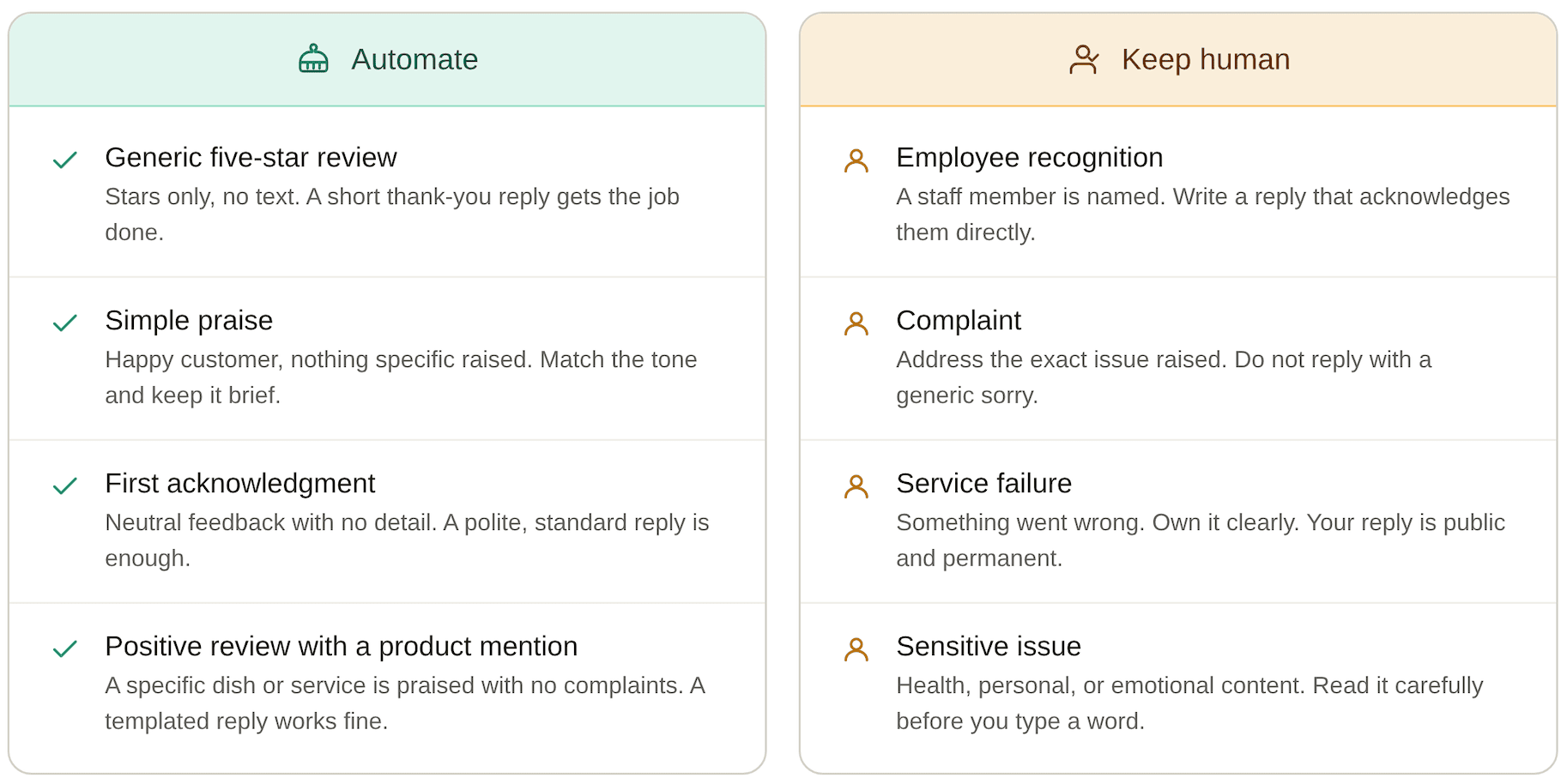
A useful rule of thumb is simple: If a review response is repetitive, predictable, and low-risk, automation is usually a good fit.
Routine positive reviews
Most businesses receive a large number of reviews that follow a familiar pattern:
"Great service."
"Friendly team."
"Loved the experience."
"Highly recommend."
These reviews are valuable because they contribute to trust and social proof. However, they typically don't require investigation, judgment, or personalized problem-solving.
A well-crafted automated response works extremely well here because the customer receives acknowledgment and the business maintains responsiveness.
The key is avoiding generic templates that feel identical every time.
Instead, businesses should create multiple response variations that reflect their tone and brand voice. Modern review management platforms, like Zoho Publish, allow businesses to build customized responses for different situations, helping maintain consistency without making every reply sound the same.
What businesses should keep human
Automation works best when situations are predictable. The challenge is that customer experiences are not always predictable. Some reviews involve emotions, context, and circumstances that can't be fully understood through templates alone. These are the moments where human involvement adds the most value and where customers are most likely to notice whether a business genuinely paid attention.
Negative reviews
Negative reviews are rarely just about facts. Behind most negative reviews is frustration, disappointment, or unmet expectations.
Customers want to know that someone understands what went wrong and is willing to address it. In fact, knowing how to handle negative Google reviews without losing customers often comes down to how thoughtfully and personally you respond in these moments.
Consider these two responses.
Response A: We apologize for your experience and appreciate your feedback.
Response B: We're sorry your delivery arrived much later than expected. We understand how frustrating that can be, and our team is reviewing what happened so we can improve the experience moving forward.
The difference is the relevance of the response. One response acknowledges the customer's specific experience, while the other could be copied and pasted beneath almost any complaint. Customers notice when a business takes the time to understand the situation, and future customers reading those reviews notice it, too.
For this reason, negative reviews are often best handled with human oversight. Automation can assist with drafting responses, but accountability and empathy should remain at the center of the conversation.
Reviews mentioning employees
Some reviews create opportunities that go beyond customer service.
Imagine a customer writes: "Sarah was incredibly helpful and made the entire process easy."
A generic thank-you response technically works, but it misses an opportunity to recognize an employee who made a positive impression. A personalized response allows the business to celebrate that contribution, reinforce a positive culture, and show customers that individual efforts are valued.
These reviews can become great moments for both customers and employees. Taking a few extra minutes to respond personally can strengthen relationships in ways that automation can't replicate.
Sensitive situations
Certain reviews require a higher degree of care and judgment. This is especially true when reviews involve healthcare concerns, safety incidents, financial disputes, legal matters, or privacy-related issues.
In these situations, context matters as much as the response itself. A poorly worded automated reply can create confusion or even escalate the issue further. Human oversight helps ensure responses are accurate, appropriate, and aligned with the seriousness of the situation.
Automation can help flag these reviews quickly, but the response should remain in human hands.
The biggest risk is bad automation
Customers don't expect every response to be handcrafted. Most people understand that businesses use technology to manage growing workloads. What they care about is whether the response feels connected to their experience. A response that acknowledges their concern, answers their question, or recognizes their feedback can strengthen trust. A response that ignores what they wrote does the opposite.
This is also why review automation saves time for multi-location businesses without sacrificing customer experience when implemented thoughtfully. Automation can handle repetitive tasks at scale, while teams focus their attention on reviews that require judgment, empathy, or investigation.
That's why successful automation focuses on relevance rather than speed alone.
A simple framework for making the decision
When deciding whether a review should be automated, ask one question:
Does this response require judgment?
If the answer is no, automation is usually appropriate.
If the answer is yes, a human should remain involved.
Final thoughts
Businesses often treat review automation as an all-or-nothing decision. Either every response is written manually, or every response is automated.
The reality is far more practical.
Automation excels at handling repetitive tasks, maintaining consistency, and helping businesses keep pace with growing review volumes. Humans excel at empathy, accountability, and judgment. The most successful businesses combine the strengths of both.