- HOME
- HR insights
- How to create an HR strategy
How to create an HR strategy
- Last Updated : March 18, 2026
- 517 Views
- 3 Min Read
In today’s workplace, HR isn't just an administrative function. As employee expectations evolve and businesses expand, organizations need a clear people strategy—one that ensures employees have the right capabilities, support systems, and experiences to drive the company’s mission, vision, and long-term goals.
Let's look at what it takes to build an HR strategy that transforms day-to-day HR operations into a true competitive advantage.
Understand your business goals
Before you start building your business strategy, it's essential to gain a clear understanding of what your business does. Otherwise, your HR strategies will become reactive instead of strategic. Connect with every team to get clarity on their broader goals. Bring your leadership team together to pinpoint your organization's overall mission, growth plans, and revenue goals. If there are plans to expand, get more information on the rate of growth, possible geographic markets, future products, and new customer segments. See if any new roles need to be created, and determine the hiring budget.
Misalignment at this stage can lead to overhiring, underhiring, or building capabilities that are unnecessary for your organization. It's best to focus on the next three years, as this will help your HR team shift from short-term hiring to long-term capability-building.
Analyze your workforce
Pinpoint key details about your employees. Look at their demographics, departments and role distribution, locations, and other essential information. This way, you'll be able to understand if your workforce can support your organization's goals and growth plans. A young workforce without clear career pathways could lead to disengagement and attrition, whereas leaders in strategic roles without the execution strength could really slow down your delivery capabilities. Similarly, conduct a thorough skill gap analysis to determine the gap between current capabilities and future skills.
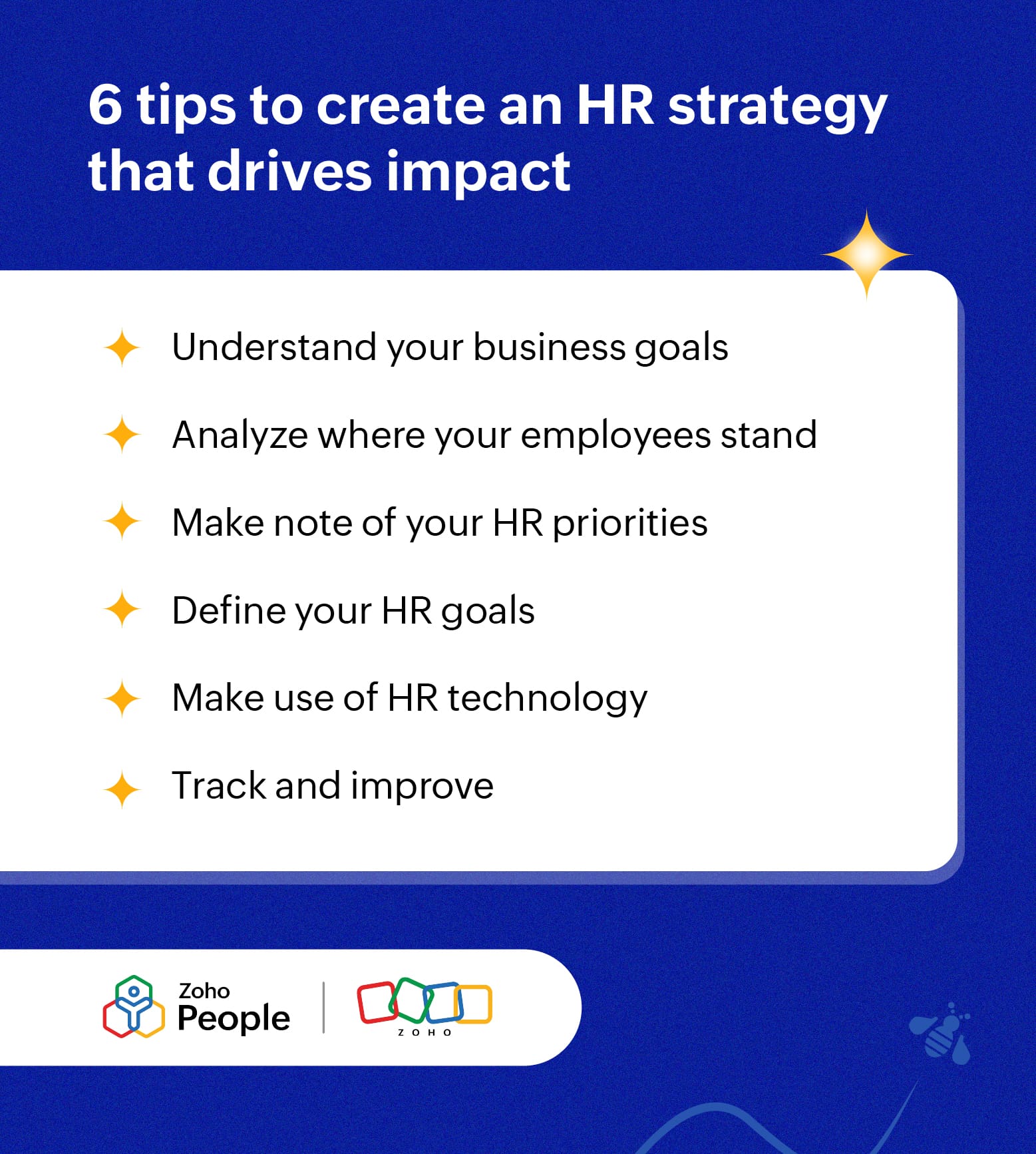
Make note of your HR priorities
By comparing your business needs to the current workforce reality, you'll have a good idea about which HR activities to prioritize. For instance, if your organization plans for rapid expansions and new product launches, then hiring and training should be your top priorities. To attract and retain top talent, focus on strengthening your compensation and benefits. As you scale, intuitive tech tools can help you move away from manual processes. A strong HR strategy prioritizes three to five high-impact HR processes rather than trying to fix everything. Narrowing your focus to the HR processes that actually support your organizational goals will drive growth and revenue.
Define your HR goals
As a next step, tie each one of your HR priorities to clear and measurable goals for effective outcome tracking. Be sure to set SMART (Specific, Measurable, Achievable, Relevant, and Time-bound) goals. Some examples include:
- Increase overall employee engagement scores by 30% in the next six months.
- Reduce the average time-to-hire from 60 days to 45 days in the next six months.
- Reduce the voluntary attrition rate by 30% in the next three months.
This way, you'll be able to prove each one of your HR priorities' impact, make any necessary improvements, and secure leadership trust.
Make use of HR technology
To effectively support your HR strategy, you need a system that automates repetitive tasks and frees up time for strategic initiatives. The technology you use should offer a seamless self-service experience so that employees can manage their routine HR needs independently. Opt for software that integrates recruitment, onboarding, attendance, leave management, performance, and exit processes so it's possible to manage your HR operations from a single system. It should also offer strong reporting and analytics capabilities that reveal real-time insights on workforce trends, performance metrics, and engagement data. The right HR tech provides the necessary infrastructure required to make your strategy scalable.
Track and improve
Once you have implemented your HR strategy, it's essential to revisit it often to make sure it's delivering the intended results. Run regular surveys for your employees and your leadership team to see what they think is working and what needs improvement. Bring your HR team together to discuss how well your organization has progressed towards its goals. It's also good to have monthly check-ins to understand what has changed, why it changed, and if any corrective actions are required.
Building an effective HR strategy means aligning your HR processes and technology to your business goals. When it’s rooted in data-driven insights and clear business priorities, your everyday HR activities can bring measurable business impact.
 Tarika
Content Specialist at Zoho People