- HOME
- The best Convert alternative in 2026
The best Convert alternative in 2026
- Last Updated : August 7, 2026
- 91 Views
- 11 Min Read

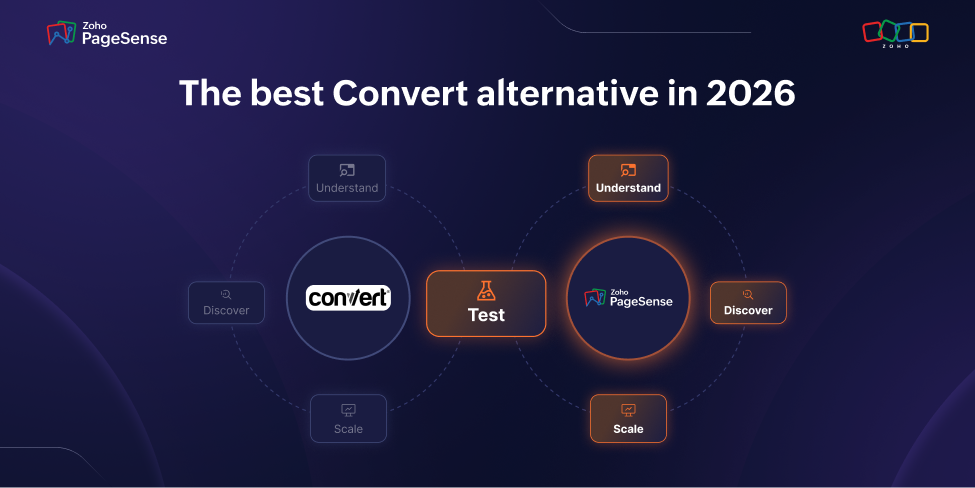
Convert and Zoho PageSense are both reliable, transparent-pricing CRO platforms that market to growth teams, digital agencies, and mid-market businesses. Confused about which is the right one for you? This page provides a detailed side-by-side comparison with everything you need to make the right decision.
Does Convert have all that you need?
Convert is a serious experimentation platform. A/B testing, split URL, multivariate, full-stack server-side testing, and a statistical engine that gives practitioners real control. For agencies and high-volume testing teams, the reputation is earned.
But there is a difference between running experiments and running an optimization program.
The best-performing CRO teams do not start with a test. They start with a question: what are visitors actually doing, where are they dropping off, and why? That requires session recordings, funnel analysis, form analytics — the behavioral layer that builds the hypothesis before anyone writes a single variant.
Convert recently added heatmaps and Convert Signals. It is a step in the right direction. But session recordings, funnel analysis, form analytics, web analytics, surveys, and push notifications are still not part of the platform.
Which means every insight has to come from somewhere else. Every time you want to move from observation to experiment, you are reconciling data across two separate tools — and paying for both.
Zoho PageSense helps CRO and growth teams understand visitor behaviour through heat maps,sesssion recordings,A/B tests and much more - within a single
AI-Powered Platform
If you switched from Google Optimize to Convert, this matters
When Google Optimize shut down in 2023, a wave of teams needed a replacement fast. Convert was a logical landing spot — affordable relative to enterprise alternatives, privacy-conscious, and quick to set up. Many teams made that move without fully evaluating whether Convert covered their full optimization workflow, because the immediate need was just to keep experiments running.
If that's your story, it's worth revisiting the decision now. The gap that existed in Google Optimize, with no native heatmaps, no session recordings, no funnel analytics — exists in Convert too. You replaced the experiment runner, but not the full program.
Zoho PageSense covers that gap directly. The Forever Free plan alone gives you heatmaps, session recordings, funnel analysis, and form analytics — the behavioral layer that neither Google Optimize nor Convert ever included. The Enterprise plan adds A/B testing, personalization, and server-side testing on top of that.
If you have been running experiments in Convert while pulling behavioral data from a separate tool, the question is whether that split is working for you — or just something you got used to.
What does Zoho PageSense offer?
Zoho PageSense is a complete privacy-first conversion rate optimization and experimentation platform built for mid-market and growth teams. It combines A/B testing, behavioral analytics, and personalization in one place — so teams can build well-grounded hypotheses, run experiments with confidence, and act on results without depending on developers or juggling multiple tools.
Forever Free Plan — Live visitor tracking, website analytics, heatmaps, session recordings, form analytics, funnel analysis, and conversion tracking for up to 5,000 monthly visitors. No credit card. No time limit.
Professional Plan — from $20/month — Everything in the Forever Free plan, without visitor limits, plus on-site surveys, website pop-ups, web push notifications, and mobile push notifications.
Enterprise Plan — from $49/month — Everything in Professional, plus unlimited A/B testing, unlimited session recordings, unlimited funnel and form analytics, personalization, and server-side testing — all in one subscription.
Across all plans:
Unsampled data — every visitor recorded within your plan, no sampling on any tier
Advanced targeting — segment by behaviour, device, location, UTM, custom events, and more
Conversion tracking — pageviews, revenue, engagement, and custom events
AI insights for web analytics — surfaces traffic patterns, top-converting pages and more
AI insights for session recordings — coming soon
Frustration monitoring — rage clicks, dead clicks, JS errors, quick backs — coming soon
Mutually exclusive groups — run multiple experiments simultaneously without visitor overlap.
Pricing: what you actually pay
Both Convert and PageSense publish transparent pricing — no sales call required. But transparent pricing and total cost of ownership are different things.
Convert pricing (at 100K MTUs/month)
To build a complete observation-through-testing workflow at the Growth tier, a team would typically add:
Session recording and heatmap platform: $1,200–$3,000/year
Funnel analysis or advanced analytics tool: $600–$2,400/year
On-site survey or feedback tool: $600–$1,800/year
Realistic total for a complete optimization stack built around Convert Growth: $5,988–$10,788/year.
Zoho PageSense pricing
Head-to-head at common traffic volumes
Why PageSense can price this way
Zoho owns and operates its own servers and storage hardware over 18+ data centres globally — in the US, EU, India, Australia, Japan, Canada, Saudi Arabia, and the UAE. Zoho does not rent compute from AWS, Azure, or GCP. It controls its own hardware stack.
That infrastructure ownership removes a significant input cost that most SaaS platforms pass through to customers. Combined with Zoho's 40% annual billing discount, it allows PageSense to price the full CRO stack at rates that would be structurally impossible for platforms running entirely on third-party cloud infrastructure.
Zoho is also privately held, bootstrapped, and profitable — no PE investors, no acquisition pipeline, no quarterly earnings pressure driving price increases.
Feature and capability comparison
Zoho PageSense helps CRO and growth teams understand visitor behaviour through heat maps,sesssion recordings,A/B tests and much more - within a single
AI-Powered Platform
Where Convert doesn't make sense
The observation gap. Until very recently, Convert had no native behavioral observation tools. Convert Heatmaps is now available across all plans, and it is a meaningful addition. But heatmaps alone do not close the observation gap. Session recordings — arguably the single most valuable tool for understanding visitor behavior at the individual level — are not part of Convert's current offering. Neither are funnel analytics or form analytics. Teams that want to understand why visitors are not converting, not just whether a variant improves conversion, will need to source those capabilities elsewhere.
Tool fragmentation and its hidden costs. When you choose a specialized experimentation tool, you implicitly commit to a multi-vendor stack. That stack creates costs that do not appear in any single pricing table: integration maintenance, data pipeline management, differing retention policies across tools, duplicate event tracking, and the cognitive overhead of cross-referencing insights from multiple dashboards. These accumulate. Teams underestimate the time cost of managing multiple tools until they are in the middle of it.
MTU pricing can scale unexpectedly. Convert's pricing model is based on monthly tested users — visitors who are bucketed into active experiments. As teams increase their experimentation velocity (running more concurrent tests, targeting broader segments), the number of MTUs grows and so does the cost. At 250K MTUs, Convert Growth charges overuse fees of $399 per additional 100K. Teams that are successful in growing their experimentation programs may find their Convert bill growing faster than expected.
Multivariate testing requires an upgrade. Multivariate testing is one of the most powerful tools for teams that have identified multiple potential improvements on a single page. In Convert, it is a Pro feature, which adds $1,452/year over the Growth plan at the base traffic tier. For teams that rely on MVT as a core workflow, this upgrade is necessary but represents a meaningful cost step.
The full-stack requirement. Server-side testing and feature flags — capabilities that product and engineering teams often need — are also Pro-only features. At the Growth tier, Convert is primarily a client-side experimentation tool. Teams that need the full technical surface of the platform need to start at Pro, which at $5,040/year represents a different pricing conversation than the $3,588/year Growth entry point.
Zoho PageSense: the most viable alternative to Convert worth trying
PageSense covers everything Convert does across its plans — testing, heatmaps, personalization — and adds session recordings, funnel analysis, form analytics, web analytics, surveys, and push notifications in one subscription, built for teams that want a complete optimization program without assembling it from separate tools.
You want to run the full optimization cycle, not just experiments. PageSense combines behavioral observation and experimentation in a single workspace. A team notices high scroll depth but low CTA engagement in the heatmap, opens a session recording to watch that behavior in context, identifies a hypothesis, and launches the A/B test — all in the same tool, with the same visitor data. Teams that have made this transition consistently report that the time from insight to live test decreases — not because the individual steps are faster, but because there are fewer of them.
Your marketing team needs to own the workflow independently. PageSense is designed for teams where marketers run the optimization program without constant developer dependency. The visual editor, no-code targeting setup, and heatmap tools are built for independence. If your marketing team needs to move from hypothesis to live experiment without opening a developer ticket, PageSense's architecture supports that workflow at every tier.
You want a predictable cost as you scale experimentation. PageSense pricing scales with visitor volume, not with the number of concurrent experiments, active projects, or team members. As experimentation velocity increases — which is a goal of any good program — the cost does not grow proportionally. Convert's MTU model ties your bill to experiment activity: the more tests you run, the more of your traffic you touch, and the higher the cost.
You do not know what to test yet — and that is exactly where to start. Most programs fail before the first test runs. Not because the testing tool was wrong, but because the team did not know what to test. The Forever Free plan puts heatmaps, session recordings, and funnel analysis in your hands before you spend a dollar — so by the time you run your first experiment, you already know where visitors are dropping off, what they are ignoring, and what actually needs fixing. That is the foundation an experimentation-only tool cannot give you.
Your data never leaves Zoho's infrastructure. Zoho owns and operates its own servers across 18+ global data centres. No visitor data routes through AWS, Azure, or Google Cloud. There is no third-party infrastructure layer where data could leave Zoho's control — and there never has been in 25 years of operation.
You want support without a tier upgrade. Zoho PageSense includes 24/7 customer support across all plans — not gated behind a Pro or Enterprise tier.
Don't just watch visitors.Win more of them.
Go from understanding behavior to improving conversions - all in one platform
When does Convert make sense?
Convert is a genuinely strong platform with a well-earned reputation in the CRO community. It is not the right fit for every team — but for a specific buyer profile, it is hard to beat. Here is when it makes sense to stay with Convert or choose it over PageSense.
You already have a behavioral analytics stack. If session recordings, heatmaps, and funnel analysis are already covered by another tool, and what you need is a rigorous experimentation layer to sit on top — Convert delivers. Its statistical engine, SRM checks, sequential testing, and Bayesian and frequentist model selection give dedicated testing teams real depth and control.
Your engineering team needs feature flags. Staged rollouts, kill switches, and percentage-based traffic splits managed at the server layer are built into Convert's Pro and Enterprise plans. If your team runs continuous delivery and needs experimentation and feature flag management in one place, Convert is purpose-built for that workflow. PageSense does not currently offer a feature flag product.
You have a dedicated CRO function. Convert rewards specialization. A full-time experimenter or a retained CRO agency will extract significantly more from Convert's advanced targeting, statistical controls, and configuration depth than a marketing team running tests alongside other responsibilities.
You work with a Convert-certified agency. If your agency has built its methodology, templates, and workflows around Convert, switching tools mid-engagement creates friction that outweighs any platform difference. Align your tooling to the expertise you are already paying for.
Your renewal is not coming up yet. Switching mid-contract rarely makes financial sense. Use the remaining runway to run PageSense's 15-day free trial in parallel — so when renewal arrives, the decision is based on real data, not a feature comparison page.
Setting up Zoho PageSense after Convert
Our team will help you replicate your entire setup — experiments, goals, funnels, and tracking configuration — at zero cost.
Reach out to us at presales@zohopagesense.com, and a specialist contacts you within 24 business hours and walks you through getting everything configured in PageSense. The script swap is one line of code. Most teams are collecting live data in PageSense the same day they decide to switch.
Frequently asked questions
Is Convert worth it?
For the right team, yes. If you have a dedicated CRO function, existing behavioral analytics infrastructure, and a program running high-volume experiments — Convert's statistical depth and feature flag management are justified. For most growth teams and mid-market businesses that need the full optimization workflow in one place, the multi-vendor overhead and the MTU pricing model add up to a platform that costs more to operate than it initially appears.
Does Convert have session recordings and funnel analysis?
No. Convert does not include session recordings or funnel analysis. The platform added heatmaps recently via Convert Heatmaps, but full session playback and step-by-step funnel drop-off analysis are not part of Convert's current offering. PageSense includes both on every Enterprise plan, with session recordings and funnel analysis available from the day you install the snippet.
Can I run PageSense alongside Convert before switching?
Yes — and it is the best way to evaluate. PageSense's 15-day free trial covers all features with no credit card required. Most teams install the snippet, run a live heatmap on their most important page, and have their first session recordings within hours. You do not need to cancel Convert to find out whether PageSense works for your team.
How long does it take to get up and running on PageSense?
Most teams are collecting live behavioral data the same day they sign up. Install one JavaScript snippet, set a goal, and your first heatmap starts recording immediately. A/B tests typically go live within the same week. There is no implementation timeline, no onboarding call required, and no two-month setup process before you see value.
Does PageSense work for teams already using Zoho CRM or Zoho One?
Yes — and the integration runs deeper than a standard connector. Visitor segments from PageSense feed directly into Zoho CRM workflows. CRM data can segment your experiment audiences. If your growth stack is already built on Zoho, PageSense is not just compatible — it makes everything else in the ecosystem more useful.