- HOME
- Your Team Has Enough Data. That's Not Why You're Stuck.
Your Team Has Enough Data. That's Not Why You're Stuck.
- Last Updated : June 23, 2026
- 56 Views
- 9 Min Read

Let me describe a meeting you've probably been in.
Someone pulls up a heatmap. Half the page is cold — visitors aren't even reaching the CTA. The scroll map shows a cliff at 40%. Three session recordings show the same confused exit in the same spot. The funnel report confirms drop-off at exactly that stage.
Everyone in the room can see it. Nobody disagrees.
And then someone says: "Let's collect a bit more data before we act."
And somehow, inexplicably — everyone nods.
This is the real problem. And nobody in the analytics industry wants to say it out loud, because it's bad for business:
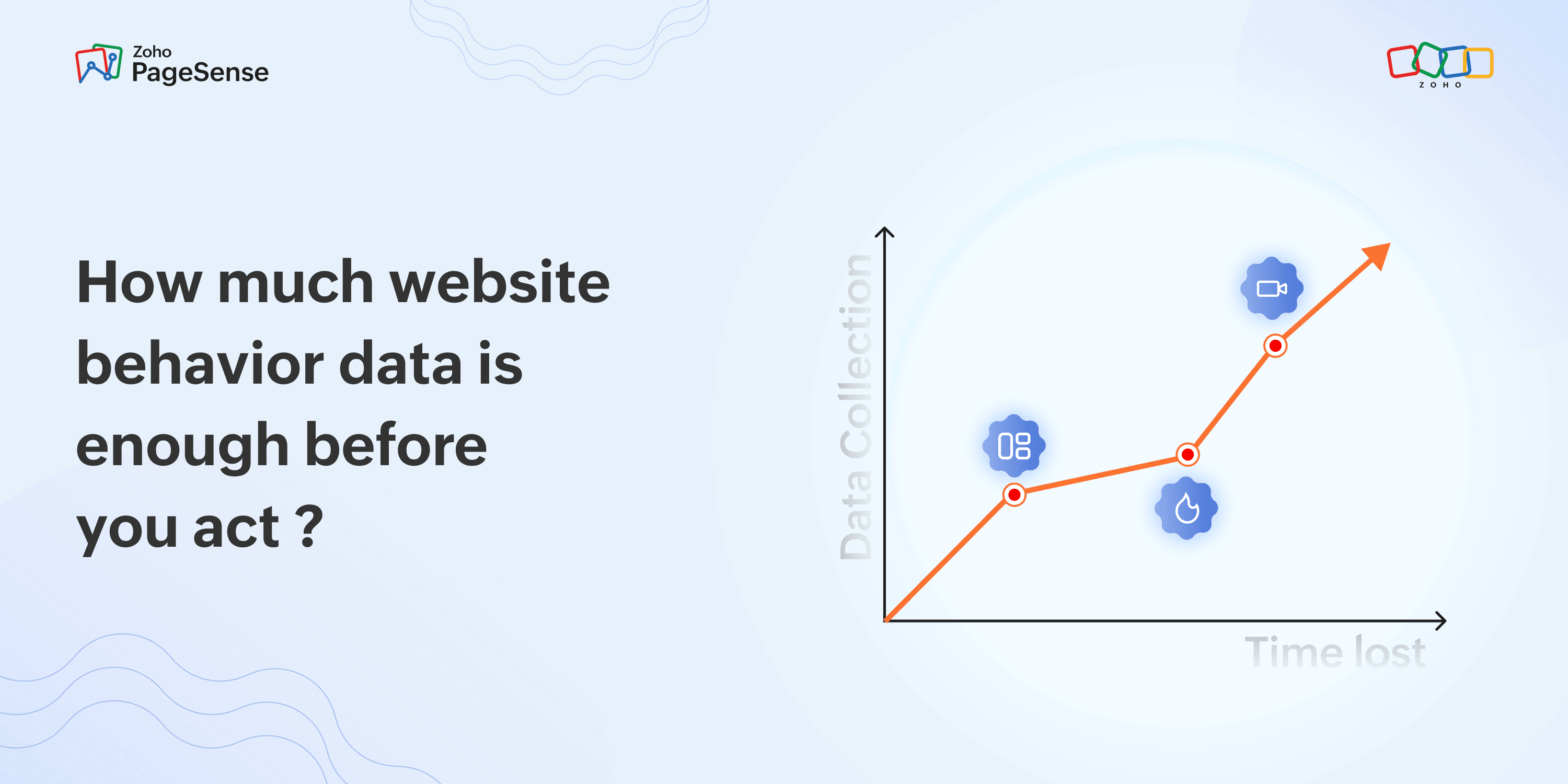
The thing holding most growth teams back isn't a lack of behavioural data. It's what happens in the room after the data shows up.
You already have heatmaps. Scroll maps. Session recordings. Funnel drop-off reports. Segmentation by device, by source, by campaign. The data stack in 2026 is extraordinary. Growth teams have more visibility into visitor behaviour than ever before in the history of digital marketing.
And decisions, are still taking weeks.
Here's What's Actually Going On
Oracle ran a study across 14,000+ business leaders in 17 countries and found something that should stop everyone in their tracks: 72% of leaders said that the sheer volume of data had prevented them from making a decision at all. Not slowed them down. Stopped them completely.
More data. Fewer decisions. How does that happen?
It happens because behavioural data — heatmaps, scroll maps, session recordings, funnels — doesn't tell you when to stop looking. It just keeps producing signals. And for a growth team under pressure to get things right, every new signal feels like a reason to look a little longer before committing.
Here's how it plays out in real terms:
You open your PageSense heatmap on Monday. Scroll cliff at 38%. Clear as day. You pull in session recordings — visitors are exiting right where the heatmap showed the drop. You check the funnel — drop-off confirmed at the same stage. You have three independent data sources all agreeing.
But instead of acting, the team asks for device-segmented heatmaps. Then a week of new sessions. Then a comparison between organic and paid traffic cohorts.
Two weeks later, you have more data. It says exactly what the first heatmap said.
The observation phase never formally closed. It just kept going — because nobody declared it done.
The Real Reason Teams Keep Collecting
This is the part most analytics content skips. Let's not.
When a growth team says "let's get more data," it almost never means they genuinely need more data. It usually means one of three things:
They're afraid of being wrong in public.
Think about it. If you act on what the heatmap showed you, run a fix, and conversion doesn't improve — that's visible. That's attributable. Someone can point to that decision and say it didn't work.
But if you spend three more weeks collecting sessions and nothing changes? Nobody adds that to the post-mortem. The cost of waiting never shows up anywhere. It's invisible.
This is basic psychology — loss aversion. The risk of a visible failure feels much bigger than the cost of invisible inaction. Even when the invisible cost is actually higher.
They haven't agreed on what the data means.
Here's the thing about behavioural data: it shows you what visitors did. It doesn't automatically resolve why they did it.
Your scroll map shows a cliff at 38%. One person on the team says the content above it is too long. Another says the hero image isn't compelling enough. A third thinks it might be a mobile load time issue. All three are looking at the same heatmap and drawing different conclusions.
So what does the team do? They collect more data. They hope that another week of sessions will make the answer obvious. It won't. More data will just produce more patterns to disagree about. The conversation the team actually needs to have is about interpretation — and no amount of additional sessions will have that conversation for them.
They're treating caution as a strategy.
Waiting for more data feels responsible. It feels rigorous. It looks like good practice from the outside. But there's a version of caution that tips into avoidance — where the observation phase stays permanently open because closing it would require someone to own a decision.
That's not rigour. That's risk aversion wearing the costume of rigour.
What Two Extra Weeks of "Gathering Data" Actually Costs
Most teams never do this calculation. Let's do it now.
Say your site is at the SaaS median — about 3.8% conversion, 50,000 visitors per month, $100 average revenue per conversion. That's roughly $190,000 in monthly conversion revenue.
Your heatmap is showing a scroll cliff that's hiding your CTA from 60% of visitors. Your session recordings confirm it. Your funnel data confirms it. The fix — moving the CTA above the fold — would take one afternoon.
But the team wants two more weeks of sessions before committing.
Those two weeks, assuming even a modest 10% improvement from the fix, cost you somewhere in the range of $3,800 in recoverable conversions. Every. Single. Week you wait.
That number has no line item anywhere in your analytics dashboard. It's not in your weekly report. It doesn't show up in the review meeting. It's just... gone. Silently.
Here's a number that will stick with you.
West Monroe surveyed 214 company leaders in 2026 and found that 73% of them believe slow decision-making costs their business up to 5% of annual revenue every year.
Not wrong decisions. Not risky bets that didn't pay off. Just... being slow.
For a business doing $2M a year, that's $100,000 quietly walking out the door — not because of a bad strategy, not because of a product problem, but because the team kept watching the data instead of acting on it.
And here's the part that makes it worse: that money never shows up anywhere. It's not a line item on a report. Nobody gets blamed for it. There's no post-mortem meeting about "the three weeks we spent collecting extra sessions instead of just fixing the CTA."
It evaporates. Silently. Every week.
That's what makes it so dangerous — the cost of waiting feels like zero, because you never see the bill.
The Question Your Team Is Asking Wrong
Every growth team asks some version of: "Do we have enough data?"
That question has no good answer. The data stack is infinite. There's always another segment to cut, another cohort to compare, another week of sessions to add. If "enough data" means certainty, you will never, ever have enough.
The question that actually works is this:
"What would it take to make this decision responsibly — this week?"
Ask that in your next review meeting and watch what happens. It forces three things:
First, it makes you name the actual decision. Not "should we improve the pricing page" — that's a project, not a decision. The decision is: "Should we move the primary CTA above the 40% scroll line, specifically for mobile visitors arriving from paid search?" The moment you get that specific, you immediately know whether your existing data actually addresses it. Usually it does.
Second, it forces someone to say what they already know. In our experience, when teams articulate the decision precisely, they realise they already have enough. The heatmap showed it. The funnel confirmed it. The recordings explained it. The delay isn't about data. It's about confidence — and those are very different problems with very different solutions.
Third, it shifts the burden. Instead of "why should we act," the question becomes "why should we wait?" If the evidence is already converging on the same answer, the team needs to justify the delay — not just default to it.
How Behavioural Analytics Actually Tells You When to Stop
Here's the practical version. This is specifically about how to use your behavioural data — heatmaps, session recordings, funnels — not just to find problems, but to know when you've found enough to act.
The heatmap is your opening signal, not your closing argument.
When you open a PageSense heatmap and see something — a scroll cliff, a dead CTA, a rage-click cluster — that's not a conclusion. That's a hypothesis. A heatmap alone tells you where something is happening. It doesn't tell you whether it's real across your full audience or just showing up in one slice of your traffic.
The funnel is how you confirm it's real.
Once the heatmap shows a pattern, open your funnel report for the same page. If visitors are dropping off at the exact stage where your scroll map shows the cliff — you now have two independent data sources pointing at the same friction. That's the moment the pattern becomes evidence, not just observation.
This is important: when your heatmap and your funnel data agree, the pattern is real. You don't need to keep collecting sessions to establish that. You need sessions to understand how the friction plays out — and that's a different, faster task.
Session recordings are for interpretation, not discovery.
This is where most teams get lost. They use session recordings to find problems, which means they watch session after session hoping something surfaces. That's exhausting and inconclusive.
Use session recordings after the heatmap and funnel have already identified the pattern. Watch five sessions specifically at the page and stage where you know the drop-off is happening. You're not looking for the problem — you've already found it. You're watching to understand what it looks like from the visitor's perspective: Do they scroll slowly and stop? Do they bounce straight away? Do they get to the CTA and hesitate? That's what recordings are for. Three to five targeted sessions answers this in under 20 minutes.
Segmentation is for confirmation, not endless exploration.
The last thing most teams do — segment by device, by source, by campaign — should happen once, specifically to confirm the pattern holds across your core traffic types. If the scroll cliff shows up on both mobile and desktop, in both organic and paid traffic, you're done. The pattern is confirmed across enough of your audience to act on it.
If it only shows up in one segment, that's useful too — it tells you where to focus the fix. Either way, one round of segmentation closes the observation phase. It's not an invitation to keep slicing.
When heatmap, funnel, recordings, and segmentation all point the same direction — that's your signal. Observation is closed. The next step is a hypothesis, a variant, and a test date. Not more data.
The Difference Between a Team That Moves and One That Watches
We've seen both kinds of teams. The ones that consistently improve conversion rates aren't the ones with the most data or the most sophisticated analytics setup. They're the ones that have — usually through hard experience — developed a shared sense of when they've seen enough.
Slow teams leave the observation phase permanently open. Nobody formally closes it. Every team member holds a private threshold for when they'd feel comfortable acting, and nobody has ever compared those thresholds out loud. So the default is always: collect a bit more.
Fast teams treat behavioural data like a case file, not a stream. They open it with a specific question. They gather evidence until the question is answered. And then they close it — deliberately — and move to action.
The difference in practice looks like this:
Slow team | Fast team |
"Let's watch more sessions" | "We've got 600 sessions confirming this — what's the hypothesis?" |
"We need another week of heatmap data" | "The funnel and heatmap agree — the pattern is real" |
"We haven't aligned on what this means" | "Here's what I think it means — does anyone disagree?" |
"What if we're wrong?" | "It takes two hours to reverse — let's run it" |
Notice the fast team isn't being reckless. They're being precise. They know what they're looking for. They know when they've found it. And they know that if the fix is reversible — which most CRO fixes are — the cost of a wrong decision is low and the cost of waiting is real.
One Last Thing Before Your Next Data Review
Before you open your next dashboard, before you schedule the next heatmap review, before you pull another week of sessions — sit with this for a second:
The friction your heatmap has been showing you for three weeks is still there. Right now. Live visitors are hitting it every single day. Every day you collect more data without acting, real people are experiencing that same broken journey, and real conversions are leaving without being counted.
Your behavioural data is not a passive report. It's a window into what's happening to your visitors in real time. When the scroll map shows a cliff, that cliff exists for every visitor who lands on that page today. When the rage click cluster shows up on your pricing toggle, that confusion is happening right now.
The data is already there. The opportunity is too.
Zoho PageSense brings heatmaps, recordings, funnels, analytics, and experimentation together in one platform — so your team can spend less time analyzing and more time improving.