Why marketing teams need a unified marketing platform
- Last Updated : July 9, 2026
- 102 Views
- 5 Min Read
Most marketing teams didn't choose their tech stack. It accumulated. An email tool here, a social scheduler there, a separate webinar platform because someone needed one for a launch, an analytics dashboard bolted on later, a survey tool a teammate signed up for on a free trial that quietly became load-bearing. Nobody planned this. It just happened, one well-intentioned purchase at a time.
The result is the thing almost every marketer now lives with: eight to twelve disconnected tools that don't talk to each other, each with its own login, its own audience list, its own definition of what a "campaign" is, and its own dashboard.
This guide is about why that arrangement quietly costs you more than you think, what a unified marketing platform actually changes, and where a platform like Zoho Marketing Plus fits once you decide to consolidate.
What unified marketing platform actually means
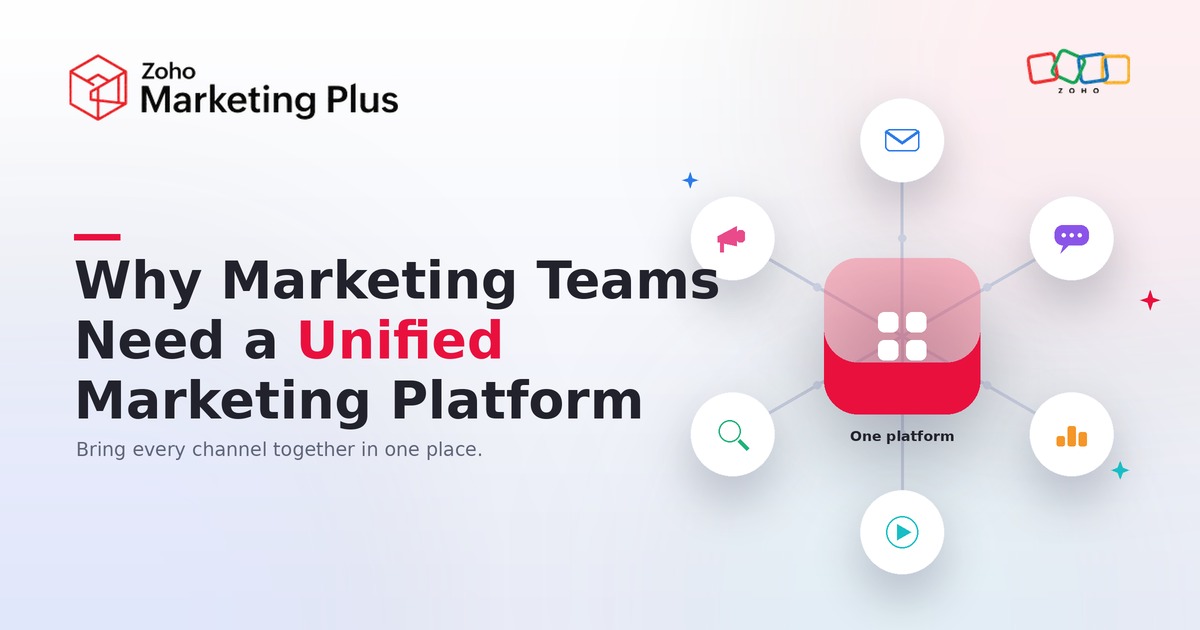
A unified platform means three things share one foundation: audience securely managed in one place, one campaign manager, and one engagement record. When you build a segment, it's the same segment in your email campaign, your social workflow, and your event invitation — not three separate uploads that drift out of sync the moment someone unsubscribes. When you plan a campaign, every channel sits on the same timeline. And when a customer opens an email, attends a webinar, and answers a survey, those three signals roll up to the same person in the same place. Unification is about the data underneath, not the icons on top.
The hidden cost of a fragmented stack
The fragmented-stack problem doesn't show up as a single big bill. It shows up as a hundred small taxes that are hard to see individually.
There's the integration tax — the engineering hours and brittle Zapier chains you maintain just to move a contact list from one tool to another. There's the reconciliation tax — the half-day every month your team spends exporting five dashboards into a spreadsheet to figure out what actually happened, because no single tool can tell you. There's the orchestration tax, which is the most expensive of all: when your channels live in separate tools, sequencing a campaign — a webinar invite Monday, a follow-up email Wednesday, a retargeting push Friday — becomes a manual relay race between disconnected systems. The touches go out in the wrong order, or late, or not at all.
And there's the tax nobody puts on a spreadsheet: the decisions you never make because the data to make them is scattered across tools that don't reconcile. You can't optimise a marketing funnel you can only see one stage of at a time.
A quick self-check. You probably need to consolidate if:
You log into more than four tools to run a single campaign.
You can't answer "which channel drove the most pipeline last quarter?" without building a spreadsheet.
The same contact exists, slightly differently, in three or more of your tools.
Your team spends more time moving data between systems than acting on it.
If two or more of those are true, the stack is working you, not the other way around.
What unification actually changes
Consolidating isn't about owning fewer logos. It changes what a team of a given size can actually execute.
First, orchestration becomes the default, not a project. When email, social, webinars, events, and SMS share one workspace, sequencing a multichannel campaign is the normal way you work — you plan it once and it executes across channels in order. The mistake most teams make is treating orchestration as something you assemble manually after the fact. On a unified platform, it's built into how the campaign is planned. Bringing all your marketing channels in one place is what makes that possible.
Second, measurement stops being archaeology. When every channel's data flows into one analytics layer, you get a single view of what worked instead of five partial ones you have to mentally stitch together. Unified marketing analytics is the difference between knowing your campaign performance and guessing at it.
Third, automation gets smarter because it has more to work with. An automated journey that can only see email behaviour is half-blind. One that sees email, web, social, and event signals together can route a customer based on everything they've done. Good marketing automation depends on unified data — automation on top of a fragmented stack just automates the gaps.
Fourth, the team finally works from one source of truth. Shared briefs, a shared calendar, and a unified brand asset library mean the right marketer has the right access to the right thing — no more hunting through Slack threads for the latest approved logo. The smaller the team, the more this matters: it lets a 3-person team run what would normally need.
How Zoho Marketing Plus can help you
Zoho Marketing Plus is built around a single brand workspace where the channels a modern campaign depends on — email, social, webinars, events, surveys, SMS, and analytics — all unify in the same place, sharing the same audience definitions, the same campaign calendar, and the same engagement data.
In practice that means you build your audience once and use it everywhere, plan your sequence on one timeline the whole team can see, and read account- and campaign-level engagement from one analytics layer instead of five dashboards. Because it also connects marketing to sales — engagement signals flow from the platform into Zoho CRM and other CRMs — the rep working a deal sees what marketing sees, and marketing sees which accounts sales are working. That alignment is the whole point of consolidating.
If you're rebuilding your stack, the platform decision is one of the first three you'll make. Get it right, and most of the taxes above simply disappear — and your team spends its time on marketing instead of on moving data between tools.
FAQ
Q: Isn't a unified platform just a bundle of the same tools I already have? No. A bundle shares a vendor; a platform shares a database. The test is simple: build a segment in one tool and check whether it exists, unchanged, in the others. If you have to re-upload it, it's a bundle.
Q: We're a small team. Isn't a full platform overkill? It's usually the opposite. Small teams feel the integration and orchestration taxes hardest because there's no spare headcount to absorb them. Unification is what lets a small team punch above its size.
Q: Will consolidating mean ripping out everything we use today? Not all at once. Most teams migrate channel by channel — start with the two or three tools causing the most reconciliation pain, then expand. The goal is one source of truth, not a big-bang rewrite.
Q: What's the single biggest benefit of going unified? One audience and one engagement record across every channel. Almost every other benefit — better orchestration, real measurement, smarter automation — follows from that one thing.
Q: How does a unified platform improve ROI specifically? Two ways. It removes the hidden costs (integration upkeep, manual reporting, missed sequencing), and it makes spend visible at the campaign, brand, and activity level so you can move budget toward what's actually working instead of what you assume is working.
Q: Does unification help with marketing and sales alignment? Yes — that's often the highest-value outcome. When engagement data flows into your CRM, both teams work from the same signal instead of arguing over two versions of the truth.
 Bala
BalaBala is a product Marketer for Zoho Marketing Plus. He is passionate about discussing MarTech, Customer Experience, Omnichannel Marketing, and Marketing Analytics.
You can start a conversation with Bala by leaving a comment on any of his blog posts.Bonus information - Bala likes cats, coffee, and G-shock watches :)