- HOME
- Industrial IoT
- From Kaizen to Six Sigma: How IoT Powers Continuous Improvement in Manufacturing
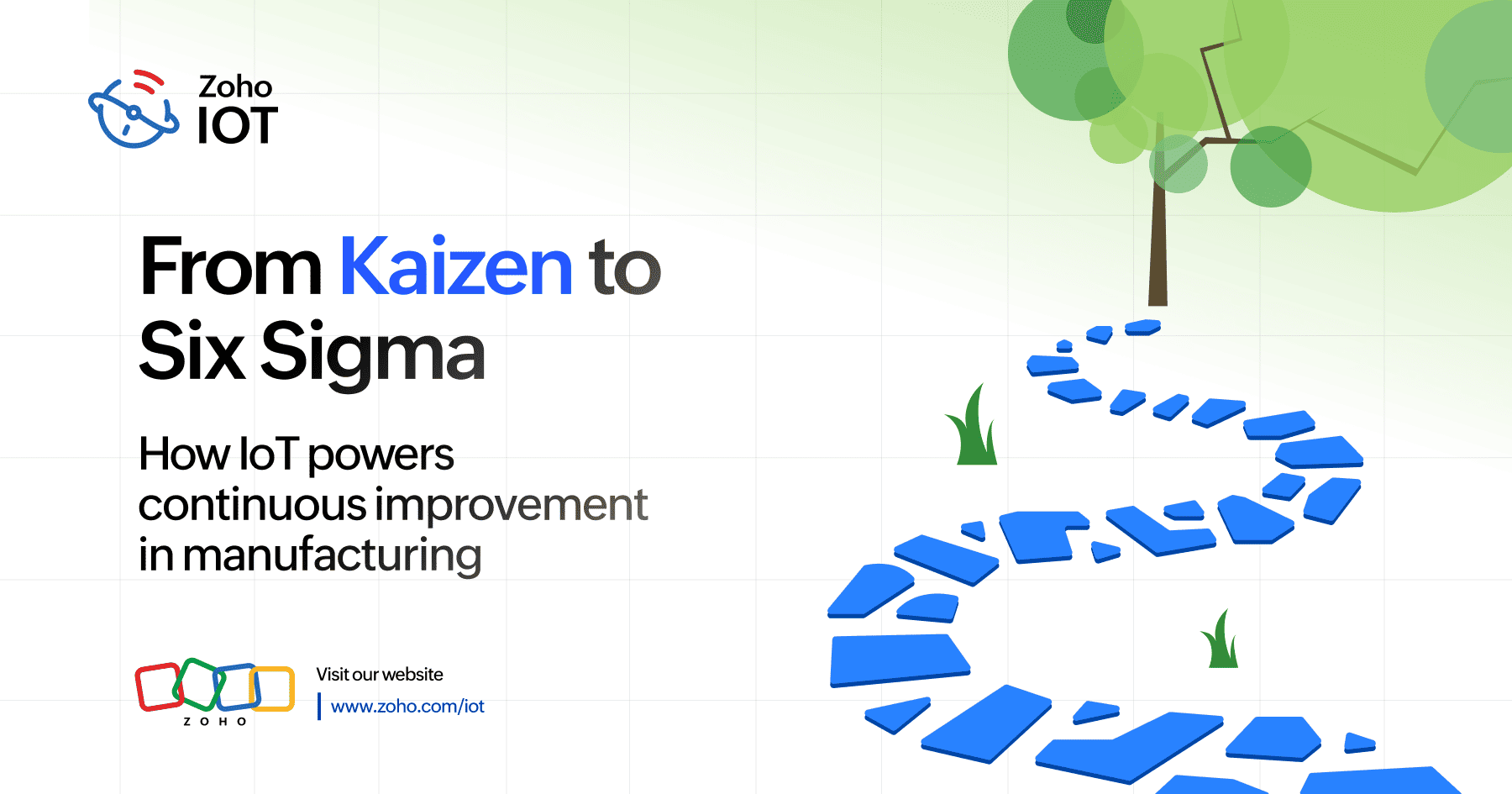
From Kaizen to Six Sigma: How IoT Powers Continuous Improvement in Manufacturing
- Last Updated : August 18, 2026
- 3 Views
- 4 Min Read

Manufacturing leaders don't lose sleep over production. They lose sleep over uncertainty the machine that fails without warning, the defect that slips through inspection, the recurring problem that was supposedly fixed last month but is back again.
These aren't isolated incidents. They're symptoms of a structural gap that quietly persists in most operations: proven improvement methodologies running on manual effort, incomplete data, and hindsight.
For decades, manufacturers have relied on a powerful toolkit Kaizen, 5S, CAPA, TPM, the 5 Whys, Six Sigma, and Poka-Yoke. Each is battle-tested. Each has driven real results. But here's what their inventors never had: continuous, real-time data from every machine, production line, and manufacturing process. Industrial IoT provides exactly that not as a replacement for these methodologies, but as the data infrastructure that makes each one work faster, sharper, and continuously.
The factories that win are not the ones that fix problems faster, but the ones that predict and prevent them altogether.
The six methodologies and what IoT adds to each
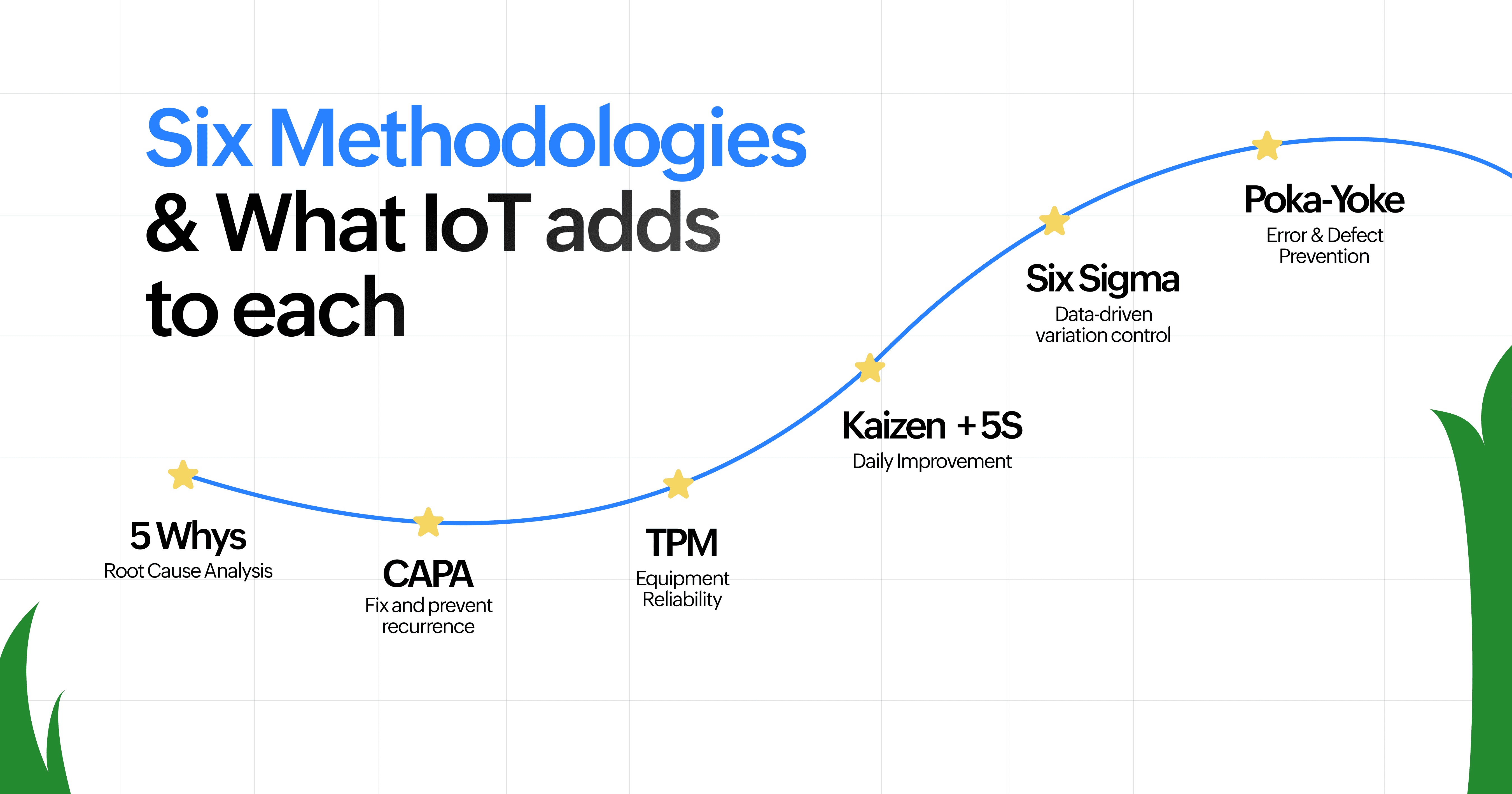
Each of these frameworks was designed to solve a specific type of manufacturing problem. Together, they form a complete system. Here's how IoT elevates each one.
5 Whys
01 · Root Cause Analysis
Without IoT | With Zoho IoT |
Rely on memory and paper logs. Investigations take days. Root cause often wrong the real trigger was on a machine nobody checked. | Complete sensor trail across every asset. Vibration anomaly 48 hrs before the failure. Root cause in minutes, with full data coverage. |
Traditional investigations rely on human memory and incomplete shift logs. IoT replaces this with timestamped data across all assets correlating events that humans would never connect, shifting root cause analysis from reactive to continuous.
- Historical sensor logs
- Event correlation
- Failure timelines
CAPA
02 · Corrective & Preventive Action
Without IoT | With Zoho IoT |
Corrective action done. Preventive action documented, then forgotten. Six months later, the same failure mode is back. | Prevention rules embedded in machine logic are enforced continuously. CAPA only closes when sensors confirm normal parameters are restored. |
IoT closes the gap between paperwork and manufacturing process behavior. Every alert, workflow step, and sensor reading at closure is auto-logged making compliance documentation a byproduct of operations, not a manual task.
- Alert-to-action
- Preventive rule engine
- Sensor-verified closure
TPM
03 · Total Productive Maintenance
Without IoT | With Zoho IoT |
Service every 500 hours whether needed or not. Some assets over-maintained; others failing faster than the schedule knows. | Maintain exactly when sensor data says so. Availability losses and OEE degradation surface in real time. Improvements in weeks, not months. |
The shift from scheduled to condition-based maintenance means intervening precisely when needed not a minute too early or late. The result: lower cost, less downtime, and equipment consistently at peak efficiency.
- Condition monitoring
- Predictive alerts
- Live OEE tracking
Poka-Yoke
05 · Error & Defect Prevention
Without IoT | With Zoho IoT |
Defects caught at inspection after they're already made. Physical jigs prevent assembly errors, but invisible parameter deviations pass through undetected. | Temperature deviation, skipped sequence, out-ofrange pressure all detected and halted before a single defective unit is produced. Quality prevention, not inspection. |
IoT extends Poka-Yoke into every invisible process parameter. The strategic shift is from quality assurance to quality prevention, if defect conditions are monitor-able, none should ever reach the inspection stage. As 5 Whys surfaces new failure modes, those become new Poka-Yoke rules. The loop tightens continuously.
- Parameter validation
- Sequential logic enforcement
- Automated process intervention
Six Sigma (DMAIC)
06 · Data driven variation control
Without IoT | With Zoho IoT |
DMAIC projects rely on manually sampled data, snapshot in time, not continuous streams. Measurement system analysis and control phase monitoring are labor-intensive, making six sigma projects slow and smapling-dependent. | Every DMAIC phase gets continuous sensor data. Define and measure phases are grounded in real process baselines, not estimates. Analyze surfaces variation patterns automatically. |
Six Sigma's DMAIC framework is the most rigorous continuous improvement methodology and the most data-hungry. Define the problem, Measure the baseline, Analyze causes, Improve the process, Control the gains. Each phase demands reliable, representative data. Historically, that data came from sampling plans and manual measurements slow, expensive, and always incomplete between observations.
Why This Matters: The Cost of Uncertainty
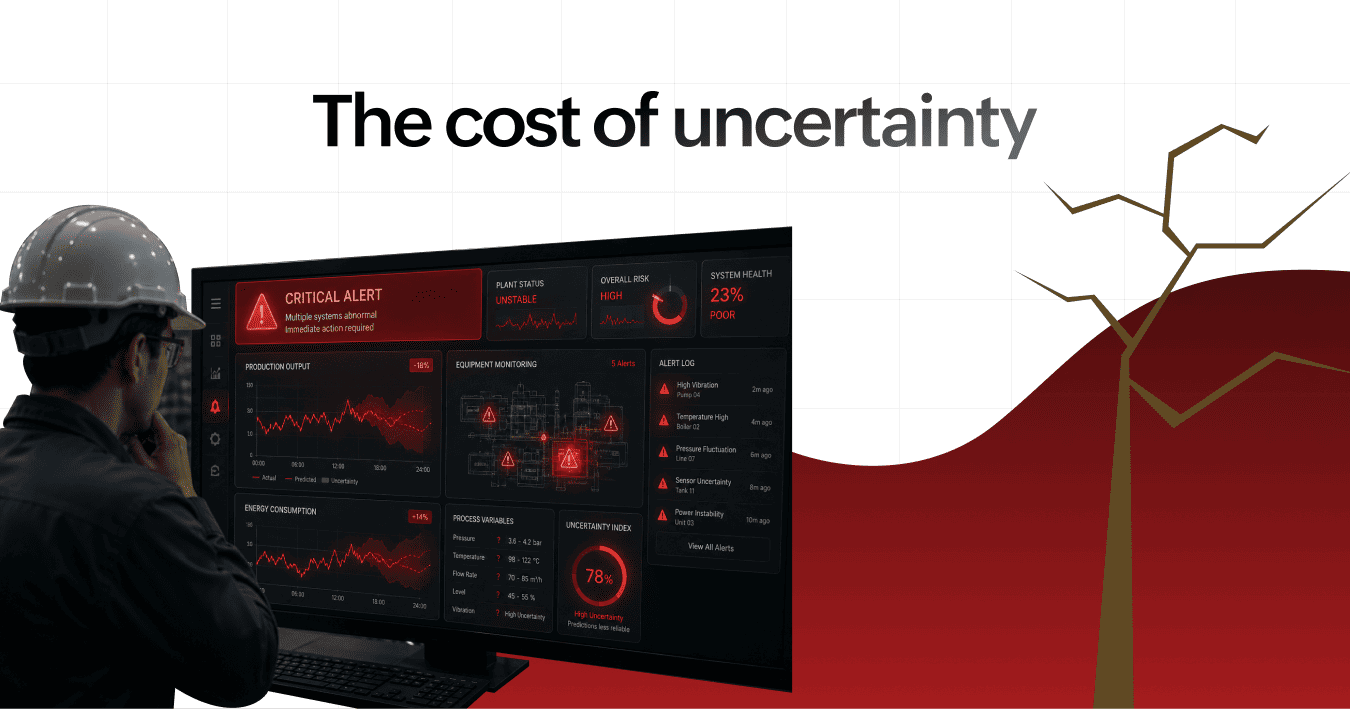
Poor maintenance and process control cost manufacturers roughly 30% of production output annually. A single unplanned downtime event on a large manufacturing line can cost $260,000 per hour not counting the downstream supply chain effects. Defects found at the customer cost 3 - 5× more to resolve than defects caught in-process, and 10 - 15× more than defects prevented at the source. These numbers explain why continuous improvement programs exist.
Going deeper: The complete stories
This blog is a strategic overview. As each methodology has its own dedicated
deep-dive guide with implementation steps, real-world manufacturing scenarios, and specific IoT configurations, let's see more of these topics in our upcoming blogs, like:
- 5 Whys + IoT: Finding Real Root Causes in Minutes, Not Days
- CAPA: From Reactive paperwork to proactive IoT
- TPM meets predictive maintenance: How IoT supercharges OEE
- Kaizen in the age of IoT: Continuous data, continuous gains
- 5S + IoT from paper checklists to digital process standards
- Digital Poka-Yoke: How IoT makes defects structurally impossible
Six sigma + IoT: How continuous data transforms DMAIC from months to weeks.
If you are looking for a solution that turns your factory from analog to completely digital and automate most of mundane manufacturing processes, write to us at evaluation@zohoiot.com or schedule a demo with our team right away.