- HOME
- More
- Industry insights
- Why new hires could be your organization's biggest security risk
Why new hires could be your organization's biggest security risk
- Last Updated : June 18, 2026
- 111 Views
- 6 Min Read

Every organization invests in security tools, policies, and employee training. But there’s a window of vulnerability that most security strategies quietly overlook: the first few weeks after someone joins your team. New employees are among the most targeted individuals in any organization, and the reason has less to do with carelessness than with something far more fundamental. They simply don’t know enough yet to judge when something is wrong.
This is more of a context problem than a people problem, and attackers know exactly how to exploit it.
The onboarding window is an open door for attackers
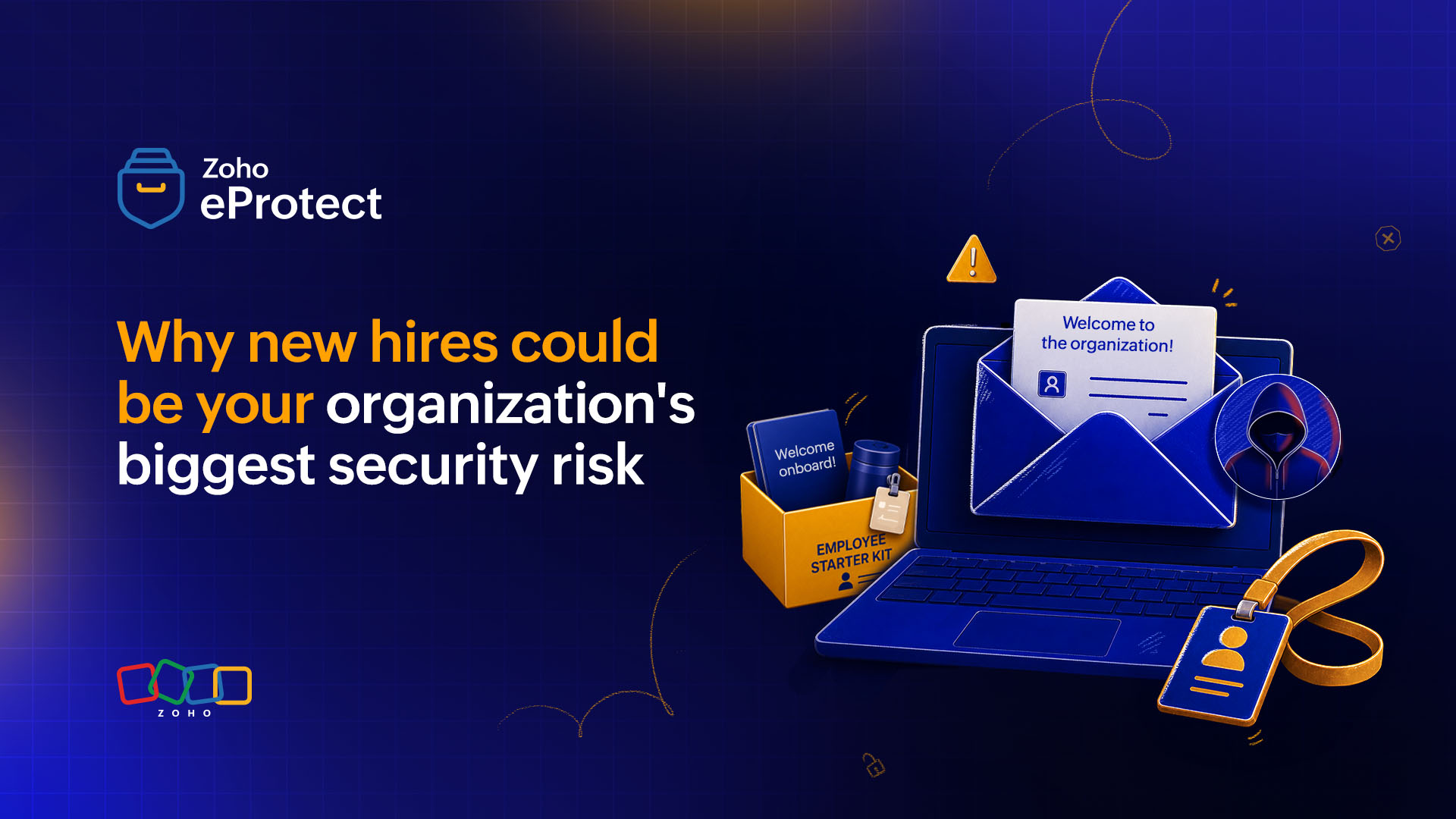
When a new employee starts, they’re navigating a flood of unfamiliar information: new systems, new processes, new colleagues, new vendors. Everything feels slightly uncertain, and urgency is often part of the experience. IT asks them to set up credentials quickly. Finance sends a form to get payroll sorted. Their manager requests something before the end of the day.
This environment is tailor-made for social engineering. Attackers don’t need sophisticated malware to compromise a new hire’s actions. They need plausibility and urgency, both of which are part of the onboarding experience.
A new employee doesn’t yet know:
- What the company’s internal communication style looks like (formal, casual, over email or instant messaging).
- Which vendors the company actually works with, or what their invoices typically look like.
- Whether the person emailing them from “IT support” is real.
- Which requests are routine and which should raise a flag.
This lack of internal context is the attack surface. And when attackers target new employees, this lack of context is all they need.
Threats that target new hires
Not all email threats are equal when it comes to new hire security risk. Some attacks rely heavily on the target having no baseline for “normal,” which makes new employees especially vulnerable to a specific set of threats.
BEC invoice fraud
In a business email compromise attack, a threat actor impersonates a vendor, executive, or finance contact and requests a payment or bank account change. For a new hire in a finance or operations role, receiving an email that appears to come from a known vendor requesting an updated payment method is almost impossible to verify. They haven’t processed enough invoices to spot a suspicious one, and they may not feel comfortable challenging a senior contact too early in their tenure.
IT impersonation
“Your account setup is incomplete. Click here to verify your credentials.” For a new employee still in the middle of provisioning software and access, this reads as routine. Fake IT emails that harvest login credentials are particularly effective during onboarding because the new hire expects to receive exactly this kind of message.
Fake HR and payroll emails
Attackers frequently impersonate HR teams to target new hires with requests to confirm banking details or complete onboarding forms through a fraudulent link. Because these requests are expected during the onboarding process, the psychological guardrails that would stop a longer-tenured employee from clicking through aren’t in place yet.
Credential phishing
More broadly, any email that creates urgency around account access, password resets, or access verification will land with unusual effectiveness on someone who’s actively setting up accounts across multiple platforms. Employee email security threats of this kind are low-effort for attackers and high-yield during onboarding windows.
What an attack actually looks like
Consider this scenario: Maya joins a mid-sized logistics company as a finance coordinator. On her third day, she receives an email from what appears to be the company’s primary freight vendor, referencing an invoice number and asking her to update their payment details via a linked form before the next billing cycle. The email domain looks nearly right, the tone matches how she’s seen colleagues write, and the request seems time-sensitive. She fills out the form. The vendor’s banking details in the system are now changed to an account controlled by the attacker.
No malware. No brute force. Just a new hire doing her job without enough context to recognize a spoofed sender.
Why security awareness training alone won’t solve this
Security awareness training is valuable, but it has a structural limitation when applied to new employees: It teaches people to recognize threats they’ve never encountered in context. A training module can explain what BEC invoice fraud looks like, but it can’t replicate the pressure, familiarity, and trust that a well-crafted attack email mimics in a real onboarding environment.
There’s also a recency gap. Most organizations run security training during onboarding as a one-time module, often before employees have enough experience with internal norms to apply what they’ve learned. The training happens before the context that would make it stick.
This is where many security frameworks have a blind spot. They focus on the employee as the last line of defense, when the stronger approach is to reduce how much depends on employees in the first place.
Email security controls to reduce the human-error surface
Reducing insider threats caused by new employees isn’t about making employees more suspicious. It’s about ensuring that the most dangerous emails never reach them in the first place, and that even if emails reach employee mailboxes, the visible signals prompt enough caution.
Email authentication
This forms the first layer. SPF, DKIM, and DMARC work together to verify that an incoming message actually originates from the domain it claims to represent. A spoofed vendor email, an impersonated IT address, or a fake HR message from a lookalike domain will fail these checks. When DMARC is configured with a reject or quarantine policy, these messages don’t reach the inbox at all.
Reception filtering
Filtering at the reception level goes a step further by analyzing incoming messages against threat intelligence, behavioral patterns, and reputation data before delivery. An email that passes basic authentication but contains suspicious link patterns, mismatched sender metadata, or known phishing indicators can be flagged or blocked at the perimeter.
Sandboxing
Sandboxing addresses the threat that slips through with a link or attachment that looks benign. When an email arrives with a URL or file, sandboxing opens and executes that content in an isolated environment to observe its behavior before allowing it to reach the user. A link that redirects to a credential harvesting page after a time delay, a common technique used to evade initial scans, will reveal its behavior in the sandbox before any employee interacts with it.
Together, these controls shift the burden of detection away from human judgment and toward the infrastructure layer. For new hires navigating an unfamiliar environment, that shift is especially important.
Attacker timing is deliberate
One point that rarely surfaces in discussions about new hire security risk is this: Attackers don’t stumble onto new employees randomly. In many cases, they identify them intentionally.
LinkedIn announcements, company press releases, and social media posts routinely broadcast exactly when someone new joins an organization and what their role is. A finance hire or an IT coordinator starting on Monday is, by Tuesday, a named target in a role with access to payment systems or credentials. Threat actors monitor these signals and time their attacks to coincide with the first week on the job, when the employee is most disoriented and least able to verify an unusual request.
This means the new hire security risk isn’t just a side effect of inexperience. It’s an actively exploited attack vector with predictable timing.
Conclusion
New employees are a high-value target during a predictable window, for reasons that have nothing to do with how careful or competent they are. The combination of unfamiliarity, urgency culture, and the active monitoring of hiring signals by threat actors creates a period of exposure to email threats. Most standard training programs aren’t designed to address this scenario on their own.
The more durable response is to pair awareness programs with a robust email security solution at the infrastructure level: Authentication controls that block spoofed senders, reception filtering that screens for threat patterns, and sandboxing that catches what gets through.
eProtect is a cloud-based email security and archiving solution that protects your organization from all email threats. With layered email security controls including SPF/DKIM/DMARC enforcement, advanced reception filtering, and sandboxing, eProtect reduces the attack surface that new hires, and every other employee, are exposed to every day.
The solution offers advanced threat detection mechanisms to protect on-premise and cloud email accounts from evolving email threats. eProtect is the security solution that powers Zoho Mail, a platform that millions of users trust.