- HOME
- Email archiving
- How archived emails help detect insider threats
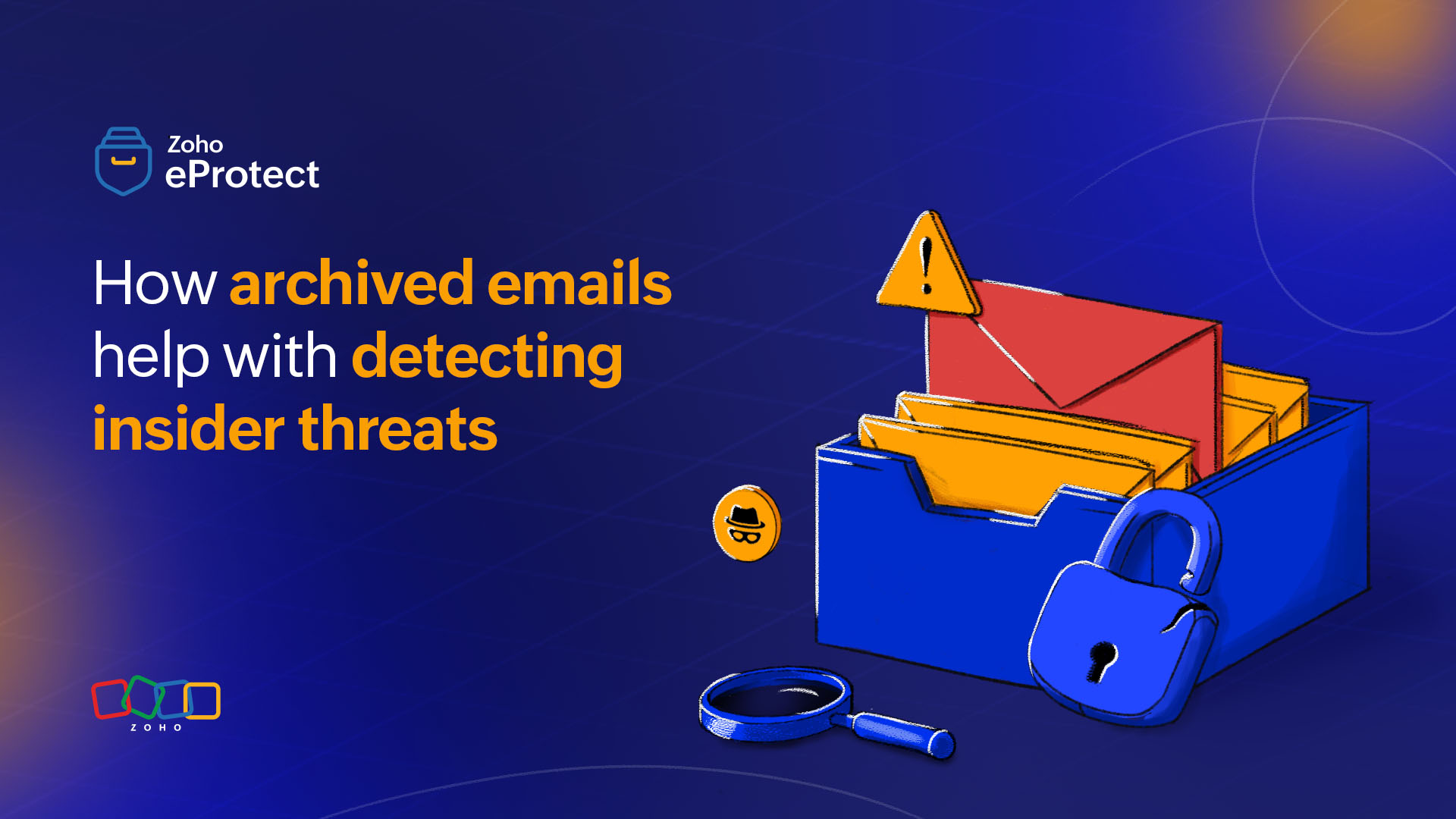
How archived emails help detect insider threats
- Last Updated : March 30, 2026
- 173 Views
- 5 Min Read

Most insider threat investigations don’t start with certainty. They start with a vague signal. A manager notices unusual behavior. A DLP alert flags a file transfer. An employee exits abruptly under unclear circumstances. At that point, security teams aren’t looking for malware or exploits. They’re most likely trying to figure out what happened over time.
To spot an insider threat attack isn’t always easy. They unfold gradually, through small, seemingly legitimate steps: forwarding a document, looping in a personal email, revisiting old threads, exporting large amounts of data, or increasing communication with external contacts. On their own, these actions are easy to dismiss. In aggregate, they form a pattern.
Email archiving helps determine the pattern. Unlike real-time monitoring tools that capture isolated events, archived emails provide a continuous, chronological record of communication. They allow investigators to traverse from a single trigger and determine the sequence of actions that led up to it. In this article, we’ll explain why email is a primary medium of insider threat activity and the ways in which email archiving contributes in detecting these threats.
Email as a primary signal for insider activity
Unlike endpoint logs or network actions, email captures intent alongside action. A file transfer may show that data moved, but an email reveals why it was shared, who requested it, and how it was framed. This context is critical in insider threat detection, where distinguishing between legitimate work and malicious behavior depends on subtle cues.
Archiving retains this context over time, allowing security teams to move beyond isolated alerts and instead analyze communication patterns. This is especially important because insider threats develop gradually, often over weeks or months.
Establishing behavioral baselines using email data
One of the key advantages of email archiving is the ability to establish a long-term behavioral baseline for each user. Without historical data, it’s difficult to determine whether an action is anomalous or simply part of normal workflow.
Archived emails enable analysis of patterns such as:
- Typical recipients (internal teams, external partners, vendors).
- Frequency and timing of communication.
- Types of files shared.
- Nature of conversations (operational, financial, strategic).
Once this baseline is established, deviations become significantly easier to detect. For example, an employee who rarely communicates outside the organization but suddenly begins sending frequent emails to personal accounts or unknown domains presents a clear anomaly. Similarly, a spike in after-hours email activity involving attachments may indicate preparation for data exfiltration.
These signals aren’t inherently malicious on their own. Their value lies in how they contrast with established behavior over time. This information can be easily discerned using a reliable email archiving solution.
Identifying early-stage data exfiltration patterns
Insider threats often begin with low-volume, low-visibility actions. Instead of large, obvious transfers, sensitive data is gradually moved out through email attachments or forwarded conversations.
Archived emails allow investigators to trace:
- When sensitive documents were first accessed and shared.
- Whether similar files were sent to multiple recipients.
- If internal threads were forwarded externally.
- How recipient lists evolved over time.
Because archives retain both content and attachments, they make it possible to validate the actual data that left the organization and not just the fact that a suspicious email was sent. This is critical in separating false positives from genuine risk.
For instance, an employee forwarding a single document to a known partner may be normal. But when archived data shows repeated forwarding of related documents to a personal email address over a short period, it could indicate exfiltration.
Detecting policy violations through context
Many insider incidents involve policy violations that aren’t immediately flagged by traditional controls. These may include sharing restricted information, bypassing approved communication channels, or engaging with unauthorized external parties.
Email archives provide the necessary visibility to detect these violations retrospectively and at scale. Because messages are indexed and searchable, security teams can identify:
- Keywords related to sensitive projects or regulated data.
- Unauthorized sharing of confidential attachments.
- Conversations that indicate deliberate circumvention of controls.
More importantly, archived emails preserve the full conversation thread. This allows investigators to understand whether a violation was accidental, negligent, or intentional, which is an important distinction for both remediation and compliance.
Reconstructing intent through conversation timelines
Understanding insider threats requires more than identifying what happened. It requires reconstructing how and why it happened. That way, any future incidents can be prevented. Email archives make this possible by preserving complete communication timelines.
By analyzing sequences of emails, investigators can:
- Track how a request for information originated.
- Identify who approved or facilitated access.
- Observe how data was subsequently shared or escalated.
This timeline-based approach reveals intent in a way that isolated logs cannot. For example, a single email with an attachment may not appear suspicious. But when viewed within a thread that includes urgency, unusual requests, or external pressure, it may indicate collusion or deliberate misuse.
Ensuring evidence integrity with immutable storage
A significant challenge in investigating insider threat attacks is the risk of evidence tampering. Because insiders have legitimate access, they may attempt to delete or modify emails to remove traces of their activity.
Email archiving mitigates this risk by storing messages in an immutable format. Once ingested, emails cannot be altered or deleted by end users. This ensures:
- Reliable forensic analysis.
- Accurate reconstruction of events.
- Legal defensibility in case of disputes or litigation.
Even if an employee attempts to cover their tracks by deleting emails from their mailbox, archived copies remain intact and accessible.
Enabling cross-user and cross-incident correlation
Insider threats aren’t always isolated to a single individual. In some cases, multiple users may be involved, either knowingly or unknowingly, in facilitating data exposure.
Archived email datasets allow for correlation across users, threads, and time periods. Investigators can:
- Identify shared recipients across different employees.
- Detect repeated communication patterns involving the same external entities.
- Link separate incidents through common keywords or attachments.
This broader view is essential for uncovering coordinated activity or systemic gaps in access control and policy enforcement. This makes archiving an essential tool for HR teams.
Detection through integration with security systems
While email archives are powerful on their own, their effectiveness increases when integrated with broader security workflows. When combined with SIEM platforms, DLP systems, or user behavior analytics tools, archived email data provides additional context that improves detection accuracy.
For example:
- A DLP alert can be validated against archived emails to confirm whether sensitive data was actually transmitted.
- Unusual login activity can be correlated with email behavior to assess risk.
- Behavioral analytics can incorporate communication patterns to refine anomaly detection.
This integration transforms email archives from a passive storage system into an active component of threat detection.
Conclusion
Insider threats are defined by subtlety. They emerge through legitimate actions that appear harmless but collectively indicate risk. Detecting them requires long-term visibility and reliable evidence.
By preserving communication history in a structured, tamper-resistant format, archiving enables organizations to identify behavioral anomalies, trace data movement, and reconstruct intent with precision. In doing so, it turns everyday email data into a critical resource for proactive insider threat detection and response.
eProtect is a cloud-based email archiving and security solution that provides email archiving for cloud and on-premise email providers. The solution offers secure email archiving, quick eDiscovery, and comprehensive audit trails to ensure that organizations stay compliant and are prepared for all kinds of email threats. eProtect is the archiving solution powering Zoho Mail, a platform trusted by millions of users.