- HOME
- Compliance & legal
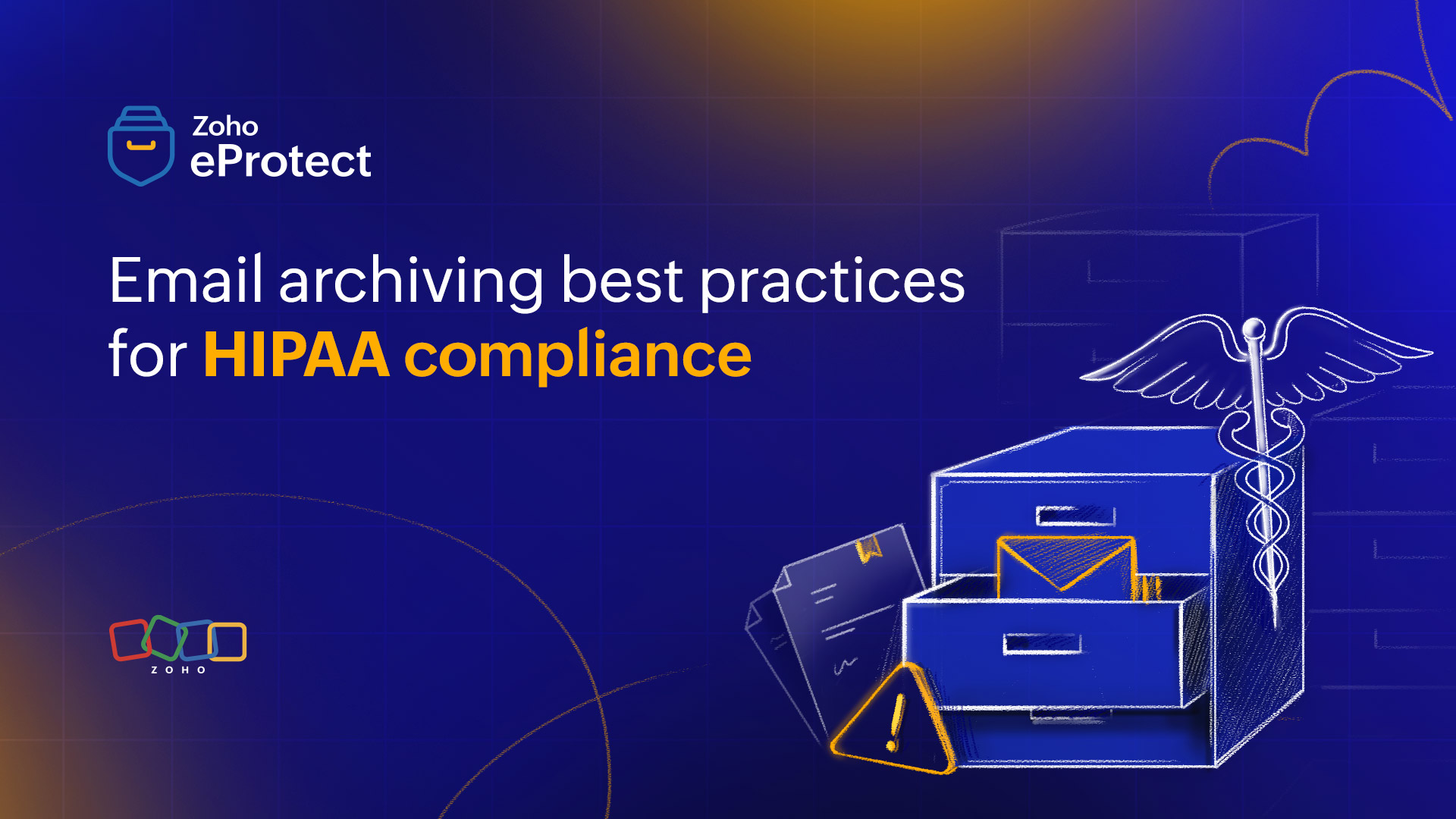
- Email archiving best practices for HIPAA compliance
Email archiving best practices for HIPAA compliance
- Last Updated : March 6, 2026
- 278 Views
- 8 Min Read

Healthcare runs on constant digital communication. Appointment reminders, lab reports, prescriptions, referrals, billing clarifications—much of it moves through email, often with attachments, scans, and detailed patient records. When these messages contain health-related identifiers, they qualify as Protected Health Information (PHI), and handling them comes with strict legal obligations.
Medical data is highly valuable and highly targeted. It includes treatment histories, insurance details, diagnostic results, and personal identifiers, information that can be exploited for fraud or identity theft. According to the IBM Cost of a Data Breach Report 2023, healthcare has had the highest average breach cost of any industry for 13 consecutive years, reaching $10.93 million per incident. The financial impact is significant, but the real cost is patient trust.
As healthcare systems digitize further and pharmaceutical innovation expands, the volume and sensitivity of shared data continue to increase. This makes secure storage and controlled access essential, both for operational continuity and for regulatory compliance. To safeguard patients and standardize protections, several regulations govern how healthcare data is collected, transmitted, stored, and retained. One of the most important is the Health Insurance Portability and Accountability Act (HIPAA).
This article explores what HIPAA means in the context of email, the specific requirements for archiving email communications, best practices for maintaining compliance, common mistakes organizations make, and what to evaluate when selecting a HIPAA-compliant email archiving solution.
What is HIPAA?
HIPAA is a U.S. federal law enacted in 1996 to protect sensitive PHI from unauthorized access, disclosure, or misuse. While it originally focused on improving health insurance portability, it has evolved into the foundational framework for safeguarding medical data in physical and digital environments.
HIPAA establishes standards for how PHI is handled by covered entities such as healthcare providers, health plans, pharmaceutical companies, and their business associates, including third-party service providers that process or store health data on their behalf.
HIPAA primarily addresses four critical areas that healthcare organizations must manage when handling patient information:
- Protecting the confidentiality of PHI.
- Safeguarding healthcare data against unauthorized access or compromise.
- Establishing clear procedures for reporting data breaches.
- Ensuring that patients retain control and access rights over their medical records.
These provisions in HIPAA help organizations maintain both data security and patient trust while managing sensitive health information.
HIPAA email-archiving requirements
HIPAA requires covered entities to maintain specific forms of compliance-related documentation for defined periods. Although the regulation doesn’t explicitly list email as a retention category, its requirements extend to any records maintained within email systems.
Email as electronically Protected Health Information (ePHI)
Emails become ePHI when they contain patient identifiers combined with health-related details such as diagnoses, prescriptions, treatment discussions, billing information, or lab results. This includes message bodies, attachments, embedded images, and metadata.
Because email is routinely used for coordination between multiple entities, archived emails must be treated with the same level of protection as electronic medical records. Any archived communication containing ePHI falls directly under HIPAA safeguards.
The HIPAA Privacy Rule for email records
The HIPAA Privacy Rule governs how PHI can be used and disclosed. Archived emails must reflect these limitations even after communication has ended. Organizations must ensure that stored emails are accessed only for legitimate healthcare, payment, or operational purposes.
Archives should prevent unauthorized viewing, uncontrolled sharing, or informal internal access. Retaining emails without enforcing privacy boundaries can still result in violations, even if the data was originally shared lawfully.
The HIPAA Security Rule for stored emails
The Security Rule requires organizations to protect ePHI through administrative and physical safeguards. For archived emails, this translates into encryption, secure storage environments, controlled system access, and protection against unauthorized alteration or deletion.
Email archives must remain continuously protected, not just during transmission, but throughout their entire retention lifecycle.
Email retention requirements
HIPAA requires covered entities to retain required documentation related to policies, procedures, and communications for at least six years from the date of creation or last effective use, following the 6-year rule.
While HIPAA doesn’t mandate retaining every email indefinitely, organizations must ensure that emails tied to patient care decisions, compliance actions, or operational records remain accessible for the required duration. Automated retention policies help enforce consistency and reduce accidental deletion.
Access controls and authorized disclosure
Archived emails containing ePHI must follow the principle of least privilege. Access should be restricted based on job role, ensuring that employees can view only the information necessary for their responsibilities.
Strong authentication, role-based permissions, and periodic access reviews help prevent unauthorized disclosure, one of the most common causes of HIPAA violations.
Audit trails and activity logging
HIPAA requires organizations to maintain visibility into how ePHI is accessed and handled. Email archiving systems should log all activities, including access attempts, searches, exports, deletions, and permission changes.
These audit trails enable organizations to investigate suspicious behavior, demonstrate compliance during audits, and reconstruct events following a security incident.
Data integrity and tamper protection
Archived emails must remain accurate and unaltered over time. HIPAA expects organizations to protect ePHI from improper modification or destruction. Immutable storage, write-once-read-many (WORM) mechanisms, and version controls ensure that emails cannot be edited or silently removed, preserving their evidentiary value.
Breach readiness and evidence preservation
In the event of a suspected breach, organizations must quickly determine what information was exposed, who accessed it, and when. Properly archived emails provide the historical evidence needed for investigation and regulatory reporting.
A compliant archive enables rapid retrieval of affected communications, helping organizations meet breach notification timelines and reduce investigative delays.
Reduced search latency
HIPAA compliance depends not only on storing information but also on retrieving it efficiently. During audits, legal discovery, or patient record requests, organizations must locate relevant communications without delay. Indexed archives with fast search capabilities reduce response time, minimize operational disruption, and ensure that organizations can produce required records when requested.
Best practices for HIPAA-compliant archiving
To ensure that an organization is compliant with HIPAA while maintaining their email records, there are certain best practices that need to be followed.
Use an archiving solution with Business Associate Agreement
Not all archiving tools are designed for regulated environments. A HIPAA-ready solution should support encryption, access controls, audit logging, and immutable storage by default. Equally important, the vendor must be willing to sign a Business Associate Agreement (BAA), confirming shared responsibility for protecting ePHI. Compliance should be built into the system architecture, not added through manual configuration.
Define clear retention policies
Retention policies should specify what emails are stored, how long they’re retained, and when they’re securely deleted. These policies must align with HIPAA documentation requirements as well as organizational legal obligations. Automated policy enforcement prevents inconsistent retention practices and reduces the risk of accidental deletion or excessive data accumulation.
Automate capture and archiving
Manual archiving introduces gaps. Emails should be automatically captured across inbound, outbound, and internal communications without user intervention. This includes attachments, metadata, and shared mailbox communications. Continuous capture ensures that records remain complete and defensible during audits or investigations.
Ensure searchability and audit trails
Archived emails must be easy to locate on request. Indexed storage, granular search filters, and export capabilities allow teams to retrieve records quickly during compliance reviews or patient data requests. At the same time, detailed audit trails should record access, searches, and data exports to provide visibility into how archived information is used.
Implement data security and encryption
Archived emails containing ePHI must remain protected throughout their lifecycle. Encryption should apply TLS 1.3 during transmission and AES-256 while at rest. Role-based access controls, strong authentication mechanisms, and secure key management help prevent unauthorized exposure of archived communications.
Regular monitoring and testing with mock audits
Compliance cannot be assumed; it must be verified. Periodic monitoring of archive health, access patterns, and retention enforcement helps identify gaps early. Conducting mock HIPAA audits or retrieval exercises ensures that teams can locate required communications quickly and demonstrate compliance under real audit conditions.
Be wary of unstructured attachments
Healthcare emails often include scanned documents, medical images, PDFs, and handwritten forms. These unstructured files frequently contain ePHI but are harder to monitor and classify. Archiving systems should capture and preserve attachments alongside emails while maintaining indexing and search visibility wherever possible.
Ensure that AI-specific data is archived
AI tools increasingly assist with documentation, summaries, patient communication drafts, and workflow automation. If AI-generated or AI-processed content includes PHI and is shared through email, it becomes part of the compliance record. Organizations should ensure that these interactions and outputs are archived to maintain transparency and audit readiness as AI adoption grows.
Choosing a HIPAA-compliant archiving solution
Selecting an email archiving solution for healthcare environments goes beyond storage capacity or cost. The archive becomes a long-term repository of ePHI, which means its design directly affects compliance, audit readiness, and breach response capabilities.
A key starting point is HIPAA alignment. The provider should support required administrative and technical safeguards and be willing to sign a BAA. Without a BAA, responsibility for protecting archived ePHI remains entirely with the healthcare organization, creating significant compliance risk.
Security capabilities should extend across the entire data lifecycle. Archived emails must be encrypted both in transit and at rest, protected through strong authentication, and governed by role-based access controls. The system should also prevent unauthorized modification or deletion through immutable or tamper-resistant storage mechanisms.
Equally important is access visibility and accountability. A compliant archiving solution should maintain detailed audit logs showing who accessed archived emails, what actions were performed, and when those actions occurred. This visibility becomes critical during investigations, compliance reviews, or legal discovery.
Healthcare organizations should also evaluate search and retrieval performance. HIPAA audits, patient record requests, and breach investigations often operate under strict timelines. Archives must allow fast, granular searches across users, dates, keywords, and attachments without disrupting production systems.
The solution should work seamlessly with existing email platforms and security tools while supporting growing data volumes over long retention periods. Healthcare data rarely decreases, and archives must remain reliable years after emails are stored.
Finally, vendor transparency and operational reliability should not be overlooked. Clear compliance documentation, uptime guarantees, data residency options, and responsive support all contribute to maintaining continuous compliance.
Common pitfalls to avoid
Using free email services
Free or consumer-grade email services are rarely designed for regulated healthcare environments. They often lack required security controls, audit visibility, and formal compliance commitments such as BAAs. Storing or archiving emails containing PHI on platforms that don’t explicitly support HIPAA requirements can expose organizations to compliance violations, even if no breach occurs.
Including PHI in the subject line
Email subject lines are frequently overlooked from a compliance standpoint. Unlike email bodies, subject lines may remain visible in notifications, logs, previews, and intermediary systems that are outside secure environments. Including PHI in subject lines increases the risk of unintended disclosure. Subject lines should remain neutral and avoid referencing sensitive information.
Not accounting for mobile devices
Healthcare professionals increasingly access email through smartphones and tablets. If mobile access isn’t governed by security policies, archived communications may be exposed through lost devices or unauthorized applications. Organizations should enforce mobile device management (MDM), secure authentication, and remote wipe capabilities to ensure that archived email access remains protected across endpoints.
Failing to conduct risk assessments
HIPAA expects organizations to regularly evaluate risks to ePHI. Without periodic risk assessments, gaps in email handling, retention enforcement, or archive access controls can go unnoticed. Changes in workflows, technology adoption, or user behavior may introduce new vulnerabilities over time. Routine assessments help validate whether archiving practices continue to meet compliance and security expectations.
Wrapping up
Email remains a critical communication channel in healthcare, but it also introduces significant responsibility. HIPAA-compliant email archiving helps organizations securely retain communications, maintain accountability, and respond confidently to audits or investigations.
eProtect is a cloud-based email archiving and security solution that provides email archiving for cloud and on-premise email providers. The solution offers secure email archiving, quick eDiscovery, and comprehensive audit trails to ensure that organizations stay compliant and are prepared for all kinds of email threats. eProtect is the archiving solution powering Zoho Mail, a platform trusted by millions of users.