- HOME
- Thought Leadership
- How to handle difficult customers with positive conversation
How to handle difficult customers with positive conversation
- Published : August 10, 2026
- Last Updated : August 11, 2026
- 38 Views
- 7 Min Read


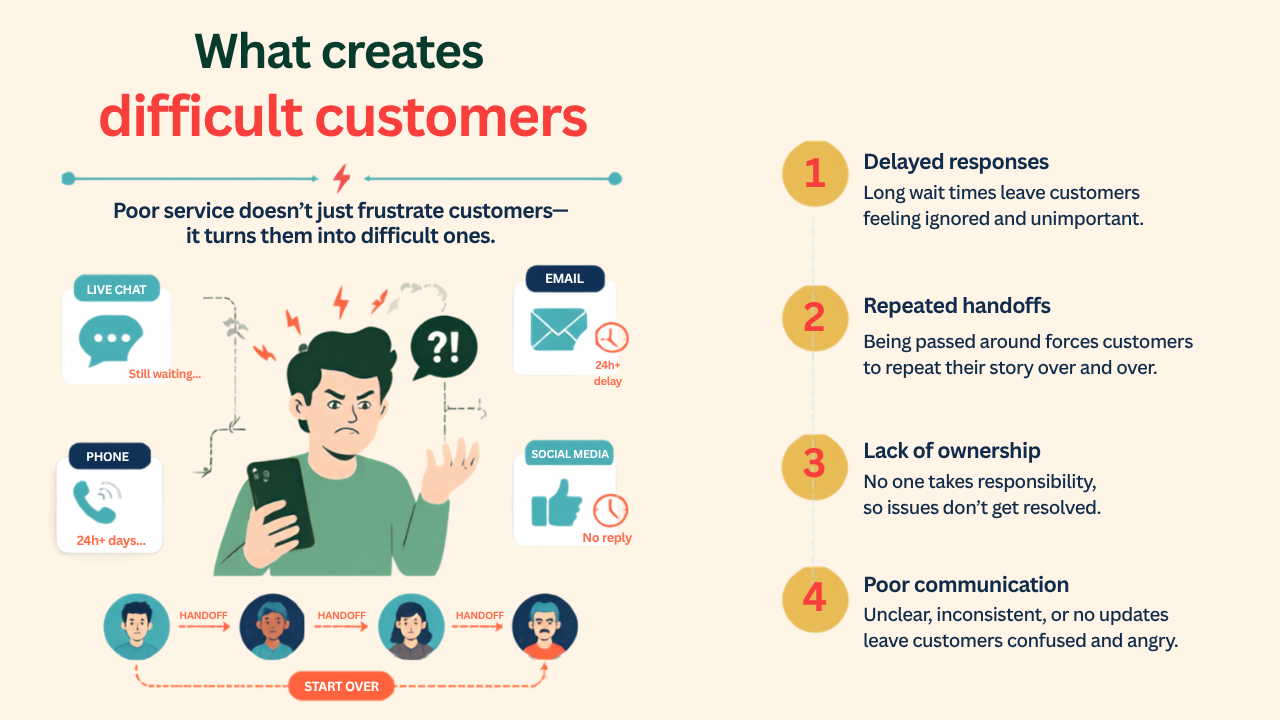
Not every "difficult customer" starts out that way. In many cases, what support teams face as difficult behavior is the result of unmet expectations, repeated friction, or broken communication over time. A customer who was once patient can become frustrated after multiple follow-ups, unclear responses, or lack of ownership.
This raises an important question: Are difficult customers created by circumstances, or by the experiences businesses deliver?
For support teams, this distinction matters, because when frustration builds, they're the first to step in—not just to resolve the issue, but to repair trust. While moments like these are challenging, these are also critical opportunities to build back trust. With the right approach, support teams can turn high-friction interactions into trust-building experiences that strengthen long-term customer relationships.
What is positive conversation?
Positive conversation is a communication approach that focuses on empathy, clarity, and solutions, especially in high-pressure situations. It focuses on what can be done over what can't be.
It serves to:
- Acknowledge the customer's emotions.
- Rebuild rapport by using constructive and respectful language.
- Guide the conversation toward a resolution.
Positive conversation makes the customer feel heard, supported, and confident that their issue is being understood.
The right way to have positive conversation
Customers don't always reach out to customer service to ask about straightforward matters like delayed shipments or maintenance updates; perhaps they're dealing with a crisis or are deeply frustrated by a long-standing problem. If such inquiries aren't addressed thoughtfully, they can quickly turn into larger issues.
Here are some common scenarios where customer support teams regularly handle difficult customers: insurance claims, billing, taxation, financial issues, or product malfunctions. Issues under these categories are high-priority, require immediate attention, and involve anxious customers who require deeper soft skills other than empathy or conversation skills.
Here's a contrast between a negative (high-friction) response and a positive (low-friction) response to the same customer problem.
On a regular day, a support rep receives a call from an anxious customer complaining about their credit card being declined mid-transaction. The customer is already frustrated and embarrassed, so at this point merely validating their feelings or responding with a templated response will further agitate the customer and escalate the situation.
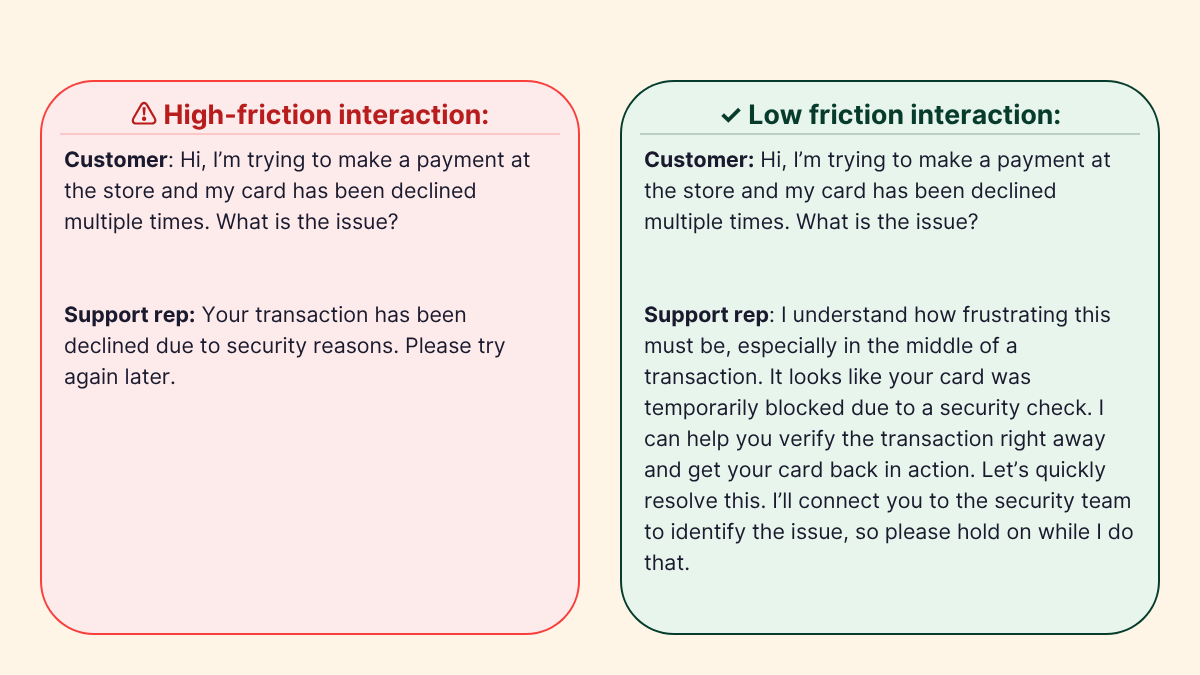
Notice how the situation didn't change; the credit card was still declined and the transaction wasn't successful, yet the situation remains controlled and the experience the customer gets in both situations is completely different.
A positive conversation can:
- De-escalate tension.
- Build trust.
- Improve customer happiness.
- Increase long-term loyalty.
Measurable insights that define positive customer conversations
While positive communication feels qualitative, its impact is highly measurable. Organizations that focus on relationship-driven service can track improvements across key customer and operational metrics.
Customer satisfaction score (CSAT)
This measures how satisfied customers are after an interaction. Positive conversations contribute towards higher CSAT scores, while a negative/friction-heavy interactions can reflect immediate drops.
First contact resolution (FCR)
FCR tracks whether the issue was resolved in the first interaction or not. Ownership and clarity can help businesses achieve high FCR rates, whereas poor communication that leads to multiple transfers can affect FCR negatively.
Customer effort score (CES)
CES measures how easy it was for the customer to get help. While empathetic interactions reduce effort, repetition and handoffs increase it.
Key differentiators in positive and negative conversations
| Aspect | Positive | Negative |
| Opening response | Acknowledges customer emotion first. | Jumps straight to policy or denial. |
Tone | Empathetic, calm, and reassuring | Scripted, mechanical, or defensive |
Language used | "Let me help", "Here's what we can do…" | "Can't", "Not possible", "You need to…" |
Focus | Resolving the issue while understanding how it is affecting the customer | Closing the ticket |
Ownership | Agents take ownership and guide customers through next steps. | Passes responsibility without briefing the next team. |
Clarity in communication | Clear, specific, and transparent | Vague or incomplete information |
Customer effort | Minimizes effort; needs are anticipated. | Requires repetition or follow-ups. |
Identifying negative conversation
- Defensive language: This arises when agents try to defend the problem by pushing company policy, regulations, or rules that are clearly causative factors.
- Dismissive or mechanical tone: Using canned responses or sending templated messages that ignore the specific nuances of the customer's issue can cause frustration.
- Passive-aggressive or blunt phrasing: This type of behavior seeks to make the customer feel responsible for the mistake.
- High effort for the customer: Forcing customers to repeat information or jump through unnecessary hoops is a sure way to drive them away.
Understanding the core principles of positive communication
Using positive communication doesn't mean never saying no to a customer; it involves focusing on what can be done to resolve the issue in hand. Here's what you should keep in mind:
Lead with empathy
Begin by acknowledging what the customer is experiencing. Frustrated customers only have the patience to wait for a solution when they feel they're being heard and understood.
Starting with a solution without acknowledging emotion can feel dismissive.
Example:
"I understand how frustrating this must be…"
This simple shift helps customers feel heard, making them more receptive to the next steps.
Use language that focuses on possibilities
Negative or restrictive language can unintentionally escalate situations. Words like "can't," "won't," or "not possible" can sound defensive and stop conversations from working towards resolutions.
So instead of dismissing by saying, "A refund is not possible," try instead, "I understand your frustration. While a refund isn't possible per our policy, I can arrange a replacement for the faulty product."
This approach keeps the conversation constructive and forward-moving.
Be clear, specific, and transparent
Uncertainty often fuels frustration. Avoid vague timelines (e.g., "in 4-5 business days"), over-promising (e.g., stating that the amount will be credited in 24 hours when it usually takes three days), or incomplete information (e.g., "Someone from payments team can help"). These things often add to customers' frustration and make them feel misled.
Positive communication prioritizes:
- Clear explanations
- Defined timelines
- Transparent next steps
Here's another example: "You can expect an update within the next 24 hours, and I'll keep you posted if anything changes. You will also receive a status update in your inbox."
This clarity in communication builds confidence and reduces the need for repeated follow-ups.
Take ownership of the conversation
When a customer reaches out to the support team, they expect to get the solution in the first interaction. The representative they interact with first becomes responsible for providing them with a solution. Customers don't want to feel like they're being handed over or left to figure things out on their own.
Taking ownership means showing accountability and staying engaged until the customer gets a satisfying solution. It's best to stay on call when the issue is transferred to another team or person, ensure you are copied on all emails, be proactive, and judge the next steps to reduce friction.
Listen actively and respond thoughtfully
Active listening is a key in positive communication because it ensures responses are thoughtful, relevant, and empathetic rather than reactive. By fully understanding the customer's concern, representatives can avoid misunderstandings and address real issues effectively. It makes customers feel heard and valued, which helps de-escalate tense situations and builds trust.
Active listening involves:
- Letting customers fully express their concerns
- Asking clarifying questions
- Reflecting back key points
This reduces misunderstandings and shows genuine attention.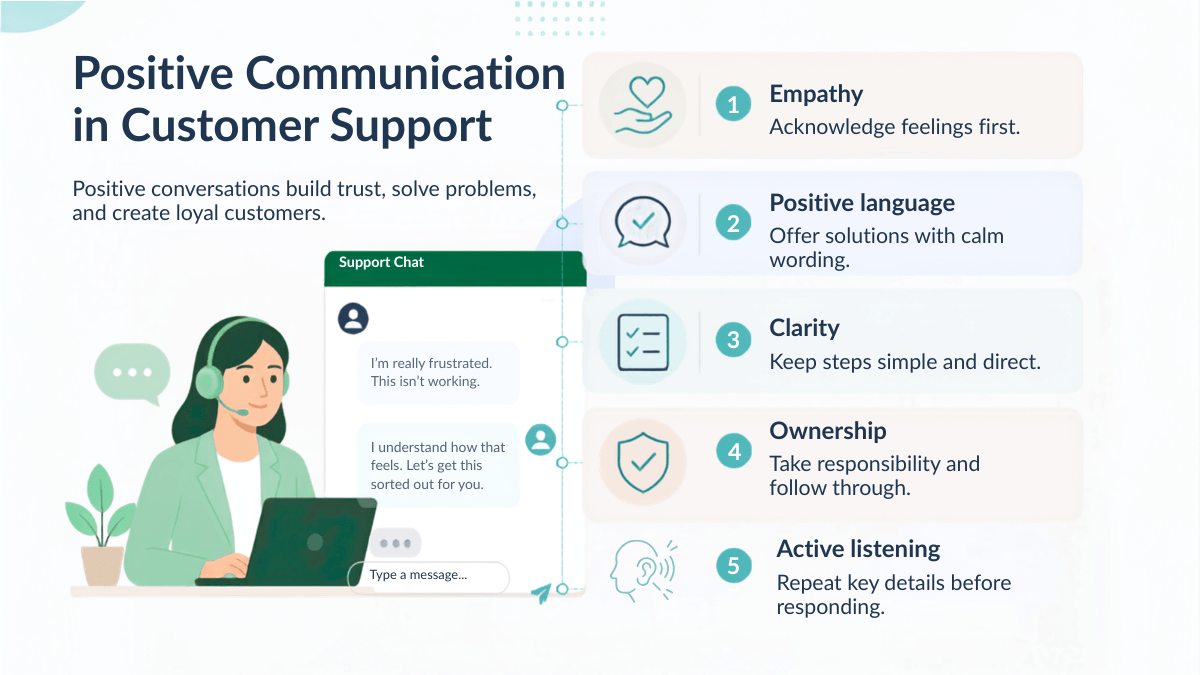
How organizations can encourage positive communication
Encouraging positive communication across the organization ensures consistency in the customer experience and helps teams move from reactive problem-solving to proactive relationship-building. When customers feel heard, respected, and supported—even during issues—they're more likely to stay loyal and trust the brand. Internally, it also reduces rep stress, improves morale, and creates a more supportive work environment.
Steps organizations can take to build positive communication
Targeted training to build the right communication skills
Organizations should invest in structured training programs that go beyond product knowledge. This includes:
- Teaching representatives how to paraphrase negative statements into positive ones.
- Practicing empathy and active listening techniques.
- Role-playing difficult customer scenarios.
Leadership can coach and conduct periodic feedback sessions to reinforce these skills over time and ensure representatives are confident and consistent in their communications.
Infrastructure that enables seamless conversations
Under pressure, even the most well-trained representatives can struggle to maintain positive communication without the right tools. Hence, organizations should provide:
- Unified communication platforms (chat, email, call support in one place)
- Access to customer history and context
- Knowledge bases and response templates
This infrastructure reduces friction and enables reps to focus more on how they communicate rather than struggling to gather information.
Empower your reps to act
Policies are essential for ensuring consistency, fairness, and compliance across customer interactions. However, when applied too rigidly, they can limit reps' ability to communicate with empathy and adapt to the situations at hand.
Instead of viewing policies as strict scripts, organizations should treat them as guidelines that define boundaries while still allowing flexibility in execution.
Giving reps a degree of autonomy enables them to:
- Offer solutions without excessive approvals
- Personalize responses based on the customer's situation
- Take ownership of issues and drive them to resolution
When reps feel trusted to operate within these boundaries, their communication becomes more confident, human, and solution-oriented, and leads to better customer experiences without compromising on policy.
Service quality check
Customer feedback is a direct input for improving how reps communicate.
Organizations should:
- Regularly review customer interactions alongside feedback.
- Analyze surveys, ratings, and reviews to spot patterns.
- Identify gaps in tone, clarity, empathy, or resolution approaches.
The key is translating these insights into action. Feedback can be used to:
- Coach representatives with real conversation examples.
- Highlight what good communication looks like in practice.
- Address recurring issues through targeted training.
- Refine scripts, templates, and response guidelines.
Closing the feedback loop ensures that insights are collected and actively used to shape better interactions, and to help representatives communicate more effectively and align with customer expectations.
Every challenging situation presents the support team with two choices: Either focus on closing the ticket or turn it into an opportunity for building a relationship. Positive conversations enable this shift. By showing empathy, concentrating on solutions, communicating clearly, and taking responsibility, support teams can turn frustration into reassurance and conflict into connection.